I Found $50,000 in a Rainy Parking Lot and Returned Every Dollar—Then a Billionaire Followed Me Home.k
part2:
There were old black-and-white photographs in the lobby showing clean brickwork, polished floors, and men wearing hats beside shiny cars.
By the time I was seventeen, the lobby tile was cracked, the security light flickered, and the elevator had been broken for three years.
Every season, the superintendent gave us a different explanation.
Parts were ordered.
Inspection delayed.
New contractor.
Insurance issue.
By the second year, nobody asked anymore.
We climbed.
Four floors.
Every day.
Groceries.
Laundry.
School bags.
Everything.
My mother, Patricia, had been sick for two years.
The diagnosis came on a Tuesday.
I remember that because Tuesdays had been normal before then.
Afterward, nothing about Tuesday ever felt ordinary again.
She had worked two jobs before getting sick.
Days at a laundromat.
Evenings cleaning office buildings downtown.
She would leave before I got home from school and sometimes return after midnight with chemical smells on her clothes and her hands cracked from detergent and cold water.
Then the illness got worse.
First fewer shifts.
Then none.
Medication stabilized her, but “stable” was not the same as healthy.
And stable cost money.
About $140 a month after insurance.
That might not sound like much to some people.
To us, $140 was a refrigerator shelf.
A utility bill.
Bus fare.
Two weeks of groceries if you planned carefully and did not mind rice.
My younger brother, Darius, was eleven.
Sixth grade.
Funny when he wanted to be.
Quiet when something hurt him.
He had one pair of decent sneakers.
They’d been new in September.
By January, his toes were pressing against the front.
He never complained.
That made it worse.
Kids at school noticed.
Of course they did.
Children can detect insecurity with the precision of trained investigators.
He never told Mom.
He never told me either.
But I knew.
You learn to recognize a particular silence when someone you love has been made to feel small.
I worked three afternoons a week and most Saturday hours at a grocery store about twelve blocks from our apartment.
School came first because Mom insisted.
“Your job right now is graduating.”
I would say:
“My job is also helping you pay for medication.”
She hated when I said that.
But she never had an answer.
I did homework late.
Sometimes midnight.
Sometimes one.
Algebra at the kitchen table.
English essays beside unpaid bills.
Chemistry flash cards while Darius slept on the couch because his bedroom got colder than the living room.
I didn’t think of myself as heroic.
I was tired.
That’s all.
Tired and practical.
I ate smaller portions when food was low.
Told Mom I wasn’t hungry.
She knew I was lying.
I knew she knew.
We maintained the fiction because sometimes love is agreeing not to expose another person’s sacrifice.
I helped Mrs. Caldwell downstairs carry groceries.
I watched her cat when she went to dialysis.
I helped Darius with fractions.
I worked.
I studied.
I climbed the stairs.
I kept moving.
Because if I stopped long enough to ask whether any of it was fair, I might not have had the energy to start again.
The night I found the money was a Wednesday.
Cold rain.
The kind that gets inside your collar and makes the whole city smell like wet concrete.
My shift ended at nine.
The bus came at 9:15.
Miss that one and the next wasn’t until 10:45.
Mom would stay awake if I was late.
So I moved quickly.
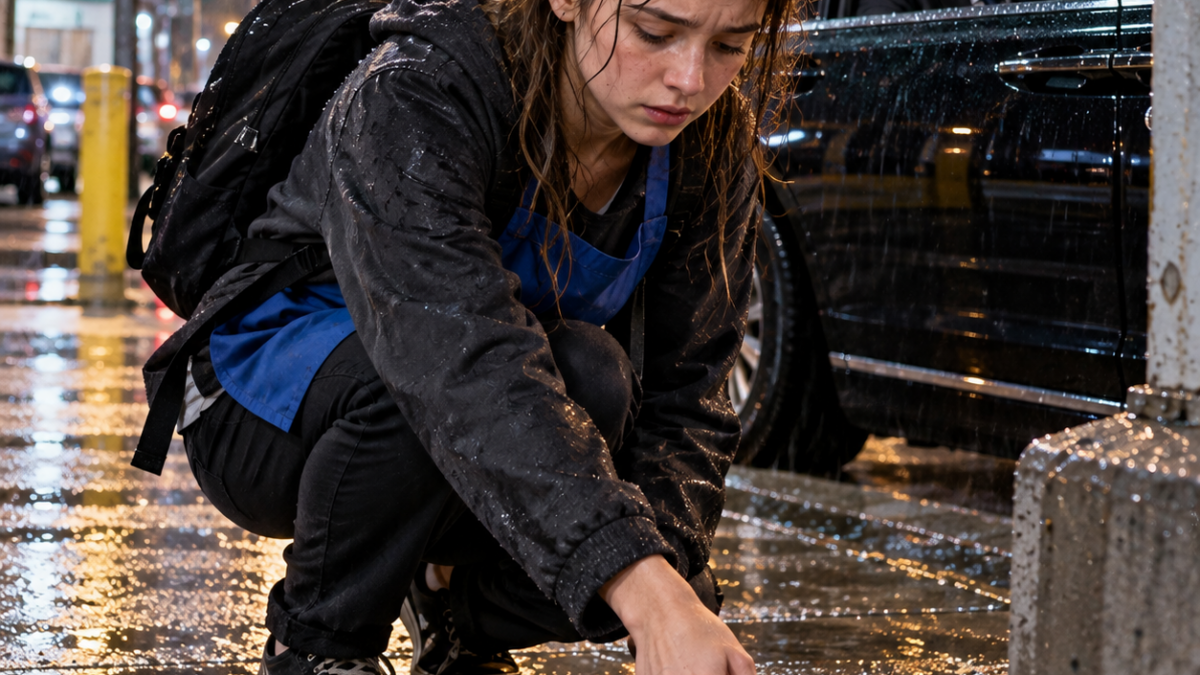
I came through the back employee exit, pulled off my apron, shoved it into my backpack, and turned toward the bus stop.
That’s when I saw the bag.
Brown leather.
Medium-sized.
Beside a concrete post near the edge of the parking lot.
At first I thought it was somebody’s purse.
I looked around.
No one.
I picked it up.
Heavy.
Very heavy.
The zipper was partly open.
I should tell you that I didn’t immediately think:
I must take this to the police.
No.
My first thought was:
What is in this thing?
I crouched beneath the parking lot light.
Opened it.
Cash.
Stacks.
Rubber bands.
Hundred-dollar bills.
I stared.
For a few seconds, my brain stopped producing useful thoughts.
Then:
Mom’s medicine.
Electric bill.
Rent.
Shoes.
Heat.
College.
Every problem in our apartment suddenly had a price tag smaller than the bag.
My hands started shaking.
Not because I was cold.
I counted one stack.
Then another.
Eventually I calculated approximately fifty thousand dollars.
Fifty thousand.
I had never held more than maybe six hundred dollars at one time.
And that had been grocery-store payroll money I wasn’t allowed to touch except to count.
This was different.
No camera obvious.
No person.
No name.
No wallet attached.
Just cash.
Then Marcus came around the corner.
Marcus worked produce.
Nineteen.
Community college.
Good guy.
He saw me crouched there.
“What is that?”
I closed the bag halfway.
“Nothing.”
He laughed.
“That looks like a lot of nothing.”
Then he saw inside.
His face changed.
“Oh my God.”
“Quiet.”
“Maya.”
“I know.”
“How much?”
“Maybe fifty thousand.”
He stared at me.
Then the bag.
Then me.
“You’re kidding.”
“No.”
He crouched beside me.
“Where?”
“Right here.”
He looked around.
“No one saw?”
I looked too.
“I don’t know.”
Rain tapping pavement.
Cars in the distance.
Store compressors humming behind us.
Marcus whispered:
“Maya.”
“What?”
“You know what that could do for you.”
I didn’t answer.
Because yes.
I knew exactly what it could do.
He continued.
“Your mom.”
“I know.”
“Your rent.”
“I know.”
“Darius.”
“I know.”
He lowered his voice.
“Nobody has to know.”
That sentence sat between us.
Nobody has to know.
Maybe he was right.
Maybe someone had dropped it during something illegal.
Maybe they’d never report it.
Maybe the police would never identify the owner.
Maybe I could take just a little.
Five thousand.
One thousand.
Enough for medication.
Who would know?
Me.
That was the answer.
I stood.
Marcus raised both hands.
“You’re actually taking it in?”
“Yes.”
“Maya.”
“I would know.”
He stared at me like I’d become unreasonable.
“You’re going to return fifty thousand dollars when your mother can’t afford medicine?”
I hated how that sounded.
Because he wasn’t wrong about our life.
I looked at the bag.
Then said:
“If I keep it, every time I buy something I’ll know where it came from.”
“What if it’s drug money?”
“Still isn’t mine.”
“What if nobody claims it?”
“Then the police can decide what happens.”
“You’re insane.”
“Probably.”
Then I started walking.
The East Side precinct was four blocks north.
The bus stop was south.
I watched my bus pass while I was halfway to the station.
That hurt.
Small thing.
But I remember thinking:
Great. I return fifty thousand dollars and get rewarded with ninety minutes in the rain.
The bag pressed against my ribs under my jacket.
Every block, another thought.
Mom’s medication.
The landlord.
Electricity.
College applications.
What if I kept five hundred?
No.
One hundred?
No.
Nobody would know.
I would.
That answer kept returning.
By the time I reached the station, I was angry at myself.
Angry at the money.
Angry at the person who lost it.
Angry at the world for giving me a moral test when what I needed was a break.
Sergeant Brooks was at the desk.
Heavyset.
Glasses.
Stack of paperwork.
He looked up.
“Can I help you?”
“I found something.”
I placed the bag on the counter.
He opened it.
His expression changed.
“Where did you get this?”
“Parking lot behind Harrison Market.”
He looked at me.
“You found it?”
“Yes.”
“Did anyone else touch it?”
“My coworker saw it.”
“Name?”
“Marcus Bell.”
He wrote.
Then:
“You counted it?”
“Enough to know it’s a lot.”
He counted later.
$50,000.
Exactly.
He asked for my identification.
Address.
Phone.
Then:
“You know if nobody claims it, there may be a legal process involving found property.”
“I don’t want it.”
He looked at me for a long time.
“There’s sometimes a finder provision.”
“I don’t want anything.”
“Why?”
I almost laughed.
Why?
Because if I kept a legal finder payment months later, maybe that would be fine.
But in that moment, I wanted distance.
The money felt too heavy.
“Just make sure whoever lost it gets it back.”
He watched me.
Then I turned toward the door.
“Maya.”
I looked back.
“Yes?”
He said:
“That was a good thing you did.”
I shrugged.
“Good night.”
I left.
I did not know Sergeant Brooks added a note to the incident report later.
This girl was extraordinary.
I also did not know that someone else had watched me.
A man named Richard Coleman.
Three blocks away, sitting inside a black sedan with heated seats while I walked through the rain.
Richard was fifty-four.
Founder and CEO of Coleman Technologies.
Worth more money than I knew how to imagine.
His company provided infrastructure software to major banks.
He had offices with glass walls, attorneys on call, a driver named Franklin, and enough money that broken appliances were inconveniences rather than emergencies.
That night, he was coming from a data center visit.
He had just spent hours dealing with another betrayal.
A senior executive named Gerald Marsh had spent years quietly leaking client information to a competitor.
Richard had trusted him.
Richard had apparently spent most of his adult life learning that trust could be expensive.
His marriage had ended partly because he worked like a corporation wearing a man’s body.
His ex-wife told him she had married ambition and ended up living with an institution.
That sentence stayed with him.
He was on the phone with attorneys when he saw me pick up the bag.
He watched me open it.
Watched Marcus talk to me.
Watched me walk the opposite direction from the bus stop.
Then he told Franklin:
“Follow her.”
That still bothers me when I tell the story.
People like turning Richard into a mysterious benefactor.
He wasn’t.
Not at first.
He was a wealthy man following a seventeen-year-old girl through a poor neighborhood because he was curious.
That is not automatically noble.
And when I eventually learned he’d done it, I was furious.
But that night, I knew none of this.
I missed the bus.
Walked home.
Forty minutes in freezing rain.
My shoes soaked through.
When I reached Callaway Arms, the security light flickered like always.
I climbed four floors.
Opened apartment 411.
Mom was awake.
Of course.
“You missed the bus.”
“Had to stop somewhere.”
“Where?”
“Police station.”
Her face changed.
“What happened?”
“Nothing.”
“Maya.”
“I found somebody’s bag.”
“What kind of bag?”
“One with money.”
“How much?”
I should have lied.
I didn’t.
“Fifty thousand dollars.”
Mom stared at me.
Darius looked up from the couch.
“Fifty thousand?”
“Go back to your homework.”
“I don’t have homework.”
“Then invent some.”
Mom said:
“What happened to it?”
“I turned it in.”
Silence.
Long silence.
Then Mom closed her eyes.
For one awful second, I thought she was disappointed.
I couldn’t handle that.
Then she opened them.
Tears.
“Oh, baby.”
I immediately got defensive.
“What?”
“Nothing.”
“I know what you’re thinking.”
“No.”
“You need medication.”
“We need rent.”
“I know.”
“Maya.”
“If you want to say I was stupid, just say it.”
She stood slowly.
Crossed the room.
Put both hands on my face.
“I am proud of you.”
That almost hurt more.
I started crying.
Not a lot.
Just enough.
“I thought about keeping it.”
“Of course you did.”
“A lot.”
“That doesn’t change what you did.”
“What if nobody ever knows?”
“We know.”
I laughed through tears.
“That was my problem.”
Mom smiled.
“Good problem.”
Darius said from the couch:
“I would’ve kept like twenty dollars.”
We both stared.
“What?”
He shrugged.
“Maybe ten.”
That broke the tension.
We laughed.
Then life continued.
That’s what people don’t understand.
I did the right thing.
Nothing changed.
The electric bill was still late.
Mom was still sick.
Darius still needed shoes.
The heater still rattled.
I still had to get up for school.
Integrity did not pay rent.
It did not come with a soundtrack.
It did not unlock some reward screen.
I made tea.
Finished algebra.
Went to bed.
Richard Coleman, meanwhile, sat in his car outside our building for almost an hour.
I learned that later.
He watched the building.
Saw our apartment light.
Thought about his own wealth.
How a heated car felt normal to him while cold was normal to us.
Then he went home.
The next morning, he did something even stranger.
He bought thrift-store clothes.
Canvas jacket.
Old jeans.
Scuffed boots.
Then waited outside my grocery store.
I was on break around noon.
Sat on my usual bench with a turkey sandwich.
He approached.
“Excuse me.”
I looked up.
He looked maybe homeless.
Maybe unemployed.
Maybe just tired.
Hard to tell.
“Can I sit?”
“Free bench.”
He sat.
Quiet.
Awkward.
I kept eating.
He kept looking at my sandwich.
Finally I said:
“You hungry?”
He blinked.
“What?”
“You keep staring at my lunch.”
“I wasn’t—”
I held out half.
“I have another half.”
He hesitated.
Then took it.
That part still makes me angry and amused at the same time.
A man worth hundreds of millions of dollars ate half my day-old turkey sandwich while pretending to be some random stranger.
He ate every bite.
When he finished:
“You didn’t have to do that.”
I shrugged.
“My mom says share what you have.”
Then:
“Especially when you don’t have much.”
He looked at me strangely.
Not pity.
Something else.
I noticed his jacket wasn’t warm enough.
Mine wasn’t either.
“You should get somewhere warm.”
He almost smiled.
“So should you.”
“I know.”
“Better coat?”
“On the list.”
I stood.
Then:
“If you get too cold, the store usually lets people sit near the front.”
He nodded.
“Thank you.”
I went back to work.
I didn’t think about him again until much later.
Richard did.
Apparently that sandwich shook him more than the fifty thousand dollars.
Maybe because returning money was abstract to him.
Sharing lunch was personal.
That night, one of his senior directors walked into his office.
Victor Hale.
Victor had worked at Coleman Technologies nine years.
Smart.
Controlled.
Ambitious.
The kind of man who remembered who mattered and forgot who didn’t.
He had heard Richard had been spending time on the East Side.
Then he learned there was a girl.
Me.
He asked Richard about it.
Richard warned him to stay out of it.
That was the first mistake.
Not because Richard should have told Victor everything.
Because Victor understood something important.
Richard cared.
And Victor had spent years learning how to use whatever other people cared about.
Three weeks passed.
I went back to normal.
School.
Store.
Apartment.
Mom.
Darius.
The fifty thousand dollars was claimed eventually, though I barely followed the process.
What mattered more happened inside Coleman Technologies.
Richard had ordered audits after the Gerald Marsh betrayal.
Old HR records.
Security incidents.
Terminations.
And one name appeared.
Marcus Johnson.
My father.
I was nine when Dad died.
Forty-one years old.
Heart attack.
Too young.
Before that, he’d worked in technology.
That’s what Mom always said.
She never talked about the details much because it hurt.
I knew he’d once had a good job.
Then something happened.
He was fired.
Accused of stealing company information.
After that, no technology company would hire him.
He took whatever work he could.
Warehouse.
Delivery.
Repair work.
Night shifts.
His confidence changed.
He stopped laughing as easily.
I remembered that without understanding why.
Then he died.
Richard found the file.
Seven years old.
My father’s termination.
Coleman Technologies.
The accusation came from a director who ran the division.
Victor Hale.
Richard looked deeper.
And what he found changed everything.
My father had not stolen anything.
The transfer logs used to accuse him had been manipulated.
Timestamps altered.
File sizes changed.
A breach Victor caused had been blamed on Dad.
Victor needed someone beneath him.
Someone with less protection.
Dad was convenient.
He lost his job.
His reputation.
His career.
And Richard Coleman had never known.
That part mattered later.
Not because ignorance made Richard innocent of everything.
But because truth needs accurate categories.
Victor lied.
Richard failed to see what happened inside his company.
Different responsibility.
Both had consequences.
Richard spent two days with the file.
Then Victor moved against me.
I was working Thursday when my manager called me into the office.
Mr. Sanchez.
Usually kind.
That day he wouldn’t look at me.
“Sit down, Maya.”
I sat.
He folded his hands.
“There has been an allegation.”
“What allegation?”
“Merchandise theft.”
I actually laughed.
Not because it was funny.
Because it was ridiculous.
“What?”
“Someone reported you’ve been removing store merchandise without paying.”
“Who?”
“I can’t discuss that.”
“Show me.”
“We’re reviewing it.”
“Show me the video.”
His eyes moved away.
“There are concerns.”
“Do you have video?”
“Maya.”
“No.”
“If you’re firing me for stealing, show me what I stole.”
He didn’t.
Because nothing existed.
Still, corporate had told him to terminate me pending investigation.
Ten minutes.
Clean out locker.
Turn in apron.
I stood outside behind the store holding a plastic bag with my uniform inside.
Same parking lot.
Same place I’d found fifty thousand dollars.
Three weeks earlier I’d returned money that could have changed our lives.
Now I had no job because someone lied.
I remember thinking:
This is what people mean when they say doing the right thing doesn’t guarantee anything.
Two days later, the landlord sent us a sixty-day notice to vacate.
No reason.
Mom read it twice.
Then handed it to me.
I called.
They said:
“Ownership restructuring.”
“What does that mean?”
“Lease will not be renewed.”
“Why?”
“No reason required under the current terms.”
I hung up.
Then I sat on the kitchen floor.
And finally broke.
Two years of holding everything.
Mom’s illness.
Dad being gone.
Bills.
Darius.
School.
Work.
Returning the money.
Losing the job.
Now losing the apartment.
I cried like I hadn’t cried since Dad’s funeral.
Darius heard me.
He came in.
Sat beside me.
Didn’t say anything.
I said:
“I did everything right.”
He put his head on my shoulder.
“I did everything right.”
Then:
“Why is it still like this?”
Nobody answered.
There was no answer.
The next evening, somebody knocked.
I opened the door.
And saw the man from the grocery-store bench.
Except he wasn’t wearing thrift-store clothes.
Dark coat.
Expensive.
Clean.
Controlled.
Behind him, parked outside, was the black sedan.
I knew immediately.
Not who he was.
That he’d lied.
“You’re not who you said you were.”
He looked at me.
“No.”
That was a good answer.
At least he didn’t pretend.
“Who are you?”
“Richard Coleman.”
The name meant nothing for half a second.
Then Darius, behind me:
“Coleman Technologies?”
Richard looked toward him.
“Yes.”
My stomach turned.
Dad.
I stared.
“What do you want?”
“To tell you the truth.”
“About what?”
“Your father.”
I almost closed the door.
Mom appeared behind me.
“Who is it?”
I said:
“Richard Coleman.”
Her face changed immediately.
Unlike me, she knew the name.
She whispered:
“Oh.”
Richard said:
“Mrs. Johnson.”
“I need to speak with you.”
Mom stared.
Then:
“Come in.”
I didn’t want him inside.
But Mom did.
So he came.
Our apartment suddenly looked smaller with him in it.
Not because he acted superior.
Because his coat probably cost more than our month’s rent.
Darius sat at the kitchen table pretending to do homework.
He was listening to every word.
Richard stayed standing until Mom pointed to a chair.
Then he began.
He told us he had seen me find the money.
My anger arrived immediately.
“You were there?”
“In a car.”
“You watched me?”
“Yes.”
“You followed me?”
“Yes.”
“You followed me home?”
“Yes.”
I stood.
Mom said:
“Maya.”
“No.”
I looked at Richard.
“You sat outside our building?”
“Yes.”
“How long?”
“About an hour.”
“That is insane.”
“I know.”
“Then you came to my job wearing thrift-store clothes.”
“Yes.”
“You pretended you needed food.”
“I didn’t say I needed food.”
“You let me believe it.”
“Yes.”
“You were testing me.”
Silence.
Then:
“Yes.”
That answer hurt.
Not because he lied beautifully.
Because he refused to hide behind wording.
“I gave you half my lunch.”
“I know.”
“You’re rich.”
“Yes.”
“How rich?”
He hesitated.
“Enough that the question makes this worse.”
I laughed once.
Angry.
“You think?”
Mom said:
“Let him finish.”
I looked at her.
Then sat.
Richard continued.
He told us about the audit.
My father’s file.
Victor Hale.
The altered logs.
The false accusation.
The termination.
For a while, I stopped hearing the room.
Dad’s badge.
Dad at the kitchen table years earlier.
Dad telling Mom:
“It’ll work out.”
Dad taking warehouse shifts.
Dad coming home with back pain.
Dad dying at forty-one.
All of that reorganized itself around one fact.
He had been innocent.
Mom whispered:
“Marcus said he didn’t do it.”
Richard looked at her.
“He didn’t.”
She covered her mouth.
Darius stopped pretending to work.
I said:
“You knew?”
Mom shook her head.
“No.”
“He always said.”
“But after a while…”
Her voice broke.
“Everyone said the company had records.”
She looked at Richard.
“Did you?”
“Not then.”
“But now you know.”
“Yes.”
“My father lost everything.”
“Yes.”
“You own the company.”
“Yes.”
“You followed me around like some experiment, and now you’re here because you feel guilty?”
Richard absorbed that.
“I do feel guilty.”
“We’re not your charity project.”
“I know.”
“Do you?”
“Yes.”
“You can write a check and go home and feel better.”
“No.”
“What do you want?”
“To fix what can still be fixed.”
“You can’t bring him back.”
“No.”
“You can’t give him seven years.”
“No.”
“You can’t make me nine again.”
“No.”
He didn’t defend himself.
That made anger harder.
I wanted him to say something arrogant.
Something I could throw back.
Instead, he said:
“I can reopen his record.”
I froze.
“What?”
“I can make Coleman Technologies formally acknowledge that your father was wrongfully terminated.”
“I can provide the original records.”
“Independent forensic review.”
“Court filings.”
“Public correction.”
“I can make sure the lie doesn’t remain the official version of his life.”
Mom stepped from the bedroom doorway.
“You would do that?”
“Yes.”
“For Maya?”
Richard looked at her.
“For Marcus.”
Then:
“Because it is right.”
I wanted to hate him.
I still partly did.
But that sentence landed.
I said:
“What about my job?”
His expression changed.
“What?”
“I was fired Thursday.”
Mom held up the eviction notice.
“And this came Saturday.”
Richard’s face went still.
He asked:
“Why were you fired?”
“Stealing.”
“Did you?”
I stared.
“No.”
“Of course not.”
“Don’t say of course.”
He stopped.
Fair.
I continued:
“They said someone reported me.”
Richard asked the store name even though he knew it.
Then looked at the eviction letter.
Something changed in his face.
Not guilt.
Recognition.
“May I photograph these?”
“Why?”
“Because I think this may be connected.”
“How?”
“I don’t know yet.”
I almost refused.
Mom said:
“Let him.”
Richard photographed everything.
Then stood.
“I will call tomorrow.”
I said:
“No more disguises.”
He looked at me.
“No more disguises.”
“No following me.”
“No.”
“No testing me.”
“No.”
Then:
“And don’t give us money.”
He hesitated.
“Maya—”
“No.”
“Fix Dad’s name.”
“Find out who did this.”
“After that, we’ll talk.”
He nodded.
“Okay.”
He left.
Darius waited until the door closed.
Then:
“Was that a billionaire?”
Mom said:
“Go to bed.”
“That’s not a no.”
I almost laughed.
Almost.
Richard apparently spent the next forty-eight hours doing what people like Richard do when they finally decide something matters.
He investigated.
Store termination.
Landlord.
Corporate contacts.
Phone records through lawful channels available to his attorneys and internal investigators.
And everything led back to Victor Hale.
The theft accusation at my store had originated as a “confidential corporate loss-prevention concern” passed through a business contact.
No evidence.
No video.
No stolen merchandise.
The landlord had received a call warning that building-code complaints might trigger expensive inspections.
The caller represented an entity tied through subsidiaries to Victor.
Pressure.
Not direct orders on paper.
Enough.
Victor had learned Richard cared about me.
So he tried to erase the inconvenience.
Again.
Just like Dad.
That was the pattern.
My father had been a convenient scapegoat.
I had become a convenient target.
Richard confronted Victor.
I wasn’t there.
Later, one of Richard’s attorneys told me Victor remained calm for exactly four minutes.
Then the forensic report was placed in front of him.
Altered timestamps.
Manipulated logs.
Metadata.
Internal emails.
His composure cracked.
Coleman Technologies fired him that afternoon.
Security escorted him out.
I learned that detail later and thought about Dad being escorted out seven years earlier.
The symmetry didn’t satisfy me.
Nothing could.
But it mattered.
Richard’s company filed a criminal referral regarding the falsified records and related conduct.
The legal process took months.
Real law is slow.
Documents.
Motions.
Forensic analysis.
Statements.
Attorneys.
No one was marched into a courtroom the next morning.
Meanwhile, Richard’s lawyers helped challenge my firing without asking me to become his charity project.
The grocery chain reviewed the accusation.
No evidence.
They reinstated me with back pay.
I declined to return.
Mr. Sanchez apologized personally.
“I should’ve pushed harder.”
“Yes.”
He looked down.
“I know.”
I didn’t enjoy making him uncomfortable.
But truth shouldn’t always be comfortable.
The landlord situation also changed.
Once the source of pressure was documented, the notice was withdrawn.
Building inspectors did come eventually.
Ironically, they found actual violations.
Broken elevator.
Heating deficiencies.
Electrical issues.
The landlord hated that.
Residents loved it.
Repairs started.
Not because Richard bought the building.
He didn’t.
Not because he secretly paid everyone.
He didn’t.
Because once somebody powerful shined a light on a system, officials finally looked.
That complicated my feelings about him.
Why should it require Richard Coleman for people to care that an elevator had been broken three years?
It shouldn’t.
But I wasn’t going to reject repaired heat out of philosophical consistency.
The bigger case was Dad.
Three forensic experts reviewed the data.
All three reached the same conclusion.
The logs used against Marcus Johnson had been manipulated after the underlying events.
Victor Hale’s explanation collapsed.
Coleman Technologies filed formal corrections.
Richard’s attorneys petitioned to reopen matters connected to Dad’s termination and reputation.
Then came the hearing.
Thursday in March.
Cold.
Clear sky.
I wore Dad’s photograph inside my jacket pocket.
The picture had been taken during his first year at Coleman.
Blue polo.
Employee badge clipped to collar.
Laughing at something outside the frame.
I had carried that photo for years.
When I was twelve, I’d found it in a box.
I didn’t know why I kept it.
Now I did.
It showed Dad before being accused.
Before job applications stopped getting answers.
Before shame settled into his shoulders.
Before he started believing maybe being honest wasn’t enough to protect you.
The courtroom smelled like wood polish and cleaning solution.
Mom sat beside me.
Darius on the other side.
Richard sat with his attorneys.
Victor with his.
When Richard testified, I expected corporate language.
He surprised me.
He said:
“Marcus Johnson was wrongfully terminated.”
Plain.
No:
Based on information subsequently discovered.
No:
Certain procedural irregularities may have occurred.
He continued:
“The process was corrupted by falsified evidence.”
Then:
“I did not know at the time.”
Pause.
“That does not change what was done to him under the name of the company I founded.”
That mattered.
He wasn’t claiming responsibility identical to Victor’s.
He was accepting responsibility for the institution.
Different.
“I cannot return Mr. Johnson’s career or the years his family lived under this false accusation.”
His voice tightened.
“I can correct the record.”
“And I am sorry that correction came after his death.”
Mom began crying.
Quietly.
I held her hand.
The judge reviewed the evidence.
Dad’s misconduct finding was vacated.
The termination record corrected.
Coleman Technologies formally withdrew the allegation.
Victor’s misconduct was documented separately through company and legal processes.
Then came the civil settlement.
I won’t give the exact amount.
That’s family business.
Enough to change our immediate circumstances.
Not enough to replace Dad.
There is no number for that.
Mom cried in the parking lot.
She leaned against a car.
Kept saying:
“Marcus.”
Just his name.
Not:
We won.
Not:
Money.
Marcus.
I took out the photograph.
Darius stood beside us with his hands in his pockets.
He looked at Dad.
Then sky.
Then me.
Something in his face loosened.
He looked eleven again.
That was when I finally cried too.
Richard stood far away near his car.
He didn’t approach.
That mattered.
He had learned something.
Not every repaired harm needs the person doing the repairing standing in the center.
Eventually, I looked over.
He was there.
Waiting.
I walked toward him.
He didn’t move closer.
I said:
“He would’ve been fifty-two.”
“Your father?”
“Yes.”
“I know.”
“You looked it up?”
“Yes.”
Silence.
Then:
“You can’t give him back.”
“No.”
“You can’t give us back those years.”
“No.”
I looked toward Mom and Darius.
“But you did the next thing.”
Richard’s eyes changed.
“That matters.”
He nodded.
“Thank you.”
I almost smiled.
“Don’t make this about you.”
He actually laughed.
First time I’d heard it.
“Understood.”
The settlement changed our life.
But not in the fantasy way people imagine.
We did not move into a mansion.
Mom did not buy a luxury car.
I did not suddenly wear designer clothes.
First:
Debt.
Medical expenses.
Reliable treatment.
Emergency savings.
New apartment eventually.
Darius got shoes.
Actual shoes that fit.
That was one of my favorite purchases.
He came home from the store wearing them.
Walked around the apartment like nothing happened.
I stared.
“What?”
“Nothing.”
“They’re shoes.”
“I know.”
“Stop being weird.”
I laughed.
Mom’s health stabilized.
A specialist changed her treatment plan.
She improved enough to work again the following spring.
Not at the laundromat.
Not office cleaning.
She found a job with a neighborhood health nonprofit helping families navigate medication programs and insurance assistance.
First week, she came home exhausted.
Happy.
“My supervisor says I’m good.”
“You’re surprised?”
“A little.”
“You’ve been managing us for years.”
She laughed.
Darius never talked much about the settlement.
He just became lighter.
Joined an after-school robotics program.
Ate lunch without hiding it.
His grades improved.
Kids can focus better when survival stops occupying half their brain.
I stayed in school.
Graduated.
Applied to college.
Richard offered help.
I refused special treatment.
That became another argument.
“You understand I can pay tuition without noticing the money is gone.”
“That is exactly why you shouldn’t.”
“Maya.”
“No.”
“We’ve established a foundation.”
“Good.”
“Apply.”
“Through the normal process.”
“Yes.”
“Independent committee?”
“Yes.”
“Then I’ll apply.”
He smiled.
“What?”
“Nothing.”
“You’re doing that rich-person amused thing.”
“I don’t know what that means.”
“It means stop.”
I applied.
Was accepted.
Not through the foundation at first.
University aid.
Scholarships.
Settlement gave our family enough stability that I could actually choose a school based on education instead of only transportation distance.
Computer science.
Yes.
People found that poetic.
My father worked in technology.
Victor destroyed his career.
I chose technology anyway.
Not because I wanted revenge.
Because I loved systems.
I liked understanding why things worked.
And why they failed.
Maybe that had always been in me.
Richard established the Marcus L. Johnson Foundation.
That made me uncomfortable at first.
“You didn’t ask us.”
He said:
“I asked your mother.”
I looked at Mom.
She shrugged.
“He did.”
“What does it do?”
“Scholarships.”
“For East Side students pursuing technology or engineering.”
I looked at Richard.
“Don’t put me on the first list automatically.”
“I wasn’t going to.”
“You were thinking about it.”
“I was.”
“No.”
“I know.”
The first cohort included eight students.
Not me.
Good.
I attended the reception anyway.
I eventually received a foundation scholarship later after applying through the same process.
I insisted the selection committee not include Richard.
He agreed.
That became our relationship.
He would offer.
I would interrogate the structure.
He would sigh.
Then improve the structure.
The foundation’s ethics rules ended up stronger because I was annoying.
Richard said that himself.
Coleman Technologies changed too.
Not perfectly.
Corporations do not become moral beings because one CEO has an awakening.
But Richard added independent termination reviews.
Evidence-preservation requirements.
Whistleblower channels outside management chains.
An ethics officer who reported to the board rather than the CEO.
Periodic audit of employment actions.
He also reviewed other old cases.
That mattered.
I told him:
“If Dad wasn’t the only person Victor hurt, fixing only Dad because you know us isn’t integrity.”
He stared at me.
Then:
“You’re right.”
“Again.”
“Don’t enjoy it.”
“I absolutely do.”
They found two other problematic cases.
Not as severe.
Both reviewed.
One resulted in compensation.
One did not because the underlying termination was still justified despite procedural problems.
That was fine.
Justice is not making every uncomfortable record disappear.
It’s finding out what happened.
Victor’s legal case continued.
He was ultimately convicted on charges tied to the falsification and later retaliatory conduct.
The exact sentence mattered less to me than the record.
For years, Dad’s record said:
Dishonest.
Now the public record said:
Wrongfully accused.
That was the thing.
Richard once asked me:
“If Victor had never targeted you, do you think I would’ve found your father’s file?”
“Eventually?”
“Maybe.”
“Soon?”
“No.”
He nodded.
“That bothers me.”
“It should.”
“Do you think I was responsible?”
I thought carefully.
“Not the same way Victor was.”
He waited.
“You built a company where somebody could destroy a lower-level employee’s life and nobody important looked closely enough.”
“That is responsibility.”
He nodded.
“Fair.”
“Not criminal responsibility.”
“Not intentional.”
“But power has consequences even when the person holding it doesn’t see them.”
He smiled sadly.
“You’re seventeen.”
“Eighteen now.”
“That does not improve this conversation for me.”
I laughed.
Richard and I became friends eventually.
Not father-daughter.
People tried to make it that.
No.
I had a father.
His name was Marcus Johnson.
Richard knew that.
He never tried to fill the space.
He became something stranger.
A mentor.
An older friend.
Someone who had caused harm indirectly, discovered it, and chose not to run from the discomfort.
That is rarer than people think.
He attended my high-school graduation.
Sat three rows behind Mom and Darius.
Didn’t announce himself.
Afterward, I found him near the edge of the parking lot.
“You could’ve sat with us.”
“I didn’t want to intrude.”
“You’ve followed me home in disguise.”
“I’ve improved.”
“Marginally.”
He smiled.
Then I asked something I’d wanted to ask for months.
“That night.”
“The money?”
“Yes.”
“Before you followed me.”
“What were you thinking?”
He considered.
Then:
“I had stopped believing people did things like that when nobody was watching.”
“That bad?”
“My experience had become narrow.”
“Gerald.”
“Victor.”
“My marriage.”
“Other people.”
“I thought self-interest explained almost everything.”
I looked toward my graduating class.
Families taking pictures.
Darius wearing my spare graduation cap for no reason.
Mom crying at everything.
I said:
“Returning it wasn’t easy.”
Richard looked at me.
“I know.”
“No.”
“You know now.”
“I want you to understand.”
He nodded.
So I told him.
“I thought about Mom’s medicine.”
“I thought about our electricity.”
“Darius’s shoes.”
“College.”
“Rent.”
“I thought about taking some and returning the rest.”
“I thought about keeping all of it.”
Richard stayed silent.
“It wasn’t some beautiful moment where I saw money and instantly chose goodness.”
“I wanted it.”
“Badly.”
Then:
“I still returned it.”
“I know.”
“That matters because it cost something.”
He nodded.
“Yes.”
“People keep telling me I did it because I’m a good person.”
“Maybe.”
“But being good doesn’t mean the wrong choice stops being attractive.”
“It means you choose anyway.”
Richard was quiet.
Then:
“You’re going to do extraordinary things.”
I almost rolled my eyes.
“Maybe.”
“Or I’ll do ordinary things with integrity.”
He smiled.
“That may be harder.”
“Probably.”
College changed me.
First semester nearly killed me.
Not literally.
Calculus tried.
Computer architecture definitely tried.
I worked fewer hours because we could finally afford that.
That was strange.
For the first time since I was fifteen, I could study without calculating how much money I was losing by not being at work.
I felt guilty.
Mom noticed.
“You’re allowed to have time.”
“That sounds suspicious.”
“Study.”
“Sleep.”
“Be eighteen.”
“I don’t know how.”
“Learn.”
I did.
Slowly.
The first winter break, I returned to East Side.
Walked past Harrison Market.
The parking lot looked smaller than I remembered.
I found the concrete post.
Stood there.
Same place.
For a while, I imagined the bag.
What if I’d chosen differently?
People sometimes asked that too.
“If you’d kept it, would you regret it?”
Yes.
But something else bothered me.
If I kept the money, Richard never followed me.
Never finds Dad’s file.
Victor stays.
Maybe keeps hurting people.
Dad’s record stays false.
It would be easy to turn that into some cosmic lesson:
See? Honesty rewarded you.
No.
I reject that.
Because when I returned the money, none of those things existed in my knowledge.
If the universe only made honesty worthwhile because a billionaire happened to see me, then honesty would be a transaction.
It wasn’t.
I returned it because keeping it would have changed how I saw myself.
Everything that happened afterward was separate.
Lucky.
Painful.
Complicated.
But separate.
Richard once said:
“If you had kept the money, none of this happens.”
I answered:
“I know.”
“Does that change how you think about the decision?”
“No.”
“Why?”
“Because that’s not why I returned it.”
He smiled.
“That answer still bothers me.”
“Why?”
“Because I spent thirty years believing incentives explain people.”
“They explain some people.”
“Not all?”
“No.”
“What’s the alternative?”
I thought.
“Identity.”
He waited.
“Sometimes people choose based on who they have decided they are.”
“Even when the reward goes the other way.”
Richard looked at me.
Then:
“That sounds expensive.”
“It can be.”
Senior year of college, I interned at Coleman Technologies.
I fought Richard about that too.
“I am not getting an executive internship.”
“You applied through university recruitment.”
“I know.”
“I did not touch the file.”
“I know.”
“Then why are we arguing?”
“Habit.”
“Excellent.”
I worked under a manager who seemed terrified of giving me special treatment.
I told her:
“Please criticize my code.”
She said:
“I do.”
“No.”
“You use soft words.”
“What would you prefer?”
“Tell me it’s bad.”
She looked at my screen.
“This function is terrible.”
“Thank you.”
We got along great.
Richard rarely came to my floor.
Good.
When he did, he treated me like every other intern.
Mostly.
Once he walked past and said:
“Your sandwich situation improved.”
I looked down.
Turkey.
Better bread.
“Go away.”
He did.
The company had changed.
Not into paradise.
People still complained.
Managers still made mistakes.
Budgets still created stupid decisions.
But fear looked different.
Employees challenged things.
HR documentation was stricter.
Ethics reviews irritated executives.
Richard considered irritation evidence they were working.
Victor’s name remained part of internal training.
Not as a monster.
As a case study.
How unchecked authority, performance pressure, and weak review allowed one powerful manager to select a vulnerable employee as a scapegoat.
Dad.
I attended one session anonymously from the back.
The instructor said:
“The organization failed Marcus Johnson before Victor Hale falsified the final record.”
That surprised me.
She explained:
One person had too much unchecked authority.
Evidence wasn’t independently reviewed.
The employee lacked meaningful appeal.
Senior leadership assumed managers acted in good faith.
The system rewarded speed over accuracy.
I cried quietly.
Because somebody finally understood.
Dad was not saved by one evil man being exposed.
Future employees were protected only if the company learned why that evil had room to operate.
Richard understood that too.
He retired as CEO when I was twenty-six.
Stayed chairman briefly.
Then stepped back.
At his retirement dinner, I spoke.
Against my better judgment.
I said:
“When I met Richard Coleman, he was wearing thrift-store clothes and eating half my sandwich under false pretenses.”
The room laughed.
Richard covered his face.
Good.
Then:
“He followed me home.”
More laughter.
His board had heard the story.
Then I became serious.
“I did not trust him because he was rich.”
“I did not trust him because he apologized.”
“I trusted him slowly because when the truth made him uncomfortable, he stayed.”
The room went quiet.
“He could not give my father back his job.”
“He could not give our family back the years shaped by a lie.”
“But he could correct the record.”
“And he did.”
“He could change the systems that failed my father.”
“And he tried.”
“He could accept that repairing harm doesn’t make you the hero of the harm.”
“And eventually, he learned that too.”
Richard laughed softly.
Then:
“That is why I respect him.”
Afterward he said:
“Eventually?”
“You were difficult.”
“I bought thrift-store boots.”
“Exactly.”
He still had them.
Apparently.
Strange man.
The Marcus L. Johnson Foundation grew.
Not enormous.
Intentional.
Mentorship.
Scholarships.
Paid internships.
Emergency grants.
The board remained independent.
I joined years later.
Not immediately.
When I did, my first proposal was to establish emergency support for students facing medical or housing crises.
Richard asked:
“Because of your family?”
“Obviously.”
The program was approved.
One year, a student nearly dropped out because his mother lost housing.
The grant kept him enrolled.
I thought about apartment 411.
How close everything had come.
Darius went to college too.
Engineering.
Of course.
He eventually admitted he liked technology because Dad had.
He also finally told me about the kids who mocked his old shoes.
We were adults by then.
I said:
“Why didn’t you tell me?”
“You had enough.”
That broke my heart.
He shrugged.
“We survived.”
I said:
“You shouldn’t have had to protect me at eleven.”
He smiled.
“You ate less so I could eat more.”
“We were both ridiculous.”
“Family tradition.”
Mom stayed with the health nonprofit for years.
She became program director.
A woman who once struggled to afford her own medication spent the rest of her career helping other families find theirs.
That feels more meaningful to me than almost anything money bought.
Her health remained stable.
Not cured.
Managed.
She saw me graduate college.
Saw Darius graduate.
Saw grandchildren eventually.
More years than we thought we would have when I was seventeen.
I never stopped understanding what that meant.
The original fifty thousand dollars?
The owner claimed it.
A small business owner who had been transferring cash receipts for a property purchase.
He had left the bag beside his car accidentally.
Police verified it.
Months later, he tried to find me.
Sergeant Brooks contacted us.
The man offered me five thousand dollars.
I said no.
Mom said:
“Maya.”
“What?”
“Take it.”
I stared.
“You told me integrity—”
“Integrity doesn’t require being allergic to gratitude.”
That was very Mom.
I eventually accepted a smaller amount.
Put it toward school.
The owner wrote me a letter.
I still have it.
He said the money had represented twenty years of work.
He had spent the night believing his mistake had destroyed his family’s plans.
Then police called.
For him, my decision had names too.
Wife.
Business.
Future.
That completed something for me.
The money hadn’t been ownerless.
It had always been someone else’s life.
I just couldn’t see whose.
That’s one of the biggest things that night taught me.
You rarely see the whole consequence of a decision while you’re making it.
Sometimes integrity means respecting the invisible person on the other side.
At thirty-one, I returned to the East Side precinct for a community event.
Sergeant Brooks had retired.
He came anyway.
Older.
Thinner.
Same glasses.
He saw me.
“Maya Johnson.”
“Sergeant Brooks.”
“Not sergeant anymore.”
“You’ll always be Sergeant Brooks to me.”
He laughed.
Then said:
“I still remember that bag.”
“So do I.”
“You walked in soaked.”
“I missed my bus.”
“I know.”
“You know?”
“You complained under your breath while filling out the form.”
I laughed.
Then he told me about the note.
This girl was extraordinary.
I shook my head.
“I wasn’t.”
“Yes.”
“I was.”
“I almost kept it.”
He shrugged.
“That’s why the choice meant something.”
Exactly.
Then:
“People think character means you don’t want the wrong thing.”
He said.
“I think character means you know what you want and still decide what you’ll do.”
I stared.
“You’ve gotten philosophical in retirement.”
“Daytime television is terrible.”
We laughed.
Years later, Callaway Arms was renovated.
Not by Richard.
The city finally cracked down on several neglected buildings after years of tenant organizing.
Elevator fixed.
Heating system replaced.
New management eventually.
I visited once.
Apartment 411 belonged to another family.
I didn’t knock.
Just stood at the end of the hallway.
The hallway smelled different.
Fresh paint.
No mildew.
I thought of seventeen-year-old me climbing those stairs with grocery bags.
I wanted to tell her:
You’re going to be okay.
But I also wanted to warn myself not to make that sentence too simple.
We became okay because of many things.
Mom.
Work.
Teachers.
Sergeant Brooks.
Richard.
The settlement.
Lawyers.
Neighbors.
Luck.
Our own choices.
And Dad’s truth finally surfacing.
There is danger in turning survival into a story where the suffering person simply needed to be virtuous long enough for rescue to arrive.
That’s not how life works.
Good people suffer.
Honest people lose.
Bad systems stay bad for years.
The right choice does not guarantee reward.
If that’s the lesson you take from my story, you’ve missed it.
The real lesson is harder.
I returned fifty thousand dollars.
Then I went home poor.
That’s the part that matters.
The next day, I was still poor.
The week after that, still struggling.
I did not know Richard Coleman had seen me.
I did not know Dad’s name would be cleared.
I did not know Victor existed.
I did not know college would happen.
I did not know Mom would improve.
I chose before any reward existed.
That is what made it mine.
People sometimes ask:
“Would you do it again?”
Yes.
Immediately?
Maybe not.
I’d probably stand in the rain swearing for thirty seconds first.
But yes.
I would walk the bag to the police station.
Because the alternative costs something I value more.
Years ago, Richard asked me what unit I use to measure wealth.
He was teasing because I’d told him he spent most of his life using the wrong measurements.
I said:
“If you lose your integrity, it doesn’t matter how much money you have.”
He smiled.
“That sounds like something foundations put on walls.”
“No.”
“It’s math.”
“How?”
“If I have fifty thousand dollars but can’t respect the person holding it, I’m poorer than I was before.”
He leaned back.
“I suspect economists would object.”
“They use the wrong unit.”
That became an inside joke.
Eventually, the foundation put it on a wall anyway.
I complained.
Richard blamed the board.
Coward.
There is a photograph hanging in the foundation office.
First scholarship reception.
Eight students.
Richard on one side.
Me on the other.
People always think we’re looking at the camera.
We’re not.
Richard is looking down the row.
I’m looking at a student beside me who had just whispered that his tie was choking him.
The photo looks profound by accident.
Most things do.
Dad’s photograph hangs nearby now.
Blue polo.
Badge.
Laughing.
Not the termination letter.
Not the court order.
Not the false accusation.
Him.
Whole.
That was the final correction I wanted.
Records matter.
But people are more than records.
Victor reduced Dad to misconduct.
Richard helped restore the paperwork.
Our family restored the person.
Mom told stories.
Darius remembered jokes.
I carried the photo.
That is how you resist someone else’s lie becoming the whole history.
Richard died years later.
I won’t tell that story here in detail.
He was older.
It was not dramatic.
At the memorial, corporate leaders spoke.
Board members.
Former employees.
His ex-wife Claire came.
So did Franklin, his old driver.
I spoke last.
I told the sandwich story again.
People laughed.
Then I said:
“Richard once told me I made him believe good people still existed.”
“I think he misunderstood what happened.”
The room quieted.
“I didn’t prove good people exist.”
“I proved that people can make one good choice while being tired, scared, tempted, and uncertain.”
“Richard’s contribution was learning that one good choice should make us look more carefully at our own bad systems.”
“That is different.”
Then:
“He followed me into my life because he wanted to understand me.”
“In the end, I think what he actually found was himself.”
Claire cried.
So did I.
Afterward Franklin approached me.
Very old by then.
He said:
“You know he wanted to give you the money that first night.”
I stared.
“What?”
“He asked me whether he should.”
“What did you say?”
“I told him absolutely not.”
I laughed.
“Thank God for you.”
“He was not always sensible.”
“I noticed.”
Franklin smiled.
Then:
“He talked about you for years.”
“That sounds dangerous.”
“He said you were the first person in decades who made him uncomfortable in a useful way.”
That may be the nicest thing anyone ever said about me.
I still think about the rainy parking lot.
Sometimes in dreams.
Not dramatic dreams.
I’m just standing there again.
Bag open.
Cash.
Cold hands.
Bus coming.
Mom’s medication.
Darius’s shoes.
All of it.
And seventeen-year-old me doesn’t know the future.
She shouldn’t.
If she knew, the choice would become easy.
That’s why I never wish I could tell her what happens next.
I’d tell her only one thing.
Nothing about Richard.
Dad.
Court.
College.
Foundation.
None of it.
I’d say:
Whatever you decide, you have to live with the person who makes the decision.
That’s enough.
The hardest choices usually happen before certainty.
Before applause.
Before witnesses.
You decide, then you carry it.
That night I carried fifty thousand dollars four blocks.
Then I put it down.
And I walked home in the rain with empty hands.
I cried for one block.
Nobody knew.
I wiped my face before entering Callaway Arms.
Climbed four flights.
Opened apartment 411.
Mom was there.
Darius was there.
The heater still rattled.
The lights were still on, barely.
Nothing had changed.
I made tea.
Looked down at my hands.
And thought:
This is who I am.
At seventeen, that was all I had.
No money.
No influence.
No rich friends.
No knowledge that my father’s name would ever be cleared.
Just myself.
People underestimate how much that can be.
Years later, after courtrooms and scholarships and repaired records and all the extraordinary things people like to attach to my story, I still believe the same thing.
Doing the right thing does not always rescue you.
Sometimes it costs you.
Sometimes nobody sees.
Sometimes you return fifty thousand dollars and walk home to an overdue electric bill.
Do it anyway.
Not because the universe promises repayment.
It doesn’t.
Not because a billionaire might be watching.
He probably isn’t.
Do it because there are prices worse than poverty.
There are losses bigger than money.
And once you stop recognizing the person in the mirror, no amount of cash can make you rich again.
That night, I returned fifty thousand dollars.
But the most valuable thing I carried home was the one thing I refused to spend.
Myself.
Tighten the repeated moral reflectionsClarify Richard’s surveillance and boundaries








