I Found a Dog Collapsing on a Texas Highway—Then the Vet Saw the Scar on My Back.K
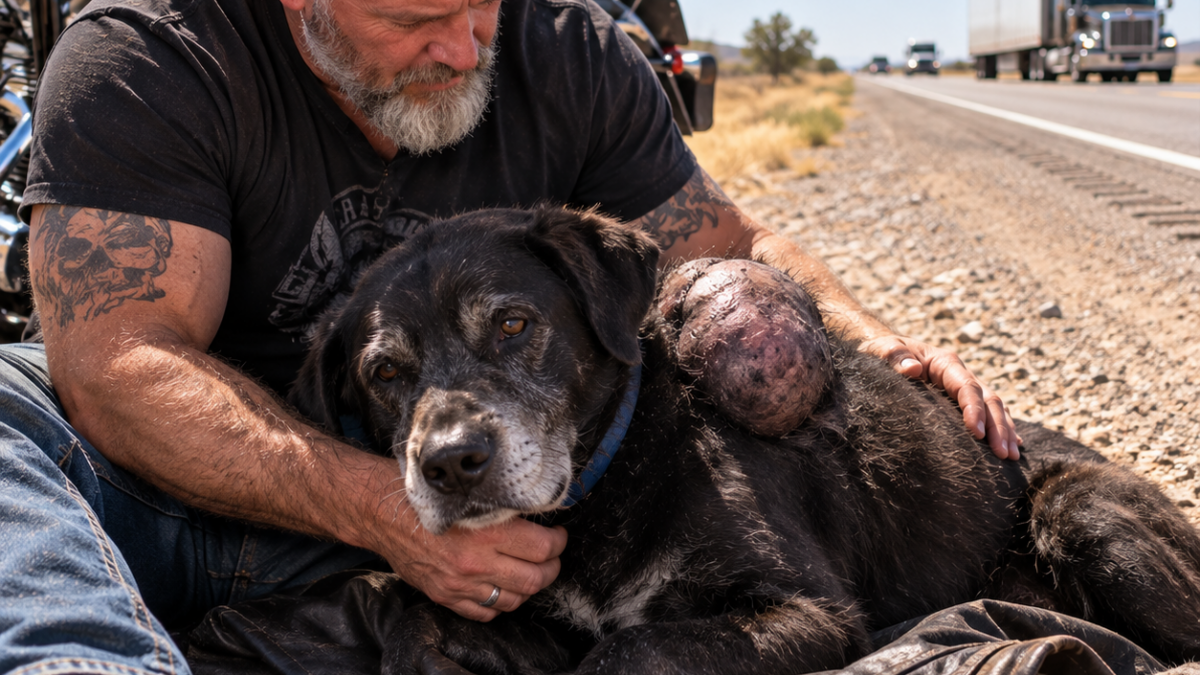
PART2:
Dr. Beaumont didn’t speak for a few seconds.
The scar was old by then.
Pale.
Wide in places.
Ugly if you cared about that sort of thing.
Another smaller scar crossed my right shoulder.
Two more sat along my ribs.
I had stopped noticing them years earlier.
Most people didn’t know they existed.
I put my shirt back on.
“Nine years ago,” I said, “I was lying beside this same highway.”
Her expression changed.
“Motorcycle?”
I nodded.
“Truck clipped me outside Quanah.”
“Driver kept going.”
“I went through a guardrail and landed in the ditch.”
“Broken shoulder.”
“Five ribs.”
“Two vertebrae.”
“Collapsed lung.”
I sat on the edge of the exam-room chair.
“Couldn’t stand.”
“Couldn’t even get my helmet off.”
“Cars went by.”
“I could hear them.”
“One after another.”
Dr. Beaumont glanced toward the treatment room where the dog had been taken for fluids.
“How long?”
“Forty-seven minutes.”
“You know the exact time?”
“I’ve never forgotten.”
I looked down at my hands.
“Then a cattle hauler named Warren Pike stopped.”
“Didn’t know me.”
“Didn’t know if I was drunk.”
“Didn’t know if I had insurance.”
“He just stopped.”
“He kept pressure on my side until EMS arrived.”
“Later he drove three hours to the hospital because somebody told him I didn’t have family nearby.”
Dr. Beaumont leaned against the counter.
“He saved your life.”
“Doctors saved my life.”
“Warren stopped long enough so they got the chance.”
I nodded toward the door.
“That dog got one mile out of me.”
“I’ve owed somebody nine years.”
She looked at me for a long moment.
Then said:
“Okay.”
Not sentimental.
Not dramatic.
Just okay.
The dog was badly dehydrated.
His temperature was elevated but not yet in the range Dr. Beaumont feared most.
They started IV fluids.
Cooling.
Pain medication.
Bloodwork.
The mass itself was ulcerated slightly underneath where his skin had rubbed against his shoulder movement, but it wasn’t actively bleeding.
She told me surgery couldn’t happen until he was stable enough for anesthesia.
“Tonight we hydrate him.”
“Tomorrow we image the mass and spine.”
“If everything looks manageable, we operate the day after.”
I nodded.
Then asked:
“What’s his name?”
She looked at me.
“I was hoping you knew.”
“No tag.”
“No chip found on the first scan.”
She scanned him again later.
Nothing.
We listed him with the county shelter.
Not because I wanted somebody to claim him.
Because he wasn’t mine yet.
That distinction mattered.
A dog found beside a highway still belongs to somebody until the legal stray-hold process and ownership questions are handled properly.
The clinic contacted local animal control.
Posted a found-dog notice.
Photographed the collar.
No identifying details beyond what was necessary.
For the first night, his paperwork simply said:
BLACK LAB MIX — FOUND U.S. 287.
I stayed until the clinic closed.
He lay on a padded kennel bed with one IV line taped to his front leg.
When I approached, his eyes opened.
The growl didn’t come.
I sat outside the kennel.
“You got anybody coming?”
His eyes stayed on me.
“Maybe.”
I didn’t know.
“Maybe somebody’s looking.”
He put his head down.
I drove home alone.
My Harley felt strangely light.
At two in the morning, I woke from the same dream I’d had off and on for nine years.
Gravel.
Heat.
My visor cracked.
Cars passing.
The sound of tires.
Nobody slowing.
Then instead of me lying beside the highway, it was the black dog.
I called the clinic when they opened.
Dr. Beaumont answered herself.
“He’s stable.”
I exhaled.
“Imaging this morning?”
“Yes.”
“Can I come?”
“You planning to work?”
“No.”
“Then come.”
My boss, Eddie Ruiz, took the call better than expected.
“You found a dog?”
“Yes.”
“And you’re missing a day?”
“Yes.”
“For a dog you don’t own?”
“At the moment.”
Silence.
Then:
“Rick.”
“What?”
“You’ve never taken a sick day in six years.”
“Technically I’m not sick.”
“You’re making my point.”
He told me to go.
At the clinic, Dr. Beaumont showed me radiographs.
The mass sat in the soft tissue between and slightly behind the shoulder blades.
Large.
Irregular.
It had distorted surrounding tissue but, based on the imaging available there, did not appear to originate from the spine itself.
That was the first good news.
Still, part of it extended deeply enough that she wanted to be careful around major structures.
She recommended sending tissue for pathology regardless of how it looked.
“Could be benign.”
“Could be malignant.”
“We don’t know until the lab tells us.”
“What happens if it’s cancer?”
“Depends on type and margins.”
“Let’s get through surgery first.”
He was estimated at seven or eight years old.
Older than I first thought.
His bloodwork showed dehydration and mild anemia but nothing that automatically ruled out surgery once fluids corrected him.
Dr. Beaumont had shaved a little fur near the mass for ultrasound.
Up close, the dog looked older.
Gray whiskers.
Scars on one front leg.
Calluses on his elbows.
Not a dog that had lived his whole life on a sofa.
I put my fingers through the kennel bars.
He sniffed them.
Then pressed his muzzle against my hand.
“That’s progress,” Dr. Beaumont said.
“He likes me.”
“Don’t become arrogant.”
“He growled yesterday.”
“Standards are low.”
Fair.
Animal control checked reports from nearby counties.
No matching missing dog.
The clinic called area shelters.
Nothing.
A Facebook post circulated.
Several people shared it.
Nobody came.
That bothered me more than I wanted to admit.
Maybe the owner was elderly.
Maybe hospitalized.
Maybe the dog had traveled far.
Maybe somebody hadn’t seen the post.
I refused to decide he’d been abandoned.
Evidence first.
That was what Warren Pike had taught me without ever saying it.
Don’t invent a reason not to stop.
Just deal with what’s in front of you.
Surgery was scheduled for Thursday morning.
I arrived before seven.
Dr. Beaumont met me in the lobby.
“You know there are risks.”
“Yes.”
“His age.”
“Heat exposure.”
“Mass location.”
“Anesthesia.”
“I know.”
“And if the tumor is invading structures we can’t safely remove—”
“Do what gives him the best chance without making him suffer.”
She nodded.
Then:
“I’ll call you.”
I sat in the parking lot for almost three hours.
Could have gone for coffee.
Didn’t.
The Harley was beside me.
Traffic moved along Main Street.
Every few minutes somebody entered the clinic carrying a cat carrier, a little dog, one terrified beagle.
Normal morning.
Inside, a dog without a name was under anesthesia because I had turned around.
At 10:46, my phone rang.
“Rick?”
“Yes.”
“It’s Sarah.”
I stood.
“We got it.”
My knees weakened.
“All of it?”
“As much as I can see safely.”
“It’s a big specimen.”
“About four pounds.”
Four pounds.
On a seventy-pound dog.
I thought about him trying to stand beside the highway.
No wonder.
“It had developed a stalk and was attached deeply in places, but it separated better than I feared.”
“Margins look encouraging grossly.”
“We’ll wait for pathology.”
“Is he awake?”
“Starting to.”
“Can I see him?”
“Give us an hour.”
When I walked into recovery, he looked terrible.
Shaved patch across most of his upper back.
Long surgical incision.
Bandaging.
Groggy eyes.
But the enormous lump was gone.
His back looked almost flat.
Dr. Beaumont warned me not to expect him to spring up.
Anesthesia.
Pain.
Weakness.
Heat exposure.
Muscle loss from carrying the mass.
He needed time.
I sat near him.
He lifted his head.
Looked at me.
Then dropped it.
“That’s enough,” I whispered.
“You don’t have to impress anybody.”
The clinic staff had started calling him Harley.
Because of the motorcycle.
I hated it.
“That’s too obvious.”
A technician named Jenna said:
“What would you call him?”
I looked at the dog.
He’d spent who knew how many hours watching Highway 287.
“Waylon.”
Jenna smiled.
“Like Jennings?”
“Texas dog.”
“Needs Texas name.”
Dr. Beaumont wrote WAYLON on his chart.
That became his name.
The pathology report took five days.
Five very long days.
Waylon stayed at the clinic for the first two after surgery.
Then, because nobody had claimed him and the stray-hold requirements had been satisfied through animal control, paperwork was arranged so I could take responsibility for him while final ownership was resolved.
I bought a dog bed.
Then another because the first one was too soft for him to stand from comfortably.
Food.
Bowls.
Harness.
Baby gate.
Rugs.
I hadn’t owned a dog since I was twelve.
My childhood dog, Red, had lived outside and eaten things a modern veterinarian would probably report us for.
Waylon was different.
The first night at my place, I carried him from the truck.
Not the Harley.
Dr. Beaumont had threatened bodily harm if I tried transporting a postoperative dog on a motorcycle.
Eddie lent me his old Ford.
I set Waylon down on the living-room rug.
He stood.
Really stood.
Four legs.
No giant mass pulling him sideways.
His body shook.
I kept both hands close without touching.
“Come on.”
He took one step.
Then another.
Stopped.
Looked confused.
The weight he’d carried was gone, but his body hadn’t learned that yet.
He compensated for something no longer there.
His front feet spread too wide.
His spine bent slightly.
Then he took another step.
And another.
By the time he reached the water bowl, I was crying.
I hated crying.
Mostly because once I started, it felt difficult to stop.
Waylon drank.
Then looked at me.
“Don’t make this weird,” I said.
He drank again.
The pathology call came Monday.
I answered before the first ring finished.
“Rick.”
Dr. Beaumont sounded careful.
“It is cancer.”
My stomach dropped.
Then:
“But listen.”
I sat at my kitchen table.
“It’s a low-grade soft-tissue sarcoma.”
“The lab believes we obtained clean margins in the submitted sample.”
“Low mitotic activity.”
“No evidence in his current chest imaging of obvious spread.”
“Does that mean he’s okay?”
“It means we have good reason to be hopeful.”
“Not a guarantee.”
“No.”
“Cancer doesn’t give those.”
I knew that already.
My older sister Ellen had died of breast cancer at forty-nine.
Nothing in life had taught me guarantees.
“What do we do?”
“Monitor.”
“Recheck the incision.”
“Periodic exams.”
“Watch for regrowth.”
“If anything changes, we respond.”
“How long does he have?”
Dr. Beaumont sighed.
“Rick, don’t reduce him to a number I can’t honestly give you.”
“He could have a recurrence.”
“He could also get hit by a meteor.”
“He’s walking.”
“He’s eating.”
“He’s recovering.”
“Live there for a while.”
That became my rule.
Live there for a while.
Waylon healed slowly.
The sutures came out.
Fur began covering the shaved area.
His balance improved.
The first time he trotted, he startled himself.
We were in the backyard.
He saw a squirrel.
Started forward.
His body suddenly moved faster than he expected.
He stopped.
Looked at me.
Then chased it anyway.
The squirrel won.
By a lot.
I laughed so hard the neighbor looked over the fence.
Waylon gradually became a dog instead of a patient.
That was important.
He liked:
Peanut butter.
Air-conditioning vents.
My old leather jacket.
Sleeping against the bathroom door.
Pickup trucks.
He hated:
Thunder.
Vacuum cleaners.
Being left in a room when I walked outside.
Motorcycles.
That last one surprised me.
If I started the Harley, he backed away.
Ears down.
So I stopped taking him near it.
I drove Eddie’s truck until I bought an old used F-150.
People at work were shocked.
“You sold the Harley?”
“No.”
“But you’re driving a truck.”
“I have a dog.”
Eddie nodded solemnly.
“This is how it begins.”
“How what begins?”
“Minivans.”
“I will die first.”
Waylon rode in the back seat.
Not the bed.
He hated being alone.
At first I thought that was normal after everything.
Then I noticed something else.
Every time we drove on Highway 287, he stood.
Even if he had been asleep.
As soon as tires hit that particular road, he raised his head and looked out the passenger window.
Passing vehicles.
One after another.
He tracked pickups longer than cars.
Dark-colored trucks especially.
The first few times I told myself I was imagining it.
Then Eddie rode with me to a supply job near Vernon.
Waylon stood behind us.
A dark maroon pickup passed.
Waylon whined.
Eddie looked back.
“What was that?”
“He does that on this highway.”
“Why?”
“I don’t know.”
Eddie watched him.
“You think somebody dumped him?”
I didn’t answer.
I still didn’t want to invent facts.
But the question stayed.
A month after surgery, Dr. Beaumont called.
“Someone saw the found-dog post.”
My heart jumped.
“Owner?”
“Maybe.”
A woman named Linda Webb lived near Amarillo.
She recognized Waylon’s photograph.
Or thought she did.
Her father, Earl Webb, had owned a black Lab mix named Duke.
Same white patch.
Same blue collar.
Same age.
Earl died eight months earlier.
“What happened to Duke?”
I asked.
“That’s the problem.”
Linda said her younger brother Travis had taken the dog after Earl’s death.
Travis traveled for construction work.
She hadn’t seen Duke since.
She assumed he was with Travis.
Now Travis wasn’t returning calls.
Linda drove down the next day.
Waylon was in the clinic for a recheck when she arrived.
The moment she walked into the exam room, she covered her mouth.
“Duke.”
Waylon lifted his head.
His tail moved.
Once.
Then faster.
Linda dropped to her knees.
“Oh my God.”
Waylon walked to her.
Pressed his head into her chest.
I knew before anyone said anything.
Waylon was Duke.
Linda cried.
I stood in the corner feeling something ugly and selfish.
This was what we’d been looking for.
His family.
His history.
An explanation.
And suddenly I wanted none of it.
I wanted him to stay mine.
That embarrassed me.
Linda looked at the long healing scar on his back.
“What happened?”
Dr. Beaumont explained the tumor.
The surgery.
Heat exhaustion.
The highway.
Linda stared at me.
“You paid for that?”
“Yes.”
“Why?”
I almost laughed.
Apparently everybody had the same question.
Linda asked:
“Where did you find him?”
I told her.
Her face changed.
“Travis works near Childress sometimes.”
Then:
“Can I call him from here?”
She tried.
No answer.
Text.
No answer.
Finally she said:
“I need to tell you something.”
I sat.
“Dad knew Duke had a lump.”
That hurt.
“How long?”
“Small at first.”
“Vet said it needed biopsy.”
“Dad’s health was bad.”
“Money…”
She looked ashamed.
“We kept putting things off.”
“Then Dad died.”
“Travis took Duke.”
“He said he would handle the vet.”
“Did he?”
“I don’t know.”
Waylon sat beside her.
She stroked his face.
“I assumed.”
That word.
Assumed.
She opened her phone.
Showed me photographs.
Duke as a younger dog beside an elderly man on a porch.
Duke wearing a red bandanna.
Duke lying beside a hospital bed.
Duke in the passenger seat of a pickup.
One photo showed Earl Webb with his hand on Duke’s neck.
They looked inseparable.
“He was Dad’s shadow,” Linda said.
“When Dad got sick, Duke wouldn’t leave him.”
“He slept beside the recliner.”
“After the ambulance took Dad the final time, Duke waited at the front window for three days.”
My chest tightened.
Highway shoulder.
Watching every passing vehicle.
Waiting for one car.
Linda began crying again.
“I think he kept waiting.”
Then Travis finally called back.
Linda put him on speaker.
“Where’s Duke?”
Long silence.
Then:
“What?”
“Dad’s dog.”
“Where is he?”
Another silence.
Finally Travis said:
“I couldn’t keep him.”
I felt heat rise behind my eyes.
Linda said:
“What did you do?”
“I tried.”
“He was sick.”
“That thing on his back kept growing.”
“He couldn’t climb stairs.”
“My landlord complained.”
“So what did you do?”
Travis inhaled.
“I found a rescue.”
“Which rescue?”
Silence.
“Travis.”
“I left him near Childress.”
Everything in the room changed.
Linda’s face went white.
“You dumped him?”
“I thought someone would find him.”
Dr. Beaumont closed her eyes.
I stood.
Every instinct in me wanted to take the phone.
I didn’t.
Linda said:
“On a highway?”
“There are truck stops.”
“People.”
“I left water.”
“Where?”
“Near a rest area.”
“Which one?”
He named a place miles north of where I’d found Waylon.
Dr. Beaumont asked quietly:
“How long before Rick found him?”
Linda asked.
Travis answered:
“Two days.”
Two days.
In July.
Texas.
One hundred degrees.
I walked out of the room.
Not because I was calm.
Because I wasn’t.
Outside the clinic, I put both hands on the hood of my truck.
Breathed.
Nine years earlier, a driver had left me bleeding after hitting me.
Maybe scared.
Maybe drunk.
Maybe didn’t know how bad it was.
I had spent years wondering what kind of person could see something happen and keep going.
Now I knew a different version.
Travis had left a sick dog because carrying the responsibility felt too heavy.
Then told himself somebody else would handle it.
The same sentence I’d told myself when I first rode past.
None of my business.
Except I’d turned around.
He hadn’t.
Linda came outside.
“Rick.”
I didn’t turn.
“I’m sorry.”
“You didn’t do it.”
“I should have checked.”
“You trusted your brother.”
“I should have checked.”
I finally looked at her.
“What do you want to do?”
She stared.
“What do you mean?”
“Duke.”
“Waylon.”
She smiled through tears.
“Waylon.”
“Legally, if your family has ownership rights…”
She shook her head before I finished.
“No.”
“He’s yours.”
I said nothing.
“My father would want the person who stopped to have him.”
“You saved his life.”
“He already chose you.”
Waylon came through the clinic door with Dr. Beaumont.
He saw me.
His entire body changed.
Tail.
Ears.
He pulled gently toward me.
Linda watched.
Then laughed and cried at the same time.
“Yeah.”
“Dad would understand.”
We handled the paperwork correctly.
Linda signed a transfer and relinquishment consistent with the legal process Dr. Beaumont and animal control recommended.
I paid the remaining clinic bill.
She tried to reimburse me.
I refused.
Then accepted one thing.
Earl’s old red bandanna.
Waylon wore it exactly once.
Hated it.
I kept it in a drawer.
Linda stayed in touch.
She sent photos.
Stories.
Waylon’s real birthday.
April 4.
His favorite treat had always been cheese.
That explained several thefts from my kitchen.
He had lived with Earl since he was eight weeks old.
Seven years.
Then Earl died.
Within months, Waylon lost:
His person.
His home.
His routine.
And eventually the man who had promised to care for him left him beside a road.
No wonder he watched traffic.
For weeks after learning that, I became angry every time he stood at the window during a passing truck.
Eventually Dr. Beaumont called me out.
“You’re treating him like he’s still waiting for Travis.”
“Maybe he is.”
“Or maybe he likes trucks.”
“I know what Linda said.”
“Rick.”
She leaned against the exam table.
“Waylon is here.”
“He’s not narrating his trauma every time he looks out a window.”
“You are.”
That annoyed me because it was true.
She continued:
“You know what happened.”
“Good.”
“Use it to care for him.”
“Don’t use it to make him sadder than he is.”
I looked at Waylon.
He was attempting to steal a treat from her pocket.
Definitely devastated.
I laughed.
“Okay.”
“Live where he is.”
“Not where he was.”
Same lesson.
Live there for a while.
Waylon and I settled into an ordinary life.
Work.
Truck rides.
Vet checks.
Walks.
He became famous at my HVAC company.
Not intentionally.
The office manager posted his before-and-after photos.
Customers started asking:
“Is that the highway dog?”
Eddie ordered him a company bandanna.
WAYLON
QUALITY CONTROL
He rode with me only when weather was safe and jobs allowed it.
Mostly he stayed at the shop office with Connie, our dispatcher.
Waylon loved air-conditioning.
That became the joke.
Of all the people who could have rescued him, he found HVAC workers.
Smart dog.
One August afternoon, a woman arrived at the shop carrying an envelope.
Her name was June Pike.
Warren Pike’s widow.
My rescuer had died two years earlier.
Heart attack.
I had attended the funeral.
June had seen the story about Waylon online.
She handed me an old photograph.
Warren beside his cattle truck.
Me beside him.
Taken six months after my accident.
I had forgotten it existed.
On the back Warren had written:
TURN AROUND WHEN SOMETHING TELLS YOU TO.
I stared.
June said:
“He talked about you.”
“I didn’t know.”
“He wondered whether you still rode motorcycles.”
“Sometimes.”
She looked at Waylon sleeping beneath the office vent.
“Guess he got his answer.”
I couldn’t speak.
June rubbed Waylon’s head.
“He would’ve stopped for the dog too.”
“I know.”
She smiled.
“He stopped for everything.”
“That man once stopped traffic to move a turtle.”
“Nearly caused another accident.”
I laughed.
That sounded exactly like Warren.
I framed the photograph.
Not at home.
At the shop.
Waylon’s bed sat beneath it.
The next year was good.
Really good.
No recurrence on exam.
Chest imaging remained clear.
Weight improved.
Muscle returned.
He could run.
Not like a puppy.
But enough.
His favorite place became Lake Kemp.
He would wade until water touched his belly.
Never swim unless I did.
Then he’d follow.
I had not been swimming in years.
My back hated cold water.
Waylon didn’t care.
We went anyway.
One Saturday, I realized I had spent an entire afternoon without thinking about the accident.
That hadn’t happened often.
It sounds ridiculous.
Nine years should be enough.
But trauma doesn’t keep calendars.
After the motorcycle crash, I healed physically.
Went back to work.
Bought another Harley three years later because I refused to let fear win.
Everybody said I was fine.
I said I was fine.
But I stopped taking 287 unless a job required it.
Never told anyone.
I used longer routes.
At night, I still woke hearing tires pass.
Waylon changed that accidentally.
His vet was in Childress.
Linda lived north.
Jobs happened.
I drove 287 because he was beside me.
At first, my hands tightened on the wheel near the accident site.
Then less.
Then one day I passed it without realizing until five miles later.
I looked at Waylon.
He was asleep.
Head against the window.
I said:
“You know what you did?”
He kept sleeping.
Typical.
He didn’t cure me.
I hate stories that make animals magical therapists without letting them be animals.
Waylon was a dog.
He ate trash.
Rolled in dead things.
Barked at the ice maker.
Once stole an entire rotisserie chicken and hid behind my recliner with it.
But living with him gave me routines that passed through places I’d avoided.
Sometimes healing is not a revelation.
Sometimes it’s taking the same road enough times that it becomes a road again.
At his next yearly exam, Dr. Beaumont felt a small thickening near the old surgical site.
My stomach dropped.
“Is it back?”
“I don’t know.”
Needle sample.
Imaging.
Waiting.
Three days.
Longest three days since the first surgery.
Result:
Scar tissue.
No obvious recurrence.
I sat in my truck afterward shaking.
Waylon put his head on my shoulder.
“You have terrible timing.”
He licked my ear.
The following spring, Linda visited.
She brought Earl’s old pickup.
Not the truck Travis had used.
A faded blue Ford from the photographs.
Waylon saw it from my driveway.
Froze.
Then ran.
Not toward the road.
Toward the truck.
He circled it whining.
Jumped with his front paws against the door.
Linda opened it.
Waylon climbed inside.
Sat in the passenger seat.
Exactly where he had sat with Earl.
Linda cried.
I did too.
We drove to Earl’s old property outside Amarillo later that year.
The house had been sold, but the new owners allowed us to visit after Linda explained.
Waylon walked through the yard.
Sniffed.
Stopped beneath an old pecan tree.
Then lay down.
I didn’t know whether he remembered.
Probably.
Scent memory in dogs is powerful.
But again, I tried not to narrate him too much.
He lay in shade.
We sat beside him.
Linda said:
“I blamed Travis for a long time.”
“You should.”
She looked at me.
“I knew you’d say that.”
“What he did was cruel.”
“Yes.”
“But?”
“No but.”
She seemed surprised.
Then I added:
“Forgiveness doesn’t require pretending something wasn’t cruel.”
She nodded.
“I talk to him again.”
“Good.”
“He knows he can’t be around Waylon.”
“Also good.”
Travis had faced local animal-abandonment consequences after the truth emerged.
The exact outcome was less dramatic than internet commenters wanted.
Fines.
Probation.
Required animal-welfare education.
Related legal conditions.
No ten-year prison sentence.
No judge ordering him abandoned on a highway.
People online were disappointed.
I wasn’t.
I didn’t need revenge.
Waylon was safe.
Travis had been held accountable.
Enough.
Linda said:
“He says leaving Duke is the worst thing he’s ever done.”
“I hope so.”
“He wants to apologize to you.”
“Why me?”
“You’re the one who found him.”
“He needs to apologize to the dog.”
She smiled sadly.
“Dogs are easier than people.”
Waylon rolled onto his back.
I rubbed his chest.
“True.”
When Waylon turned ten, Dr. Beaumont threw him a birthday party.
That sentence tells you too much about small-town veterinary clinics.
Cupcakes for humans.
Dog-safe cake.
Staff sang.
Waylon hated the hat.
A photograph appeared online.
Comments flooded in from people who remembered the highway story.
One said:
I drove that road that afternoon. I think I saw him. I didn’t stop. I’ve thought about it ever since.
That comment bothered me.
Not because I blamed the stranger.
Because I understood.
Hundreds of reasons.
Traffic.
Safety.
Heat.
Didn’t realize how bad it was.
Thought someone else would stop.
Same sentence.
Someone else.
I replied:
You can stop next time.
That’s all.
A few months later, that same person messaged me.
She had found a dehydrated puppy near Vernon.
Stopped.
Called animal control.
Puppy survived.
I showed Eddie.
He said:
“Now you’re running a movement.”
“Shut up.”
But something did grow from Waylon.
Our company started carrying animal-rescue basics in service trucks.
Slip leads.
Water bowls.
Gloves.
Emergency numbers.
Not because technicians were supposed to become roadside animal-control officers.
Safety first.
Traffic first.
Professionals when needed.
But if someone safely encountered a dog in obvious distress?
They had something.
Other local businesses joined.
June Pike donated funds in Warren’s name.
We called it the Turn Around Kit.
I hated the name.
Everyone else loved it.
One summer, a service technician named Carlos used one after finding a cattle dog trapped behind a guardrail.
Another employee found a kitten beneath a parked truck.
Small things.
No heroics.
People stopping.
That’s what mattered.
Waylon became the unofficial mascot.
His face went on the kit instructions.
He did not receive royalties.
When he was eleven, arthritis started.
Shoulders first.
Then hips.
Nothing unusual for a large older dog.
Medication.
Joint supplements.
Weight management.
Swimming.
He slowed.
I slowed too.
My back had become less forgiving.
Dr. Beaumont joked:
“You two are becoming the same patient.”
“Which one of us is cheaper?”
“Waylon.”
Rude.
We still went to Lake Kemp.
Shorter walks.
Longer rests.
He still watched trucks on 287.
But one behavior changed.
Years earlier, every dark pickup made him stand.
By eleven, he barely lifted his head.
At first I thought age.
Then I realized something.
He had stopped searching.
Or maybe I had.
Either way, the road no longer held the same question.
He belonged somewhere.
Home was not behind the next windshield.
Home was the truck he was already inside.
That thought nearly wrecked me.
By twelve, Waylon’s muzzle was almost completely gray.
The surgical scar had disappeared beneath thick fur except for a thin line I could feel with my fingers.
No recurrence.
Dr. Beaumont called that “the long version of good news.”
The cancer never came back in a clinically significant way.
Eventually something else would take him.
That’s how age works.
I knew it.
Still hated knowing.
My sister’s daughter, Emily, moved to Wichita Falls with her six-year-old son Noah.
Noah loved Waylon.
Waylon tolerated children but adored him.
Noah read books to him.
Waylon slept.
Noah considered this attentive listening.
One afternoon, Noah asked:
“Uncle Rick, why does Waylon have a line on his back?”
“Had surgery.”
“Why?”
“Big tumor.”
“Did it hurt?”
“Probably.”
“Were you scared?”
“Yes.”
“Was he scared?”
“Probably.”
“Did you know him?”
“No.”
Noah frowned.
“Then why did you help?”
There it was.
The question.
Again.
I sat beside him.
“Because somebody once helped me when they didn’t know me.”
He looked at the scar visible above my collar.
“The motorcycle?”
“Yes.”
“Did you pay them back?”
“Warren wouldn’t take anything.”
“So how did you pay him?”
I looked at Waylon.
“You don’t always pay back.”
“Sometimes you pay forward.”
Noah considered that.
Then:
“Like chain letters?”
“No.”
“Absolutely not.”
He laughed.
Good.
When Waylon was thirteen, Dr. Beaumont retired.
That hurt more than I expected.
She had been there from the highway afternoon.
Through surgery.
Cancer.
Every scare.
She introduced us to Dr. Priya Raman, who bought the practice.
Priya was younger.
Quiet.
Excellent.
Waylon accepted her after three cheese cubes.
Cheap loyalty.
At Sarah’s retirement party, I gave her a framed photograph.
Waylon on the clinic floor.
Mass gone.
Bandage across his back.
Me beside him looking like I hadn’t slept.
She stared.
“You look terrible.”
“Thank you.”
“You were terrified.”
“I was not.”
“Rick.”
“Fine.”
She hugged me.
I froze because apparently fifty-eight-year-old men still don’t know what to do with hugs.
Then hugged back.
She whispered:
“You turned around.”
I thought of Warren’s photograph.
“Yeah.”
“I did.”
The next two years were quieter.
Waylon slept more.
Walked less.
He still came to the shop once a week.
Still stole cheese.
Still barked at the ice maker.
Still hated the Harley.
I rode less anyway.
One morning when he was fourteen, he didn’t get up for breakfast.
I knew immediately.
Not the ending.
But the beginning of it.
Dr. Raman found a heart problem.
Then kidney disease.
Manageable at first.
Medication.
Diet.
Regular tests.
Like everything else with an old dog, the goal shifted.
Not cure.
Comfort.
Good days.
Enough appetite.
Enough mobility.
Enough interest.
I had once thought saving him meant surgery.
Then cancer monitoring.
Then keeping him alive as long as possible.
Eventually I learned saving isn’t always keeping.
Sometimes it’s recognizing when your fear is becoming heavier than their body.
We had eight more good months.
Good by old-dog standards.
Short walks.
Truck rides.
Lake visits without swimming.
Noah reading beside him.
Linda visiting twice.
One last trip north.
Then, in October, Waylon stopped wanting the truck.
That scared me most.
He had always loved it.
I opened the rear door.
He looked.
Lay back down.
Dr. Raman came to the house two days later.
She examined him on his bed.
Heart.
Kidneys.
Arthritis.
Weakness.
No single dramatic catastrophe.
Just an old body running out of reserve.
“Is he hurting?”
“Some.”
“Can we control it?”
“For a little while.”
“How little?”
She met my eyes.
“Rick.”
I hated that tone.
Not because she was wrong.
Because I understood it.
We increased comfort medication.
Three more days.
On Friday morning, Waylon refused cheese.
That was his line.
Not mine.
His.
I called Dr. Raman.
Then Linda.
Then Noah and Emily.
Eddie came from the shop.
June Pike came too.
That surprised me.
She brought Warren’s photograph.
Not for Waylon.
For me.
We sat in the backyard.
October sun.
Seventy degrees.
Waylon on my old leather jacket.
The same jacket I’d wrapped around him on Highway 287.
Fifteen years of scratches and age had softened it.
I’d never worn it much after he claimed it.
Waylon rested his head on the sleeve.
Linda scratched his ear.
“He looks like Dad’s Duke again.”
I said:
“He always did.”
She smiled.
“You changed his name.”
“Waylon’s better.”
She laughed.
“He is.”
Dr. Raman arrived in the afternoon.
Everyone else eventually moved inside except me.
I wanted it quiet.
I lay beside Waylon on the grass.
His breathing was slow.
His eyes partly closed.
I ran my hand over the place where the tumor had once been.
Flat.
Soft fur.
Nothing pulling him down anymore.
I thought about the shoulder.
One hundred three degrees.
His body hitting gravel again and again.
Watching cars.
Waiting.
I whispered:
“You don’t have to get up this time.”
His ear moved.
I put my forehead against his.
“You hear me?”
“No more trying.”
“You already got there.”
Dr. Raman gave the first medication.
Waylon relaxed.
For a few minutes, he slept deeply.
No strain.
Then the final medicine.
His breathing slowed.
Stopped.
I kept my hand on his chest.
Silence.
Not highway silence.
Home silence.
Different.
He was fourteen and a half.
I had him almost seven years.
Half his life.
Maybe the best half.
Maybe not.
Earl loved him before me.
I never needed to own every good part of his story.
After Dr. Raman left, I sat outside until dark.
Nobody rushed me.
Eventually Eddie came out.
“You okay?”
“No.”
“Good answer.”
He sat beside me.
We didn’t talk.
That helped.
I had Waylon cremated.
Some ashes went to Linda.
I kept the rest.
For months, the house felt wrong.
Too easy to walk through.
No dog bed.
No nails on the floor.
No giant black head appearing whenever cheese opened.
I went back to work.
People at the shop stopped saying his name at first because they were trying to protect me.
I hated that.
So one morning I brought his photograph.
Hung it beneath Warren’s.
Eddie looked.
“Good?”
“No.”
“But better.”
He nodded.
The Turn Around Kits continued.
We removed Waylon’s face from the newest version because I didn’t want him turning into a logo forever.
Carlos objected.
I won.
Instead, the instruction card said:
IF IT’S SAFE TO STOP, STOP.
CALL FOR PROFESSIONAL HELP.
SOMETIMES BEING THERE IS THE FIRST THING THAT MATTERS.
Warren would’ve liked that.
A year after Waylon died, Noah was riding with me on 287.
He was older.
Nine.
We passed the stretch where I had found Waylon.
I knew the place exactly.
Same mesquite.
Same rise in the road.
Shoulder had been resurfaced.
Nothing marked it.
No memorial.
Good.
Noah asked:
“Was it here?”
“Yes.”
“Where?”
I pointed.
“About there.”
He looked.
“Doesn’t look special.”
“It isn’t.”
We drove another mile.
Exactly where I had turned around.
I slowed.
Pulled onto the shoulder.
Noah looked at me.
“What?”
I shut off the truck.
We sat.
Heat wasn’t bad.
Spring day.
Wind.
Semis passing.
Noah said:
“This where you turned around?”
“Yes.”
“Why here?”
“I don’t know.”
“Just couldn’t keep going.”
He looked back toward the south.
Then:
“Would you stop again?”
“Yes.”
No hesitation.
That was the answer to everything.
Not because stopping always produces a happy ending.
Sometimes it doesn’t.
Sometimes the animal is already gone.
Sometimes helping means calling somebody qualified.
Sometimes a road is too dangerous to stop safely and you have to report the location instead.
Sometimes the bill is more than you can pay.
Sometimes you do everything right and still lose.
Helping is not a contract guaranteeing success.
Warren didn’t know I’d live.
I didn’t know Waylon would survive surgery.
Dr. Beaumont didn’t know the tumor would have clean margins.
Nobody knew we’d get nearly seven years.
We acted with what we knew.
That is enough.
Noah looked at me.
“Can we go?”
“Yeah.”
I started the truck.
Before pulling onto the highway, I looked in the rearview mirror.
Empty back seat.
For one second, I saw Waylon there anyway.
Gray muzzle.
Head against the glass.
Watching traffic.
Memory does that.
Then we drove.
Years later, people still send me dogs.
Not literally, thank God.
Photos.
Messages.
“Found this one.”
“What should I do?”
I tell them:
Safety first.
Call local animal control.
Veterinarian if injured.
Don’t put yourself in traffic.
Don’t assume every loose dog is abandoned.
Check for a chip.
Document where found.
Follow local stray-hold rules.
And if you can help without creating another emergency?
Help.
Not because you’re guaranteed a Waylon.
Because something lying beside a road doesn’t need to understand your reasons.
It just needs somebody to stop.
I never learned who hit me nine years before I found Waylon.
The driver was never identified.
I used to care.
Then less.
Warren’s stop mattered more than the stranger’s failure.
That’s another thing Waylon taught me.
You can build your life around the person who left.
Or around the person who turned around.
Both are real.
Only one gives you somewhere to go.
Waylon had Travis.
He also had Earl.
Linda.
Dr. Beaumont.
Me.
He was abandoned once.
He was loved much longer.
I prefer that arithmetic.
My Harley is still in the garage.
Old now.
Black paint scratched.
I ride occasionally.
Not in July if I can help it.
Age has finally made me smarter.
My leather jacket hangs beside it.
No.
That’s not true.
The original jacket is folded inside a cedar chest.
Waylon died on it.
I couldn’t wear it afterward.
Didn’t want to wash it for months.
Eventually I did.
The leather still carries scratches from his nails.
I keep it.
Not as a holy object.
Just mine.
Ours.
One afternoon, Noah found it.
He was twelve.
“Why don’t you wear this?”
“Too old.”
“The jacket or you?”
“Watch yourself.”
He laughed.
Then noticed the scratches.
“Waylon?”
“Yeah.”
He put the jacket on.
Way too big.
Looked ridiculous.
For one second, I remembered myself lifting a seventy-pound dog off burning gravel and wrapping him inside that leather.
I had no idea what would happen.
No idea whether he’d live through the night.
No idea whether somebody would claim him.
No idea he would spend seven years sleeping in my house.
No idea he’d get me driving 287 again.
No idea an entire little rescue program would grow out of one U-turn.
I only knew I couldn’t leave him there.
That was enough.
People ask whether I believe things happen for a reason.
I don’t know.
I think sometimes things happen.
Then we decide what to do next.
Waylon’s tumor did not happen so I could learn a lesson.
My accident did not happen so I would save a dog.
Earl did not die so Waylon would meet me.
Travis abandoning him was not some necessary part of a better plan.
Cruel things don’t become good because something good eventually grows afterward.
But good can grow anyway.
That’s different.
Warren stopped for me.
Nine years later, I stopped for Waylon.
Years after that, somebody who had read his story stopped for a puppy.
Then somebody else.
None of that erases the road.
It changes what happens beside it.
That is enough meaning for me.
The clinic where Dr. Beaumont treated Waylon has changed owners twice.
The cinderblock walls are painted now.
New sign.
Bigger waiting room.
Dr. Raman still practices there part time.
On one wall hangs a board of patient photographs.
Waylon is there.
Not the highway picture.
Not the giant tumor.
Not the surgery.
A photograph from Lake Kemp.
Wet.
Black fur shining.
Gray muzzle.
Mouth open.
Looking straight at the camera.
Underneath:
WAYLON SUTTER
HIGHWAY FOUNDLING
PROFESSIONAL CHEESE THIEF
I approved that description.
Much better than:
Cancer survivor.
Waylon was more than the worst thing that happened to him.
So am I.
That may be the real reason I turned around.
I didn’t know it then.
On that highway shoulder, I saw a dog being reduced to one terrible moment.
Tumor.
Heat.
Abandoned.
Unable to stand.
Nine years earlier, I’d been exactly that to passing drivers.
A body in a ditch.
Motorcycle wreck.
Problem.
Risk.
Delay.
Warren looked long enough to see a person.
I looked long enough to see a dog.
After that, responsibility became simple.
Not easy.
Simple.
Stop.
Call.
Lift.
Pay.
Wait.
Hope.
Love what shows up after survival.
Then, eventually, let go.
If I had kept riding that afternoon, somebody else might have stopped.
I tell myself that sometimes.
Maybe.
Or maybe not.
What I know is that I did.
And because I did, a dog who had spent two days waiting beside a Texas highway got nearly seven more years of:
Air-conditioning.
Lake water.
Cheese.
Truck rides.
Children reading to him.
Veterinary birthday parties.
A red bandanna he hated.
An old leather jacket that became his bed.
And a house where nobody ever drove away and left him behind.
I got something too.
A road back into my own life.
For nine years, Highway 287 had been the place where the world passed me.
After Waylon, it became the place where I turned around.
Those are two very different stories about the same stretch of pavement.
I know which one I choose to keep.
So when people ask why I spent thirty-five hundred dollars on a stray dog I’d known less than an hour, I don’t show them the scar anymore.
I don’t need to.
I just say:
“Because once, a stranger stopped for me.”
Then, if they keep asking, I tell them about Waylon.
The black dog with the giant tumor.
The dog who watched every passing vehicle because he thought somebody might come back.
The dog I rode past.
The dog I couldn’t leave.
And I always end with the same part.
Not the surgery.
Not the cancer.
Not even the day he died.
I tell them about the first night at my house.
Waylon stood on four legs without that massive weight on his back.
He swayed.
Looked confused.
Took one step.
Then another.
Then another.
No gravel.
No trucks.
No burning highway.
Just a rug.
A water bowl.
And me standing a few feet away trying not to cry.
He crossed the room under his own power.
Reached the water.
Drank.
Then looked back at me as if he needed to make sure I was still there.
I was.
And for the next seven years, whenever he looked back, I stayed.








