I Found an Old Dog Abandoned on a Frozen Bench—Then the Vet Saw What Was Filling His Stomach.k
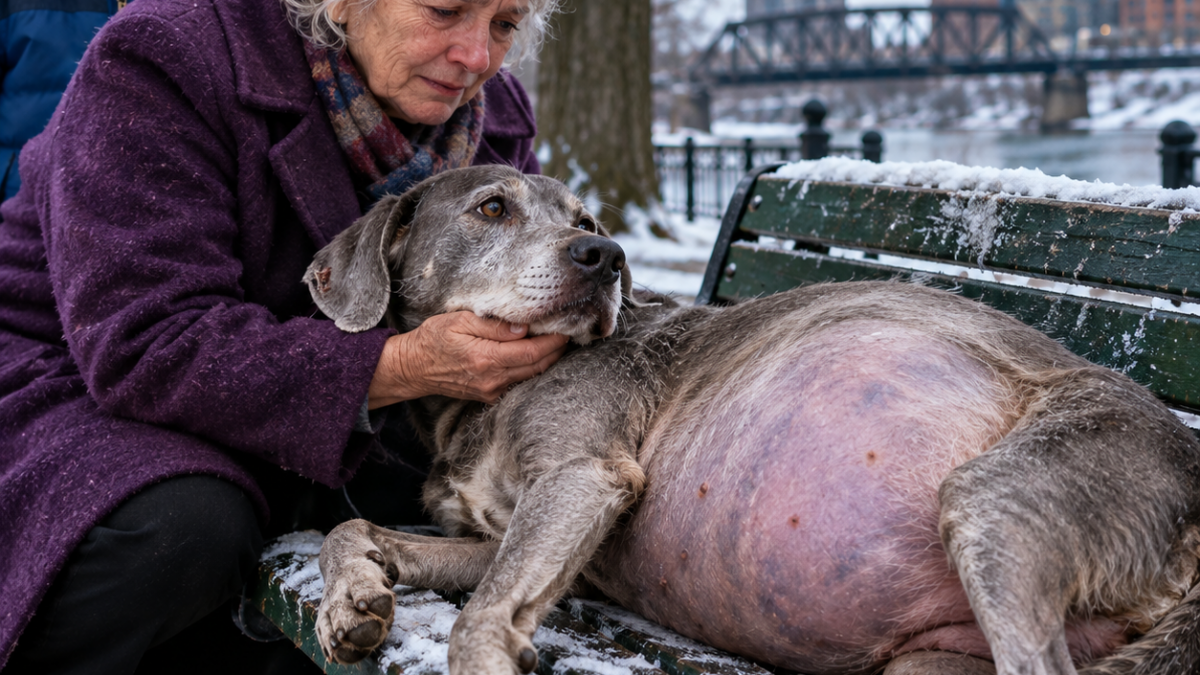
part2:
I noticed the worn line around his ribs next.
A faint band through the fur, just behind his front legs.
The kind of mark made by something worn for years.
Harness.
Working vest.
Mobility gear.
Something.
Teddy crouched beside me.
“Can I pet him?”
“Very gently.”
He touched two fingers to the dog’s shoulder.
The dog didn’t move.
“What’s his name?”
“I don’t know.”
“Can we name him?”
“Not yet.”
“Why?”
“Because he might already belong to someone.”
Teddy looked around the empty stretch of trail.
“Then why’d they leave him?”
That question hurt more than I expected.
“I don’t know.”
A jogger slowed near us.
Middle-aged woman.
Pink headband.
She looked at the dog’s stomach.
“Oh, poor thing.”
“Somebody probably dumped him.”
Then she said:
“My uncle’s dog looked like that right before his liver failed.”
She shook her head.
“Nothing they could do.”
And continued running.
I wanted to call after her.
Not because I knew she was wrong.
Because she had already turned the dog into something finished.
I took out my phone.
Called Kent County Humane Rescue.
The dispatcher asked for location.
Condition.
Whether the dog was responsive.
“Responsive, yes.”
“Can he stand?”
“No.”
“Any visible injury?”
“Not exactly.”
“His stomach is enormously swollen.”
“How enormous?”
I looked at him.
“Like a barrel.”
That changed her tone.
“We’re sending a team.”
Twenty minutes later, a white rescue van pulled onto the park access road.
Two staff members came with a stretcher.
A woman named Janelle and a younger man named Marcus.
Janelle took one look at the dog.
“Oh, buddy.”
She knelt.
Checked his gums.
Listened to his breathing.
Then carefully felt his abdomen.
Her face changed.
“Has he vomited?”
“Not since we’ve been here.”
“Any water?”
“I didn’t give him anything.”
“Good.”
That worried me.
“Why good?”
“With this kind of distention, we don’t know what’s happening yet.”
They slid a blanket beneath him.
It took both of them to lift him.
Not because he was muscular.
Because the swelling made him unexpectedly heavy and awkward.
He didn’t cry.
Didn’t fight.
He only turned his head.
And watched me.
All the way to the van.
I don’t know why I asked.
“Can I come?”
Janelle looked surprised.
“You found him?”
“Yes.”
“You family?”
“No.”
She studied me.
Then Teddy.
Then the dog.
“Follow us.”
I called my daughter.
Her name is Anna.
“Teddy and I are going to the humane clinic.”
Silence.
“What happened?”
“We found a dog.”
“Mom.”
“Yes?”
“You cannot adopt every injured thing you see.”
“I’ve never adopted an injured thing.”
“You fed that raccoon for two months.”
“He had a limp.”
“Raccoons all look like they’re limping.”
“I don’t think that’s true.”
“Mom.”
“This is serious.”
That changed her voice.
“What happened?”
I told her.
She said she’d meet us after picking up Teddy.
We followed the rescue van.
Teddy was quiet.
Unusually quiet.
Finally:
“Grandma?”
“Yes?”
“If he dies, do dogs know someone stayed with them?”
I looked at him in the rearview mirror.
Six years old.
Red coat.
One blue glove.
One green.
“I think kindness matters even if nobody understands it perfectly.”
He frowned.
“That sounds like a grandma answer.”
“It is.”
At the clinic, they took the dog straight back.
Teddy and I waited beneath fluorescent lights while an old terrier barked from somewhere behind a door.
Then Dr. Paul Brennan came out.
Tall.
Gray hair.
Gentle voice.
He shook my hand.
“You brought in the Weimaraner mix?”
“We found him.”
“He’s older.”
“How old?”
“Hard to say.”
“Maybe ten.”
“Maybe twelve.”
“His abdomen is significantly distended.”
I nodded.
“Do you know why?”
“Not yet.”
“We’re going to image him.”
“Can I stay?”
“You can.”
Anna arrived twenty minutes later.
She took Teddy to the waiting room but he refused to leave entirely.
“I want to know.”
Anna looked at me.
I nodded.
So he stayed near the doorway while Dr. Brennan performed the ultrasound.
The dog lay on his back with support beneath one side because his abdomen was so large.
They shaved a small patch.
Gel.
Probe.
Gray shapes moved across the monitor.
I understood none of them.
Dr. Brennan moved slowly.
Then stopped.
His whole posture changed.
He leaned toward the screen.
Long silence.
I held Teddy’s hand.
He whispered:
“Are those babies?”
Dr. Brennan finally said:
“No.”
Then looked at me.
“Those aren’t puppies.”
My stomach dropped.
“What are they?”
He moved the probe again.
“Fluid.”
I stared.
“All of that?”
“A very large amount.”
“What kind of fluid?”
“Likely abdominal fluid.”
“Ascites.”
“Could be from heart disease.”
“Liver disease.”
“Cancer.”
“Internal bleeding.”
“We need blood work and more imaging.”
Teddy asked:
“Is that bad?”
Dr. Brennan turned toward him.
“It means he’s very sick.”
Teddy nodded seriously.
“But we’re going to figure out why.”
That was the right answer.
Not false hope.
Not despair.
A job.
Figure out why.
They drew blood.
Took radiographs.
Checked for a microchip.
Nothing.
No collar.
No identification.
Then Janelle came in carrying a clear plastic evidence bag.
Inside was a torn strip of dark navy fabric.
“We found this caught in the fur under his chest.”
I looked closer.
Heavy nylon.
Reflective thread.
Something embroidered along one edge.
Only four letters remained.
…VICE
Service?
I looked at the worn line around his ribs.
My memory stirred again.
A dog.
Harness.
Chin on my hand.
Hospital.
No.
Not hospital.
I closed my eyes.
And suddenly I saw my husband.
Frank.
Eight years earlier.
Sitting in a wheelchair.
A silver-gray dog beside him.
That dog had rested his chin on Frank’s knee whenever Frank’s hands began shaking.
My eyes opened.
Impossible.
No.
That dog had been younger.
Darker.
Still.
My heart started beating faster.
Dr. Brennan noticed.
“You okay?”
I looked at the dog.
Then the notch in his right ear.
The white star.
And I remembered.
“Check his left rear paw.”
“What?”
“Please.”
Janelle lifted it carefully.
One pad had a pale crescent-shaped scar.
I sat down.
Anna came closer.
“Mom?”
I couldn’t speak.
Then:
“I know this dog.”
Everyone went still.
Anna stared.
“What do you mean?”
I looked at her.
“This is Duke.”
She shook her head.
“No.”
“Dad’s Duke?”
“Yes.”
“That can’t be.”
“Duke disappeared after Dad died.”
“I know.”
Eight years earlier, my husband Frank had suffered a stroke.
Not catastrophic.
But enough to leave weakness on his right side and unpredictable episodes of panic.
Frank had spent thirty-five years as a city building inspector.
Proud.
Independent.
Stubborn.
The stroke took his confidence faster than his mobility.
Our daughter found an organization that placed trained mobility-assistance dogs with older adults.
That was how Duke came to us.
He was four then.
Silver-gray.
Long-legged.
Smart.
He wore a navy service vest.
He retrieved dropped objects.
Helped Frank stabilize when standing.
Could bring a phone.
Could open certain doors.
But his real gift was not listed in any training manual.
When Frank became overwhelmed, Duke rested his chin on him.
Hand.
Knee.
Lap.
Didn’t matter.
Pressure.
Stillness.
Wait.
Frank called it:
“The anchor.”
The first week Duke came home, he did it to me once.
I had been crying quietly in the kitchen after thinking Frank was asleep.
Duke walked over.
Put his chin on the back of my hand.
Exactly what he’d done in the park.
That’s why it felt familiar.
After Frank died three years later, Duke changed.
He searched rooms.
Waited outside Frank’s bedroom.
Refused to sleep near the empty wheelchair.
I wanted to keep him.
Desperately.
But the service organization told me Duke still had working years and could potentially be reassigned.
I thought letting him help someone else would honor Frank.
So I agreed.
Worst decision?
For years I believed maybe.
The organization later merged with another nonprofit.
Records became complicated.
The family Duke was reassigned to moved out of state.
I received one update.
Then another.
Then nothing.
Three years later, I tried finding him.
Emails bounced.
Phones disconnected.
I assumed he had retired with his second handler.
Anna sat beside me.
“Mom.”
I touched Duke’s head.
His eyes opened.
“Duke.”
His ears twitched.
“Duke, it’s Dolores.”
Nothing.
Then I whispered the old command Frank used.
“Anchor.”
Duke raised his head.
Slowly.
Straining against the swollen weight of his body.
He stretched forward.
And put his chin against my hand.
Anna started crying.
I did too.
Teddy looked between us.
“This was Grandpa’s dog?”
“Yes.”
“You know him?”
“Yes.”
Duke’s tail tapped once.
Dr. Brennan gave us a few seconds.
Then gently:
“We still have to figure out what’s happening medically.”
Reality returned.
Blood work showed anemia.
Low protein.
Abnormal liver values.
But not complete liver failure.
His heart was enlarged slightly, though not enough to explain the volume of fluid.
They drained a small sample from his abdomen.
Clear yellow fluid.
Not blood.
That was good.
Sort of.
Then X-rays revealed something near his liver.
A mass.
Dr. Brennan wanted an advanced ultrasound.
Maybe CT.
My brain stopped at one word.
“Mass.”
“Cancer?”
“Possibly.”
“Could be benign.”
“Could be inflammatory.”
“We don’t know yet.”
Duke lay beside us.
Eyes half closed.
Teddy whispered:
“Can you take the water out?”
“Some.”
Dr. Brennan said.
“But we can’t remove too much too quickly.”
“Why?”
“Because his body has adapted to the pressure.”
“We have to be careful.”
They admitted him.
Again, I found myself leaving a dog behind in a clinic.
Except this time he wasn’t a stranger.
He was family I had already lost once.
That night, I pulled out every photograph of Frank and Duke.
There weren’t many printed.
Most were digital.
But I had one favorite.
Frank on our back porch.
Wheelchair.
Plaid shirt.
Duke beside him wearing the navy vest.
Right ear.
Notch.
Chest.
Tiny white star.
Rear paw barely visible.
No doubt.
It was him.
Eight years older.
Thin.
Sick.
But Duke.
Anna sat at the table.
“I can’t believe it.”
“Neither can I.”
“Where has he been?”
“I don’t know.”
“How does a trained service dog end up abandoned on a bench?”
I looked at the photo.
“That is what I want to know.”
The rescue contacted the successor organization that had absorbed Duke’s original program.
It took two days.
Records were incomplete.
But eventually, a coordinator named Beth called.
Duke had indeed been placed after Frank’s death.
Second handler:
Thomas Greene.
Former postal worker.
Multiple sclerosis.
Lived in Lansing.
Duke worked with him nearly four years.
Then Thomas died.
A niece named Carla took Duke.
At that point, he was around eleven.
Too old for reassignment.
Records ended there.
Beth gave us the last known contact number.
Disconnected.
Address.
Rental apartment.
Anna searched public records.
Carla had moved to Grand Rapids the previous year.
Then I felt ashamed.
Because I knew what my mind was doing.
Building a villain.
Carla abandoned him.
Carla starved him.
Carla dumped him.
Maybe.
Maybe not.
Facts first.
I had spent enough years married to a building inspector to know assumptions create expensive mistakes.
Dr. Brennan performed the advanced ultrasound.
The mass was not inside Duke’s liver.
It was attached near the spleen.
About the size of a grapefruit.
No obvious widespread metastasis.
The abdominal fluid appeared related to severe low protein and impaired circulation, possibly worsened by the mass and chronic malnutrition.
Surgery was risky.
But potentially meaningful.
“How risky?”
I asked.
Dr. Brennan didn’t soften it.
“High.”
“He’s old.”
“Malnourished.”
“Anemic.”
“We need to stabilize him first.”
“What if we don’t operate?”
“We manage symptoms.”
“Drain fluid carefully.”
“Support nutrition.”
“But if the mass is contributing significantly, he’ll decline.”
“How long?”
“I can’t honestly tell you.”
Teddy was not there for that conversation.
Good.
I said:
“Can he recover enough for surgery?”
“Maybe.”
That word again.
Maybe.
Duke spent four days in intensive care.
Small meals.
Protein support.
Medication.
Careful fluid drainage.
The first time they removed enough abdominal fluid for him to bend one leg normally, he looked confused.
Then tried standing.
Failed.
Tried again.
Janelle supported his chest.
He got all four paws beneath him.
Ten seconds.
Then collapsed onto the blanket.
I laughed and cried at once.
“Stubborn.”
Janelle smiled.
“Service dogs often are.”
On day five, Duke walked six steps.
Slow.
Unsteady.
But walked.
Teddy counted every one.
“One.”
“Two.”
“Three.”
Duke stopped.
“Come on, Duke.”
“Four.”
“Five.”
“Six!”
Teddy cheered like we’d won the Super Bowl.
Duke looked embarrassed.
That was the first moment he seemed like the dog I remembered.
Proud.
Slightly judgmental.
Frank used to say Duke’s greatest flaw was that he knew he was more competent than the people around him.
Probably true.
The clinic scheduled surgery for the following Monday.
The night before, I stayed late.
Duke lay on a blanket.
His belly was still enlarged.
Less grotesquely now.
I rested my hand beside his head.
“Your first person left you.”
“Then you lost the second.”
“I don’t know what happened after that.”
His eyes watched me.
“I’m sorry I let you go.”
That sentence had lived inside me for eight years.
It came out before I could stop it.
Duke lifted his head.
Rested his chin on my hand.
Anchor.
I laughed softly.
“You’re not supposed to comfort me.”
He stayed.
Of course he did.
Surgery lasted two hours and forty minutes.
I know because I watched every minute on the clock.
Anna came.
Teddy stayed at school.
Dr. Brennan finally walked into the waiting room.
Surgical cap still on.
“The mass is out.”
I stood.
“Was it cancer?”
“We need pathology.”
“Was there bleeding?”
“Some.”
“He’s stable.”
Stable.
Another precious word.
The mass arose from the spleen.
Dr. Brennan removed the spleen with it.
No visible lesions elsewhere.
Duke needed blood support.
But he made it through anesthesia.
That night, he slept.
Next morning, he ate chicken from Janelle’s hand.
By afternoon, he tried getting up without permission.
Definitely Duke.
Pathology took four days.
I was washing dishes when Dr. Brennan called.
“Dolores.”
“Yes?”
“It’s benign.”
I didn’t understand.
“What?”
“The mass.”
“Benign nodular hyperplasia.”
“No malignant cancer found.”
I sat down at the kitchen table.
“So he doesn’t have cancer?”
“Not based on what we removed.”
His abdominal problems had multiple causes.
Malnutrition.
Low protein.
The splenic mass impairing circulation.
Age-related heart changes.
But no terminal cancer.
No inevitable death sentence.
Treatment.
Nutrition.
Monitoring.
Possible recovery.
I covered my mouth.
Then started laughing.
Dr. Brennan waited.
“Sorry.”
“Don’t apologize.”
“Can I tell Teddy?”
“Absolutely.”
I called Anna first.
Then Teddy.
He shouted:
“Duke isn’t dying?”
I looked out my kitchen window.
“We’re all dying eventually, sweetheart.”
Anna yelled in the background:
“Mom!”
I corrected.
“Duke is not dying from this.”
Teddy cheered.
Better.
Then the police called.
I hadn’t involved police.
The rescue had.
Because abandoning a severely ill animal in freezing weather could potentially be cruelty.
An animal-control investigator named Sheila Moran had been trying to locate Carla Greene.
They found her.
At a motel.
Carla wasn’t a monster.
That complicated everything.
She was thirty-eight.
Recovering from opioid addiction.
Had lost her apartment.
Had been living in her car with Duke for nearly two months.
She had tried contacting three shelters.
One said full.
Another couldn’t accept an elderly dog with severe medical needs without an appointment.
The third gave her a low-cost veterinary number.
Carla had no money.
Duke’s abdomen began swelling gradually.
Then rapidly.
She panicked.
On the morning I found him, she had taken him to Riverside Park because she knew rescue workers regularly patrolled the area.
She left him on the bench.
Then sat in her car across the road for nearly an hour.
Waiting for somebody to notice.
The dark sedan she’d been driving had been captured on a park camera.
She watched me stop.
Watched rescue arrive.
Then drove away.
Why not stay?
She was terrified she would be arrested.
She also had an outstanding warrant for a missed court appearance related to a drug possession case.
Not violence.
Not animal cruelty.
Fear.
Bad decisions.
Desperation.
Did leaving Duke there endanger him?
Yes.
Was it the right thing?
No.
But the story I had built in my mind—cruel woman discards old dog because he became inconvenient—wasn’t true.
She had been sharing food with him.
That’s part of why she was visibly underweight herself.
Duke’s malnutrition wasn’t only from lack of food.
His disease had interfered with nutrition and protein balance.
Carla had actually been giving him most of what she had.
She just didn’t know how sick he was.
Sheila Moran asked whether I wanted to speak with her.
At first I said no.
Then yes.
We met at the rescue clinic.
Carla looked exhausted.
Brown hair pulled into a knot.
Hands shaking.
She saw Duke through the glass.
Started crying immediately.
“Is he alive?”
“Yes.”
“Is he okay?”
“He had surgery.”
Her face crumpled.
“Cancer?”
“No.”
She covered her face.
“Oh, thank God.”
That reaction told me a lot.
I waited.
Then:
“Why didn’t you ask someone for help?”
“I did.”
“Nobody listened.”
She looked at me.
“I should’ve stayed.”
“Yes.”
“I know.”
“You left an animal who couldn’t stand on a freezing bench.”
“I know.”
Her eyes filled again.
“I thought if I stayed, they’d take me to jail before they helped him.”
“That wasn’t necessarily true.”
“I wasn’t thinking.”
“No.”
She looked through the glass.
“My uncle Tom made me promise I’d keep him.”
“Thomas Greene?”
She nodded.
“He loved that dog.”
“When Uncle Tom got bad, Duke wouldn’t leave the bedroom.”
“After he died, I couldn’t put Duke through another shelter.”
“So I kept him.”
“Then I lost my job.”
“Then my apartment.”
“I thought his belly was because I was feeding him badly.”
“I kept buying cheap food.”
“He got bigger here.”
She touched her abdomen.
“And thinner everywhere else.”
“I knew something was wrong.”
“I just…”
Her voice failed.
I wanted to be angry.
Part of me was.
Another part remembered years of watching Frank become ashamed whenever he needed help.
People often disappear before they ask because needing something feels like failure.
I said:
“Duke belonged to my husband before Thomas.”
Carla stared.
“No.”
“Yes.”
She looked at me differently.
“You’re Dolores?”
My skin prickled.
“You know my name?”
“Uncle Tom did.”
“He had the service-transfer papers.”
“He said Duke’s first handler was a man named Frank.”
“He said Frank’s wife had let Duke keep working after Frank died.”
She started crying again.
“He always said whoever did that must’ve loved him a lot.”
That sentence destroyed me.
For years, I had carried guilt over letting Duke go.
Someone I never met had understood it as love.
I sat down.
Carla looked terrified she’d said something wrong.
I shook my head.
“It’s okay.”
Then:
“Tell me about Thomas.”
So she did.
Duke learned where Thomas kept medication.
Helped him stand.
Retrieved dropped objects.
When Thomas’s hands failed, Duke would bring the phone.
When he fell in the bathroom once, Duke barked until the neighbor came.
Near the end, Thomas couldn’t walk much.
Duke stayed beside his bed.
Same dog.
Same job.
Anchor.
Carla said:
“He saved my uncle more than once.”
“I believe it.”
“After Uncle Tom died, he stopped wearing the vest.”
“I couldn’t throw it out.”
“Do you still have it?”
She nodded.
“It’s in a storage tote.”
Navy fabric.
Reflective lettering.
That explained the torn strip.
Carla had put the old vest on Duke when his stomach became too heavy for her to help him into the car.
Used it as a support harness.
The fabric tore.
She cried explaining it.
I understood.
We didn’t become friends that day.
Life isn’t that tidy.
She faced consequences for abandoning Duke.
The animal-control investigation considered all circumstances.
She also entered treatment.
A social worker connected her to housing support.
I didn’t control any of that.
Nor should I have.
But I told Sheila Moran one thing clearly.
“Carla didn’t cause his abdominal disease.”
Dr. Brennan confirmed that.
And:
“She was trying badly.”
Sometimes trying badly still hurts someone.
Both truths can exist.
Duke came home with me eleven days after surgery.
Not because Carla didn’t care.
Because everyone agreed she was not in a position to provide the medical care he needed.
And because I had been part of Duke’s family first.
Carla signed the transfer voluntarily.
Her hand shook.
Before signing, she asked:
“Can I visit him?”
I looked at her.
“Yes.”
Then:
“When you’re stable.”
She nodded.
Fair.
The first night Duke returned to my house, he stopped in the hallway.
He looked toward the living room.
The kitchen.
Then the old den.
Frank’s room had been remodeled years earlier.
But some things remained.
The stone fireplace.
Oak bookshelf.
Window facing the backyard.
Duke walked slowly toward it.
Sniffed the floor.
Then stood near the spot where Frank’s wheelchair used to sit.
My heart broke.
“Do you remember?”
He looked at me.
Then lay down.
I brought his orthopedic bed beside the fireplace.
He ignored it.
Of course.
He chose the rug.
Old habits.
Teddy arrived the next morning.
He ran toward Duke.
I stopped him.
“Slow.”
He slowed dramatically.
Tiptoed.
“Hi, Duke.”
Tail tap.
Teddy crouched.
“You knew Grandpa?”
Duke blinked.
“Grandma says you helped him.”
Another tail tap.
Teddy looked at me.
“He said yes.”
“Obviously.”
Recovery took months.
Duke’s belly slowly returned toward normal.
Not immediately.
His protein levels needed time.
Medication helped his heart.
We fed carefully.
Small meals.
High-quality nutrition.
Follow-up testing.
He gained muscle.
His legs stopped looking like sticks.
The first time he climbed the two steps onto my porch without assistance, Teddy applauded.
Duke turned and looked at us like:
Please control the child.
I laughed.
He had become old.
There was no pretending otherwise.
Arthritis.
Cloudiness beginning in one eye.
Hearing slightly reduced.
He tired easily.
But old is not the same as finished.
That’s something I wish the jogger in the park could have understood.
She had looked at his swollen belly and said:
Liver’s probably shot.
Nothing they can do.
Maybe she was trying to protect herself.
People often predict death because uncertainty makes them uncomfortable.
But Duke had years of service behind him.
He deserved someone to ask one more question before writing the ending.
What is actually wrong?
Not:
What does this look like?
Dr. Brennan gave us that question.
We answered it.
Fluid.
Mass.
Malnutrition.
Circulation.
Then treatment.
Not miracle.
Medicine.
Time.
Care.
The worn line around Duke’s ribs never fully disappeared.
His service vest had shaped his fur for years.
I contacted the successor assistance-dog organization and gave them his history.
Their coordinator cried.
Apparently Duke had been one of the last dogs from the original training program.
They found his intake records.
Born in Ohio.
Trained beginning at eighteen months.
Temperament notes:
Exceptionally calm. Strong task persistence. Naturally offers physical contact during emotional distress.
I laughed.
“Anchor.”
Exactly.
They mailed me copies of his original training photographs.
Young Duke.
Dark silver.
Long ears.
Bright eyes.
No white muzzle.
I showed Teddy.
“That isn’t Duke.”
“It is.”
“No.”
“Grandma.”
“He’s black.”
“Gray.”
“Dark gray.”
“Same dog.”
Teddy compared the ear notch.
Then believed me.
One photo showed Duke in a training vest.
The same navy color.
He was learning to retrieve a phone.
Another showed him resting his chin on a trainer’s knee.
That behavior hadn’t belonged to Frank.
Or me.
Or Thomas.
It was simply Duke.
A thing he offered.
His way of saying:
I’m here.
Carla visited four months later.
She looked different.
Healthier.
Hair cut.
New coat.
She was living in transitional housing and working part-time at a grocery store.
She stood at my door holding a bag of dog treats.
“I checked with Dr. Brennan.”
“Low sodium.”
“Good.”
Duke was asleep near the fireplace.
She whispered his name.
His head rose.
For a second, nothing.
Then his tail started moving.
Carla dropped to her knees.
Duke stood.
Slowly.
Walked toward her.
She pressed both hands to his face.
“I’m sorry.”
Duke licked her chin.
No judgment.
Dogs have advantages over us.
Carla stayed an hour.
We talked about Thomas.
Frank.
Duke.
Before leaving, she gave me the old service vest.
She had repaired the torn edge.
Across the side, faded but readable:
SERVICE DOG — DO NOT DISTRACT
I ran my fingers over it.
Eight years.
Two handlers.
Then Carla.
The worn line in his fur.
All connected.
I hung the vest inside my hall closet.
Not because Duke needed it anymore.
He was retired.
Firmly.
His job now consisted of eating breakfast and judging my television choices.
He excelled.
Teddy disagreed.
“He still works.”
“How?”
“He makes people feel better.”
Fair.
Duke developed a routine.
Morning:
Out to the yard.
Breakfast.
Medication hidden inside cheese.
He always found the pill.
I became more creative.
He became more suspicious.
At ten, he slept near the window.
At three, Teddy sometimes visited.
At five, Duke sat beside the kitchen because dinner could theoretically happen at any moment.
At night, he slept in the den.
Eventually on the expensive orthopedic bed.
After six weeks of pretending it didn’t exist.
Animals need to preserve dignity.
The park became complicated for me.
I avoided Riverside for months.
Then one Thursday, Teddy asked:
“Can Duke come on Grandma Day?”
I looked at Duke.
He could walk maybe ten minutes before tiring.
So we took the car.
Parked near the trail.
I brought a folding wagon in case he couldn’t make it back.
Duke walked slowly.
Teddy beside him.
We reached the bench.
Green slats.
Same one.
I knew immediately.
Duke stopped too.
Sniffed.
Then looked at me.
I have no idea what he remembered.
Maybe nothing.
Maybe smells.
Cold.
Fear.
Carla’s car.
My voice.
We sat.
Duke climbed halfway onto the bench, then decided old knees disagreed.
So he lay at my feet.
Teddy said:
“This is where you found him?”
“Yes.”
“Were his paws really in the air?”
“Pretty much.”
He tried imagining it.
Then:
“That’s weird.”
“It was.”
A runner passed.
Different person.
She smiled.
“Beautiful dog.”
“Thank you.”
I looked down.
Duke’s white muzzle rested on my boot.
Not abandoned.
Not dying.
Just old.
That mattered.
I began volunteering at the rescue clinic once a week.
Not medically.
Nobody wants me holding a syringe.
I answered phones.
Folded towels.
Sat with frightened animals when staff were overloaded.
My specialty became old dogs.
Of course.
People walked past them.
Young dogs got attention.
Puppies got applications.
Old dogs waited.
I understood why.
Time.
Medical costs.
Loss coming sooner.
But Duke taught me something.
Shorter future doesn’t mean smaller life.
One dog might live fifteen years.
Another eighteen months.
Both know breakfast.
Warmth.
A hand.
A porch.
They don’t measure love in expected remaining lifespan.
We do.
Sometimes too much.
One elderly beagle named Mabel arrived with arthritis and bad teeth.
Nobody applied.
I told everyone I was not bringing home another dog.
Teddy said:
“That’s what you said about the raccoon.”
“I did not bring the raccoon home.”
“You built him a box.”
“It was winter.”
Mabel eventually got adopted by a retired teacher.
Good.
My house remained Duke’s.
He deserved a quiet retirement.
A year after I found him, Dr. Brennan ran another ultrasound.
No new masses.
Heart stable.
Protein normal.
Weight good.
He looked at Duke.
Then me.
“This dog likes surprising everyone.”
“Yes.”
“How old do you think he is?”
“Probably thirteen.”
“Maybe fourteen.”
I looked at Duke.
“Don’t tell him.”
“He has no concept of birthdays.”
“That’s why he’s doing so well.”
Dr. Brennan laughed.
Then became serious.
“He’s doing very well for his age.”
“But arthritis will progress.”
“Heart disease may too.”
“I know.”
“Enjoy him.”
I did.
That’s harder than it sounds when you’ve already lost someone once.
For the first months, every time Duke slept too deeply, I checked his breathing.
Every stumble frightened me.
Every missed meal became catastrophe.
Then I realized I was treating him like a countdown.
That’s not living either.
So I stopped measuring everything.
Mostly.
I still counted pills.
But I let him be old.
If he wanted to sleep all afternoon, fine.
If he wanted to sniff one tree for four minutes, we waited.
If Teddy wanted to walk fast, he learned not to.
Duke set the pace.
Good lesson for all of us.
Carla continued visiting.
Her recovery wasn’t a straight line.
She relapsed once.
Disappeared for two months.
Then called me from treatment.
“I messed up.”
“Yes.”
“You don’t sound surprised.”
“Recovery is complicated.”
She cried.
“Can I see Duke when I get out?”
“Yes.”
She did.
That second return mattered.
Duke greeted her exactly the same.
No ledger.
No disappointment.
Humans could learn something there.
Not that consequences don’t matter.
They do.
But love doesn’t always need to pretend it never knew you at your worst.
Carla eventually became a veterinary assistant.
That surprised everyone except maybe Duke.
She said helping animals was the first work she’d done that made her want to stay sober the next morning.
Three years after I found Duke, she became full-time at another clinic.
Good at it too.
People contain more than their worst day.
So do dogs.
Duke’s worst day was a frozen bench.
It wasn’t his whole story.
Neither was Frank.
Neither Thomas.
Neither Carla.
He belonged to all of us differently.
That’s something I had to learn.
At first, part of me thought:
He came back to me.
As if destiny had returned something that belonged to me.
Then I corrected myself.
Duke wasn’t an object.
He had a whole life after Frank.
Thomas loved him.
Needed him.
Carla cared for him badly sometimes and deeply at the same time.
His story continued without me.
Finding him didn’t erase those years.
It added another chapter.
Teddy understood this better than I did.
He once drew a picture for school.
Duke in the middle.
Three stick people around him.
Grandpa Frank.
A man labeled TOM.
A woman labeled CARLA.
Then me.
Above Duke he wrote:
HE HELPED EVERYBODY.
I framed it.
The teacher probably thought it was a family tree.
In a way, it was.
Duke’s final year came gently.
That is a gift.
His heart disease progressed.
Arthritis worsened.
He slept more.
Walked less.
Still ate.
Still watched Teddy.
Still anchored.
One December morning, I was sitting at the kitchen table crying over nothing specific.
Anniversary of Frank’s death.
Snow outside.
Duke rose from his bed.
Walked slowly across the room.
Rested his chin on my hand.
Same as always.
His legs shook.
His breathing was heavier.
But he stayed.
I whispered:
“You’ve done enough.”
He didn’t move.
“Really.”
“You can retire from everybody.”
Tail tap.
Stubborn.
A month later, he stopped wanting breakfast.
That was the sign.
Duke had never rejected breakfast voluntarily.
Dr. Brennan examined him.
Blood work.
Heart.
Abdomen.
No dramatic new catastrophe.
His body was simply failing.
Age.
Disease.
Time.
Dr. Brennan said:
“We can support him.”
“But I think we’re approaching the point where comfort needs to lead every decision.”
I knew.
I hated knowing.
For three days, Duke ate chicken from my hand.
Walked to the yard.
Slept.
Teddy came.
Carla came.
Anna.
Everyone.
No crowd at once.
Duke would’ve hated that.
One by one.
Teddy sat beside him.
“Do dogs know when they’re going to die?”
I said:
“I don’t know.”
“Does Duke?”
“Maybe he knows he’s tired.”
Teddy put his hand on Duke’s head.
“Grandpa knows him, right?”
I swallowed.
“That depends what you believe.”
“I believe Grandpa has dogs.”
“Then yes.”
Teddy nodded.
“Okay.”
On the last morning, Duke couldn’t stand.
I called Dr. Brennan.
He came to the house.
I didn’t want Duke’s final trip to be another clinic.
Carla arrived too.
She sat on one side.
I sat on the other.
Duke’s head rested in my lap.
He was calm.
Dr. Brennan explained everything.
I barely heard.
I had done this before with family pets.
Never like this.
Before the final medication, I put Frank’s old photograph beside Duke.
Not because Duke needed it.
I did.
Then whispered:
“Anchor.”
Duke’s eyes opened.
He looked at me.
His tail moved once against the blanket.
And he rested his chin on my hand.
The last thing he ever did for me.
Of course.
I laughed through tears.
“You stubborn old man.”
Carla was crying too.
Dr. Brennan waited.
Then Duke went to sleep.
Quiet.
No fear.
No frozen bench.
No strangers passing.
Home.
Afterward, I kept my hand beneath his chin for several minutes.
Couldn’t move.
Dr. Brennan didn’t rush me.
Neither did Carla.
Eventually, Teddy came later with Anna.
He saw the empty bed.
Then looked at me.
“Is he with Grandpa?”
I said:
“I hope so.”
He nodded.
Then:
“Did he die alone the first time?”
I understood.
The bench.
“No.”
“He didn’t die that day.”
“I know.”
“But he thought maybe he would.”
I looked at Teddy.
Then said:
“He wasn’t alone.”
“You were there.”
“Yes.”
“And he wasn’t alone this time.”
“No.”
Teddy hugged me.
“Good.”
We buried Duke’s ashes beneath the maple tree in my backyard beside Frank’s.
Carla brought Thomas’s old service photo.
We placed a copy in the small box.
No service vest.
I kept that.
The faded navy fabric hangs inside my closet.
Sometimes I touch it when reaching for a coat.
Not sadly every time.
Memory changes.
The bench in Riverside Park changed too.
The rescue organization eventually installed a small plaque nearby.
Not about Duke by name.
I didn’t want that.
It says:
IF AN ANIMAL LOOKS LOST, SICK, OR ABANDONED, STOP. CALL. SOMEONE’S LIFE MAY DEPEND ON IT.
That’s enough.
One spring morning, Teddy and I walked there again.
He was nine by then.
Too old to hold my hand unless distracted.
We sat on the bench.
A man passed with an elderly silver dog.
Teddy watched.
Then said:
“Grandma?”
“Yes?”
“Why did everybody keep walking past Duke?”
Hard question.
“Some probably didn’t understand.”
“Some were afraid.”
“Some thought somebody else would stop.”
“Some thought there was nothing they could do.”
He looked at the trail.
“But you didn’t know what to do either.”
“No.”
“What if you were wrong?”
“About what?”
“That he could be saved.”
I thought.
“I didn’t need to know he could be saved.”
“I only needed to know he needed help.”
Teddy leaned back.
That was the answer I’d been trying to understand for years.
We often wait for certainty before acting kindly.
Will it work?
Can the animal recover?
Will the person appreciate it?
Is somebody else responsible?
Sometimes those questions matter.
Sometimes the first job is smaller.
Stop.
Look.
Call.
Stay.
That Thursday morning, I had no idea Duke was my husband’s old service dog.
I didn’t stop because he belonged to me.
I stopped because he was suffering.
That’s important.
The dramatic part of the story is recognition.
The notch in his ear.
The scar.
The service vest.
The command:
Anchor.
People love that part.
I understand why.
But suppose he’d been a stranger.
Suppose I’d never seen him before.
Suppose no one had ever loved him.
Would he have deserved less help?
No.
The coincidence gave me my Duke back.
It didn’t create his worth.
That’s what I want Teddy to remember.
Duke’s life was much bigger than the bench.
He helped Frank after a stroke.
He helped Thomas through multiple sclerosis.
He stayed with Carla while she fell apart.
Then he somehow came back to me.
He spent his retirement stealing warm places near the fireplace and waiting for Teddy to drop food.
He survived a splenic mass.
He survived starvation.
He survived being written off by passing strangers.
Then old age finally took him.
That’s not tragedy.
Not entirely.
That’s a life.
Long.
Useful.
Loved.
Messy.
Full.
Sometimes I still think about the first moment.
Frozen pavement.
Purple coat.
Teddy tugging my sleeve.
Duke’s enormous stomach making his legs hang awkwardly.
A jogger saying:
“Nothing they can do.”
Then Duke lifting his head.
Tail tapping once.
Chin settling on my hand.
At the time, I thought he was asking for help.
Years later, I think maybe that interpretation was too human.
Duke did what he had always done.
He found someone who was upset.
And offered the one thing he knew.
Stillness.
Contact.
I’m here.
Even half-starved.
Even unable to stand.
Even while his own body was failing him.
He comforted me.
That was Duke.
He did it for Frank.
Thomas.
Carla.
Teddy.
Me.
Maybe dozens of people I never knew.
And on the worst morning of his life, after person after person walked past the bench, he still had enough trust left to raise his head for one more stranger.
Thank God I stopped.
Not because I saved him.
A whole chain of people did that.
Greg—no, that belonged to another story.
Here it was Janelle.
Marcus.
Dr. Brennan.
The rescue staff.
Carla telling the truth.
Anna.
Teddy.
Medicine.
Surgery.
Time.
Duke himself.
I only did the first small thing.
I stopped walking.
Sometimes that is where everything begins.
A year after Duke died, I adopted another old dog.
I know.
Anna said exactly what you’re thinking.
“Mom.”
His name is Walter.
Twelve.
Beagle mix.
Overweight.
Selective hearing.
No tragic mystery.
His previous owner entered assisted living and couldn’t keep him.
Walter has never worked a day in his life.
I can tell.
He expects food to arrive simply because he has considered it.
Teddy loves him.
So do I.
Walter doesn’t rest his chin on my hand.
He puts one paw on my foot when he wants dinner.
Different dog.
Different life.
Good.
I didn’t adopt him to replace Duke.
Nothing replaces anyone.
You make another space.
That’s all.
Duke’s photograph remains on my bookshelf beside Frank’s.
Young Duke in his navy vest.
Frank smiling.
Wheelchair half visible.
Underneath, Teddy’s drawing:
HE HELPED EVERYBODY.
Sometimes visitors ask who the dog is.
I tell them:
“An old friend.”
If they want the whole story, they get coffee.
It takes a while.
But the ending is simple.
On a freezing November morning, an old dog lay on a park bench with a belly so swollen that people assumed there was no point helping him.
They were wrong.
His body was full of fluid.
A mass was pressing against organs.
He was weak.
Hungry.
Sick.
But not finished.
And before anyone knew his name, before I remembered the white star or the scar or the service vest, he did the same thing he’d done his entire life.
He reached toward someone who looked worried.
Rested his chin on her hand.
And waited.
That old dog had spent years helping people through the worst moments of their lives.
On that morning, he finally needed someone to return the favor.
I’m just grateful I was there when he asked.








