I Saw My Son’s Caregiver Climb Into His Bed at 3:17 A.M.—Then He Screamed.k
part2:
Emma had arrived four days earlier wearing a worn navy coat and carrying an old brown leather bag.
Thirty-four.
No expensive credentials framed in gold.
No elite private-nursing agency.
No desperate attempt to impress me.
That alone made her suspicious.
Everybody wanted something from Vincent Calder.
Money.
Influence.
Safety.
Fear.
Emma looked at me as if I were simply a difficult employer sitting behind an oversized desk.
I studied her application.
“Emma Reed.”
“Yes.”
“You’re not a registered nurse.”
“No.”
“Your certification is rehabilitation support.”
“Yes.”
“You’ve worked with children with mobility injuries.”
“Yes.”
“Two pediatric rehabilitation programs.”
“Yes.”
“Then nothing for two years.”
She didn’t answer.
I looked up.
“Are you planning to explain the gap?”
Emma crossed one ankle over the other.
“Depends on the question.”
Dominic shifted beside the office door.
Nobody talked to me that way.
I leaned back.
“I’m asking why you disappeared from professional work for two years.”
“That’s a better question.”
“Then answer it.”
“Not yet.”
Dominic’s eyes moved toward me.
I almost dismissed her.
Then Emma added:
“If you want someone who tells you everything because your reputation frightens them, don’t hire me.”
I stared.
“Do you understand who you’re speaking to?”
“A man offering three times the normal salary.”
“That wasn’t my question.”
“It was my answer.”
For the first time in months, something almost like amusement moved through me.
I crushed it immediately.
“My son needs specialized care.”
Emma nodded.
“Medication supervision.”
“Yes.”
“Transfers.”
“Yes.”
“Daily stretching.”
“Yes.”
“Physical therapy support.”
“Yes.”
“He has refused three caregivers in four months.”
“That seems relevant.”
“He barely speaks.”
Emma’s expression changed.
Not pity.
Attention.
“How much?”
“Some days twenty words.”
“Some days none.”
“Before the bombing?”
“He never stopped.”
I hated how quickly the answer came.
Emma looked toward the closed office door.
“Does he know you’re discussing him right now?”
“No.”
“Good.”
Then:
“Do people discuss him in front of him?”
I frowned.
“What?”
“Doctors.”
“Therapists.”
“Caregivers.”
“Do they say things like ‘he’s uncooperative,’ ‘he’s withdrawn,’ ‘he won’t participate’ while he’s sitting there?”
“That happens.”
Emma’s jaw tightened.
“He’s eight.”
“I know how old my son is.”
“Then stop letting adults discuss him like furniture.”
Dominic actually inhaled.
I stared at her.
“You haven’t met him.”
“No.”
“Yet you already think you understand him.”
“No.”
Emma stood.
“I think he deserves to be in the conversation about his own body.”
Silence.
Then:
“Let me meet him.”
That should have been the end of the interview.
Instead, I called Dominic.
“Bring Noah.”
Five minutes later, Dominic returned pushing Noah’s wheelchair.
My son sat with his hands folded.
Dark hair.
Caroline’s eyes.
My stubborn mouth.
He looked at Emma.
Then at me.
“Another one?”
My chest tightened.
Emma crouched.
Not directly in front of him.
Slightly to the side.
“Apparently.”
Noah stared.
“You’re supposed to say you’re excited to meet me.”
“I’m not.”
His eyebrows lifted.
Emma said:
“I don’t know you.”
“You don’t know me either.”
“I know you’re eight.”
“So?”
“And I’m Emma.”
“So?”
“And your dad has a terrifying desk.”
Noah’s mouth twitched.
Dominic looked down.
I said:
“Enough.”
Emma ignored me.
“What do you like?”
Noah shrugged.
“Nothing.”
“Convenient.”
He looked at her.
“What?”
“Nothing is easy to shop for.”
He almost smiled.
Almost.
Then he noticed me watching.
The expression disappeared.
I hated that.
Emma saw it too.
She stood.
“When do I start?”
I said:
“You haven’t been hired.”
She picked up her bag.
“Then don’t hire me.”
“Emma.”
She stopped.
I don’t know why I said it.
Maybe because Noah was watching her leave.
Maybe because I had spent fourteen months paying experts to give me results measured in millimeters, while she had almost made him smile in sixty seconds.
“Tomorrow.”
She turned.
“Seven.”
“Eight.”
“Seven.”
“Eight.”
“Noah wakes at seven.”
Emma looked at him.
“What time do you want me here?”
My son blinked.
Nobody asked him those questions.
“Eight.”
Emma looked at me.
“Eight.”
Then left.
I hired her.
For the next three days, I watched.
Not occasionally.
Constantly.
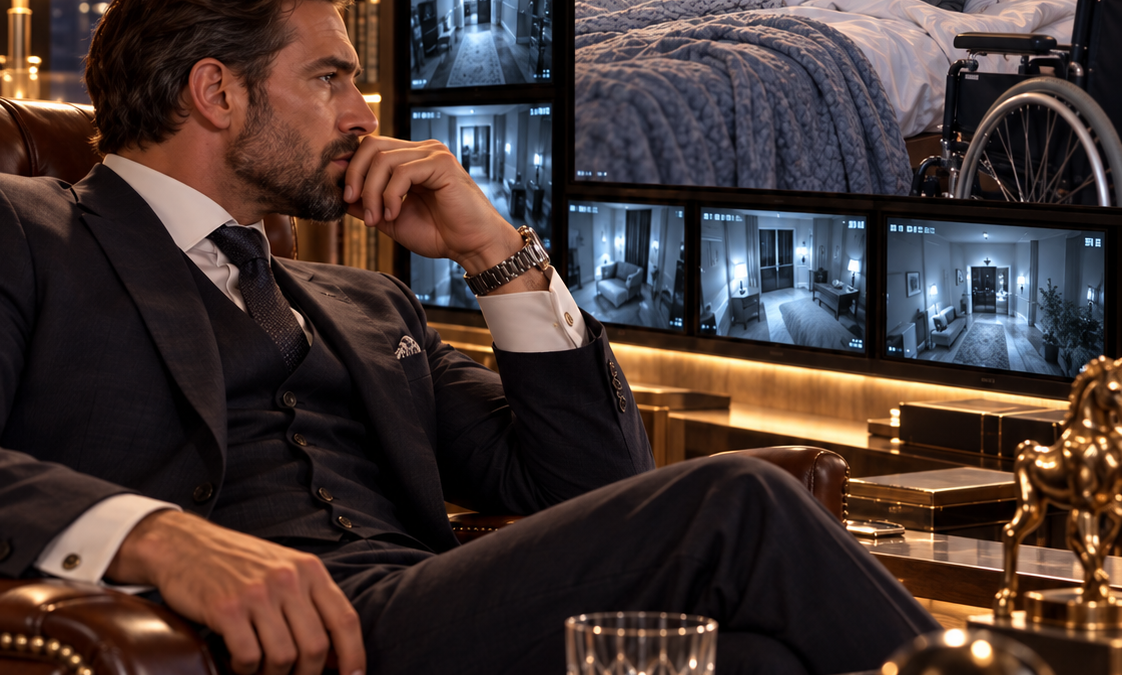
My office held six security monitors.
I could pull any camera feed onto the main screen.
Emma knew the mansion had visible security.
She didn’t know about every hidden camera.
That bothered me less then than it does now.
At the time, privacy was a luxury I believed danger had taken from us.
Morning one.
Breakfast.
Noah sat in his wheelchair beside a plate of eggs, toast, apple slices.
Emma sat across from him drinking coffee.
He didn’t touch the food.
Ten minutes.
Fifteen.
Previous caregivers had begged.
Negotiated.
Cut food into shapes.
Used reward charts.
One woman had actually made airplane noises while moving a spoon toward his mouth.
Noah hated her by lunch.
Emma looked at the clock.
“Not hungry?”
“No.”
“Okay.”
She stood.
His eyes widened.
“You’re not going to make me?”
“Nope.”
“My dad will.”
Emma looked toward the door.
“Your dad isn’t in the room.”
I was watching from upstairs.
Noah stared at his plate.
“The other lady made airplane noises.”
Emma closed her eyes.
“That sounds exhausting.”
A tiny smile appeared.
Then she walked to the counter.
Noah picked up an apple slice.
One bite.
Then another.
He ate half.
I replayed that footage twice.
Morning two.
Emma found him staring through the living-room windows.
A lawn crew was working outside.
Before the bombing, Noah liked following gardeners around asking questions.
Now he rarely went into the yard.
Emma stood beside him.
“Want outside?”
“No.”
“Okay.”
She walked away.
He turned.
“That’s it?”
“What?”
“You aren’t going to tell me fresh air is good for me?”
“No.”
“Why?”
“You already know air exists.”
Noah stared at her.
Then:
“Maybe later.”
“Okay.”
At two-thirty, he asked to go outside.
Emma pushed his chair onto the terrace.
He stayed twelve minutes.
Longest time outside in three weeks.
Day three.
Stretching.
Noah hated therapy more than almost anything.
His muscles tightened because he spent too much time rigid in the chair.
The physical therapist had warned about contractures.
But Noah associated stretching with pain.
Loss.
Adults manipulating legs he could no longer feel normally.
Emma placed him on the therapy bed.
“Left leg.”
“No.”
“Okay.”
He looked suspicious.
“Okay?”
“Which one first?”
“Neither.”
“That’s not one of the legs.”
No response.
Emma sat.
“Right or left.”
“Noah.”
Silence.
“Your body.”
“Your choice.”
I leaned closer to the monitor.
No caregiver had said that.
Eventually:
“Left.”
Emma supported his knee.
Slowly bent it.
His fingers tightened around the sheet.
She stopped immediately.
“Pain?”
“No.”
“Fear?”
He glared.
Emma waited.
Then he whispered:
“I hate it.”
“What?”
“Everything.”
Emma’s face softened.
She did not touch him.
“That’s allowed.”
Noah looked at her.
“Dad says I’m supposed to fight.”
My chest tightened.
Emma said:
“You can fight tomorrow.”
“Today you can hate it.”
He turned his face away.
I couldn’t see his expression.
Emma waited.
After almost a minute:
“Do it.”
“What?”
“Stretch.”
“Sure?”
“Yes.”
She continued.
That session lasted forty-seven minutes.
No screaming.
No refusal.
At the end, Noah looked exhausted.
Emma put his socks back on.
He asked:
“Are you coming tomorrow?”
She smiled.
“If your dad hasn’t fired me.”
My son said:
“He won’t.”
I sat in my office staring at the screen.
I wanted to know how Noah could be so certain.
Then he added:
“He watches everything.”
Emma’s hands paused.
I froze.
She looked around the room.
Not directly at the camera.
“Does he?”
Noah nodded.
“Cameras.”
“Everywhere.”
Emma didn’t look surprised.
That bothered me.
She asked:
“How do you feel about that?”
Noah shrugged.
“Dad thinks everyone wants to kill us.”
My jaw tightened.
Emma said:
“Does everyone?”
“Probably.”
I almost laughed despite myself.
My son knew the family business better than I wished.
Emma said:
“I don’t.”
Noah looked at her.
“Want to kill you.”
She clarified.
“Good.”
“Thanks.”
Then:
“I do want to beat you at cards.”
“No chance.”
“Tomorrow.”
“Fine.”
They played three games the next afternoon.
Noah cheated twice.
Emma caught him once.
He laughed.
Actually laughed.
The sound came through the monitor speakers.
I hadn’t heard it in months.
I turned the volume higher.
Dominic entered my office while Noah was laughing.
He stopped.
Looked at the monitor.
Then at me.
“That’s new.”
“Yes.”
“She’s good.”
“Maybe.”
Dominic knew me well enough not to argue.
He had worked for me twelve years.
Former Marine.
Forty-seven.
Calm under pressure.
The kind of man who could tell me something I didn’t want to hear and survive.
He said:
“You still looking into her gap?”
“Yes.”
“Found anything?”
“Not enough.”
Her employment history stopped two years earlier.
Before that, excellent references.
Children’s rehabilitation center in Boston.
Home-care cases.
Mobility training.
Trauma support.
Then nothing.
No arrests.
No financial disasters.
No suspicious travel.
No connection to rival families.
Nothing.
That should have reassured me.
Instead, missing information bothered me more than bad information.
I told Dominic:
“Find out.”
He nodded.
Then looked at the monitor again.
Noah had dealt a card to Emma.
She accused him of stacking the deck.
He said:
“Prove it.”
Dominic smiled.
“Maybe don’t scare her away before she fixes what money couldn’t.”
I looked at him.
“Careful.”
He nodded.
“Always.”
That night, Emma ate dinner with Noah in his room.
Not because she was scheduled.
She was supposed to leave at seven.
At six-forty-five, Noah had a bad muscle spasm.
Then refused dinner.
Emma stayed.
At eight-thirty, I entered his room personally.
Emma was reading from a ridiculous adventure book.
Noah’s eyes were closed.
I assumed he was asleep.
Then:
“Don’t stop.”
Emma glanced at me.
Continued reading.
I stood near the door.
Noah finally drifted off around nine.
Emma closed the book.
I followed her into the hallway.
“You worked an extra two hours.”
“Yes.”
“Submit overtime.”
“No.”
I frowned.
“Why?”
“I stayed because he asked.”
“You still get paid.”
“Fine.”
She started walking.
“Emma.”
She stopped.
“You’re getting results.”
“Don’t say that.”
“What?”
“Results.”
“He’s not a quarterly report.”
I felt irritation rise.
“You correct me a lot.”
“You give me plenty of opportunities.”
I stepped closer.
Most people moved away when I did that.
Emma didn’t.
“You’re in my house.”
“Yes.”
“My rules.”
“Regarding security?”
“Yes.”
“Employment?”
“Yes.”
“Your son?”
I stared.
She continued:
“No.”
“Not completely.”
“You’re his father.”
“You’re responsible.”
“But Noah gets a vote.”
“He’s eight.”
“He’s also the one living in that body.”
For several seconds, neither of us spoke.
Then she picked up her bag.
“Good night, Vincent.”
Nobody called me Vincent in my house except Dominic and Caroline.
I should have corrected her.
I didn’t.
At 11:43, Noah had his first nightmare.
I knew because the motion sensor triggered on my phone.
I opened the camera.
He was awake.
Breathing hard.
Looking toward the door.
He didn’t call anyone.
Didn’t press the bedside alert.
After five minutes, he lay back down.
At 12:20, he woke again.
Same thing.
At 1:08.
Again.
I almost went in.
Then stopped.
For months, every time Noah woke screaming, I rushed to him.
Eventually he started hiding his nightmares.
The grief therapist said he might be trying to protect me.
An eight-year-old protecting his father.
Failure has many forms.
At 2:51, I was still awake in my office.
The bombing had destroyed my sleep too.
I worked nights.
Read intelligence.
Reviewed security reports.
Watched cameras.
At 3:11, movement appeared in the east hallway.
Emma.
I sat upright.
She wasn’t supposed to be there.
Her shift had ended hours earlier.
Then I remembered she’d agreed to stay overnight because the regular night aide had called in sick.
I hadn’t liked it.
Noah had.
So I allowed it.
Emma walked barefoot down the hallway wearing gray sweatpants and a long-sleeved shirt.
She carried nothing.
She stopped outside Noah’s bedroom.
Didn’t knock.
Opened the door slowly.
My body went rigid.
I changed the camera feed.
Noah lay still.
Emma crossed the room.
Then did something I did not understand.
She climbed into my son’s bed.
Not sitting beside him.
Onto the mattress.
She lay down behind him.
Every protective instinct I had exploded.
My hand reached into the desk drawer.
Gun.
I stood.
Then Noah screamed.
The sound came through the speakers so suddenly I nearly dropped the weapon.
“No!”
Emma wrapped her arms around him.
Not restraining.
Holding.
His upper body twisted.
He couldn’t move his legs.
His hands clawed at her sleeves.
“NO! MOM!”
I stopped.
Mom.
Noah hadn’t said that word during a nightmare in months.
Emma held him tighter.
“I know.”
“No!”
“I know, Noah.”
“She’s in the car!”
My breath disappeared.
He was back there.
The bombing.
Noah had been conscious after the blast.
I didn’t know how much he remembered.
Therapists had tried.
He refused to discuss it.
Emma whispered:
“Where are you?”
“In the car!”
“What can you see?”
“Fire!”
My hand tightened around the gun.
I wanted to run upstairs.
Emma said:
“Listen to me.”
Noah sobbed.
“She’s not moving!”
“Listen to my voice.”
“No!”
“Your name is Noah Calder.”
His breathing broke.
“You are eight years old.”
“Your bedroom is blue.”
“You have a terrible dinosaur lamp.”
Noah gasped.
“M-Mom—”
“Your dad is downstairs.”
I froze.
“Dominic is probably awake because Dominic never sleeps.”
Even in terror, something in Noah’s face changed.
Emma continued:
“You are not in the car.”
“You’re in your bed.”
“You are safe right now.”
Noah shook violently.
“I left her.”
The words nearly put me on my knees.
Emma whispered:
“You didn’t leave her.”
“I couldn’t move.”
“Noah.”
“I couldn’t get her!”
“You were eight.”
“I should’ve—”
“No.”
Emma’s voice changed.
Firm.
“You do not get to blame an eight-year-old boy for surviving a bomb.”
Noah sobbed.
“She called my name.”
My gun lowered slightly.
Emma held him.
“She was scared.”
“I couldn’t move.”
“That wasn’t your fault.”
“She died.”
“I know.”
“Dad didn’t save her.”
I closed my eyes.
There it was.
The sentence I had been saying to myself for fourteen months, now coming from my child.
Emma said:
“Your dad couldn’t.”
“He’s supposed to.”
“He’s my dad.”
I leaned against the desk.
Emma’s face rested against Noah’s hair.
“Dads can’t stop everything.”
Noah cried harder.
“He thinks he can.”
I almost laughed.
Almost.
Emma said:
“Yeah.”
“He definitely thinks that.”
My hand came off the gun.
I set it on the desk.
Noah’s breathing remained ragged.
Emma started doing something strange.
She hummed.
A simple melody.
Three notes.
Then five.
I knew it.
Caroline used to sing it.
Not a real song.
Something she made up when Noah was a baby because she couldn’t remember lullaby lyrics.
My body went cold.
How did Emma know that?
Noah froze too.
His sobbing slowed.
Emma continued humming.
Noah whispered:
“Mom’s song.”
“Yes.”
“How do you know?”
Emma stopped.
For the first time that night, fear crossed her face.
Not fear of Noah.
Fear of the question.
Then she said:
“You sang it yesterday.”
Noah frowned.
“No, I didn’t.”
Emma swallowed.
“You were humming during therapy.”
He stared at her.
I stared at the monitor.
Had he?
I replayed yesterday in my mind.
I hadn’t noticed.
Noah whispered:
“Mom sang it.”
Emma nodded.
“I guessed it meant something.”
Then:
“Want me to stop?”
“No.”
She started again.
Noah’s breathing gradually slowed.
His hands released her sleeves.
His head rested against her shoulder.
Within fifteen minutes, his eyes closed.
Emma remained.
One arm around him.
Nothing inappropriate.
Nothing threatening.
Just a woman holding a frightened child whose father had installed enough security equipment to protect a small country but had never discovered that what Noah needed at three in the morning was permission to say:
I couldn’t save Mom.
I sat back down.
The gun remained on the desk.
For the first time that night, I saw the monitor differently.
I wasn’t watching a security breach.
I was watching something I had no idea how to give my own son.
Comfort without trying to fix him.
At 4:06, Emma carefully slid out of the bed.
She adjusted Noah’s blanket.
Then looked directly toward the hidden camera.
Directly.
Not approximately.
At it.
My entire body tensed.
Emma stared into the lens for three seconds.
Then raised one eyebrow.
And walked out.
She knew.
At seven-thirty, she entered my office without knocking.
Dominic was already there.
I said:
“You knew about the camera.”
Emma put down her coffee.
“Eventually.”
“How?”
“There’s a reflection at night from the sensor.”
Dominic muttered something under his breath.
I looked at him.
“We’ll fix that.”
Emma said:
“No.”
Both of us looked at her.
She continued:
“You won’t.”
“Excuse me?”
“You’re removing the camera from Noah’s bedroom.”
Dominic became very still.
I said:
“No.”
Emma pulled out the chair.
Sat.
“Then I quit.”
I stared at her.
“You don’t dictate security in my house.”
“And you don’t secretly watch an eight-year-old change clothes, cry, sleep, and have nightmares.”
“The camera protects him.”
“From whom?”
“Everyone.”
“Including him?”
My jaw tightened.
“You entered his bed at three in the morning.”
“Yes.”
“With no authorization.”
“He was having a trauma episode.”
“You could have called me.”
Emma laughed once.
Not kindly.
“That is exactly what he didn’t need.”
Anger rose.
“He’s my son.”
“Yes.”
“And he thinks he has to protect you from hearing what happened.”
That stopped me.
Emma leaned forward.
“Do you know why he doesn’t talk?”
“Trauma.”
“No.”
“That’s part of it.”
“He doesn’t talk because every adult in this house reacts like every word is an emergency.”
“You tense.”
“The therapists analyze.”
“Dominic calls security when he hears a door slam.”
Dominic said:
“That’s my job.”
Emma looked at him.
“I know.”
Then back to me.
“Noah has figured out silence is the only thing that doesn’t create consequences.”
I said nothing.
She continued:
“Last night he talked because he thought I wasn’t going to break.”
“He talked because he was half asleep.”
“Maybe.”
“But he talked.”
I looked away.
Emma said:
“He believes he failed his mother.”
My throat tightened.
“I heard.”
“He believes you failed her too.”
“I heard.”
“And he thinks you believe the same thing.”
I looked at her.
She held my gaze.
“Do you?”
The room became silent.
Dominic shifted.
I said:
“This conversation is over.”
Emma stood.
“Then I’m done.”
She picked up her bag.
Noah had almost smiled after months.
Had eaten.
Gone outside.
Cooperated with therapy.
Slept after saying words nobody had managed to pull from him for a year.
And this woman was about to walk out because I refused to remove one camera.
Fear told me:
Let her leave.
Control told me:
Nobody sets conditions.
Something quieter said:
Caroline would hate what you’ve become.
“Wait.”
Emma stopped.
I looked at Dominic.
“Remove the bedroom camera.”
He stared.
“Boss?”
“Today.”
Emma turned back.
“And the bathroom?”
“No cameras in bathrooms.”
“Good.”
“Therapy room stays.”
“Visible camera.”
“No.”
“Then tell Noah where it is.”
I almost snapped.
Then stopped.
“Fine.”
Emma nodded.
“Hallways?”
“They stay.”
“Entrances?”
“Obviously.”
“Bedroom camera gone?”
“Yes.”
“Good.”
She sat back down.
I stared.
“You’re staying?”
“You agreed.”
“That was blackmail.”
“That was a boundary.”
Dominic coughed to hide a laugh.
I glared at him.
He became professionally fascinated by the wall.
Then I looked at Emma.
“How did you know what to do last night?”
Her expression changed.
There.
The missing two years.
I said:
“Now you’re going to explain.”
Emma looked toward the window.
“No.”
“Emma.”
“No.”
“You’re caring for my son.”
“And doing it well.”
“I need to know who you are.”
“You know enough.”
“No.”
Something in my tone finally affected her.
Not fear.
Pain.
Her fingers tightened around her mug.
Then:
“My younger brother was injured in a car accident.”
I waited.
“His name was Evan.”
“Was?”
Emma’s eyes lowered.
“He died two years ago.”
The room changed.
“How old?”
“Twenty-seven.”
“What happened?”
“Spinal cord injury.”
I understood immediately.
“Paralyzed.”
“Yes.”
“For how long?”
“Three years.”
“And you stopped working to care for him.”
“Yes.”
The missing employment gap.
I felt ashamed of every suspicion I’d attached to it.
Emma continued:
“He lived with me.”
“My parents weren’t capable.”
“He had a high cervical injury.”
“Different from Noah.”
“Much more dependent.”
“Ventilator at first.”
“Then not.”
“He hated being treated like a patient.”
“So I learned.”
“Transfers.”
“Skin checks.”
“Range of motion.”
“Autonomic dysreflexia.”
“Pressure relief.”
“But mostly…”
She stopped.
“Mostly what?”
“How to shut up.”
I frowned.
Emma smiled sadly.
“Everyone wanted Evan to inspire us.”
“Doctors wanted compliance.”
“Friends wanted courage.”
“My mother wanted miracles.”
“I wanted my brother back.”
“And he wanted permission to be furious.”
My chest tightened.
“What killed him?”
“Pneumonia.”
She said it simply.
“Complication.”
“I was there.”
“I held him.”
Then she looked at me.
“After he died, I couldn’t work in rehabilitation anymore.”
“For two years.”
“Yes.”
“Why now?”
She looked toward the hallway.
“Noah.”
“You hadn’t met him.”
“I read the job posting.”
“What about it?”
“It said:
‘Child withdrawn after traumatic spinal cord injury. Family seeks disciplined caregiver capable of enforcing rehabilitation schedule.’”
I knew the wording.
My assistant wrote it.
Emma smiled without humor.
“I hated every word.”
“So you applied?”
“Yes.”
“That makes no sense.”
“It made perfect sense.”
“I thought maybe whoever wrote that needed someone to remind them the patient was a child.”
I almost smiled.
Then:
“Why didn’t you tell me about Evan?”
“Because grief isn’t a qualification.”
“No.”
“But experience is.”
“Maybe.”
“I didn’t want you hiring me because you thought I had a tragic backstory that matched Noah.”
That I understood.
Too well.
Emma stood.
“Now you know.”
“Does Noah?”
“No.”
“Will you tell him?”
“If it helps.”
“Not because we’re collecting sad stories.”
She picked up her coffee.
Then stopped.
“One more thing.”
“What?”
“Your gun.”
Every muscle tightened.
“How do you know?”
“You were holding it when you came halfway down the hall last night.”
I stared.
I hadn’t realized she saw me.
After setting it down, I had gone upstairs.
I stopped outside Noah’s door.
Emma had opened it slightly.
Seen me.
“Why didn’t you say anything?”
“Because you put it away.”
Her voice hardened.
“If you ever enter that child’s room armed during one of his nightmares, I am leaving.”
I felt anger.
Then shame.
“I wasn’t going to hurt him.”
“I know.”
“Or you.”
“I know.”
“Then—”
“Guns change rooms.”
She said it calmly.
“Your son already survived an explosion.”
“He doesn’t need to wake from one nightmare and find another kind of danger standing in the doorway.”
I didn’t like hearing it.
That didn’t make her wrong.
“Fine.”
Emma nodded.
Then left.
Dominic waited ten seconds.
Then:
“I like her.”
“Don’t.”
“I do.”
“Remove the camera.”
“Yes, boss.”
“And fix the sensor reflections on the others.”
He smiled.
“Immediately.”
Over the next two weeks, something changed in the mansion.
Not dramatically.
Noah didn’t suddenly become the child he’d been before.
That child was gone.
Emma understood that before I did.
She wasn’t trying to return him to “normal.”
She was helping him build a life inside what existed now.
One morning, she brought a basketball into the therapy room.
Noah stared.
“What am I supposed to do with that?”
“Basketball.”
“I can’t run.”
“I noticed.”
He glared.
Emma bounced it.
“Wheelchair basketball exists.”
“That’s stupid.”
“Probably.”
“You haven’t tried.”
“Neither have you.”
He threw the ball at her.
She caught it.
“Good pass.”
He looked furious.
Then interested.
The next day, a sports wheelchair appeared.
I had not bought it.
Emma had borrowed it from a rehabilitation center.
Noah refused to sit in it.
Emma left it in the corner.
Three days later, I watched him roll over and touch the wheel.
A week later, he tried it.
He hated it.
Then tried again.
That became our new rhythm.
Not breakthroughs.
Attempts.
His nightmares continued.
But now he talked about them.
Sometimes with Emma.
Occasionally with his therapist.
Never with me.
That hurt.
I tried not to make it about myself.
One evening, I sat beside him after dinner.
No television.
No paperwork.
No questions.
Noah looked at me.
“Why are you here?”
“I live here.”
“You don’t sit here.”
Fair.
“I thought I would.”
He stared at the window.
Five minutes.
Ten.
Then:
“Emma says you’re scared.”
I almost laughed.
“Emma talks too much.”
“She says you think cameras make bad things not happen.”
I looked at him.
“What do you think?”
“They didn’t stop Mom.”
No.
They hadn’t.
The bomb had gone under the SUV despite drivers, guards, route checks, cameras, armor.
Somebody had gotten through.
I said:
“No.”
“They didn’t.”
Noah looked at his hands.
“Do you know who did it?”
There was the question.
The one I had kept away from him.
“Yes.”
“Are they dead?”
I didn’t answer immediately.
He looked at me.
“Dad.”
“Yes.”
“Did you kill them?”
Children raised around men like me learn questions other children don’t.
I said:
“The people responsible cannot hurt you.”
“That isn’t what I asked.”
I closed my eyes.
Emma would have been proud of him.
“I made sure they couldn’t hurt us again.”
Noah stared.
Then:
“Did that make Mom come back?”
The question hit like a bullet.
“No.”
“Did it make my legs work?”
“No.”
“Then why?”
Because revenge was the only language I’d known when helplessness became unbearable.
Because I needed someone to pay.
Because killing enemies was easier than sitting beside my son and admitting I couldn’t repair him.
I said none of that.
Instead:
“Because I was angry.”
Noah nodded.
“I’m angry too.”
“I know.”
“Can I kill someone?”
“No.”
He looked at me.
“Why not?”
Despite everything, I nearly laughed.
“Because you’re eight.”
“That’s not a reason.”
“Yes, it is.”
He thought.
Then:
“Emma says being angry doesn’t mean you get to choose what happens to everybody.”
I sighed.
“Emma says a lot of things.”
“She says you don’t like that.”
“Correct.”
Noah smiled.
Small.
Real.
Then:
“Dad?”
“Yes?”
“I remember Mom.”
My chest tightened.
“From the car?”
He nodded.
“You don’t have to tell me.”
Emma had taught me that sentence.
Noah looked surprised.
Then:
“I want to.”
So I listened.
Not correcting.
Not reassuring.
Not saying:
It wasn’t your fault.
Not yet.
He told me the explosion felt like being picked up and thrown.
He remembered Caroline screaming his name.
He remembered smoke.
Glass.
The seat belt trapping him.
His legs not working before he understood what that meant.
He remembered me bleeding.
Trying to reach his mother.
He remembered someone pulling him through a broken door.
Then:
“I saw you go back.”
I stared.
“I couldn’t reach her.”
“I know.”
“You were unconscious later.”
“I know.”
Noah swallowed.
“I thought you left her.”
My breath stopped.
“What?”
“When they carried me away.”
“I couldn’t see you.”
“I thought you left.”
“No.”
My voice broke.
“Noah, I went back.”
“I know now.”
“How?”
“Emma asked what happened after.”
“I remembered.”
Tears blurred my vision.
I had spent fourteen months believing my son blamed himself.
He did.
But he had also carried something else.
He thought I had abandoned Caroline.
“I would never have left your mother.”
“I know.”
“She died before—”
My voice failed.
Noah looked at me.
Then:
“Dad.”
I couldn’t speak.
He reached toward me.
I took his hand.
For the first time since the bombing, I cried in front of my son.
Not silent tears I could hide.
I broke.
Noah watched.
Then said:
“Emma says dads can cry.”
I laughed through it.
“Of course she does.”
“She says you’re bad at it.”
“That also sounds like her.”
He squeezed my fingers.
That night, I didn’t open a single camera feed.
The next morning, Emma found me in the kitchen.
She looked at my face.
“You okay?”
“No.”
“Good.”
I frowned.
“Good?”
“You look like you finally slept badly for an honest reason.”
“What does that mean?”
“You cried.”
I stared.
“How do you know everything?”
“Your eyes are swollen.”
I poured coffee.
“Noah told me about the bombing.”
Emma stopped.
“All of it?”
“Enough.”
“How’d you react?”
“Poorly.”
“Meaning?”
“I cried.”
She nodded.
“That’s not poor.”
“Felt poor.”
“Feelings don’t care.”
I hated when she sounded like a therapist.
“You’re not a psychologist.”
“No.”
“Then stop talking like one.”
“Stop needing one.”
I almost smiled.
Then Dominic entered.
His face told me something was wrong.
The atmosphere changed instantly.
He handed me a folder.
“Boss.”
I opened it.
Photographs.
Vehicle.
License plate.
Man outside the property fence two nights earlier.
Same man near Noah’s rehabilitation center.
My entire body changed.
Emma saw it.
“What?”
“Nothing.”
She laughed once.
“That’s your dangerous voice.”
I looked at Dominic.
“Take this upstairs.”
Emma stepped in front of me.
“What involves Noah?”
“Not your concern.”
“If it involves his safety, it is.”
I wanted to order her away.
Then remembered every conversation about giving Noah agency.
I hated how principles become inconvenient when they apply to you.
I said:
“Someone has been watching the property.”
Emma’s face lost color.
“Connected to the bombing?”
“We don’t know.”
Dominic said:
“We’re checking.”
Emma looked at me.
“What happens now?”
“Security tightens.”
“No outside appointments.”
“Vehicle changes.”
“More men.”
“Noah stays home.”
Emma shook her head immediately.
“No.”
I stared.
“No?”
“You don’t lock him inside.”
“There may be a threat.”
“Then manage the threat.”
“I am.”
“By imprisoning an eight-year-old?”
Anger hit.
“You don’t understand.”
“Then explain.”
“The last time I underestimated danger, my wife died.”
Silence.
Emma’s face softened.
But she didn’t retreat.
“I know.”
“No.”
“You know the sentence.”
“You don’t know what it means.”
She nodded.
“Probably not.”
Then:
“But if every threat means Noah loses more of his life, the people who bombed that car keep taking things from him forever.”
That stopped me.
Dominic looked between us.
Emma continued:
“Make reasonable changes.”
“Escort.”
“Secure transport.”
“Check venues.”
“But don’t teach him that survival means never leaving the house.”
I looked toward the windows.
She was right.
I hated it.
Again.
“We cancel two days.”
Emma considered.
“Two.”
“Then reassess.”
“Fine.”
“I’m not negotiating.”
“Yes, you are.”
I glared.
Dominic said:
“I can build a safer transport plan in forty-eight hours.”
Traitor.
“Fine.”
The suspicious man turned out to be real.
Not an enemy.
A private investigator.
Hired by an insurance company reviewing one of the bombing-related claims connected to the original incident.
Aggressive.
Inappropriate.
But not a murderer.
Dominic handled it through lawyers.
No blood.
No disappearing bodies.
Emma seemed almost disappointed that I could resolve something legally.
“I do have attorneys.”
“I assumed they existed for money laundering.”
I stared.
She smiled.
“Joke.”
“Bad one.”
“Still alive.”
“Barely.”
That was another change.
People started laughing in my house.
Noah first.
Emma.
Dominic occasionally.
Even me.
Months passed.
Noah joined a wheelchair basketball program.
The first practice was a disaster.
He hated the chair.
Hated being the slowest.
Hated people telling him he was doing great when he knew he wasn’t.
Halfway through, he threw the ball and said:
“I’M DONE.”
Every parent in the gym stared.
I started toward him.
Emma blocked me.
“Don’t.”
“He’s upset.”
“Yes.”
“He needs—”
“To choose.”
Noah rolled toward the exit.
Emma waited.
Five minutes later, he came back.
Not because anyone dragged him.
Because another boy named Marcus had shouted:
“Calder, you throw like my grandmother.”
Noah wheeled back in.
“Your grandmother can beat you.”
The coach blew the whistle.
Game on.
By the third week, Noah asked to practice at home.
I paid to have a court adapted in one of the mansion’s unused garages.
Emma found out.
“You built a private court?”
“Yes.”
“He needs teammates.”
“I know.”
“So why?”
“Because I can.”
She stared.
“You are exhausting.”
Still, Noah loved it.
So did the neighborhood kids eventually.
For years, our gates had represented distance.
Security.
Fear.
Under controlled conditions, we began letting children from Noah’s team come over.
Dominic nearly had a heart attack the first Saturday.
Twelve children.
Parents.
Wheelchairs.
Shoes.
Pizza.
Noise.
My house hadn’t sounded like that since before Caroline died.
At one point, I stood in the hallway listening to Noah yell because Marcus had cheated.
Emma came beside me.
“You okay?”
“No.”
She looked worried.
Then I said:
“This is loud.”
She smiled.
“Yes.”
“I missed loud.”
“I know.”
Noah started therapy with a new trauma specialist.
His idea.
Not mine.
He told me after Emma helped him research options.
That annoyed me for about three seconds.
Then I realized he had chosen help.
That mattered more.
His physical prognosis did not suddenly transform.
This is where people always want miracles.
They want the boy to stand.
Move a toe.
Surprise doctors.
Walk across the room while everyone cries.
That didn’t happen.
Noah remained paralyzed.
He became stronger.
More independent with transfers.
Better at managing his chair.
Learned his body’s signals.
Built upper-body strength.
Improved balance.
But he did not walk.
And eventually I stopped treating walking as the only ending worth wanting.
Emma helped with that too.
One afternoon, I heard her tell him:
“Your life is not a waiting room for walking.”
I stopped outside the therapy room.
Noah said:
“But Dad keeps asking doctors.”
“He’s your dad.”
“He’d ask God for a second opinion.”
I laughed before I could stop myself.
Emma turned.
“You’re eavesdropping.”
“My house.”
“Bad excuse.”
Noah looked at me.
“Are you still trying to fix my legs?”
The question was direct.
I entered.
Sat beside him.
“I’ll never stop looking at medical options.”
His face fell.
I continued:
“But I’m not waiting for them to start your life.”
He watched me.
Then nodded.
That answer passed.
Barely.
The real problem came six months after Emma arrived.
Not from an enemy.
Not from security.
From her.
She resigned.
She placed an envelope on my desk at eight in the morning.
I looked at it.
Then at her.
“No.”
She blinked.
“You haven’t read it.”
“No.”
“Vincent.”
“No.”
“You can’t refuse a resignation.”
“Watch me.”
She folded her arms.
“I’ve been offered a position.”
“Pay them more.”
“Not about money.”
“Then what?”
“A pediatric rehabilitation program in Providence.”
“Fine.”
“You can work there part-time.”
“And here?”
“Yes.”
She stared.
“You are unbelievable.”
“That’s been established.”
Then:
“Why?”
I asked.
Her expression softened.
“Because I’m ready to go back.”
I understood.
Evan.
The two-year gap.
Noah had brought her back into the work she’d abandoned.
I should have been happy.
Instead, anger rose.
“You’re leaving him.”
There it was.
Emma’s face hardened.
“No.”
“You’re leaving.”
“Those are different sentences.”
“Noah trusts you.”
“Yes.”
“He depends on you.”
“That’s why I have to change the relationship.”
I stared.
She continued:
“If Noah believes safety depends on me being in this house every day, I’ve failed him.”
“He has other caregivers.”
“He has you.”
“Dominic.”
“His therapist.”
“His team.”
“Friends now.”
“He doesn’t need me twelve hours a day anymore.”
I hated every word because they were true.
Then something worse occurred to me.
“Does Noah know?”
“Yes.”
“You told him before me?”
“Obviously.”
My hand hit the desk.
Not hard.
Emma didn’t move.
“What did he say?”
“He was angry.”
“Good.”
“He called me selfish.”
“Smart boy.”
“Then he asked whether I was still coming to his games.”
I said nothing.
Emma smiled.
“I said yes.”
“How often will you work here?”
“Two afternoons a week for the first month.”
“Then one.”
“Then as needed.”
I felt abandoned.
That realization embarrassed me.
Not Noah.
Me.
Emma had become part of the architecture of the house.
Her coffee in the kitchen.
Her arguments.
Her bag near the stairs.
Her voice telling me when I was being controlling.
The thought of her leaving felt like losing another person.
I said:
“You could have told me.”
“I am telling you.”
“Earlier.”
“Why?”
“So I could prepare.”
Emma looked at me for a long time.
Then:
“That’s what Noah said.”
I almost smiled.
“Maybe we’re related.”
“Unfortunately.”
She turned toward the door.
“Emma.”
She stopped.
“I’m proud of you.”
The words felt strange.
Her face changed.
“Thank you.”
Then she left my office.
Noah handled the transition better than I did.
Of course.
He was angry for three days.
Then he started making a calendar.
Emma’s hospital shifts.
Her visits.
Games.
He liked knowing when she would come back.
No mystery.
No disappearance.
That was important.
People leaving had become connected to death in his mind.
Emma taught him that leaving could also mean returning Thursday at four.
Simple.
Revolutionary.
I learned the same thing.
The house settled into a new rhythm.
Noah had two regular aides.
He rejected three candidates before choosing them himself.
I let him.
One was a nursing student named Miguel.
The other was a retired pediatric nurse named Joanne, who immediately terrified Dominic and therefore earned my respect.
Emma continued visiting.
Not as an employee eventually.
That transition happened quietly.
One afternoon, she arrived with pizza instead of medical supplies.
I said:
“You’re not working today.”
“No.”
“Then why are you here?”
“Noah invited me.”
“My son invites people to my house now?”
“Yes.”
“Dangerous trend.”
She looked at me.
“Do you want me to leave?”
“No.”
The answer came too fast.
Emma noticed.
So did I.
Something had been building between us for months.
I refused to name it.
Not because I didn’t feel it.
Because Caroline had been dead less than two years.
Because Emma had entered my life as my son’s caregiver.
Because power complicates everything.
Because I didn’t trust myself to know whether I wanted Emma or simply wanted the safety she had somehow brought into the house.
So I did nothing.
That was unusual for me.
Probably healthy.
Then Noah ruined everything.
We were eating dinner.
Emma had stayed.
Noah looked between us.
Then said:
“You two are weird.”
I put down my fork.
“What?”
“You like each other.”
Emma choked on water.
I said:
“Eat.”
“You do.”
“Not relevant.”
“You stare at her.”
I glared.
“Noah.”
Emma was trying not to laugh.
He pointed at her.
“She stares at you too.”
“I do not.”
“You do.”
“Eat your carrots.”
“I hate carrots.”
“Then stop talking and hate them.”
Noah smiled.
“See?”
“Married already.”
I nearly dropped my glass.
Emma said:
“Okay.”
“Bedtime.”
“It’s six-thirty.”
“Early bedtime.”
“You can’t punish me for being observant.”
I looked at Dominic standing near the dining-room entrance.
He was openly smiling.
“Leave.”
“Yes, boss.”
Traitors everywhere.
After Noah went upstairs, Emma helped carry dishes to the kitchen.
We stood beside the counter.
Awkward.
I had negotiated multimillion-dollar criminal arrangements with less discomfort.
Emma finally said:
“He’s eight.”
“Nine now.”
“Right.”
“He’s nine.”
“He’s also nosy.”
“He’s correct.”
I looked at her.
Emma stopped moving.
I said:
“He’s correct.”
Silence.
Then:
“Vincent.”
“I don’t know what I’m doing.”
That might have been the most honest sentence I’d said to a woman since Caroline died.
Emma looked down.
“Good.”
I frowned.
“You like me confused?”
“A little.”
Then she became serious.
“I don’t know either.”
“I was your employee.”
“Not anymore.”
“You’re Noah’s caregiver.”
“Not anymore.”
“You’re still part of his support team.”
“Yes.”
“This could hurt him.”
“Yes.”
“We don’t do that.”
“No.”
I nodded.
“Then nothing happens.”
Emma stared.
“You make everything sound like a contract.”
“It helps.”
“It doesn’t.”
“What do you suggest?”
“Time.”
I hated the answer.
Of course she chose it.
So we took time.
Months.
No secret affair.
No dramatic kiss in the hallway.
No using Noah as an excuse to see each other.
Emma worked at the rehabilitation program.
I rebuilt parts of my business to spend more time home.
That was not noble.
Caroline had asked me to do it for years.
I had always said:
Soon.
After the next problem.
After the next expansion.
After one more enemy.
Then she died.
Regret is expensive.
I reduced operations.
Moved some legitimate businesses forward.
Cut ties with ventures that kept dragging violence toward the family.
Dominic handled the transition.
One night, he sat in my office.
“You’re changing.”
“Don’t start.”
“Caroline would’ve liked it.”
That stopped me.
“I should’ve done it when she was alive.”
“Yes.”
I looked at him.
“You could lie.”
“You don’t pay me for that.”
“Apparently I do.”
He smiled.
Then:
“Guilt isn’t loyalty.”
“What?”
“Destroying the rest of your life doesn’t prove you loved your wife.”
I stared.
“Emma tell you that?”
“No.”
“I’m capable of wisdom occasionally.”
“Rare.”
He left.
I sat alone for a long time.
A year after Emma first walked into my office, Noah had another nightmare.
3:17 A.M.
Almost exactly.
I woke because my phone buzzed.
Not a camera.
Noah’s bedside alert.
I walked to his room.
Unarmed.
Door open.
He was awake.
Breathing fast.
I sat beside the bed.
“Want Emma?”
He shook his head.
“No.”
“Want me to leave?”
“No.”
“Okay.”
I waited.
Then he said:
“Car again.”
I nodded.
“What do you need?”
He thought.
“Mom’s song.”
My throat tightened.
I couldn’t sing.
Caroline used to tease me about it.
Noah knew.
He smiled slightly.
“You’re terrible.”
“I know.”
“Do it anyway.”
So I hummed.
Three notes.
Then five.
Wrong key.
Probably wrong rhythm.
Noah corrected me twice.
Eventually his breathing slowed.
He closed his eyes.
Before falling asleep, he whispered:
“You’re getting better.”
“At singing?”
“No.”
I knew what he meant.
I sat there until morning.
That was the night I realized Emma had given Noah something money never had.
Not independence.
He was building that himself.
Not courage.
He already had it.
Permission.
Permission to be angry.
Afraid.
Disabled.
A child.
Permission to need someone without becoming weak.
And somehow, while teaching him, she had taught me too.
Three months later, I asked Emma to dinner.
Not in my house.
Not with Noah.
Not as employer.
Not as caregiver.
I called.
“Dinner.”
“Is that an order?”
“No.”
“Good start.”
“Would you like to have dinner with me?”
“Why?”
I almost hung up.
“Emma.”
“I’m asking.”
“Because I like you.”
Silence.
Then:
“That must’ve hurt.”
“More than you know.”
She laughed.
“Yes.”
Dinner was terrible.
Not because of her.
Because I had forgotten how to date.
I had drivers.
Reservations.
Private room.
Emma arrived and said:
“Absolutely not.”
“What?”
“Private room?”
“Yes.”
“No.”
“Why?”
“Because I am not eating dinner in what looks like a hostage negotiation suite.”
We moved to the main dining room.
She ordered pasta.
I ordered steak.
She told me my shoes were too expensive.
I told her her bag was falling apart.
She said Evan gave it to her.
I apologized.
She said:
“Don’t.”
Then told me stories about him.
Not his injury.
Him.
He loved terrible horror movies.
Could repair anything electronic.
Cheated at board games.
Called Emma “Em” only when he wanted something.
She laughed while talking.
Then cried once.
Wiped it away.
Continued.
I told her about Caroline.
Not the bombing.
Her.
Caroline sang badly on purpose.
Loved thunderstorms.
Hated expensive restaurants despite marrying me.
Used to hide my cufflinks when I worked too late.
Emma smiled.
“What would she think of me?”
That question scared me.
I answered honestly.
“She’d probably like you more than me.”
“Reasonable woman.”
We kept seeing each other.
Slowly.
Noah noticed immediately.
He became unbearable.
“Date?”
“Yes.”
“Kiss?”
“None of your business.”
“So yes.”
“Noah.”
“Emma likes you.”
“Eat.”
He laughed.
The first time I kissed Emma happened six weeks later outside her apartment.
No security team in the room.
No son.
No emergency.
Just two adults.
I asked.
She smiled.
“Look at you learning consent.”
Then kissed me first.
I laughed against her mouth.
It felt strange.
Good.
Terrifying.
I went home afterward and stood in front of Caroline’s photograph.
Not because I believed I had betrayed her.
Because part of me still expected guilt to arrive like punishment.
It did.
Then passed.
I touched the photograph.
“I miss you.”
Both things could be true.
I could love someone dead.
And someone living.
Grief doesn’t obey replacement logic.
Noah understood before I did.
One afternoon, he asked:
“Are you going to marry Emma?”
“We’ve been dating two months.”
“So?”
“So no.”
“Eventually?”
“I don’t know.”
He thought.
“Mom would like her.”
I looked at him.
“How do you know?”
“She doesn’t treat me weird.”
Caroline would’ve liked that.
Then he said:
“But Emma can’t be Mom.”
“I know.”
“Good.”
Simple boundary.
Important.
Emma never tried.
She didn’t remove Caroline’s photographs.
Didn’t become “new Mom.”
Didn’t ask Noah to call her anything except Emma.
At Christmas, she helped him choose flowers for Caroline’s grave.
Then waited in the car while Noah and I visited.
When we returned, Noah asked:
“Why didn’t you come?”
Emma said:
“That time was yours.”
He nodded.
Then later, on his own, asked if she wanted to go next time.
That’s how families change.
Not through declarations.
Through invitations.
My enemies didn’t disappear because I became emotionally healthier.
Life isn’t that generous.
There were still threats.
Still business problems.
Still consequences from the world I’d built.
But I changed how those problems entered the house.
No meetings beside Noah’s therapy.
No guns left accessible.
No violent conversations within earshot.
Security became quieter.
More professional.
Less like fear wearing a suit.
Dominic approved.
Mostly.
We moved one year later.
Not because the mansion was unsafe.
Because Noah hated it.
Too many memories.
Too many hallways built for a running child.
Too many cameras.
We bought a smaller coastal property near Newport.
Still large by normal standards.
I’m not pretending I became modest.
But accessible.
Single-level sections.
Wide halls.
An elevator.
Adapted bathroom.
Outdoor paths Noah could use independently.
Before renovations, I asked him:
“What do you want?”
He stared.
“Nobody asks kids about architecture.”
“I am.”
He thought.
“Kitchen counters I can reach.”
Done.
“Desk looking at the water.”
Done.
“No camera in my bedroom.”
That one hurt.
I smiled.
“Done.”
“Can Marcus stay over?”
“Who’s Marcus?”
He stared.
“Basketball.”
“Right.”
I knew exactly who Marcus was.
He smiled.
“Done.”
Then:
“Emma room?”
I nearly choked.
Emma said:
“Noah.”
“What?”
“She needs one if she’s here.”
I looked at her.
She looked at me.
Eventually:
“Guest room.”
Noah rolled his eyes.
Children hate slow adults.
Emma moved in eighteen months after our first date.
Her own decision.
No pressure.
Noah was ten.
By then, he could transfer himself from chair to bed most days.
His basketball team had won exactly two games all season.
They celebrated like champions.
He had friends.
Homework.
Bad moods.
A crush on a girl named Ava that he denied so aggressively it confirmed everything.
He was living.
Not waiting.
That’s what mattered.
I proposed to Emma near the water.
No restaurant.
No diamonds hidden in food.
I asked while she was wearing an old sweatshirt and yelling at me because I had bought Noah another wheelchair without consulting his physical therapist.
Romantic.
“Emma.”
“What?”
“Marry me.”
She stopped.
“What?”
“I said marry me.”
“You’re changing the subject.”
“Yes.”
“Vincent.”
“I have a ring.”
“You had a ring while we were arguing about wheelchair positioning?”
“I’ve had it three weeks.”
She stared at me.
Then started crying.
I panicked.
“Is that no?”
“You’re an idiot.”
“Is that no?”
She laughed.
“Yes.”
My heart stopped.
“Yes no?”
“Yes yes.”
I had negotiated with men holding guns and felt calmer.
She wore the ring.
Then continued arguing about the wheelchair.
Marriage did not improve her respect for my authority.
Good.
We married quietly.
No criminal spectacle.
No hundred-person ballroom.
No business alliances disguised as guests.
No press.
Dominic stood beside me.
Noah was my best man.
He insisted.
He was eleven.
Emma’s parents came.
A few friends.
Lena from the rehabilitation program.
Dr. Sanchez, Noah’s therapist.
Marcus’s family.
Maybe forty people.
Before the ceremony, Noah rolled beside me.
“You nervous?”
“No.”
“Liar.”
“Go away.”
He grinned.
Then became serious.
“Dad?”
“Yes?”
“You happy?”
I looked toward Emma.
“Yes.”
“Good.”
Then:
“Mom would want that.”
I couldn’t speak for a second.
He rolled away before I could embarrass him.
Emma and I didn’t have more children.
Not because we decided immediately.
Life decided partly for us.
She was thirty-eight by the time we married.
We discussed it.
Considered.
Then chose not to pursue treatment when pregnancy didn’t happen naturally.
No tragedy.
No replacement child.
Noah was enough.
Our life was enough.
He grew.
That surprised me most.
When your child almost dies at eight, part of you freezes him there.
I kept seeing the little boy in the hospital bed even as his shoulders broadened.
Thirteen.
Fifteen.
Sixteen.
He became taller than Emma while sitting.
Developed my sarcasm and Caroline’s compassion.
Terrible combination.
He played wheelchair basketball through high school.
Not professionally.
Not inspirationally.
He was good.
Then interested in something else.
Engineering.
Specifically adaptive design.
He wanted to build better mobility equipment.
At seventeen, he told me he was applying to universities out of state.
I said:
“No.”
Emma started laughing from the kitchen.
Noah stared.
“What?”
“You’re not leaving Rhode Island.”
“Dad.”
“No.”
“I’m going to college.”
“Locally.”
“MIT.”
“No.”
Emma laughed harder.
I glared.
“This isn’t funny.”
She said:
“It is exactly funny.”
Noah crossed his arms.
“I got accepted.”
I froze.
“What?”
He handed me the letter.
MIT.
Acceptance.
I read it.
Twice.
My chest tightened.
My first thought:
Pride.
Second:
Security.
Housing.
Accessibility.
Medical support.
Transportation.
Distance.
Danger.
Control woke immediately.
Then I remembered an eight-year-old telling me cameras didn’t stop the bomb.
I folded the letter.
“When do we visit?”
Noah smiled.
That was growth.
For both of us.
He went.
Dominic quietly arranged reasonable security without telling half of Boston.
No hidden cameras.
No guards outside classrooms.
No armored convoy.
I hated every minute.
Emma held my hand when we drove away from his dorm.
“He’ll call.”
“He better.”
“He won’t.”
“I’ll cancel tuition.”
“No, you won’t.”
“He could call.”
“He’s eighteen.”
“I don’t care.”
She smiled.
“That’s healthy.”
“I hate you.”
“No, you don’t.”
Noah called three days later because his wheelchair charger failed.
Not because he missed me.
Good enough.
Years passed.
The organization I had built changed too.
I won’t pretend I became a legitimate businessman overnight.
Life doesn’t erase decades.
But I stopped expanding the violent parts.
Then dismantled them piece by piece.
Some people left.
Some didn’t like it.
There were consequences.
I handled them.
Legally when possible.
Carefully when necessary.
Noah knew enough about who I’d been.
I didn’t lie.
He also knew I was trying to make sure he wouldn’t inherit any of it.
I built legal businesses.
Real estate.
Shipping.
Security consulting.
Hospitality.
The boring things Caroline had always told me could make us enough money without somebody getting shot.
She had been right.
Annoying.
Emma says I have a type.
Women who are right when I don’t want them to be.
Noah graduated college at twenty-two.
His cap was crooked.
He refused help fixing it.
Emma cried before the ceremony started.
I told her she was embarrassing us.
Then cried during his name.
He rolled across the stage.
No miracle walk.
No dramatic medical reversal.
Wheelchair.
Strong arms.
Huge smile.
Diploma.
Perfect.
Afterward, a reporter from the university publication asked Noah about overcoming adversity.
He looked annoyed.
Emma whispered:
“Here we go.”
The reporter said:
“You survived a bombing, lost your mother, became paralyzed, and now you’re graduating from MIT.”
“What message do you have for people facing challenges?”
Noah thought.
Then:
“Stop asking disabled people to turn their lives into motivational speeches.”
Emma almost applauded.
The reporter blinked.
Noah smiled.
“But if you need a quote, ramps should be designed by people who actually use them.”
That became the headline.
Of course.
He founded a small adaptive-equipment company with two classmates.
I offered investment.
He refused.
That hurt.
Then six months later, he accepted a smaller amount under terms negotiated by actual lawyers.
Proud moment.
He made me sign a conflict-of-interest provision.
Emma laughed for an entire day.
He hired engineers.
Designers.
Occupational therapists.
Wheelchair users.
His first product was a modular transfer system.
Not glamorous.
Useful.
Exactly Noah.
At twenty-five, he was invited to speak at the rehabilitation center where Emma had worked after leaving us.
I sat in the back.
Emma beside me.
Noah talked about autonomy.
Equipment.
Design.
How adults often decide what disabled children need without asking them.
Then he said:
“When I was eight, everyone around me wanted to fix me.”
My chest tightened.
“One person finally asked what I wanted.”
I looked at Emma.
She looked down.
Noah continued:
“That changed everything.”
Afterward, he found us.
Emma hugged him.
I said:
“One person?”
Noah smiled.
“You eventually caught up.”
“Eventually?”
“Dad.”
“Respect your elders.”
“You’re old.”
“Careful.”
Emma said:
“You’re both exhausting.”
Some things never change.
Dominic retired when Noah was twenty-six.
Actual retirement.
I thought he’d die beside a security monitor.
We held dinner.
He hated speeches.
So naturally, Noah gave one.
He told everyone Dominic had been the only adult in the mansion who knew where the hidden candy was.
Dominic denied it.
Liar.
Then he said:
“I spent twenty years protecting this family.”
He looked at me.
“And most of that time, Vincent thought protection meant knowing where every threat was.”
He paused.
“Turns out sometimes protection means knowing when to stop watching.”
I knew exactly what he meant.
The camera.
3:17 A.M.
I still remembered the feed.
The greenish low-light image.
Emma climbing onto Noah’s bed.
My hand reaching for the gun.
The instant I believed danger had entered the room.
How wrong I had been.
After dinner, Dominic handed me a small black device.
The original hidden camera from Noah’s bedroom.
I stared.
“You kept this?”
“Evidence locker.”
“Of what?”
“You being an idiot.”
Emma laughed.
I turned the camera over.
Tiny.
Cold.
Harmless by itself.
I had once believed it represented safety.
Now it represented something more complicated.
Fear.
Love.
Control.
Failure.
Learning.
I handed it to Noah.
He looked confused.
“What is this?”
“Your old bedroom camera.”
His face changed.
“You still had that?”
“Dominic did.”
“Creepy.”
“Agreed.”
He studied it.
Then said:
“Can I smash it?”
Emma said:
“Yes.”
I said:
“Wait.”
Both looked at me.
I took the camera.
Set it on the concrete patio.
Handed Noah a hammer.
“Now.”
He hit it once.
Plastic cracked.
Again.
Lens shattered.
Third time.
Gone.
He smiled.
“Therapeutic.”
Emma looked at me.
“How do you feel?”
“Like I paid too much for security equipment.”
She rolled her eyes.
By the time Noah turned thirty, the bombing had become something that happened to him.
Not the thing that defined every day after it.
That’s the best description I can give.
It didn’t disappear.
His mother remained dead.
His spinal cord remained injured.
Some anniversaries hurt.
Fireworks occasionally caught him off guard.
He still hated the smell of burned rubber.
But life grew around the wound.
Big enough that it stopped filling the whole frame.
Mine did too.
Emma and I grew older.
She got gray at the temples.
I pretended not to.
She pointed out mine.
I threatened divorce.
She said:
“Lauren Mitchell available?”
Wrong story.
She laughed anyway.
We visited Caroline’s grave every year.
Eventually, Emma came automatically.
Noah wanted her there.
One spring afternoon, we stood beside the stone.
Noah had brought flowers.
He was thirty-two.
Successful.
Annoying.
Alive.
He touched Caroline’s name.
Then said:
“I don’t remember her voice anymore.”
My heart broke.
I pulled out my phone.
I had recordings.
Thousands.
I’d saved every video after the bombing but rarely watched them.
Noah looked at me.
“You have her voice?”
“Yes.”
“Why didn’t you tell me?”
“I thought it would hurt.”
He stared.
Then laughed sadly.
“Dad.”
“I know.”
Still learning.
We sat in the car afterward listening to Caroline sing the ridiculous three-note lullaby.
Her voice filled the speakers.
Wrong lyrics.
Laughing halfway through.
Noah closed his eyes.
Emma held my hand.
No security system in the world could have protected us from that pain.
So I stopped trying.
We let it hurt.
Then we went to lunch.
That’s life.
Pain.
Then lunch.
People always want to know what happened to the men who bombed us.
They expect revenge to be the final chapter because of who I was.
It isn’t.
Those responsible were dealt with years earlier.
Some through law.
Some through the world they had chosen.
I won’t decorate it.
None of it brought Caroline back.
None repaired Noah’s spine.
No grave, prison sentence, missing enemy, or blood debt ever gave us what we actually wanted.
Time.
That’s the thing nobody can return.
A morning before the bomb.
One more dinner.
One more argument.
Caroline singing badly in the kitchen.
That realization changed me more than revenge ever did.
Violence gives you the illusion of control for about five minutes.
Then you wake the next day still missing the dead.
Emma taught me something else.
Safety is not the absence of risk.
It’s the presence of trust.
I hated that sentence the first time she said it.
Probably because I knew it was true.
When Noah was eight, I trusted cameras more than people.
Cameras didn’t lie.
Didn’t betray.
Didn’t get tired.
Didn’t fall in love.
Didn’t make mistakes.
But cameras also couldn’t hold my son during a nightmare.
Couldn’t tell him he wasn’t responsible for surviving.
Couldn’t make him laugh over breakfast.
Couldn’t ask him whether he wanted his left leg stretched first or his right.
Couldn’t teach me when to put down a gun.
The person I initially trusted least did all of that.
Not because Emma was magical.
She made mistakes.
Lost patience.
Once yelled at Noah when he tried transferring without locking his chair.
He yelled back.
She apologized for yelling.
He apologized for being reckless.
Normal.
That’s what she gave us.
Normal conflict.
Normal care.
Normal boundaries.
A home where not every mistake felt like life or death.
I had forgotten such a place could exist.
One night, decades after that first 3:17 A.M. incident, I woke and found Emma’s side of the bed empty.
For one terrible second, old fear returned.
I sat up.
Then heard voices downstairs.
I walked to the kitchen.
Noah was visiting with his wife and their daughter.
Yes.
My son became a father.
A little girl named Caroline.
That nearly destroyed me.
She was four.
Sitting at the kitchen table in pajamas because she’d had a nightmare.
Emma held her.
Noah made warm milk.
I stopped in the doorway.
The clock on the microwave:
3:17 A.M.
I actually laughed.
Emma looked up.
“What?”
“Nothing.”
Little Caroline saw me.
“Grandpa.”
“Yes?”
“I had a bad dream.”
I walked over.
No gun.
No camera.
No security alert.
Just bare feet on a kitchen floor.
“What happened?”
“Monster.”
“Big one?”
She nodded.
“Terrible.”
“Want me to handle it?”
Emma gave me a warning look.
Noah laughed.
Caroline considered.
Then:
“No.”
“Grandma already did.”
I pretended to be offended.
“Of course.”
Emma was better at everything.
The little girl reached for me anyway.
I picked her up.
She rested against my chest.
Noah looked at me.
There was something in his expression.
Memory.
He knew the time too.
“You remember?”
I asked.
“Yeah.”
Emma became quiet.
Noah smiled.
“That night you almost shot Emma?”
Caroline’s eyes widened.
“You shot Grandma?”
“No.”
Emma said:
“Your grandfather was being dramatic.”
“I was protecting him.”
Noah rolled his eyes.
“From a hug?”
“I didn’t know it was a hug.”
Emma laughed.
Little Caroline looked confused.
Good.
Some family histories should sound ridiculous to the next generation.
That means they aren’t living inside them.
We sat around the kitchen table until the little girl fell asleep.
Noah carried her upstairs.
Wheelchair elevator.
Careful transfer.
Practice built over decades.
Emma leaned against me.
“You know what?”
“What?”
“You finally learned.”
“Learned what?”
“To wait before reaching for a weapon.”
I looked at her.
“That’s your measure of success?”
“For you?”
“Yes.”
“Very high bar.”
I kissed her forehead.
She smiled.
The house was quiet.
Not the old Rhode Island mansion.
We sold that years earlier.
This house was smaller.
Warm.
Accessible.
Messy when grandchildren visited.
Perfect.
There were security cameras outside.
Of course.
I’m not insane.
But none in bedrooms.
None hidden from the people living there.
The difference matters.
I kept one photograph from the old mansion.
Noah at nine.
Wheelchair basketball uniform.
Emma crouched beside him.
Me behind them.
Dominic pretending not to smile.
No guns.
No suits.
No tragedy visible.
If you didn’t know us, you would think we were ordinary.
That became the greatest luxury money ever failed to buy me.
Ordinary.
I spent half my life believing power meant ensuring nobody could surprise me.
Then at 3:17 one morning, the woman I’d hired to care for my son surprised me completely.
I saw her climb into Noah’s bed and believed I was watching a threat.
My hand went to a gun because that was the only language fear had taught me.
Then my son screamed for his dead mother.
Emma held him.
She didn’t interrogate.
Didn’t demand he calm down.
Didn’t tell him to be strong.
Didn’t promise everything would be fine.
She told him where he was.
Who he was.
That he was safe in that moment.
Then she gave him permission to say the sentence he’d been carrying for fourteen months.
“I couldn’t save her.”
And when he finally said it, she didn’t try to turn him into a hero.
She reminded him he had been a child.
That night, something happened in me too.
I put the gun down.
That sounds small.
It wasn’t.
For years, every fear ended with my hand reaching for control.
A weapon.
A guard.
A camera.
An order.
Money.
A threat.
At 3:17 A.M., none of those things could help my son.
Emma could.
Not because she was stronger than me.
Because she understood what I had forgotten.
Sometimes protecting someone means standing between them and danger.
Sometimes it means sitting beside them while they feel pain you cannot remove.
I had spent fourteen months trying to do the first.
That night was the beginning of learning the second.
Noah never walked again.
Caroline never came back.
The bombing never became fair.
There was no miracle that erased what happened.
But my son lived.
Really lived.
He became a teenager who embarrassed me.
A college student who ignored my calls.
An engineer.
A businessman.
A husband.
A father.
A man who once told a reporter he didn’t want to inspire anyone.
Emma returned to the profession grief had taken from her.
Then became my wife without becoming Caroline’s replacement.
Dominic eventually retired without getting shot, which he considered a personal achievement.
And I became something I had never expected.
A man who could sleep without six monitors glowing beside his desk.
Sometimes people still call me the most feared man on the East Coast.
They’re usually telling old stories.
They don’t know the important one.
The important story isn’t about the people who feared me.
It’s about an eight-year-old boy who didn’t.
A caregiver who definitely didn’t.
And the night both of them forced me to understand that fear had never been the same thing as safety.
At 3:17 A.M., I thought I was about to protect my son.
Instead, I watched someone else teach him he was allowed to be afraid.
Then I lowered my weapon.
Years later, I understood that was the first time after Caroline’s death I had protected him in the way he actually needed.
Not by shooting anyone.
Not by tightening security.
Not by watching every corner.
By finally learning when to let go.








