My Brother Started Selling Dad’s $11 Million Estate—Then the Lawyer Turned the Trust Toward Me.K
My Brother Started Selling Dad’s $11 Million Estate—Then the Lawyer Turned the Trust Toward Me
Nine days after my father died, my sister-in-law had already covered his furniture with pink SELL stickers and was telling buyers that my older brother would inherit the entire eleven-million-dollar estate because it was his “birthright.”
I sat across from them in Dad’s attorney’s office while she explained that I had my Army career and Julian had the family name, as though grief, responsibility, and ownership could be divided according to who had been born first.
Then Mr. Harrison opened the trust Dad had signed six months before his death, turned the first page toward me, and quietly revealed who had actually been placed in charge.
My name is Lauren Ross.
The first pink note I saw was stuck to my father’s desk.
SELL.
Vanessa’s block letters.
She had put another one on the grandfather clock in the front hall and two more on the leather chairs where customers used to sit when they brought Dad problems he could solve over coffee.
The house still smelled faintly of funeral lilies.
Dad had been buried Tuesday.
I arrived Thursday evening carrying an overnight bag and half a turkey sandwich from a gas station outside Dayton.
Vanessa stood in Dad’s study with a clipboard.
My brother Julian was in the dining room talking on his phone about a boat.
I pulled the sticker from the desk.
“Those chairs aren’t being sold.”
Vanessa looked at me.
“Lauren, somebody has to be practical.”
“Your father owned too much stuff.”
“We cannot preserve a museum.”
“Nothing has even been distributed yet.”
Julian ended his call.
“We’re evaluating everything.”
“There are buyers interested in the company.”
“The house has appreciated.”
“Vanessa made spreadsheets.”
“Dad was buried two days ago.”
His expression tightened.
“I know when the funeral was.”
Then he softened.
“We’re trying to keep things moving.”
That sentence told me more than he realized.
Julian had always been good at moving forward when the difficult part was behind somebody else.
During Dad’s final months, his visits had been short.
Lunch.
Hospital stop.
Quick conversation.
Then networking dinners, real-estate meetings, weekend trips.
I wasn’t innocent either.
I lived near Fayetteville, North Carolina, and my Army career had taken me away from birthdays, Sunday dinners, and one Fourth of July Dad spent in the hospital.
But I called.
Every day near the end.
Sometimes we talked baseball.
Sometimes freight costs.
Sometimes nothing.
Six months before he died, Dad had asked me to come home for a meeting with his attorney and accountant.
His pancreatic cancer was no longer responding.
He wanted decisions made while he could still explain them.
That afternoon, he asked me one question I had never expected.
“Will you be my successor trustee?”
I said yes.
I just hadn’t understood yet what that answer was going to cost me.
PART2 AND FULL STORY IN THE FIRST COMMENT
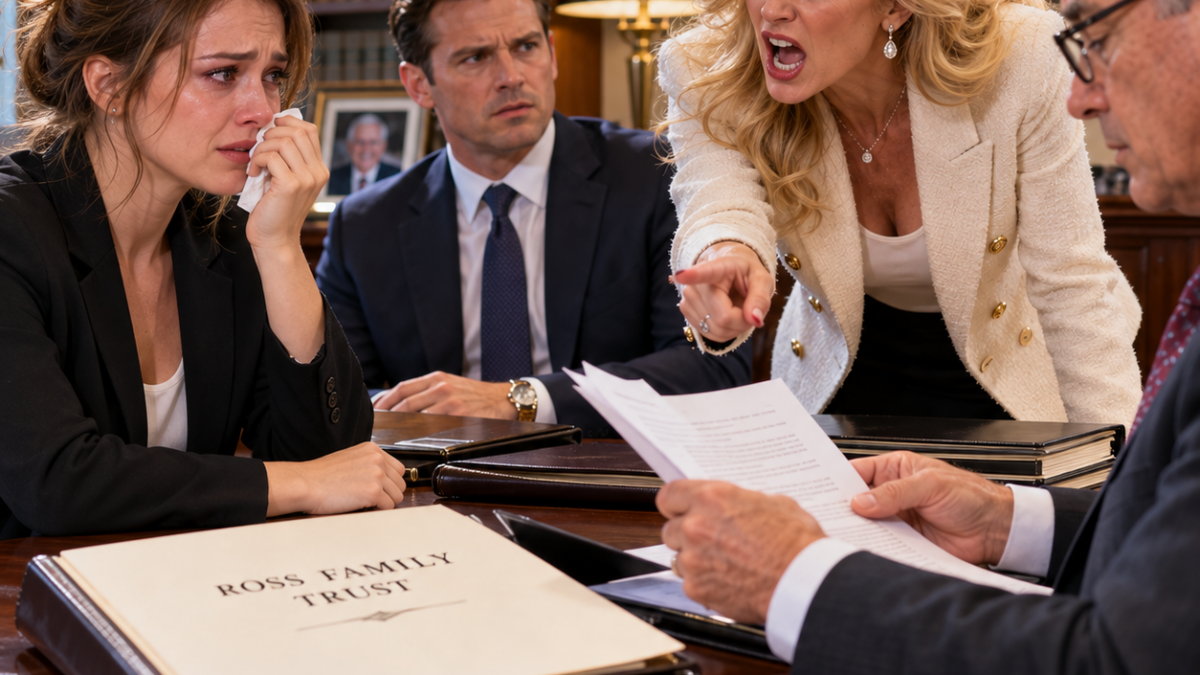
The morning after I found the pink stickers, the three of us sat in Harrison & Cole, a small law office on the second floor of an old brick building downtown.
Mr. Harrison had handled Dad’s business and estate planning for nearly twenty years.
He was seventy, narrow-shouldered, soft-spoken, and forever pushing reading glasses up his nose while looking for the same glasses on his desk.
Vanessa wore a camel coat.
Julian wore a silver watch that still had protective film under the clasp.
He kept picking at it with his thumbnail.
Harrison began by explaining that this was not some ceremonial reading of a will like people see in movies.
It was an estate-administration meeting.
Dad had owned some property individually at death, but most of the major assets had been transferred months earlier to the Ross Family Trust.
Vanessa interrupted.
“Let’s not make this complicated.”
Harrison looked up.
She crossed one leg over the other.
“Julian is Daniel’s eldest son.”
“The eleven-million-dollar estate, the company, the properties—those belong to him by birthright.”
“The law respects that.”
Harrison blinked.
Then a surprised laugh escaped him.
He caught himself immediately.
“I’m sorry.”
“That was unprofessional.”
Vanessa’s face hardened.
“But Ohio law does not give an eldest child an entire estate merely for being born first.”
“I’m telling you what Daniel wanted.”
“Then we should look at what Daniel signed.”
He opened a thick blue folder.
The top schedule listed trust assets.
Ross Logistics operating interests.
Warehouse properties in Columbus, Dayton, and Springfield.
Equipment interests.
Investment accounts.
Cash reserves.
Several smaller real-estate holdings.
Estimated net trust value after known liabilities:
Approximately eleven million dollars.
Julian stopped picking at his watch.
“So who gets the trust?”
Harrison turned the page.
Then looked at me.
“The person Daniel named to succeed him as trustee is Lauren.”
Silence.
Vanessa’s expression didn’t change at first.
It was as though the words reached her but refused to arrange themselves into meaning.
Then she laughed.
“No.”
Harrison looked at the document.
“Yes.”
Julian leaned forward.
“Trustee means what exactly?”
“It means Lauren is responsible for administering the trust according to Daniel’s written instructions.”
“Managing trust assets.”
“Overseeing distributions.”
“Protecting beneficiaries.”
“Hiring professionals where necessary.”
“Keeping records.”
“And acting in the interests of the trust rather than herself.”
Vanessa looked at me.
“You knew?”
I could feel my pulse in my throat.
“I knew Dad asked me to serve.”
“You knew this for six months?”
“I knew I was successor trustee.”
“I did not know every asset or every distribution term.”
Her face reddened.
“And you let us discuss selling things?”
“I told you not to sell anything until Harrison explained ownership.”
Julian stared at me.
“You could have said something.”
“I did.”
“No.”
“You could have said, ‘Dad put me in charge.’”
The words stung because part of me understood why he felt blindsided.
But Dad had asked me not to turn his final months into an inheritance fight.
He had specifically said:
“When the time comes, Harrison explains it.”
So that was what I had done.
Harrison raised one hand.
“Before anybody misunderstands this, Lauren being trustee does not mean Lauren personally owns eleven million dollars.”
Vanessa said:
“Obviously.”
Her tone suggested nothing was obvious anymore.
Harrison continued.
“The trust has beneficiaries.”
“Distribution provisions.”
“Management restrictions.”
“Debt obligations.”
“Tax considerations.”
“And specific instructions regarding Ross Logistics.”
Julian leaned forward again.
“Am I a beneficiary?”
“Yes.”
He relaxed.
Barely.
“Lauren?”
“Yes.”
“So we split it fifty-fifty?”
“No.”
That changed the room again.
Harrison turned to another section.
“Daniel created separate beneficial interests.”
“He also distinguished between income, voting control, business-management authority, and eventual principal distributions.”
Vanessa said:
“In English.”
Harrison removed his glasses.
“In English, Daniel did not divide everything into two equal piles and tell you to sell whatever you wanted.”
I almost smiled.
Didn’t.
He pointed to the trust.
“Ross Logistics is not to be sold for at least five years unless an independent fiduciary adviser and trustee conclude a sale is necessary to prevent substantial business harm or is overwhelmingly in the beneficiaries’ interests.”
Julian stared.
“Five years?”
“Yes.”
“Why?”
Harrison looked at him for a long second.
“Daniel wrote a letter explaining that.”
Vanessa sat back.
“Of course he did.”
Harrison ignored the sarcasm.
He continued.
“Lauren receives no automatic right to run daily operations.”
“Daniel anticipated her military obligations.”
“The company is to be managed by a civilian operating executive selected by the trustee with approval from an advisory committee.”
“That committee includes the company’s chief financial officer, long-time outside accountant, and one independent business adviser.”
I exhaled.
That matched what Dad and I had discussed.
I had never intended to leave the Army one morning and start ordering warehouse supervisors around the next.
I knew freight.
I’d studied Dad’s numbers.
But knowing a business from spreadsheets and conversations isn’t the same as running three warehouses and hundreds of daily shipments.
Dad understood that.
Julian asked:
“What about me?”
Harrison lowered his eyes to the page.
“Daniel gave you the opportunity to serve on the advisory committee after completing certain conditions.”
“What conditions?”
Harrison hesitated.
That made Vanessa lean forward.
“What conditions?”
“Completion of an accredited business-finance program.”
“Two years of full-time employment inside Ross Logistics in a nonexecutive operational role.”
“And no outstanding unsecured obligations owed by you to the trust or company.”
Julian laughed.
Not because it was funny.
“You’re kidding.”
“No.”
“He wants me loading trucks?”
“He said operational role.”
“You spent years telling everybody I would run the company.”
Harrison’s expression softened.
“I can’t speak to every conversation you and your father had.”
“I can only administer the documents he signed.”
Julian turned toward me.
“Did you know about this?”
“No.”
That was true.
Dad had told me he wanted Julian involved if Julian learned the business from the ground up.
He had never shown me the conditions.
Vanessa slammed her palm against the desk.
“This is manipulation.”
Harrison looked at her.
“By whom?”
“Her.”
She pointed at me.
“Lauren was constantly in Daniel’s ear.”
“She got him when he was sick.”
“You’re suggesting undue influence?”
“Yes.”
The word came easily.
Too easily.
I felt my stomach twist.
Harrison’s tone changed.
He stopped sounding like an elderly family lawyer.
He sounded like counsel.
“Then I recommend you choose your next words carefully.”
Vanessa blinked.
He opened another section of the file.
“Daniel executed the trust amendment in my office.”
“His treating physician provided a capacity letter after Daniel specifically requested one because he anticipated family conflict.”
“He met with me privately twice.”
“He also met independently with his accountant.”
“Lauren was not present for the final execution.”
“She received no draft beforehand.”
“Daniel was competent.”
“Clear.”
“And extremely specific.”
Vanessa looked at me.
I had never known about the doctor’s letter.
Dad had expected this.
That hurt.
Not because he distrusted me.
Because he knew us.
His own family.
And he had spent part of his dying months preparing for battle after he was gone.
Julian said quietly:
“What did he leave me?”
Harrison looked at him.
The anger had gone from Julian’s face.
For the first time, he looked like a son whose father had died.
Not an heir calculating percentages.
Harrison spoke gently.
“You are not disinherited.”
“Far from it.”
“You receive trust income under a defined formula.”
“You may eventually receive substantial principal.”
“But Daniel placed protections around those distributions because of your existing debts and financial history.”
Julian’s jaw tightened.
“How much debt?”
Vanessa looked at him.
That was interesting.
Harrison said:
“I cannot disclose private creditor information to Vanessa without your authorization.”
She turned.
“What debt?”
Julian rubbed his forehead.
“Not now.”
“What debt, Julian?”
“Not now.”
Harrison continued.
“Daniel also directed the trustee to pay certain verified medical, educational, and housing expenses for both children separately from discretionary distributions.”
“For grandchildren, if any, there are education trusts.”
“And the family residence is handled separately.”
Vanessa immediately said:
“The house goes to Julian.”
Harrison looked at the paper.
“No.”
She almost stood.
“Then Lauren gets it?”
“No.”
“Who does?”
“Neither of them presently.”
Dad had placed the house into a separate residence trust.
Mom had died twelve years earlier.
Dad apparently wanted the house preserved for eighteen months after his death, giving Julian and me time to decide jointly whether one of us wanted to buy the other’s beneficial interest at appraised value.
If neither did, the trustee could sell.
No pink stickers.
No immediate buyers.
No Friday moving company.
I looked at Vanessa.
“The movers are canceled.”
She stared.
Julian said nothing.
Harrison closed the folder.
“We’re not finished.”
Of course we weren’t.
The next section dealt with personal property.
Dad had created a written memorandum.
Specific items.
Grandfather clock to me.
Mom’s jewelry divided between me and Julian’s daughter, if she wanted it when she turned eighteen.
Dad’s truck to Julian.
His woodworking tools to my cousin Aaron, who had spent summers working beside him.
Family photographs to be digitized, then originals divided by agreement.
The leather chairs?
Remain with the house during the eighteen-month decision period.
Dad’s desk?
Mine.
I looked at the faint adhesive mark I had left when I ripped Vanessa’s sticker off.
For some reason, that nearly made me cry.
Then Harrison handed me an envelope.
My name was written across the front in Dad’s handwriting.
LAUREN — READ AFTER THE MEETING.
He gave Julian another.
JULIAN.
Vanessa held out her hand.
“Mine?”
Harrison looked genuinely confused.
“No.”
She stared.
“I’m his daughter-in-law.”
“Yes.”
“Daniel and I were family for twelve years.”
“I understand.”
“So he wrote nothing to me?”
“Not in the materials I was instructed to distribute.”
Vanessa’s face became perfectly still.
That moment mattered more than I understood then.
Being left out wasn’t about money.
It was humiliation.
For years, Vanessa had behaved as though she and Julian were the natural continuation of Dad’s life.
Oldest son.
Future president.
Executive wife.
Big house.
Company.
Legacy.
She had already imagined herself standing in Dad’s office giving instructions.
The trust hadn’t merely denied her control.
It had revealed Dad never intended to give it.
The meeting ended with Harrison giving me a trustee checklist.
Secure trust property.
Notify financial institutions.
Preserve company operations.
Obtain updated valuations.
Inventory personal property.
Change no business process unnecessarily.
Communicate with beneficiaries.
Document everything.
Avoid self-dealing.
Hire professionals.
He looked over his glasses.
“And, Lauren?”
“Yes?”
“Do not try to run this like the Army.”
I almost laughed.
“Meaning?”
“Your father used to say you believed every problem improved when placed in a spreadsheet and assigned a responsible officer.”
“He wasn’t wrong.”
“Families aren’t units.”
“Beneficiaries aren’t subordinates.”
“Your brother can disagree with you without committing insubordination.”
Julian looked at me.
For the first time that morning, we both smiled.
Small.
Temporary.
But real.
Then Vanessa said:
“This isn’t over.”
The smile disappeared.
Harrison looked at her.
“What specifically do you intend to challenge?”
“Everything.”
She stood.
“The trust.”
“Her appointment.”
“Daniel’s capacity.”
“All of it.”
Julian whispered:
“Vanessa.”
She turned.
“What?”
He looked exhausted.
“Dad isn’t even cold in the ground.”
That shut her up.
For about thirty seconds.
Outside the office, she pulled Julian toward their car.
I stayed on the sidewalk.
He looked back once.
I wanted to say something.
I didn’t know what.
So I drove to Dad’s house alone.
The pink stickers were still there.
I removed every one.
I did not throw them away.
I put them in an envelope.
DATE FOUND: NINE DAYS AFTER DANIEL ROSS’S DEATH.
Trustee documentation.
Harrison would’ve approved.
Then I canceled the moving company.
The manager sounded confused.
“Mrs. Ross confirmed the pickup.”
“Which Mrs. Ross?”
“Vanessa.”
“She does not own the property.”
Silence.
“I’ll email written confirmation from counsel.”
“Please do.”
I spent the rest of the afternoon photographing the house.
Every room.
Furniture.
Art.
Electronics.
Dad’s study.
Garage.
Tools.
Vehicle.
Not because I thought Julian would steal from me.
Because I had already learned that grief makes memory unreliable and conflict makes it worse.
At eight that evening, I finally opened Dad’s letter.
Lauren,
If you’re reading this, I lost the argument with my pancreas.
I laughed and cried at the same time.
Typical Dad.
He continued:
You are going to be angry with me for putting you in this position.
Correct.
I chose you because you can say no when somebody you love wants you to say yes.
That is not always a pleasant quality.
It is a useful one.
I sat at his desk.
Kept reading.
He wrote about Julian.
Not cruelly.
That mattered.
Your brother is not stupid.
He is not lazy in the way people think.
He is impatient with the part of success that comes before applause.
That sentence hurt because it was exactly true.
Dad said Julian had spent his adult life chasing outcomes without wanting the boring middle.
Company launch.
Real-estate deal.
Luxury-watch import business.
Every venture began with logos, announcements, dinners, promises.
Then inventory management arrived.
Payroll.
Tax filings.
Returns.
Customer complaints.
The work after excitement.
Julian disappeared emotionally.
Dad kept rescuing him.
I helped create the problem, he wrote.
Every time he fell, I put money under him before he hit the ground.
He never learned whether he could stand because I never let him find out.
Then:
Do not make my mistake.
That line sat alone.
Dad continued.
He wanted Julian to have a path into Ross Logistics.
A real path.
Not because Julian was the son.
Because he might become good at it if he ever accepted that nobody starts at the top just because a family photograph hangs in the lobby.
He wanted me to protect the company from both Julian’s ambition and my own temptation to overcorrect.
Do not punish your brother for being the child I spoiled.
Make him responsible.
Those are not the same thing.
Then he wrote about me.
You are going to want to prove I chose correctly.
Don’t.
The trust is not a medal.
It is work.
If you become attached to being the responsible one, you will make as many bad decisions as Julian does while attached to being the heir.
I stopped.
Read that paragraph again.
Dad still knew how to hit me after death.
He ended:
Keep the company alive if it deserves to live.
Sell it if someday that is truly best.
Keep the house only if one of you actually wants the house, not because dead people lived there.
And please, for the love of God, don’t turn my desk into a shrine.
It has coffee stains because I spilled coffee.
Not because they mean anything.
Love,
Dad
P.S. Harrison will pretend he isn’t enjoying this. He is lying.
I laughed so loudly in the empty study that I scared myself.
Then somebody knocked.
Julian.
Alone.
I opened the door.
“Where’s Vanessa?”
“Home.”
He stepped inside.
His eyes went toward the missing pink stickers.
“She was trying to organize.”
“She was selling Dad’s things.”
“I know.”
He rubbed his face.
“Can we talk?”
We sat in the leather chairs.
The ones Vanessa had tagged.
For a minute, neither of us spoke.
Then Julian pulled out Dad’s letter.
His copy was crumpled at the edges.
“Did yours make you feel like an idiot?”
“Yes.”
“Good.”
“What did yours say?”
He looked down.
“Private.”
“Fair.”
Then:
“He knew about my debt.”
“Harrison mentioned it.”
Julian laughed bitterly.
“Of course he did.”
“How much?”
He looked toward the window.
“About one-point-four.”
I stared.
“Million?”
“Yes.”
“Julian.”
“I know.”
“How?”
“Business guarantees.”
“Credit lines.”
“Personal loans.”
“Taxes from the watch company.”
“Some real-estate stuff.”
“Does Vanessa know?”
“Not all of it.”
I sat back.
Now I understood the silver watch.
The boat conversation.
The urgency.
He had not merely expected an inheritance.
He needed one.
“What did you promise buyers?”
“Nothing binding.”
“Julian.”
“Nothing binding.”
He met my eyes.
“I had conversations.”
“Someone is interested in buying Ross Logistics.”
“Who?”
“Northstar Freight Holdings.”
I knew the name.
Private-equity-backed logistics consolidator.
Bought regional companies.
Cut overlap.
Merged routes.
Sold property.
Dad had complained about them twice.
“You talked to Northstar before Dad died?”
Julian didn’t answer.
That was answer enough.
“How long?”
“Four months.”
My stomach dropped.
“Did Dad know?”
“No.”
“You were negotiating the sale of a company you didn’t own.”
“I wasn’t negotiating.”
“I was exploring.”
“For what?”
He stood.
“For a way out.”
That stopped me.
He looked at me.
“I am drowning, Lauren.”
“You have your Army salary.”
“You have housing.”
“You have benefits.”
“You don’t know what it is like to owe a million dollars.”
“No.”
“I don’t.”
“And you don’t know what it feels like to have Dad introduce you your whole life as ‘the one who’ll run this someday’ and then discover he put your little sister in charge.”
There it was.
Not greed.
Not only greed.
Shame.
“I didn’t ask for this.”
“You said yes.”
“Because he was dying.”
“So was I supposed to say no?”
“Maybe.”
His answer came too quickly.
I stood.
“You think I wanted to spend bereavement leave cataloging chairs while you arranged buyers?”
“I think Dad trusted you more.”
“That isn’t the same thing.”
“It feels the same.”
We stared at each other.
Then he said:
“Sell the company.”
“No.”
His face hardened.
“You haven’t even looked at the offer.”
“The trust says five years unless independent review supports a sale.”
“You’re trustee.”
“You can interpret that.”
“That’s exactly why Dad created the restriction.”
“Northstar will pay thirty-two million.”
I froze.
“What?”
“Thirty-two.”
Ross Logistics was valued far below that on Dad’s internal estimate.
If Northstar was truly offering thirty-two million, I had a duty to examine it.
Not reject it because Dad disliked them.
Not accept it because Julian needed money.
Examine it.
“Send the written offer to Harrison.”
Julian looked surprised.
“You’ll consider it?”
“I will do what the trust requires.”
“That sounds like a no.”
“It sounds like what Dad asked me to do.”
He left angry.
But he sent the offer.
Northstar wasn’t offering thirty-two million.
Not exactly.
The headline enterprise value was thirty-two million subject to debt assumption, working-capital adjustments, property treatment, environmental review, customer retention, and earn-out provisions.
Cash at closing would be much lower.
They wanted the warehouse real estate included.
They also wanted broad authority to eliminate redundant staff immediately after closing.
Harrison brought in an independent valuation firm.
Dad’s CFO, Teresa Malloy, supplied records.
An outside logistics consultant reviewed operations.
For three weeks I lived in numbers.
Revenue.
Margins.
Fleet leases.
Warehouse occupancy.
Customer concentration.
Maintenance.
Fuel hedging.
Labor.
Insurance.
Dad’s company was healthier than I realized.
Not perfect.
But healthy.
He had understated its value.
Not fraudulently.
Conservatively.
The independent valuation put the operating company and associated real estate significantly above the trust schedule.
Northstar’s deal was not absurd.
But it was not a miracle either.
And the consultant found something else.
Northstar’s internal integration model assumed eliminating approximately seventy-eight Ross Logistics jobs within the first eighteen months.
Some of those roles probably were redundant.
Others weren’t.
I could not reject a financially beneficial offer simply because layoffs made me uncomfortable.
But I also wasn’t required to ignore long-term value.
The adviser concluded:
Do not sell now.
At least not under those terms.
Ross Logistics had enough cash flow, customer loyalty, and owned real estate that a professional management transition could likely create greater beneficiary value over five years.
Harrison asked me privately:
“You know Julian is going to hate this.”
“Yes.”
“Still comfortable?”
“No.”
“Good.”
“People comfortable with fiduciary decisions often haven’t considered who gets hurt.”
We rejected the offer.
Documented.
Independent advice attached.
Valuation attached.
Julian accused me of doing it personally.
I sent him the complete trustee summary.
No private customer data.
No privileged portions.
Enough for him to see:
This wasn’t Lauren versus Julian.
It was the trust following Dad’s process.
Vanessa took a different route.
She hired a probate litigator.
Three weeks after Dad’s funeral, we received notice that Julian was considering challenging the trust amendment based on lack of capacity and undue influence.
I called him.
“You authorized this?”
Silence.
“Julian.”
“Vanessa says we have to preserve our options.”
“Do you believe Dad lacked capacity?”
“I believe he was sick.”
“That wasn’t my question.”
He sighed.
“I don’t know.”
“You talked to him during those months.”
“Yes.”
“Did he know who you were?”
“Yes.”
“Did he understand the company?”
“Yes.”
“Did he understand his finances?”
“Probably better than me.”
“Then what exactly are you claiming?”
“I haven’t claimed anything yet.”
That was technically true.
The filing was exploratory.
Document requests.
Medical records.
Draft history.
Attorney notes.
Harrison was almost offended.
“Let them look.”
They did.
Dad’s oncologist documented cognition.
Primary-care physician documented capacity.
Harrison had meeting notes.
The accountant had notes.
Dad had even recorded a short video at Harrison’s suggestion.
I didn’t know until litigation began.
In it, Dad sat in the same office.
Thin.
Tired.
Completely himself.
He looked directly at the camera.
“My name is Daniel Ross.”
“I know what I own.”
“I know who my children are.”
“I know what this trust does.”
“I am naming Lauren successor trustee because she has demonstrated financial discipline and because her brother Julian currently has obligations that make unrestricted control unwise.”
Then:
“This is not punishment.”
“If Julian meets the conditions I’ve created, I want him involved.”
“I love both my children.”
“I do not love them by giving them identical responsibilities.”
I watched it once.
Then stopped.
Hearing his voice was too much.
Vanessa’s lawyer saw it too.
The capacity theory disappeared almost immediately.
Undue influence was harder to allege after evidence showed I wasn’t present for execution and had not received drafts.
The challenge did not vanish entirely.
But its foundation weakened.
Then we discovered something that frightened me more than the lawsuit.
Dad’s home office computer showed remote-access activity three days after his death.
Someone had opened:
Financial folders.
Equipment schedules.
Personal-property inventory.
A file named TRUST SUMMARY.
The login used was Julian’s old family credentials.
I called him.
“Did you access Dad’s computer after he died?”
“No.”
“Think before you answer.”
“I said no.”
“Did Vanessa?”
Silence.
“Julian.”
“I don’t know.”
That meant yes or maybe.
Either was bad.
The forensic technician found a USB drive had been connected.
Several files copied.
Nothing deleted.
No bank passwords apparently used.
But trust schedules and company valuations had been accessed before Harrison’s meeting.
That explained something.
Vanessa’s confidence.
Eleven million.
Not a guess.
She knew the figure before Harrison said it.
I confronted Julian in Harrison’s office.
He admitted Vanessa had gone through Dad’s computer.
“She said we needed to understand what we were dealing with.”
“Dad was dead three days.”
“I know.”
“She copied trust documents.”
“She said she found an old summary.”
“Did you tell her to?”
“No.”
“Did you stop her?”
“No.”
That answer hurt more.
Julian looked miserable.
“I thought everything was ours anyway.”
“Ours?”
“Family.”
“No.”
I pointed toward Harrison.
“Dad’s death did not turn every locked file into community property.”
Julian stood.
“I know that now.”
“Do you?”
Vanessa entered the room halfway through.
Apparently Julian had told her where we were.
She looked at me.
“You’re acting like I hacked the Pentagon.”
“You accessed a dead man’s private records.”
“My father-in-law.”
“Without authorization.”
“We were protecting Julian’s interests.”
Harrison said:
“Please stop speaking.”
She stared.
“Excuse me?”
“Your counsel should be here.”
“This conversation now involves potential claims outside ordinary estate administration.”
For once, Vanessa listened.
She left.
Julian remained.
He sat down.
Then he did something unexpected.
He cried.
My brother had cried at Dad’s funeral.
Quietly.
Controlled.
This was different.
He bent forward.
Hands over his face.
“I screwed everything up.”
I sat there.
Harrison looked at me.
Then left the room without a word.
I didn’t touch Julian.
He wasn’t a child.
Neither was I.
After a minute, he said:
“Dad knew.”
“Yes.”
“He knew I was drowning.”
“Yes.”
“And instead of helping me, he put conditions around everything.”
I almost snapped.
Then remembered Dad’s letter.
Do not punish your brother for being the child I spoiled.
Make him responsible.
I said:
“He did help you.”
Julian laughed through tears.
“This is help?”
“He created income.”
“Medical support.”
“Debt planning.”
“A path into the company.”
“He didn’t hand you eleven million because you’d burn through it paying people who loaned you money for businesses you didn’t understand.”
His face hardened.
“Nice.”
“You want me to lie?”
“No.”
“Then listen.”
I sat closer.
“Dad spent years rescuing you.”
“You know that.”
“You hate him for stopping only when he was dying.”
Julian looked away.
“I hate him for choosing you.”
There it was.
I nodded.
“I would too.”
He looked at me.
“You don’t have to be generous.”
“I’m not.”
“If Dad put you in charge of me, I’d be furious.”
“He didn’t put me in charge of you.”
“He put me in charge of a trust.”
“Same thing.”
“No.”
“And if I start treating it the same, fire me.”
That got his attention.
“Can I?”
“No idea.”
“Ask Harrison.”
A weak laugh escaped him.
Good.
The litigation paused.
Julian asked his lawyer to hold further challenge activity while he reviewed Dad’s documents independently.
Vanessa did not like that.
Their marriage started cracking where all the pressure had been hidden.
Debt.
Status.
Promises.
She had apparently told her parents that Julian would become CEO after Dad died.
She had discussed moving into Dad’s house.
She had contacted an interior designer.
She had spoken with a yacht broker.
The boat call I’d heard after the funeral wasn’t theoretical.
A deposit had been discussed contingent on estate distribution.
Julian told me all of this over coffee two weeks later.
“You were buying a boat?”
“I wasn’t buying it.”
“You were shopping.”
“Yes.”
“With one-point-four million in debt?”
“Yes.”
“Why?”
He stared at his cup.
“Because I thought if Dad died and I got the company, everything before that would stop mattering.”
That sentence was the first honest explanation he’d given me.
Inheritance as reset button.
Not wealth.
Erasure.
Debt disappears.
Failed businesses stop defining him.
Dad’s approval arrives posthumously in the form of ownership.
Vanessa becomes the executive wife she had imagined.
Everything corrected by one death.
Except Dad had refused to die according to their plan.
I said:
“You need a bankruptcy lawyer.”
Julian flinched.
“No.”
“You need somebody independent to assess your options.”
“I am not filing bankruptcy.”
“Maybe not.”
“But hiding from the numbers isn’t working.”
He looked at me.
“Did Dad tell you to say that?”
“No.”
“He would’ve said it worse.”
That made him smile.
He hired a restructuring attorney.
Not because I ordered him.
Because he finally wanted to know the real number.
Some of the debt was personally guaranteed.
Some negotiable.
Some tied to assets already worth less than the loans.
He sold the luxury watch inventory remaining from his failed company.
Sold his sports car.
Canceled the boat idea.
Put their vacation property on the market.
Vanessa exploded.
I know because she called me.
“This is your fault.”
“What?”
“You’ve convinced Julian we’re poor.”
“You owe more than a million dollars.”
“That doesn’t mean we’re poor.”
I almost admired the logic.
She continued:
“He’s liquidating everything.”
“He’s being humiliated.”
“He is dealing with debt.”
“You always hated him.”
“No.”
“You wanted Dad to choose you.”
“No.”
“You think you’re better.”
That one stopped me.
Because sometimes I did.
Not consciously.
But yes.
Responsible Lauren.
Reliable Lauren.
The one Dad called when something needed fixing.
The one who didn’t need rescuing.
There is vanity in competence.
Dad’s letter had warned me.
I said:
“I don’t think I’m better.”
Vanessa laughed.
“You don’t have to think it.”
“You built your whole identity around being the good child.”
Then she hung up.
I sat with that longer than I wanted.
The next morning, I called Harrison.
“Can trustees get therapy reimbursed?”
He paused.
“For whom?”
“The trustee.”
Another pause.
“Lauren.”
“I am kidding.”
“Mostly.”
He sighed.
“Your father owes me even in death.”
I did get therapy.
Privately.
Out of pocket.
Because Vanessa’s insult had found a real crack.
I had spent years proving I didn’t need what Julian needed.
Money.
Attention.
Dad’s rescue.
That independence had become its own competition.
If Julian failed, I became more valuable.
I hated admitting that.
Grief made all of us uglier before it made us honest.
Ross Logistics hired a professional CEO named Allison Greene.
Forty-seven.
Twenty-two years in regional freight.
No family connection.
No patience for family mythology.
At our first meeting, she told me:
“I work for the company, not the Ross family.”
“Good.”
“If your brother gets a job here, he reports to whoever holds the role above him.”
“Good.”
“If you call me asking to move a shipment because your friend needs a favor, I’ll bill the trust for the wasted hour.”
“Also good.”
She stared.
“You’re too agreeable.”
“I’ve been warned.”
She smiled.
Under Allison, the company began changing.
Not dramatically.
Better route software.
Warehouse maintenance schedule.
Driver-retention program.
More disciplined customer credit.
Dad had resisted some technology because the old system still worked.
Allison didn’t care what had always worked.
She cared what would work next.
That was exactly why Dad wanted outside management.
Julian surprised everyone.
Six months after the funeral, he applied for a warehouse operations position.
Not executive.
Not advisory.
Operations coordinator in Springfield.
Allison called me.
“Do you want input?”
“No.”
“You’re trustee.”
“You’re CEO.”
“Good answer.”
She hired him.
Regular salary.
No title inflation.
No private office.
His first week began at 5:30 a.m.
He called me after day three.
“I hate Dad.”
“He’s dead.”
“I know.”
“Still.”
“What happened?”
“A forklift battery failed and a refrigerated load got routed to the wrong door.”
“Welcome to logistics.”
“I’ve never been this tired.”
“Goodnight.”
“That’s all?”
“What do you want?”
“Sympathy.”
“You chose the job.”
“Vanessa was right about you.”
He hung up.
Then went back the next morning.
Month after month.
He learned.
Receiving.
Dispatch.
Dock scheduling.
Claims.
Driver shortages.
Customer-service escalation.
Inventory mismatches.
Weather delays.
All the boring middle.
The part Dad always said he skipped.
Julian turned out to be good with people.
Really good.
Drivers liked him.
Warehouse teams did too once they discovered he wasn’t going to invoke the family name every ten minutes.
He knew customers.
Remembered names.
Could calm an angry client.
He was terrible at inventory controls.
Learned.
Weak with compliance documentation.
Learned.
Allison gave him no special treatment.
That may have saved him.
Vanessa hated it.
Their marriage deteriorated.
She considered his warehouse job humiliating.
He considered her obsession with appearance exhausting.
Eventually they separated.
I didn’t celebrate.
Whatever Vanessa had done, twelve years of marriage don’t become meaningless because a trust meeting goes badly.
Julian was devastated.
Their daughter, Ava, was thirteen.
That was the real damage.
She didn’t care about trusts.
She wanted her parents to stop fighting.
I stayed out of the divorce as much as possible.
When Julian tried to complain about Vanessa, I said:
“Tell your lawyer or therapist.”
“Not me.”
When Vanessa tried to draw me into arguments about money, I redirected everything through counsel.
Boundaries.
Dad would’ve been shocked.
Or proud.
Probably both.
The trust distributed income to Julian according to Dad’s formula.
But because of creditor protections, some payments went directly toward negotiated obligations rather than passing through his hands unrestricted.
He hated that at first.
Then one day, nearly two years after Dad died, he called.
“Guess what?”
“What?”
“My unsecured debt is under four hundred thousand.”
“That is still a lot.”
“You ruin everything.”
I laughed.
He continued.
“I think I can clear it in another two years.”
“You probably can.”
Silence.
Then:
“I should have done this before.”
“Yes.”
“You don’t have to agree that fast.”
“You called the wrong sister.”
He laughed.
That was when I knew we might actually become siblings again.
Not trustee and beneficiary.
Not responsible child and irresponsible child.
Siblings.
Two damaged adults who had spent years acting out roles Dad had accidentally reinforced.
The house remained untouched for the eighteen months required.
I stayed there during some visits.
Julian occasionally did too.
No pink stickers.
No buyers.
We repaired the roof.
Serviced the furnace.
Digitized photographs.
Went through Mom’s jewelry.
That day was harder than Dad’s business records.
A bracelet.
Her wedding earrings.
An old silver compact.
Objects hold memory in ways spreadsheets don’t.
Ava chose one small necklace.
I kept Mom’s watch.
Julian took Dad’s truck.
The grandfather clock came to me.
Dad’s desk eventually moved to my house in North Carolina.
I did not turn it into a shrine.
Mostly.
I kept the brass ruler.
That was allowed.
At the end of eighteen months, neither Julian nor I wanted Dad’s house.
That surprised us.
We loved it.
We didn’t want to live there.
Dad’s letter had predicted that too.
Keep the house only if one of you actually wants the house, not because dead people lived there.
We sold it.
Proper appraisal.
Market listing.
No private deal.
No rush.
A family with three children bought it.
At closing, the mother asked whether we minded if they renovated Dad’s study.
I almost said yes.
Then caught myself.
“It’s your house.”
She smiled.
“We’ll take care of it.”
Outside, Julian stood beside Dad’s truck.
“You okay?”
“No.”
“Me neither.”
We sat on the curb.
Two grown adults.
Forty and thirty-six by then.
Staring at a house that no longer belonged to us.
Julian said:
“Vanessa had a buyer nine days after Dad died.”
“I remember.”
“I was okay with that.”
“I remember.”
He looked ashamed.
“I didn’t even want the house.”
“No.”
“I wanted the money.”
“Yes.”
“Are you going to keep agreeing?”
“Probably.”
He laughed.
Then cried.
I did too.
We drove away separately.
The trust received the sale proceeds.
Nobody got an immediate windfall.
Life continued.
At Ross Logistics, Allison promoted Julian to regional operations manager after twenty-eight months.
Not because of Dad.
Because his performance supported it.
I recused myself from the compensation discussion beyond my formal trustee obligations and relied on the independent advisory committee.
Julian wanted me to know that.
“I earned it.”
“I know.”
“You didn’t tell them to?”
“No.”
“Promise?”
“Julian.”
“Fine.”
Then:
“Dad would’ve been surprised.”
I thought about the letter.
“No.”
“I don’t think he would.”
Julian went quiet.
Maybe Dad had known him better than either of us believed.
Five years after Dad’s death, the sale restriction expired.
Almost to the day, Northstar returned.
New offer.
Much higher.
Ross Logistics had grown under Allison.
Margins improved.
Owned warehouses had appreciated.
Customer contracts stronger.
This time, Northstar offered a structure the independent advisers considered genuinely compelling.
But we had another option.
Management-led recapitalization.
Sell a minority interest to an institutional partner.
Give employees equity participation.
Keep headquarters and most operations intact.
Diversify the trust so neither Julian nor I had our entire inheritance tied to one freight company.
The advisory committee split.
Independent valuation.
Tax modeling.
Legal review.
We spent four months deciding.
Julian was now eligible to sit on the advisory committee.
He had completed the business-finance program.
Worked more than two years.
Cleared the required debt conditions.
Dad’s path.
He had done every part.
During the final meeting, I watched him read the Northstar proposal.
Five years earlier he would have looked only at purchase price.
Now he asked:
“What happens to the Dayton warehouse employees?”
Northstar’s representative gave a corporate answer.
“Integration efficiencies will be evaluated after closing.”
Julian looked at Allison.
“How many positions?”
She said:
“Probably sixty to ninety over two years.”
He nodded.
Then asked:
“What about customer-service retention?”
“What about the unionized maintenance group?”
“What happens to real estate if they consolidate Springfield?”
He knew what he was asking.
He had become what Dad hoped he might.
Not because he inherited the title.
Because he spent five years learning the job.
After the meeting, I said:
“Still want to sell?”
He looked at me.
“For the right deal.”
“That’s not an answer.”
“Exactly.”
Dad would’ve loved that.
We ultimately chose the recapitalization.
Sold a significant minority interest.
Distributed risk.
Paid beneficiaries properly.
Funded employee-equity participation.
Retained operating control with professional management.
The transaction created enough liquidity that Dad’s trust could diversify substantially.
Julian received a permitted distribution after all his conditions were satisfied.
He used part of it to finish clearing obligations.
Part to buy a modest house after his divorce.
Part into long-term investments.
No yacht.
I asked.
He told me to go to hell.
Progress.
Ava went to college.
Dad’s education trust paid tuition according to its terms.
She studied industrial engineering.
Julian blamed me.
“I did nothing.”
“She grew up around warehouses because of you people.”
“You people?”
“The responsible ones.”
I laughed.
Vanessa and I barely spoke for years.
Then, seven years after Dad died, she called.
I almost didn’t answer.
“Lauren?”
“Yes.”
“I need to tell you something.”
My first instinct was:
What now?
Then I heard her voice.
Different.
Older.
Tired.
“I found some of Daniel’s things.”
“What things?”
“Files.”
Apparently during the divorce, several boxes from Dad’s study had ended up among storage items moved to Vanessa and Julian’s former vacation property.
Julian had assumed they were old business papers.
Vanessa had kept them.
Now she was moving and wanted them returned.
I met her at a coffee shop.
She placed a banker box on the table.
Inside were old customer letters.
Family tax records.
Dad’s handwritten shipment notes.
Nothing explosive.
No secret trust.
No hidden inheritance.
Just paper.
Then she said:
“I owe you an apology.”
I didn’t respond.
She looked down.
“The pink stickers.”
That surprised me.
“I have thought about those stupid stickers for years.”
I waited.
She continued.
“I told myself I was being efficient.”
“Julian was panicking about debt.”
“I knew more about it than I admitted.”
“We thought if we could move quickly, we could stabilize everything before anyone started asking questions.”
“That included Dad’s furniture?”
She winced.
“No.”
“That was me.”
“I had already pictured the house sold.”
“Company sold.”
Debt gone.”
“New life.”
“I was decorating a future that didn’t exist yet.”
That was painfully honest.
Then:
“When Harrison said you were trustee, I hated you.”
“I know.”
“I thought Daniel had chosen you over Julian.”
“He hadn’t.”
“I know that now.”
She looked at me.
“I didn’t understand the difference between control and responsibility.”
Neither had I at first.
She said:
“I also copied files from Daniel’s computer.”
“I know.”
“I shouldn’t have.”
“No.”
“I told myself I was protecting my family.”
“You were protecting the version of the future you wanted.”
She nodded.
“Yes.”
Then:
“I am sorry.”
Not:
Sorry things got ugly.
Not:
Sorry you felt hurt.
Just:
I am sorry.
I believed her.
That didn’t mean I suddenly wanted to become friends.
I said:
“Thank you for returning the box.”
She laughed softly.
“Still you.”
“What does that mean?”
“Careful.”
“Even when you’re forgiving somebody.”
“I didn’t say I forgive you.”
She smiled.
“Fair.”
We finished coffee.
Then left.
That was the closest thing to closure we ever needed.
My Army career eventually ended too.
I retired after twenty-two years.
Dad had worried I would abandon my career immediately because of the trust.
I didn’t.
The trust hired people.
Professionals.
That was one of the most important lessons.
Being responsible does not mean personally doing everything.
Sometimes responsibility is knowing who should do what.
After retirement, I joined the Ross Logistics board in a nonexecutive capacity.
Not CEO.
Not daily operator.
Allison stayed another four years, then retired.
The board selected her successor through a formal process.
Julian applied.
That shocked me.
Not because he wasn’t qualified by then.
Because he finally understood what applying meant.
He did not come to me first.
Did not say:
Dad would’ve wanted this.
Did not say:
It’s my turn.
He submitted a résumé.
Business plan.
Interviewed with the independent directors.
Another candidate won.
Julian was furious.
For forty-eight hours.
Then he called me.
“I think they made the right choice.”
I almost dropped the phone.
“Who are you?”
“Shut up.”
The new CEO promoted him later to chief operating officer.
That role fit him.
People.
Execution.
Operations.
He never became CEO.
And he stopped needing to.
That may have been Dad’s greatest gift.
Not denying him a title.
Teaching him that he could matter without inheriting one.
As for me, being trustee became less dramatic with time.
Annual reports.
Tax filings.
Investment reviews.
Distributions.
Meetings.
Boring.
Dad’s eleven-million-dollar trust eventually became worth significantly more, despite distributions, because the company and investments grew.
People who heard the family story sometimes assumed I became rich by “winning.”
I didn’t win the estate.
I administered it.
I received benefits under Dad’s plan like Julian did.
But control never meant the money was mine.
That distinction saved us.
Had Dad simply handed me eleven million because he trusted me more?
Maybe I would have become insufferable.
Maybe Julian would’ve spent the rest of his life believing he was rejected.
Instead Dad built a structure.
Imperfect.
Complicated.
But wise.
It gave Julian time to become someone who could receive wealth without expecting wealth to become him.
It gave me time to learn that being trusted wasn’t proof I was morally superior.
And it prevented Vanessa’s pink stickers from becoming a moving truck before anyone had read the papers.
Years later, Julian and I found one sticker inside Dad’s old desk.
It had slipped beneath a drawer.
Pink.
Faded.
SELL.
I held it up.
“You remember these?”
He groaned.
“Burn it.”
“No.”
“Lauren.”
“I’m keeping it.”
“Why?”
“Humility.”
“For you or Vanessa?”
“Everybody.”
He laughed.
I stuck it inside Dad’s old trust binder.
Not on anything.
Just between two pages.
Julian looked at me.
“You know Dad would say that’s dramatic.”
“Dad is dead.”
“He’d still say it.”
True.
Then Julian pulled something from his wallet.
His old silver watch.
The one from Harrison’s meeting.
Protective film long gone.
“You still have that?”
“Vanessa bought it before the funeral.”
“With what?”
“Credit card.”
“Of course.”
He turned it over.
“I kept it because every time I wear it, I remember what an idiot I was.”
“That seems healthy.”
“More practical than your pink sticker.”
“Debatable.”
We were laughing.
That mattered.
Because there had been a time when Dad’s death almost turned us into enemies.
Not because he left too little.
Because he left enough for every insecurity in the family to become expensive.
Inheritance doesn’t create character.
It amplifies whatever is already there.
Julian’s desperation.
Vanessa’s hunger for control.
My pride in being dependable.
Dad’s guilt.
All of it surfaced across one lawyer’s desk.
The trust didn’t solve those things.
It slowed us down long enough to confront them.
That is why, when people hear the beginning of our story, they expect a revenge ending.
My brother gets nothing.
My sister-in-law loses everything.
I inherit eleven million dollars.
I fire Julian.
Sell his house.
Expose his debts.
Stand at Dad’s grave and tell him I won.
None of that happened.
Because Dad did not write a revenge document.
He wrote a plan.
Julian remained his son.
I remained his daughter.
Both of us benefited.
Both of us were restricted in different ways.
Both of us were forced to grow around the places where Dad knew we were weakest.
Vanessa suffered consequences mostly from her own marriage and financial decisions, not because I used the trust to punish her.
And Ross Logistics remained what Dad wanted it to be:
A business.
Not a crown.
One winter evening, almost ten years after Dad died, Julian and I stayed late at the Columbus warehouse after a board meeting.
Snow outside.
Trucks coming and going.
A dispatcher named Keisha was arguing with a driver about weather restrictions.
Forklift alarms echoed.
People moved everywhere.
Julian stood beside me.
“Dad would’ve loved this.”
“Chaos?”
“He loved controlled chaos.”
I smiled.
A truck pulled away from dock six.
Julian said:
“You know what I hated most?”
“What?”
“That he named you trustee.”
“I noticed.”
“No.”
“I mean why.”
I waited.
“I thought it meant he loved you more.”
My throat tightened.
He continued.
“Took me years to understand he gave you the job because you were good at saying no.”
“And gave me the path because I was bad at hearing it.”
I looked at him.
“Dad wrote almost exactly that.”
“What?”
“In my letter.”
“You never told me.”
“It was private.”
He laughed.
Then:
“My letter said something too.”
“What?”
He looked toward the warehouse.
Dad had written:
Julian, I have spent your whole life opening doors before you knocked. I am sorry. The next one is yours.
I had to look away.
“That was Dad.”
“Yeah.”
Julian smiled.
“I hated him for it.”
“For a while.”
“And now?”
He watched a forklift disappear behind stacked pallets.
“Now I’m glad he finally stopped carrying me.”
We stood there in silence.
The company kept moving around us.
Not inheritance.
Not legacy.
Work.
Real work.
People doing it.
That was the thing Dad understood at the end.
Family ownership means nothing if the next generation thinks ownership replaces effort.
The trust forced us to separate those ideas.
Birth did not make Julian CEO.
Being trustee did not make me owner of everything.
Eleven million dollars did not erase debt.
The family name did not make Vanessa’s assumptions legal.
Dad’s death did not convert his possessions into whoever put a sticker on them first.
Documents mattered.
Intent mattered.
Process mattered.
But relationships mattered too.
If I had treated Julian only as a beneficiary problem, I might have preserved the money and lost my brother.
If he had treated me only as the sister who took his birthright, he might have spent his life fighting a dead man through me.
We got close.
Very close.
Dad’s structure bought us time.
Time to be angry.
Time to fail.
Time to learn.
Time to become something other than the roles we’d inherited.
I retired as trustee at sixty-two.
The trust instrument allowed appointment of an independent corporate trustee after certain conditions.
By then, I was tired of tax meetings.
Julian joked:
“You’re abandoning your birthright.”
I said:
“I’m finally using mine.”
We selected a professional fiduciary.
Clean transition.
Audited records.
Every beneficiary notified.
No drama.
Harrison had retired years earlier.
His daughter, Emily Harrison, handled the final papers.
She found the old meeting notes.
“Dad wrote something about your first trust meeting.”
“What?”
She smiled.
“He wrote: Vanessa asserted primogeniture. Nearly laughed. Recovered poorly.”
I burst out laughing.
Julian asked:
“What’s primogeniture?”
I looked at him.
“Your alleged birthright.”
He laughed harder.
Vanessa would’ve hated that.
Maybe she’d laugh now too.
I don’t know.
I don’t need to.
After signing the trustee resignation, I drove to the cemetery.
Dad’s marker was wet from rain.
I stood there.
No speech prepared.
I told him:
“I think it worked.”
Then corrected myself.
“Mostly.”
Wind moved through the trees.
Nothing answered.
Good.
I didn’t need imagined approval.
Dad had already done enough from beyond the grave.
I put my hand on the stone.
“I was mad at you.”
That was true.
“For making me responsible for everybody.”
Also true.
“But I understand.”
I paused.
“Not everything.”
“You still overcomplicated the tax provisions.”
Somebody nearby would’ve thought I was insane.
I didn’t care.
Then:
“Julian’s okay.”
That was the thing Dad would have wanted most.
“He’s actually good.”
I smiled.
“Annoying.”
“But good.”
I left.
At home, Dad’s desk sits in my study.
The coffee stain remains.
I never refinished it.
Not because the stain is sacred.
Because refinishing furniture is work and Dad was right that I would over-romanticize it if given the chance.
The brass ruler sits in one drawer.
The pink SELL sticker is inside the trust binder.
Dad’s letter is in the safe.
Sometimes I reread it.
Less often now.
The line I remember most is not about money.
Not Julian.
Not the company.
It’s this:
If you become attached to being the responsible one, you will make as many bad decisions as Julian does while attached to being the heir.
That sentence probably saved me more than the trust.
Being responsible can become a form of control.
You start believing:
I know better.
I should decide.
People need me.
That’s not far from Vanessa’s mistake.
She believed she knew what the family future should look like.
Julian believed birth entitled him to lead.
I believed competence entitled me to judge.
Different versions of the same temptation.
Dad’s last act forced each of us to let go of one.
Not perfectly.
Enough.
The eleven-million-dollar estate became the least interesting part of the story.
Money made the conflict visible.
It wasn’t the conflict.
The real inheritance was expectation.
Julian inherited Dad’s promises.
I inherited Dad’s dependence.
Vanessa inherited a picture of status she thought marriage guaranteed.
All of us had to decide whether to keep those things.
Some we did.
Some we didn’t.
Julian kept Dad’s truck.
Still has it.
He restored the seats.
Drives it on Sundays.
Ava graduated from college and joined a manufacturing company nowhere near Ross Logistics.
Julian was secretly disappointed.
Then proud.
He told her:
“You don’t owe the family business your life.”
That sentence made me cry when Ava told me.
Generational progress sometimes looks like a father giving his child permission he never believed he had.
Ross Logistics continued.
Eventually the family sold another minority stake.
Employees own a meaningful portion now.
Company name remained.
Not because the Ross name is sacred.
Because customers knew it.
Practicality.
Dad would’ve approved.
Or argued.
He loved arguing.
If the company gets sold completely someday, I won’t haunt anybody.
At least I don’t plan to.
Dad’s trust was never meant to freeze the world.
It was meant to prevent a panicked family from making irreversible decisions nine days after a funeral.
That is exactly what it did.
Nine days.
Pink stickers.
Boat brochures.
Potential buyers.
Eleven million dollars everyone thought they understood.
Had Dad left a simple will saying:
Split everything equally,
we might have sold the company immediately.
Paid Julian’s debts.
Divided cash.
Moved on.
Maybe that would’ve been fine financially.
Maybe not.
But Julian would never have learned whether he could do the work.
I would never have learned the difference between responsibility and superiority.
And Dad’s employees would’ve become line items in a transaction nobody had taken time to examine.
Instead we slowed down.
That was the gift.
Not control.
Time.
Time is expensive when everyone is grieving and money is waiting.
Dad bought it for us with legal documents.
When I think about the first meeting now, I don’t remember Vanessa shouting about birthright as clearly as people might expect.
I remember Harrison turning the paper toward me.
I remember Julian’s thumb freezing against the plastic on his new watch.
I remember the weight in my stomach.
Because I already knew Dad had asked me to serve.
But knowing privately and having it become real in front of your family are completely different things.
That was the instant the job became mine.
Not the estate.
The job.
Protect what Dad built.
Protect the beneficiaries.
Protect Julian even when protecting him meant disappointing him.
Protect myself from becoming the person who thought Dad’s trust made me queen.
And eventually, know when to give the job away.
I think Dad would’ve liked that ending.
Not because I remained trustee forever.
Because I didn’t.
Responsibility completed is supposed to end.
Vanessa’s pink stickers taught me the opposite lesson.
She had entered Dad’s house and started deciding what everything was worth before anyone had decided what anything meant.
Desk.
Sell.
Clock.
Sell.
Chairs.
Sell.
Company.
Sell.
House.
Sell.
Grief rewards speed because speed lets you avoid feeling.
Estate administration rewards patience because rushed decisions become permanent.
We were lucky Dad anticipated us.
Or unlucky that he needed to.
Probably both.
If I could go back to the morning in Harrison’s office, I would change one thing.
When Vanessa said:
“The eleven-million-dollar estate is Julian’s by birthright,”
I wouldn’t sit there fighting tears.
I wouldn’t secretly hope Harrison would humiliate her.
I wouldn’t look at Julian and think:
Dad chose me because I’m the better child.
I would look at both of them and understand what took me years to learn.
Dad hadn’t chosen a winner.
He had chosen a structure.
There is a difference.
I was trustee because he believed I could carry the responsibility at that moment.
Julian was beneficiary because he was his son.
He had a path toward leadership because Dad still believed in him.
The restrictions weren’t rejection.
They were guardrails.
Mine were different.
Mine were fiduciary duties.
Independent advisers.
No self-dealing.
No unilateral control of daily operations.
Documentation.
Dad didn’t trust me without limits either.
Good.
People shouldn’t be trusted without limits merely because they’re competent.
That would have been another inheritance disaster.
Today, Julian and I talk every Sunday.
Not because Dad asked us to.
Because we want to.
Sometimes business.
Mostly not.
Baseball.
Ava.
My retirement travels.
His terrible golf game.
Once in a while, one of us mentions Vanessa.
Not often.
She remarried years ago.
Last I heard she was working in real estate.
I genuinely hope she is happy.
That surprises people who know the story.
But I don’t need her life to stay miserable for mine to feel justified.
She was wrong.
She caused damage.
She eventually apologized.
We moved on.
That’s enough.
Julian once asked:
“Do you think Dad knew we’d end up okay?”
“No.”
“He planned all this.”
“He planned for risk.”
“Different thing.”
He thought.
Then:
“You sound like Harrison.”
“That’s the worst thing you’ve ever said to me.”
He laughed.
Maybe Dad didn’t know.
That’s what makes the trust more meaningful.
It wasn’t prophecy.
It didn’t guarantee reconciliation.
It only stopped our worst impulses from becoming irreversible while grief was fresh.
The rest was up to us.
And that’s the part I carry with me.
Not the valuation.
Not the trustee title.
Not the day Vanessa discovered there was no eldest-son birthright.
The choice after.
Julian could have spent his life suing.
He didn’t.
I could have used Dad’s trust as proof I was superior.
I tried not to.
Vanessa could have remained convinced everyone betrayed her.
Eventually she named what she’d done.
Dad could have kept rescuing Julian from beyond the grave with a giant unrestricted inheritance.
He didn’t.
Everyone stopped doing one thing that had once felt necessary.
That is growth.
Messy.
Slow.
Expensive.
But real.
The desk is still in my house.
There are no pink stickers on it now.
Just my laptop.
Dad’s brass ruler.
A coffee cup.
And sometimes, when I’m sorting papers, I find the faint pale rectangle where Vanessa’s sticker sat all those years ago.
I could refinish it.
I don’t.
Not because the mark is sacred.
Because it reminds me of how quickly people can mistake access for ownership.
Vanessa had a key to the house.
That did not make the house hers.
Julian had Dad’s last name.
That did not make the company his.
I had Dad’s trust.
That did not make eleven million dollars mine.
All three of us had been given some form of access.
Each of us had to learn where it ended.
Dad understood boundaries better in death than we did in grief.
And if there is one thing I wish families understood before money and mourning collide, it’s this:
Inheritance is not a race to see who can claim things first.
It is not a reward for being born oldest.
Not a medal for being responsible.
Not compensation for love.
Not proof of who mattered most.
Sometimes it is simply one final set of instructions from a person who knew exactly how badly the people he loved might hurt each other if he left them nothing but money.
Dad left us more than that.
He left us time.
Rules.
A path.
And enough friction to keep any one of us from running away with the future before the others had learned how to stand inside it.
Nine days after his death, Vanessa believed the pink SELL stickers meant decisions had already been made.
She was wrong.
The most important decision Dad made wasn’t who received the house.
Or who controlled the company.
Or who inherited the biggest account.
It was deciding that none of us should be allowed to turn grief into an irreversible financial decision before we understood what we were doing.
The lawyer turning that trust toward me didn’t make me the winner.
It made me the person responsible for making sure there didn’t have to be one.
And years later, when my brother stood beside me in the warehouse Dad built and admitted he was grateful nobody had handed him the company before he had learned how to earn responsibility inside it, I finally understood why Dad chose the structure he did.
He hadn’t taken Julian’s birthright away.
There had never been one.
What Dad gave both of us was harder.
A chance to become people who could receive what he left without letting it destroy us.








