My Daughter Found a Dying Puppy in a Shoebox—Then the Vet Looked at Her Face.k
PART2:
“Where did you find him?”
I asked.
“In a box.”
“What box?”
“By Nashville Road.”
“In the ditch.”
“You went into the ditch?”
“Mom, he was crying.”
I put my sandwich down.
The puppy moved weakly against her.
Then began searching.
His nose pushed against the side of her hand.
His mouth found her finger.
He started sucking.
Frantic.
Desperate.
But he couldn’t maintain suction.
His little mouth slipped away.
He tried again.
A tiny squeak escaped him.
Ivy whispered:
“He’s hungry.”
I stared at his face.
My heart started pounding.
When Ivy was born, one of the first things the hospital team had explained was that babies with certain cleft palates couldn’t create the suction required for ordinary feeding.
We had used specialized bottles.
Different nipples.
Different positions.
Every feeding took patience.
Every ounce felt like victory.
The memory came back so fast I could almost smell the hospital antiseptic.
I stepped toward Ivy.
“Don’t feed him anything yet.”
Her eyes widened.
“Why?”
“I don’t know exactly what’s going on inside his mouth.”
“But he’s starving.”
“I know.”
I touched her shoulder.
“We’re getting help.”
I grabbed my purse.
Then hesitated.
Vet.
Money.
I had thirty-seven dollars available until Friday.
The credit card was nearly maxed.
I hated that my brain went there.
But it did.
That’s what happens when you live close enough to the edge.
Compassion still arrives with arithmetic.
Ivy looked at me.
“Mom?”
“Get in the car.”
Her shoulders relaxed.
I ran upstairs.
Opened the bedroom door.
Matt woke immediately.
Years of night work had taught him to wake angry and confused.
“What?”
“Ivy found a newborn puppy.”
He stared at me.
“What?”
“He’s hurt.”
“How hurt?”
“Cleft.”
That word woke him completely.
He sat up.
“I’ll come.”
“You need sleep.”
“Laura.”
“I’ll call.”
He was already reaching for his jeans.
Twenty minutes later, the three of us were inside an exam room at Barren River Animal Clinic.
Ivy held the puppy wrapped in a towel.
Matt looked like a man who had been pulled from sleep and dropped directly into somebody else’s emergency.
Which was exactly what had happened.
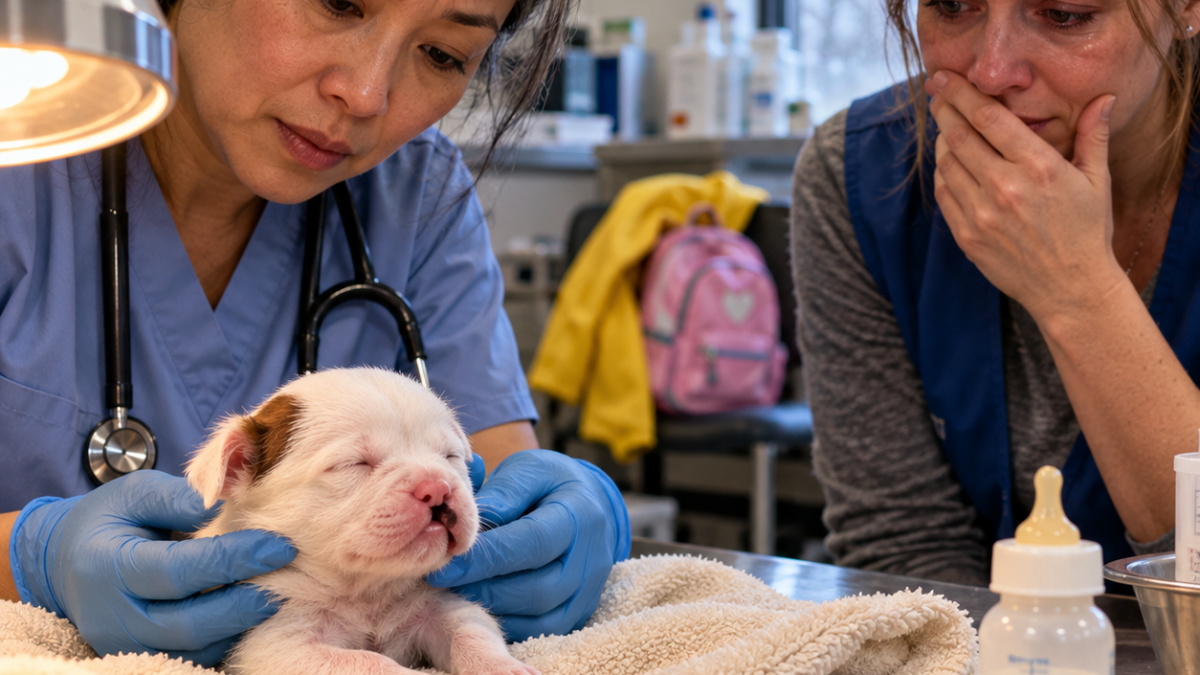
Dr. Kim Nguyen came in.
She was small, soft-spoken, maybe in her fifties, with silver beginning to show through her dark hair.
The first thing she did was weigh him.
One pound, two ounces.
Then temperature.
Too low.
Hydration.
Bad.
She put him beneath a warming lamp.
“Age?”
I asked.
“Maybe three days.”
“Four at most.”
“Where’s his mother?”
“We don’t know.”
Ivy told her about the box.
Dr. Nguyen’s expression hardened slightly.
“Any other puppies?”
“I looked.”
Ivy said.
“There weren’t any.”
“Blanket?”
“Dish towel.”
“Anything else?”
“No.”
Dr. Nguyen nodded.
“Okay.”
She warmed formula.
Then touched the nipple carefully to the puppy’s mouth.
He latched immediately.
My stomach twisted.
He sucked.
For maybe two seconds.
Then milk bubbled from his nose.
He coughed.
Sneezed.
His entire body jerked.
Dr. Nguyen immediately stopped.
Ivy gasped.
“What’s happening?”
Dr. Nguyen cleaned his nose.
Let him settle.
Then gently opened his mouth.
She angled the exam light.
For several seconds she said nothing.
I knew before she told us.
The lip was only what we could see.
The real problem was inside.
“Oh, sweetheart.”
Dr. Nguyen murmured.
She turned him slightly.
“Laura.”
I stepped closer.
There it was.
An opening in the roof of his mouth.
A cleft palate.
Ivy stood beside me.
Her hand moved over her lips.
Dr. Nguyen noticed.
Then looked at me.
I shook my head slightly.
Not yet.
The vet lowered the puppy.
“He has a congenital cleft lip and palate.”
Ivy asked:
“What does that mean?”
Dr. Nguyen chose her words carefully.
“The roof of his mouth didn’t completely close before he was born.”
“So the milk goes up?”
“Yes.”
“Into his nose?”
“Yes.”
“Can it go somewhere worse?”
Dr. Nguyen looked at me.
Then at Ivy.
“It can get into his lungs.”
“That’s dangerous.”
Ivy’s eyes filled.
“Can you fix him?”
“Not today.”
“Why?”
“He’s much too small for surgery.”
“How long?”
“If he survives and grows well, a surgeon may be able to repair the palate when he’s older.”
“How older?”
“Usually we’d be talking about months, not days.”
Ivy looked at the puppy.
He was curled under the warming light, exhausted.
“How does he eat until then?”
That was the question.
Dr. Nguyen pulled a stool closer.
“He may need assisted feeding that keeps milk away from the opening.”
“Because he’s so young, that can involve tube feeding by someone trained to do it safely.”
Ivy immediately said:
“I can learn.”
“No.”
I said.
Too sharply.
She looked at me.
I softened.
“Honey, that’s something an adult has to handle.”
Dr. Nguyen nodded.
“Your mom is right.”
“There are risks if it’s done incorrectly.”
“But you can help in other ways.”
“What ways?”
“Keeping him warm.”
“Tracking his weight.”
“Helping prepare clean towels.”
“Talking to him.”
Ivy looked down.
“Talking helps?”
“It doesn’t hurt.”
That earned the smallest smile.
I saw it.
Then saw her hand rise.
She covered her mouth before the smile finished.
Dr. Nguyen saw that too.
Matt saw me seeing it.
His face changed.
We had missed this.
Both of us.
Our daughter had developed a habit of hiding the part of her face she’d spent years learning was safe to show.
And somehow a three-day-old puppy had exposed it in fifteen minutes.
Dr. Nguyen asked:
“Has Ivy had cleft repair?”
Ivy went still.
I answered carefully.
“Yes.”
“She was born with a cleft lip and palate.”
Ivy stared at the floor.
Dr. Nguyen didn’t make a big deal of it.
Didn’t say:
“Just like him!”
Didn’t turn my daughter into a teaching tool.
She simply nodded.
“That means your family already understands some of the feeding challenges better than most people.”
Ivy looked up.
“Mine was like his?”
“Not exactly.”
Dr. Nguyen said.
“No two clefts are exactly alike.”
“But you had an opening that doctors repaired.”
Ivy touched her upper lip.
A thin pale scar ran from the base of her nose downward.
Most people barely noticed it now.
I noticed because I was her mother.
She noticed because it was her face.
“Did I do that?”
she asked.
“What?”
“Milk from my nose?”
Matt laughed softly.
“A lot.”
Ivy looked horrified.
“You never told me.”
“You also threw up on my shirt approximately every six minutes.”
“That is not true.”
“It felt true.”
For the first time since we entered the room, she laughed.
Then covered her mouth.
Dr. Nguyen didn’t miss it.
Neither did I.
The puppy whimpered beneath the lamp.
Ivy’s hand dropped.
She moved closer.
“Does he have a name?”
Dr. Nguyen looked at us.
“No identification.”
“No chip, obviously.”
“No collar.”
“Nothing in the box?”
Ivy shook her head.
“Then maybe he doesn’t yet.”
Ivy stared at the brown spot over his ear.
“Milk.”
I almost laughed.
“Milk?”
“He’s white.”
Matt said:
“That’s like naming a black dog Shadow.”
“People do that.”
“True.”
Ivy considered.
Then:
“Finn.”
“Why Finn?”
She shrugged.
“I don’t know.”
The puppy squeaked.
She smiled.
“See?”
“He likes it.”
I would later learn that every animal agrees with every name if the alternative is silence.
But Finn he became.
Then Dr. Nguyen said the sentence I had been afraid of.
“We need to talk about his chances.”
Ivy’s smile disappeared.
Dr. Nguyen didn’t sugarcoat it.
Finn was severely dehydrated.
Likely hypothermic from the rain.
His inability to nurse normally meant he might already have inhaled formula or fluids before Ivy found him.
Aspiration pneumonia was a serious risk.
Newborn puppies normally depend on their mother for warmth, stimulation, frequent feeding, and protection.
Finn had none of that.
And a cleft palate turned ordinary feeding into a medical problem.
“He might not make it through tonight.”
Dr. Nguyen said.
Ivy’s chin trembled.
“But you’re going to help.”
“Yes.”
“We are.”
“Then he’ll make it.”
Dr. Nguyen glanced at me.
There are moments when adults understand probability and children understand only promise.
I crouched beside Ivy.
“Baby.”
“No.”
She shook her head.
“You always say we don’t give up before we try.”
That was unfortunately something I had said.
Many times.
Usually about spelling tests.
Swimming lessons.
Vegetables.
Now it was coming back at me in an exam room.
“We’re going to try.”
I said.
“But trying doesn’t mean we control what happens.”
She looked at Finn.
“I know.”
She didn’t.
Not fully.
Neither did I.
Dr. Nguyen admitted Finn for stabilization.
Warm fluids.
Oxygen if necessary.
Monitoring.
Safe assisted feeding.
I finally asked:
“What is this going to cost?”
I hated how quietly I said it.
Dr. Nguyen gave me the estimate.
I felt my stomach drop.
Not enormous by emergency-vet standards.
Impossible by ours.
Matt looked at me.
I looked at him.
We both knew our checking balance.
Dr. Nguyen watched us.
Then said:
“Before you answer, let me make a phone call.”
She stepped out.
Ivy sat on the floor beside Finn’s warming station.
Matt moved close to me.
“We can put it on the card.”
“The card has maybe six hundred left.”
“I get overtime next week.”
“We don’t know what surgery would cost later.”
“I know.”
“What if he needs weeks of care?”
“I know.”
I whispered:
“We have Ivy’s orthodontist bill.”
“I know.”
“Car insurance.”
“I know.”
“We can’t—”
“I know.”
He took my hand.
“I know.”
That was marriage sometimes.
Two people saying I know because neither wants the other to finish the sentence.
Ivy looked over.
“Are we giving him back?”
There was fear in her voice.
Not anger.
I sat beside her.
“We don’t own him.”
“You know what I mean.”
“We’re trying to figure out how to help him.”
“Money?”
There it was.
Children hear more than we think.
“Yes.”
“Because we’re poor?”
Matt closed his eyes.
I said:
“We’re not poor.”
She gave me a look that was far too adult for eight.
“We use coupons for everything.”
“Coupons are smart.”
“You cried when the car needed tires.”
I stared.
She had seen that.
Of course she had.
“We have to be careful with money.”
I said.
“That isn’t the same thing as having nothing.”
“But we can’t pay for Finn.”
“We don’t know yet.”
She looked at him.
Then took off her backpack.
Unzipped the front pocket.
Pulled out a small purple wallet.
She opened it.
Nine dollars.
Three quarters.
Several pennies.
“My birthday money.”
My eyes burned.
“Ivy.”
“He can have it.”
“No, baby.”
“Why?”
“Because that’s yours.”
“So?”
I had no answer that wouldn’t break me.
Matt turned away.
Dr. Nguyen returned with another woman.
Tall.
Red hair pulled into a bun.
Gray sweatshirt with an animal rescue logo.
“This is Megan Brooks.”
Dr. Nguyen said.
“She coordinates neonatal foster cases for Bluegrass Second Chance Rescue.”
Megan knelt beside Ivy.
“I hear you found our smallest patient.”
Ivy immediately said:
“He’s not yours.”
Megan blinked.
Then smiled.
“Fair.”
“He’s Finn.”
“Finn.”
“Good name.”
Megan explained that the rescue had a medical fund for special-needs neonates.
If we surrendered Finn legally into rescue care, the organization could assume his veterinary expenses.
He could be placed with an experienced neonatal foster who knew tube-feeding protocols.
If he survived long enough for surgery, they’d seek a specialist and fundraise.
Ivy listened.
Then asked:
“Will I see him?”
Megan looked at me.
“If your mom agrees.”
I nodded.
“We can arrange updates.”
Megan continued.
“And because you found him, maybe you can be part of his team.”
Ivy’s shoulders relaxed slightly.
“Can he stay with us?”
There it was.
Megan didn’t lie.
“Right now, he needs someone who already knows how to care for a puppy who can’t nurse normally.”
“But Mom did it with me.”
I almost smiled.
“I was not tube-feeding you.”
Dr. Nguyen said gently:
“Finn’s situation is more complicated than yours was.”
Ivy looked disappointed.
Then:
“Can we learn?”
Megan and Dr. Nguyen exchanged a look.
Megan said:
“Possibly later.”
“But first he needs to get stronger.”
Ivy nodded.
“Okay.”
That night, Finn stayed at the clinic.
We went home without him.
Ivy cried in the car.
Quietly.
She pressed her forehead against the window.
Rain streaked the glass.
At home, she went straight to her room.
Matt had to leave for his shift at nine.
He stood in the kitchen wearing his brown UPS uniform.
“She okay?”
“No.”
“Are you?”
“No.”
He kissed my forehead.
Then:
“Did you see her hand?”
“Yes.”
“She kept covering her mouth.”
“I know.”
“How long has she done that?”
I thought.
Christmas photographs.
School concert.
Her birthday.
At first, I had assumed she was embarrassed by a missing front tooth.
Then shy.
Then habit.
“Months.”
I said.
Matt leaned against the counter.
“What happened?”
“I don’t know.”
“We need to ask.”
“Yes.”
“But not tonight.”
“No.”
He left.
I went upstairs.
Ivy’s light was on.
She sat on her bed looking through an old photo album.
Hospital pictures.
I hadn’t seen that album in years.
She had found photographs of herself as a baby.
Before surgery.
Tiny face.
Cleft lip visible.
One picture showed me holding her in the hospital, exhausted, terrified, twenty-six years old and pretending I knew what motherhood required.
Ivy pointed.
“That’s me?”
“Yes.”
“Before they fixed it?”
“Yes.”
She stared.
“Was it bad?”
I sat beside her.
“It was part of you.”
“That doesn’t answer.”
I thought carefully.
“It made feeding harder.”
“It meant surgeries.”
“Appointments.”
“But you were healthy.”
“You were strong.”
“Were you sad?”
“Me?”
“When I looked like that.”
The question nearly stopped me.
“No.”
I said immediately.
“Scared?”
“Yes.”
“Sad?”
“Sometimes.”
“But not because of how you looked.”
“I was scared you’d have trouble eating.”
“Scared surgery would hurt.”
“Scared I wouldn’t know how to help you.”
She touched the photograph.
“Did people stare?”
“Yes.”
Her hand rose toward her mouth.
This time I gently caught it.
Not forcing it down.
Just holding her fingers.
“Why do you keep doing that?”
She pulled her hand away.
“Doing what?”
“Covering your mouth.”
“I don’t.”
“Ivy.”
Silence.
Then:
“Nothing.”
“What happened at school?”
Her eyes filled immediately.
There it was.
I waited.
Finally:
“Dylan said I look like somebody sewed my face wrong.”
My entire body went hot.
“What?”
“At lunch.”
“When?”
“Before Christmas.”
“Who else heard?”
She shrugged.
“A bunch.”
“Did a teacher know?”
“No.”
“Why didn’t you tell me?”
“Because you always say the doctors did a good job.”
“They did.”
“And you say nobody notices.”
I went still.
Because I had said that.
Many times.
Nobody notices.
I thought it was reassuring.
What I had actually taught my daughter was that being noticeable would be bad.
She whispered:
“But they do.”
I closed my eyes.
Then opened them.
“Yes.”
“Some people notice.”
She looked surprised.
“And some people may ask.”
“Yes.”
“And sometimes somebody will say something cruel because children—and adults—can be careless or mean.”
Her lip trembled.
“So it is ugly?”
“No.”
“That’s not what I’m saying.”
“Then what?”
I took her hand.
“I’m saying I shouldn’t have told you nobody could see it.”
“Your scar is visible.”
“It is also not something you need to hide.”
She cried.
“But Dylan said—”
“I don’t care what Dylan said.”
“I do.”
“I know.”
That was the important correction.
I know.
I couldn’t make an eight-year-old stop caring because I wanted confidence for her.
I said:
“You don’t have to love your scar every day.”
“You don’t have to be grateful for it.”
“You don’t have to give people a speech.”
“But you also don’t have to cover your smile to make other people comfortable.”
She wiped her face.
“Finn can’t cover his.”
“No.”
“He doesn’t have hands.”
That made me laugh.
She laughed too.
Hand rose automatically.
Then stopped halfway.
She looked at it.
Slowly lowered it.
Tiny thing.
Huge moment.
At 1:17 a.m., my phone rang.
Barren River Animal Clinic.
I sat up so fast I hit the headboard.
Dr. Nguyen.
Finn had started coughing.
Chest sounds concerning.
They suspected aspiration pneumonia.
He needed antibiotics and oxygen.
His temperature had stabilized.
Blood sugar was improving.
But the next twelve hours mattered.
I stood in our dark kitchen holding the phone.
“Is he suffering?”
“He’s uncomfortable.”
“We’re treating that.”
“Should we—”
I couldn’t finish.
Dr. Nguyen understood.
“We are not at a point where I think stopping is the humane choice.”
“He’s fighting.”
“But I will call you if that changes.”
“Okay.”
“Laura?”
“Yes?”
“Ivy gave him a chance he would not have had in that ditch.”
“No matter what happens.”
I cried after we hung up.
Quietly.
Because Matt was at work.
Because Ivy was asleep.
Because motherhood had trained me to cry in practical locations.
The next morning, Ivy came downstairs.
First words:
“Finn?”
“Still here.”
She exhaled.
“Can we see him?”
“After school.”
She shook her head.
“I’m not going.”
“To school?”
“No.”
“Why?”
“What if he dies?”
I understood.
Still:
“You’re going.”
She stared at me.
“Mom!”
“Finn is being cared for.”
“You sitting beside the clinic all day won’t change his medicine.”
“But—”
“You found him.”
“You helped him.”
“Now doctors are helping.”
“And you have school.”
She folded her arms.
I recognized myself.
Then she said:
“What if Dylan says something?”
That was the real question.
I crouched.
“If Dylan says something about your face, you tell him to stop.”
“If he doesn’t, you tell your teacher.”
“If the school doesn’t help, you tell me.”
“And then?”
“Then I become extremely annoying.”
That got a smile.
No hand.
I noticed.
Didn’t say anything.
At school, Ivy told her teacher.
Her teacher called me that afternoon.
Mrs. Chambers sounded horrified.
She had known Ivy had become quieter.
Hadn’t known why.
Dylan was spoken to.
His parents were contacted.
The school counselor met with Ivy.
There was no movie-style expulsion.
No villain child ruined forever.
He was eight too.
Eight-year-olds can be cruel and still be children who need correction.
Later, I learned Dylan apologized.
Badly.
Something like:
“Sorry if what I said made you sad.”
Ivy told him:
“You didn’t make me sad because I misunderstood.”
“You said something mean.”
That sentence came from the counselor.
I was proud anyway.
After school, we went straight to the clinic.
Finn was inside a small oxygen chamber.
He looked even smaller surrounded by equipment.
Ivy sat beside it.
“You look stupid.”
I stared at her.
She looked at me.
“What?”
“You said we can tell the truth.”
Dr. Nguyen laughed from across the room.
Finn did look ridiculous.
A tiny white head.
Brown spot.
Tube.
Blankets.
Serious expression.
Ivy leaned closer.
“But you’re cute too.”
She talked to him for twenty minutes.
About school.
About Dylan.
About math.
About how she hated fractions even though they hadn’t really started fractions yet.
Finn slept.
The next morning, his breathing was better.
Two days later, he came off oxygen.
Four days after that, he had gained enough weight for Megan to take him to an experienced neonatal foster.
Her name was Carla Jensen.
Retired NICU nurse.
Of course.
Some people apparently spend their careers keeping tiny humans alive and retire by keeping tiny animals alive.
Carla lived fifteen minutes outside Bowling Green.
Her dining room looked like a veterinary supply closet.
Heating pads.
Scales.
Formula.
Towels.
Charts.
A whiteboard with feeding times.
She showed Ivy where Finn slept.
A small heated incubator-style enclosure.
Ivy whispered:
“He looks like I did.”
Carla looked at me.
I nodded.
“Maybe a little.”
Ivy asked:
“Can I hold him?”
Carla said:
“Sit first.”
She washed Ivy’s hands.
Wrapped Finn.
Placed him against Ivy’s chest.
Finn immediately began rooting.
Found the fabric of her shirt.
Tried to suck.
Ivy laughed.
Then her face changed.
“He still thinks everything is milk.”
“Newborn puppies aren’t complicated.”
Carla said.
“Warm.”
“Food.”
“Sleep.”
“Bathroom.”
“Repeat.”
“Sounds like Dad.”
I nearly choked.
Matt heard about that for weeks.
For the next month, Finn lived with Carla.
We visited twice a week.
Ivy kept a notebook.
Not because anybody asked her to.
Weight.
Day.
Little observations.
March 11 — 1 lb 8 oz. Sneezed on me.
March 14 — Eyes starting to open. Looks weird.
March 18 — 2 lbs. Tried to bite blanket but has no idea how.
March 22 — Tail moved when Carla talked.
Every entry ended:
Still here.
That phrase became our family’s private celebration.
Still here.
At five weeks, Finn could walk.
Badly.
His legs went in four different directions.
At six, he played.
At seven, he discovered shoelaces.
At eight, he had transformed from fragile white mouse into actual puppy.
The cleft remained.
So did the feeding challenge.
But as he matured, his veterinary team adjusted nutrition safely.
No ordinary bowl of water left where he could aspirate.
No normal kibble tossed casually.
Everything planned.
Ivy learned to respect that.
She never attempted medical tasks herself.
She could weigh him.
Bring towels.
Hold him when instructed.
Read to him.
And she did.
Every visit.
Books she’d outgrown.
Dr. Seuss.
Animal stories.
One chapter book she couldn’t fully pronounce.
Finn didn’t care.
He especially liked chewing corners.
Bluegrass Second Chance Rescue posted his story online.
Not Ivy’s medical history.
Just Finn.
Found abandoned in a wet box.
Congenital cleft.
Neonatal foster.
Future surgery needed.
Donations came.
Five dollars.
Ten.
Twenty-five.
A local pet store covered formula.
A veterinarian in Louisville offered a discounted surgical consultation.
One woman mailed a note:
My son was born with a cleft. Tell Finn we’re rooting for him.
Another:
I had cleft repair in 1963. We grow up just fine.
I showed Ivy that one.
She read it twice.
“She’s old.”
I said:
“I am not telling this woman you said that.”
“She is.”
“That’s irrelevant.”
“She grew up.”
“Yes.”
Ivy looked at Finn.
“So will he.”
That became her answer whenever anybody asked about him.
So will he.
Meanwhile, something changed at school.
Not instantly.
Ivy still covered her mouth occasionally.
Especially when new people spoke to her.
But less.
Mrs. Chambers called one afternoon.
“We had class pictures today.”
I braced.
“And?”
“Ivy smiled.”
I almost laughed.
“She’s smiled in pictures before.”
“No.”
Mrs. Chambers said.
“I mean really smiled.”
The school sent proofs two weeks later.
There she was.
Brown ponytail.
Blue shirt.
Front tooth slightly crooked.
Thin pale scar.
Huge grin.
No hand.
I ordered too many copies.
Matt said:
“How many grandparents do you think she has?”
“Quiet.”
I mailed one to Carla.
She put it beside Finn’s weight chart.
At ten weeks, Finn’s surgical consultation happened.
Dr. Amelia Hart was a veterinary surgeon in Louisville with experience repairing congenital palate defects.
She examined him.
Reviewed imaging.
Explained that his defect was significant.
One surgery might not be enough.
Palate tissue in young animals is delicate.
Repairs can fail.
Growth can create new problems.
He could develop chronic nasal issues.
Dental abnormalities.
Feeding complications.
Future corrective procedures.
Ivy listened.
Dr. Hart looked at her.
“You have questions?”
“Yes.”
“What?”
“If the surgery doesn’t work, will you do it again?”
“If another procedure is safe and gives him a good chance.”
“Will it hurt?”
“We’ll control his pain.”
“Will his lip look normal?”
Dr. Hart glanced at me.
Then answered perfectly.
“It will look like Finn.”
Ivy stopped.
Dr. Hart continued:
“My job isn’t to make him look like every other dog.”
“My job is to help his mouth function safely.”
I watched my daughter absorb that.
Function.
Not disguise.
Not erase.
That sentence mattered.
Ivy touched her own lip.
“My doctors did that too?”
“Yes.”
I said.
“They repaired what needed repair.”
Dr. Hart nodded.
“You still get to look like you.”
The surgery was scheduled for when Finn was old enough and strong enough.
Until then:
Grow.
Stay healthy.
Avoid aspiration.
Ivy took that mission personally.
Every Saturday, she checked Finn’s weight chart.
Three pounds.
Four.
Five.
He grew long legs.
His coat became bright white.
The brown mark over his ear darkened.
His personality arrived at full volume.
Finn was not gentle.
This surprised everyone.
After spending weeks treating him like crystal, we discovered he had the temperament of a tiny demolition company.
He attacked towels.
Stole socks.
Barked at his reflection.
Once dragged an entire roll of paper towels through Carla’s kitchen.
Carla called me.
“Your miracle puppy is a criminal.”
Ivy heard.
“Good.”
“Why good?”
“He feels better.”
Hard to argue with that.
At four months, surgery day came.
We drove to Louisville before sunrise.
Ivy barely spoke.
Finn had been transferred from rescue foster into surgical care the night before.
She held his stuffed toy in the car.
A little green dinosaur.
Matt had taken the night off.
He drove.
I sat in front.
Ivy in back.
Halfway there, she asked:
“Did you feel like this when I had surgery?”
I turned.
“Worse.”
“Why?”
“Because you were mine.”
“Finn is ours.”
Matt looked at me.
There it was.
We hadn’t said it.
Not formally.
The rescue still legally owned him.
We had been discussing adoption after recovery.
But no decision had been finalized.
I asked:
“You want him to be ours?”
Ivy stared at me as though I had asked whether she wanted oxygen.
“Yes.”
Matt said:
“Obviously.”
I turned toward him.
“You said we couldn’t afford a dog.”
“You said that.”
“You agreed.”
“I was half asleep.”
“You were conscious at the clinic.”
He smiled.
“I’ve had four months to reconsider.”
I looked back at Ivy.
She was holding the dinosaur.
“What about the medical needs?”
“We’ll figure it out.”
Matt said.
Money still mattered.
We weren’t magically rich because a puppy survived.
But the rescue had helped us think realistically.
Insurance.
Emergency fund.
Ongoing veterinary costs.
Finn might always be more expensive than an average dog.
We had picked up extra hours.
I had been promoted to department lead.
Matt had moved to a slightly better-paying route.
Not wealthy.
Stable enough.
Maybe.
I said:
“We’ll talk after surgery.”
Ivy hugged the dinosaur.
That was apparently yes.
The operation lasted nearly three hours.
Longest three hours of my life since Ivy’s surgeries.
I knew exactly how absurd that sounded.
This was a dog.
My daughter had undergone anesthesia.
Human surgery.
Real risk.
But waiting rooms flatten categories.
You sit.
You watch doors.
You check the clock.
You imagine everything.
Dr. Hart finally came out.
Mask lowered.
“The repair went well.”
I exhaled so hard my chest hurt.
Ivy jumped up.
“Is it closed?”
“Yes.”
“Completely?”
“We achieved a good closure.”
“But the next couple of weeks are very important.”
No chewing.
No hard toys.
Restricted activity.
Careful feeding.
Medication.
Monitor for opening of the repair.
Ivy looked at the green dinosaur.
Then handed it to me.
“He can’t have this.”
“Not yet.”
She nodded.
Finn came home to Carla first because his postoperative care needed experience.
We visited.
His mouth looked swollen.
His lip repair had been revised at the same time.
Ivy stared.
I watched her face.
“Different?”
I asked.
She nodded.
“Do you like it?”
She frowned.
“What?”
“His face.”
She looked offended.
“He’s Finn.”
I smiled.
“Exactly.”
The first week went well.
Then day nine.
Carla called.
“There may be a small opening.”
My heart dropped.
We went back to Dr. Hart.
A tiny section of the palate repair had separated.
Not catastrophic.
But real.
Dr. Hart wasn’t surprised.
Disappointed.
Not surprised.
“We may need another procedure after more healing.”
Ivy started crying in the exam room.
“Did we do something wrong?”
“No.”
Dr. Hart answered immediately.
“No.”
“This happens.”
“But it was fixed.”
“Yes.”
“And now it isn’t.”
“Part of it isn’t.”
“That’s not fair.”
“No.”
Dr. Hart said.
“It isn’t.”
Ivy cried harder.
Adults often want to answer children’s pain with optimism.
Dr. Hart didn’t.
She let unfair be unfair.
Then:
“But this isn’t the same as starting over.”
“He’s bigger.”
“Stronger.”
“Most of the repair held.”
“We know more now.”
“We have another plan.”
Ivy wiped her eyes.
“So we’re not giving up.”
“No.”
“Absolutely not.”
Second surgery happened six weeks later.
Smaller repair.
More delicate.
It held.
At Finn’s follow-up, Dr. Hart smiled.
“I’m happy.”
Ivy narrowed her eyes.
“Happy like actually happy or doctor happy?”
Dr. Hart laughed.
“Actually happy.”
The palate was closed.
No abnormal passage visible.
He still had nasal asymmetry.
His lip would always look different.
There might be dental issues later.
But he could transition gradually toward normal feeding under veterinary guidance.
Ivy stared at him.
Finn tried to eat the exam-table paper.
Perfect.
Bluegrass Second Chance finalized him for adoption two weeks later.
We filled out the paperwork at our kitchen table.
Megan brought the forms.
Finn was six months old.
No longer tiny.
Twelve pounds.
Long-legged.
Big paws.
White fur.
Brown spot.
Crooked little smile.
Ivy sat beside me.
Megan asked:
“Primary adopter?”
I wrote:
Laura Kendrick.
Then Matt.
Ivy said:
“My name?”
“You’re eight.”
“That wasn’t my question.”
Megan added a line beneath ours.
Official Puppy Finder: Ivy Kendrick
Ivy signed in huge letters.
Then drew a heart.
Finn stole the pen.
That photograph is still on our refrigerator.
The first night he officially belonged to us, I expected something profound.
Instead, he peed near the back door.
Stole one of Matt’s work socks.
Barked at the dishwasher.
Then fell asleep on Ivy’s feet.
Normal.
Beautifully normal.
His medical story slowly became less central.
Vet visits.
Dental monitoring.
One more minor procedure at eighteen months.
Otherwise?
Dog.
He loved peanut butter.
Hated vacuum cleaners.
Feared thunderstorms.
Chased leaves.
Refused to retrieve anything unless he personally saw value in it.
He slept upside down.
He snored.
And he adored Ivy.
Not in some mystical “he knew she had the same condition” way.
I don’t know what dogs understand about scars.
Probably less symbolism than people want.
But he knew her.
Her smell.
Voice.
Footsteps.
Schedule.
When she came home from school, he was at the door.
When she cried, he sat nearby.
When she laughed, he jumped because she laughed loudly once she stopped covering her mouth.
That last change happened gradually.
The school counselor helped.
So did a pediatric craniofacial support group we had somehow never joined before.
That was my mistake.
I’d spent years treating Ivy’s cleft as something we finished.
Surgery done.
Speech good.
Dental plan underway.
Move on.
I thought normal meant no longer talking about it.
But she still lived with the scar.
With questions.
With mirrors.
With photographs.
With classmates.
With being the only child in her grade she knew who had been born that way.
At the support group, she met three other children with repaired clefts.
One girl named Hannah wore braces and had a visible lip scar.
A boy named Mateo had undergone another palate procedure the previous year.
They compared hospital stories the way other kids compare soccer injuries.
On the drive home, Ivy said:
“Mateo’s scar is bigger than mine.”
I braced.
Then she added:
“He’s funny.”
That was it.
Scar.
Fact.
Then person.
Exactly the order I’d wanted the world to learn.
A year earlier, she had believed the scar defined the room.
Now it was information.
Not verdict.
Finn became popular at the group too.
The first time we brought him to an outdoor family picnic, children gathered.
One little boy pointed.
“His mouth looks like mine.”
His mother froze.
Ivy said:
“Kind of.”
Then:
“He had two surgeries.”
The boy said:
“I had four.”
Ivy looked impressed.
“You win.”
His mother laughed so hard she cried.
Finn ate half a hot dog somebody dropped.
A star was born.
Eventually, Dr. Nguyen asked whether we’d consider letting Finn participate in a clinic education day about congenital conditions.
Not as some inspirational mascot.
Just a friendly dog whose case could help families understand that visible differences and functional problems weren’t the same thing.
I asked Ivy.
She said:
“Only if people don’t act sad at him.”
That became the rule.
No pity show.
Finn didn’t know he was inspirational.
He knew there were treats.
At one event, a woman crouched beside him.
“Oh, poor baby.”
Finn immediately stole a cheese cube from her hand.
Ivy whispered to me:
“He hates pity.”
“Clearly.”
The woman laughed.
Good.
Ivy kept growing.
Nine.
Ten.
Eleven.
Middle school.
The age I had feared.
Kids become more aware of appearance.
So did she.
There were difficult days.
One morning she came downstairs and said:
“I hate my nose.”
Not:
Someone said something.
Not:
I’m fine.
Just:
I hate my nose.
I had learned not to answer:
No, you don’t.
Or:
It’s beautiful.
Those answers mean well but can feel like correction.
Instead:
“What about it?”
She sat.
“One side is different.”
“Yes.”
“It looks weird in selfies.”
“Sometimes camera angles make asymmetry more obvious.”
“I don’t want a science answer.”
“Sorry.”
She smiled reluctantly.
Then:
“Do I have to like it?”
“No.”
That surprised her.
“No?”
“No.”
“You have to live with yourself respectfully.”
“You don’t have to love every feature every day.”
She looked toward Finn.
He was asleep upside down with one tooth visible.
“He doesn’t care.”
“No.”
“He also eats tissues.”
“His judgment is questionable.”
She laughed.
No hand.
Never again, not habitually.
I still saw her cover her mouth once when a stranger asked about the scar.
Then she caught herself.
Dropped her hand.
Said:
“I was born with a cleft lip.”
The stranger said:
“Oh.”
Ivy said:
“Yep.”
Conversation over.
That’s confidence too.
Not a speech.
Not pride.
Just not disappearing.
When Ivy was twelve, her school assigned a personal narrative.
She wrote about finding Finn.
I didn’t know until she asked me to proofread.
Title:
The Puppy Who Couldn’t Drink
I cried before page two.
She wrote about the ditch.
The box.
His sucking on her finger.
Milk from his nose.
The surgeries.
Then she wrote:
When I saw Finn, I thought his face looked wrong because I thought mine looked wrong too. Later I understood that different and wrong are not the same word.
I had to stop reading.
“Mom?”
“I’m fine.”
“You’re crying.”
“I’m aggressively fine.”
She rolled her eyes.
Then came the line that destroyed me:
I used to cover my mouth when I laughed because I wanted people to forget I had a scar. Finn never covered his, so eventually I got tired of covering mine.
I put the paper down.
“Ivy.”
“What?”
“Can I hug you?”
“Why are you asking?”
“Because you’re twelve and everything I do is apparently embarrassing.”
“Fair.”
She hugged me first.
Her teacher submitted the essay to a statewide student writing contest.
Ivy won honorable mention.
She was furious it wasn’t first.
That was my daughter.
Finn did not care.
He ate the corner of the certificate.
Years passed.
The little white puppy grew into a medium-sized dog with a broad chest and ridiculous long legs.
His brown spot remained over his left ear.
His lip never looked symmetrical.
His nose tilted slightly.
When he panted, one side lifted more.
People noticed.
Some asked.
Most didn’t.
Ivy noticed less.
Which, in a strange way, meant I had finally gotten what I’d wanted all those years when I told her nobody noticed.
Not invisibility.
Irrelevance.
The scar became one feature among thousands.
Brown eyes.
Quick temper.
Love of horses.
Terrible handwriting.
Good memory.
Scar.
Funny laugh.
Person.
Finn became the same.
White dog.
Brown spot.
Crooked mouth.
Steals socks.
Hates thunderstorms.
Dog.
When Ivy was fourteen, she asked why someone had abandoned him.
I had wondered the same thing for years.
We never found out.
No mother dog.
No litter.
No owner.
No explanation.
Maybe somebody saw the cleft and assumed he couldn’t survive.
Maybe a backyard breeder didn’t want veterinary costs.
Maybe someone panicked.
Maybe cruelty.
Maybe ignorance.
We had no evidence.
I refused to invent a villain just to make the story cleaner.
“We don’t know.”
I said.
Ivy looked annoyed.
“There has to be a reason.”
“Yes.”
“But not one we know.”
She looked at Finn.
He was sleeping with his head in her lap.
“Do you think they thought he was ugly?”
“I don’t know.”
“Do you?”
“What?”
“Think he was ugly when I found him?”
I thought back.
Wet fur.
Tiny ribs.
Split lip.
Cold.
Helpless.
“I thought he was in trouble.”
“That wasn’t the question.”
I smiled.
“No.”
“I didn’t think he was ugly.”
“What did you think?”
I answered honestly.
“I thought he looked like you.”
She stopped stroking Finn.
“Before surgery?”
“Yes.”
“Did that scare you?”
“Yes.”
“Because of me?”
“Because I remembered how scared I was when you were born.”
She nodded slowly.
“That’s why your face went weird.”
“My face?”
“At the kitchen.”
“You looked like you’d seen a ghost.”
“I kind of had.”
We sat quietly.
Then she said:
“Maybe that’s why I found him.”
I knew what she meant.
Still:
“No.”
She frowned.
“No?”
“You found him because you were walking home and heard a box move.”
“You helped him because you cared.”
“I don’t want you thinking some terrible thing happened to him so the universe could teach you a lesson.”
She thought.
“That would be mean.”
“Exactly.”
“Can I still think it meant something to me?”
“Yes.”
That distinction mattered.
Finn wasn’t born to fix Ivy.
Ivy wasn’t born with a cleft so she could rescue Finn.
Pain doesn’t need destiny to become meaningful afterward.
We make meaning.
That’s different.
At sixteen, Ivy began volunteering with Bluegrass Second Chance.
Not neonatal care.
She was too young initially for some medical tasks.
She cleaned bowls.
Folded towels.
Photographed adoptable dogs.
Then, after training, helped with socialization.
Megan was still there.
Older.
Same red hair, now threaded with gray.
One Saturday, I came to pick Ivy up.
She sat on the floor outside a foster pen.
Inside was a small tan puppy with one deformed front leg.
Ivy wasn’t touching him.
Just reading.
I smiled.
She caught me.
“What?”
“Nothing.”
“Mom.”
“You’re reading to a dog.”
“So?”
“Nothing.”
She narrowed her eyes.
“Don’t make this sentimental.”
“Wouldn’t dream of it.”
I absolutely made it sentimental in my head.
Finn aged.
That’s the cruelest part of getting what you pray for.
First, you pray they’ll survive the night.
Then surgery.
Then recovery.
Then one birthday.
Then another.
Suddenly, the creature you once begged to live is old.
At nine, Finn developed arthritis.
At ten, a heart murmur.
At eleven, his hearing faded.
Ivy was nineteen by then, away at Western Kentucky University.
Not far.
But not home every day.
Finn still waited near the front window around the time she used to come home from school.
Dogs are terrible at updating schedules.
When Ivy visited, he became young for fifteen minutes.
Tail.
Crooked smile.
Whole body moving.
She lay on the floor beside him.
“You remember me?”
He licked her cheek.
“Gross.”
She laughed.
No hand.
Never.
At eleven and a half, Finn stopped finishing meals.
We changed food.
Ran bloodwork.
Ultrasound.
Dr. Nguyen had partially retired by then but still worked two days a week.
I requested her.
She examined Finn.
Older now.
More silver in her hair.
Still gentle.
The ultrasound showed a mass near his liver.
Biopsy.
Cancer.
The word landed differently than cleft.
Cleft had always meant:
Plan.
Repair.
Adapt.
Cancer meant:
How much time?
Dr. Nguyen looked at me.
“Could be weeks.”
“Could be a few months.”
“What about treatment?”
“There are options.”
“But given his age, heart condition, and the type of mass, we need to weigh what treatment gives him against what it asks from him.”
I knew.
I had learned this language through years of loving animals around rescue people.
Quality.
Comfort.
Function.
Joy.
I called Ivy.
She drove home that evening.
Walked into the kitchen.
Finn was on his bed.
He tried to stand.
Couldn’t the first time.
Tried again.
Made it.
His tail moved.
Ivy fell to her knees.
“Hi, baby.”
He pressed his crooked muzzle against her chest.
She cried into his fur.
That night, she slept on the living-room floor beside him.
Same yellow blanket he’d had since he was three.
At two in the morning, I came downstairs.
Ivy was awake.
“Mom?”
“Yeah?”
“Was this how you felt when I had surgery?”
“What do you mean?”
“Like if you could trade places, you would.”
I sat beside her.
“Yes.”
She looked at Finn.
“I hate this.”
“I know.”
“He fought so hard.”
“I know.”
“It’s not fair.”
“No.”
I didn’t say:
He had a good life.
Not yet.
That’s true.
But timing matters.
Good memories are not payment you hand someone while they’re actively losing something.
We chose palliative care.
Pain medication.
Anti-nausea medicine.
Whatever food he wanted within reason.
Short walks.
Sun.
Ivy stayed home for a week.
Her professors worked with her.
Finn had good days.
Then worse.
One afternoon, he stole a sandwich from Matt’s plate.
We celebrated.
“Criminal’s back.”
Matt said.
The next day, he barely moved.
That is how endings often happen.
Not a straight line.
Good hour.
Bad night.
Tail wag.
No breakfast.
Hope.
Then truth.
Two weeks after diagnosis, Finn stopped drinking.
He looked at me.
That old look.
The same helplessness I’d seen beneath the heat lamp.
Not identical.
He wasn’t a newborn anymore.
But I knew.
I called Ivy.
She was already driving home.
Dr. Nguyen came to our house.
She offered.
I didn’t even know she still did home euthanasia occasionally.
Finn lay on the living-room rug.
Matt on one side.
Me on the other.
Ivy arrived five minutes before Dr. Nguyen.
She dropped her backpack.
Kneeled.
Finn lifted his head.
One last tail movement.
Ivy laughed and cried at the same time.
“Show-off.”
She put one finger near his mouth.
Not inside.
Just against his chin.
Then whispered:
“Remember when you tried to eat my finger?”
I remembered.
She was eight.
Yellow raincoat.
Wet hair.
A newborn puppy desperately sucking because hunger was the only thing he understood.
Now she was nineteen.
Finn old.
Same pair.
Different room.
Dr. Nguyen explained each step.
No rushing.
Finn relaxed as the first medication made him sleepy.
Ivy held his head.
Her thumb rested near the scar over his lip.
She didn’t hide her own.
“It’s okay.”
she whispered.
“I know.”
The same words she’d said in the ditch.
“It’s okay.”
“I know.”
His breathing slowed.
Then stopped.
No drama.
No pain.
Just stillness.
For several minutes, none of us moved.
Matt cried openly.
I had seen him cry maybe four times in twenty years.
Ivy kissed Finn’s forehead.
Then sat back.
Dr. Nguyen checked his heart.
“He’s gone.”
Ivy nodded.
“Okay.”
She didn’t sound okay.
None of us were.
After Dr. Nguyen left with him, I found something beneath his bed.
The old green dinosaur.
The one we’d bought before his first surgery.
Its tail was missing.
One eye gone.
Fabric gray with age.
We had kept it after all.
I carried it to Ivy’s room.
She was packing to return to campus the next day.
I held it up.
She laughed through tears.
“No.”
“Yes.”
“I thought we threw that away.”
“Apparently Finn had an archive.”
She took it.
Held it to her chest.
Then:
“Mom?”
“Yeah?”
“Can I keep it?”
“Obviously.”
Finn’s ashes came home a week later.
Simple wooden box.
No grand memorial.
We placed it beneath a framed picture from the day we adopted him.
Ivy.
Eight years old.
Big smile.
Thin scar.
Finn in her arms.
Crooked little mouth.
Neither hiding anything.
For months after he died, I expected to hear his nails in the hallway.
Matt still stepped around the spot where his water bowl had been.
Ivy called more often.
Sometimes just to say:
“I miss him.”
I’d say:
“Me too.”
No fixing.
Eventually grief changed shape.
It stopped being the first thing.
Then stopped being the loudest.
Never disappeared.
That’s okay.
The following spring, Ivy called me from college.
“Mom.”
“What?”
“I need you not to freak out.”
That’s how children guarantee parents will freak out.
“What happened?”
“Nothing.”
“I’m applying for something.”
“What?”
“A summer internship.”
“Where?”
“Cincinnati Children’s.”
I stopped.
Craniofacial program.
She had been studying speech-language pathology.
I knew she was interested in pediatric speech.
I hadn’t realized how specifically.
“Cleft team?”
“Maybe.”
“If I get it.”
I sat at the kitchen table.
Finn’s photograph across the room.
“Why didn’t you tell me?”
“Because you’d cry.”
“I am not crying.”
“Your voice is doing the thing.”
“My voice has allergies.”
“In April?”
“Yes.”
She laughed.
Then:
“I think I want to work with kids like me.”
My throat tightened.
“That’s wonderful.”
“Don’t make it destiny.”
I smiled.
She remembered.
“I won’t.”
“I just like it.”
“That’s enough.”
She got the internship.
Then graduate school.
Years later, she became a pediatric speech-language pathologist working with craniofacial teams.
Not because Finn saved her.
Not because her scar dictated her career.
Because she was good at it.
Because she understood how speech, feeding, surgery, confidence, family anxiety, and childhood all tangled together.
Sometimes she told families about Finn.
Not always.
Only when useful.
A scared parent.
A child embarrassed by a scar.
A teenager who thought nobody understood.
She kept a photograph on her desk.
Not the adoption picture.
A later one.
Ivy about fifteen.
Finn sitting beside her.
Both facing the camera.
She’d written underneath:
DIFFERENT ISN’T BROKEN.
I told her that sounded like something you’d find on a coffee mug.
She said:
“You work at Kroger.”
“Stay in your lane.”
Fair.
Matt eventually moved to daytime work.
I got promoted twice.
Money became less frightening.
Not because life suddenly rewarded us.
Because careers changed.
Debt reduced.
Ivy grew up.
The expensive years rearranged themselves.
Sometimes I think about that first afternoon and how close I came to saying no all the way through.
No dog.
No vet.
Animal control.
Not our problem.
I don’t judge the woman I was.
She was tired.
Scared.
Working two shifts.
Counting dollars.
Caring is easier when your checking account has room.
That’s something people should admit.
We didn’t save Finn alone.
Dr. Nguyen did.
Megan.
Carla.
Bluegrass Second Chance donors.
Dr. Hart.
People who sent ten dollars.
The pet store that donated formula.
Veterinary technicians.
Volunteers.
Community.
Without them, my compassion would have hit a financial wall.
That’s why rescue systems matter.
Love is not a payment method.
People need support to turn intention into care.
Ivy understood that early.
As an adult, she began donating monthly to the rescue’s medical fund.
Twenty dollars at first.
Then more.
On Finn’s adoption anniversary every year, she paid the fee for one special-needs animal.
Never announced it.
Megan told me once because she assumed I already knew.
I didn’t.
I called Ivy.
“Are you paying rescue fees?”
Silence.
“Who told you?”
“Megan.”
“Traitor.”
“Why didn’t you tell me?”
“Why would I?”
“Because I’m your mother.”
“That has never been a valid reason.”
Fair again.
One March Tuesday, almost exactly twenty years after Ivy found Finn, I drove Nashville Road.
I wasn’t looking for anything.
Just coming home.
Rain.
Light drizzle.
Tall grass along the ditch.
The area had changed.
More businesses.
More traffic.
The old patch where Ivy found the shoebox was nearly unrecognizable.
I pulled over anyway.
Safe shoulder.
Hazards on.
Sat in the car.
I could picture her.
Yellow slicker.
Pink backpack.
Eight years old.
Almost walking past.
Then the box moved.
One second.
That’s how close some lives are to never intersecting.
A movement.
A sound.
Someone notices.
I used to tell this story as:
My daughter rescued a puppy.
Then for a while:
A puppy helped my daughter accept her scar.
Both were true in simplified ways.
Neither feels complete now.
The real story was about being seen correctly.
Ivy looked at Finn and saw a creature who needed help.
Not an ugly mouth.
Not a defective puppy.
Need.
Finn looked at Ivy and saw—
Who knows?
Warmth.
Smell.
Voice.
Hands.
Safety.
Dr. Nguyen looked at both of them and saw medical problems that could be treated without reducing either one to the problem.
That’s the difference.
Being seen isn’t the same as being stared at.
Ivy had been stared at.
Finn probably would have been too.
What each needed was someone to look longer.
Past the first visible difference.
When Ivy was born, I spent months wishing nobody would notice her scar.
I know better now.
People will notice things.
Scars.
Birthmarks.
Wheelchairs.
Hearing aids.
Missing limbs.
Different faces.
Bodies are visible.
The goal isn’t invisibility.
The goal is teaching people that noticing doesn’t entitle them to cruelty.
And teaching children that being noticed doesn’t make them wrong.
I wish I had understood that when Ivy was eight.
Finn helped me understand it.
Not because he was wise.
He ate drywall once.
Let’s keep perspective.
But loving him forced me to examine the language I’d used with my daughter.
Nobody can tell.
Nobody notices.
It barely shows.
All those sentences were meant to comfort.
Every one carried the same hidden message:
The best outcome is appearing as though this never happened.
But it did happen.
Ivy was born with a cleft.
She had surgery.
She has a scar.
That is history written lightly on her face.
Why should success require pretending history left no mark?
Finn’s surgeons repaired his palate so he could eat safely.
They improved his lip.
They didn’t erase him.
His crooked smile remained.
We loved it.
Eventually, Ivy understood I could love hers too without pretending it was invisible.
That may have been the greatest thing a wet shoebox ever brought into my kitchen.
I still have Ivy’s first notebook.
Finn’s weights.
Bad spelling.
Little paw drawings.
Every page:
Still here.
March 11.
Still here.
March 12.
Still here.
April.
May.
Surgery.
Still here.
Second surgery.
Still here.
Adopted.
Still here.
Years.
Still here.
Then eventually no longer.
I thought those final words would make the notebook unbearable.
They don’t.
Because “still here” was never a promise of forever.
It was gratitude for today.
That’s something animals teach better than people.
Finn did not know he had beaten impossible odds.
He didn’t know people donated money.
Didn’t know his surgery was complicated.
Didn’t know Ivy saw herself in him.
He knew breakfast.
Sun.
Ivy coming home.
Matt dropping food.
My spot on the couch.
Thunder bad.
Socks good.
Life.
Maybe that’s enough.
Ivy is in her late twenties now.
Married.
No children yet.
One dog.
Not a cleft puppy.
A giant black Labrador named Walter who has no medical drama whatsoever and compensates by eating expensive objects.
She sent me a picture last week.
Walter had destroyed a television remote.
Caption:
Finn trained him spiritually.
I replied:
Incorrect. Finn had standards.
She sent a laughing face.
In the photograph, Ivy was smiling behind Walter.
Wide.
Uncovered.
Her scar visible if you know where to look.
I always know.
I’m her mother.
I also know it isn’t the first thing anymore.
Maybe it never should have been.
The photograph of Finn and eight-year-old Ivy still sits in our hallway.
Visitors sometimes ask about him.
I tell them:
“My daughter found him in a ditch.”
Then the story.
Shoebox.
Rain.
Cleft palate.
Foster care.
Surgery.
Adoption.
Eleven years.
Sometimes people say:
“What are the chances?”
I don’t know.
Very small, probably.
A child born with a cleft finds a puppy born with one.
Same town.
Same road.
Same afternoon.
It sounds like something a writer would invent because reality wasn’t dramatic enough.
But coincidence doesn’t have to mean destiny.
It only has to happen.
What we do afterward is ours.
Ivy could have kept walking.
She didn’t.
I could have said no and meant it.
I didn’t.
Dr. Nguyen could have treated Finn like a hopeless neonatal case.
She didn’t.
Carla could have retired from caring for vulnerable things.
She didn’t.
Donors could have scrolled past.
They didn’t.
Finn’s life was built from hundreds of people making small decisions not to look away.
So was Ivy’s confidence.
That’s why I no longer call Finn a miracle.
Not exactly.
Miracle makes it sound like nobody did any work.
Finn’s survival required work.
Skill.
Money.
Time.
Sleepless nights.
Tube feedings by trained adults.
Medication.
Surgery.
Failure.
Second surgery.
Monitoring.
Patience.
A miracle may have started it.
People carried the rest.
The last time Dr. Nguyen saw Ivy professionally, years after Finn died, Ivy was home from graduate school.
We visited the clinic to drop off a donation.
Dr. Nguyen looked at her.
“My goodness.”
“You’re grown.”
Ivy smiled.
“So I’ve heard.”
“What are you studying?”
“Speech-language pathology.”
Dr. Nguyen’s eyes filled.
“Oh.”
Ivy pointed.
“No.”
“What?”
“You don’t get to cry.”
“I delivered the diagnosis.”
“I get one tear.”
“Half.”
They hugged.
Then Dr. Nguyen said:
“You know, I remember the first day.”
“Me too.”
“You kept putting your hand over your mouth.”
Ivy froze.
Then laughed.
“I forgot you noticed.”
“I notice things.”
“You’re a vet.”
“Yes.”
“But humans are animals too.”
“Don’t tell my patients.”
They both laughed.
I stood behind them.
Twenty years disappeared.
Heat lamp.
Tiny white puppy.
Milk at his nose.
My daughter’s hand hiding her lips.
If I could go back to that room, I would tell younger me one thing.
Don’t rush to tell her everything will be normal.
Normal isn’t the prize.
Safe.
Healthy.
Loved.
Able to eat.
Able to laugh.
Able to be seen without believing visibility is shame.
Those are better prizes.
Finn got them.
So did Ivy.
Not perfectly.
Life doesn’t do perfectly.
But enough.
More than enough.
Every March, on the Tuesday closest to the day she found him, Ivy sends me the same message.
A photograph of Finn.
Sometimes puppy.
Sometimes old dog.
Then two words:
Still here.
The first year after he died, I didn’t understand.
I called.
“What does that mean?”
She said:
“Not physically.”
“Mom.”
I felt foolish.
Then she explained.
“The story.”
“The stuff he changed.”
“The rescue fund.”
“My job.”
“You.”
“Me.”
“He’s still here.”
I usually dislike sentimental things when they’re too neat.
But she was right.
Not in some mystical sense.
In consequences.
A puppy lived.
A child stopped hiding her smile.
A mother changed how she talked about scars.
A rescue created a medical fund named after no one because Ivy refused to let them call it Finn’s Fund.
She said:
“Make it for every puppy.”
They named it the Second Chance Neonatal Fund.
Dr. Nguyen eventually retired.
Carla fostered until she was seventy-one.
Megan still sends Christmas cards.
Life moved.
Finn did too, in the only way anything stays after it’s gone.
Through what came next.
The shoebox is gone.
The ditch has changed.
The yellow slicker is somewhere in an attic box.
The pink backpack definitely didn’t survive elementary school.
But I can still see Ivy entering my kitchen.
Wet ponytail.
Cheeks red from running.
Rain dripping onto the floor.
Both hands protecting something beneath her coat.
“Mom, please.”
I remember saying:
“No.”
Before I even knew the question.
Then she opened the jacket.
A tiny white face appeared.
Split lip.
Brown spot.
Weak little body.
Searching for milk.
And my daughter’s hand rose to cover the scar above her own mouth.
I didn’t understand it then.
But that was the moment our family stopped trying to make scars invisible.
Finn needed his repaired because he couldn’t eat safely.
Ivy had needed hers repaired for many of the same medical reasons.
But neither one needed to be erased.
They needed care.
They needed time.
And they needed people willing to look at them without deciding that different meant less.
Ivy found Finn half-dead in a wet shoebox beside Nashville Road.
For years, people told her she saved him.
She always corrected them.
“Lots of people saved Finn.”
Then they’d ask:
“But you found him.”
“Yes.”
“Doesn’t that make you his rescuer?”
And even now, she gives the same answer.
“I picked up the box.”
That’s all.
But sometimes picking up the box is where everything begins.
A puppy survives.
A scar stops being something to hide.
A child grows into a woman who helps other children find their voices.
And a mother finally learns that the most loving thing she can tell her daughter isn’t:
“Nobody can see it.”
It’s:
“Yes, they might see it.”
“Smile anyway.”








