My Ex Saw My Son on a Harvard Stage—Then He Counted Back 18 Years.k
part2:
I filed for divorce three weeks later.
Vincent fought it at first.
Not publicly.
He knew better than to turn our private disaster into entertainment for Chicago.
But behind closed doors, he argued.
Pleaded.
Explained.
Ethan had been conceived before Vincent and I became serious.
Sophia hadn’t told him immediately.
By the time Vincent learned, Ethan was already a toddler.
He said Sophia refused to let him become involved publicly.
Then changed her mind.
Then demanded stability.
Then threatened to disappear with the boy.
Every explanation had another explanation inside it.
I listened to all of them.
None answered the only question that mattered.
“Why didn’t you tell me?”
Vincent said:
“I was afraid you’d leave.”
I remember laughing.
Not because it was funny.
Because fear had apparently convinced the most powerful man I knew to do exactly what guaranteed the outcome he feared.
“You didn’t give me a marriage,” I told him.
“You gave me a version of one you thought I could survive.”
He reached across the table.
I moved my hand away.
That hurt him.
I saw it.
At the time, I was glad.
Then he said:
“I never stopped loving you.”
I looked at him.
“That doesn’t help.”
He closed his eyes.
I continued.
“You built another family in a room I wasn’t allowed to enter.”
“Ethan is my son.”
“I know.”
“He didn’t do anything wrong.”
“I know that too.”
“Then don’t make this about—”
I stood.
“Don’t you dare.”
Vincent went silent.
“I am not angry at a six-year-old boy.”
“I am angry at my husband.”
“Those are different things.”
He looked ashamed.
Good.
I wanted him ashamed.
Then Sophia made everything worse.
She came to my apartment two days after I moved out.
Uninvited.
Perfect coat.
Perfect hair.
Perfect expression.
She looked like the kind of woman who never entered a room without deciding how she wanted to be remembered.
“Claire.”
I almost shut the door.
She placed her hand against it.
“I think we should talk.”
“We shouldn’t.”
“For Ethan.”
“I have nothing to discuss with you about Ethan.”
“You’re divorcing his father.”
“Correct.”
“That affects him.”
“Then talk to Vincent.”
Her mouth tightened.
“You think you’re better than me.”
“No.”
“I think you slept with a man who later married me, had his child, and participated in keeping that child secret.”
“That is enough.”
She stared.
Then:
“Vincent chose you.”
I almost laughed.
“What?”
“For years.”
“He chose you.”
“He kept me hidden because you were what he wanted.”
There it was.
The competition she wanted.
I refused.
“I am not competing with you for a man who already lied to both of us.”
Her face changed.
Then she said something I never forgot.
“You’ll come back.”
“No.”
“You love him.”
“Yes.”
That surprised her.
I continued.
“I love him.”
“And I’m still leaving.”
That was the first time I understood something I would spend years teaching Noah.
Love is not always the same as permission.
You can love someone and still refuse what they do to you.
I closed the door.
A week later, I discovered I was pregnant.
I was thirty-one.
Sitting alone in a furnished apartment overlooking Milwaukee Avenue because I couldn’t tolerate sleeping in the condo Vincent and I had shared.
The pregnancy test sat on the bathroom counter.
Two lines.
I took another.
Then another.
Six total.
All positive.
I sat on the tile floor.
And cried.
Not because I didn’t want the baby.
Because I knew exactly who the father was.
Vincent.
There had been no one else.
Not before.
Not during.
Not after.
Our marriage had been ending while our child was beginning.
For three days, I carried my phone everywhere.
I typed messages.
Deleted them.
Called his number once.
Hung up before it rang.
Then I saw a photograph online.
Vincent leaving a charity dinner.
Sophia beside him.
Ethan between them.
The caption called them:
THE MORETTI FAMILY.
That should not have decided anything.
But it did.
Maybe unfairly.
Maybe emotionally.
I looked at the picture and saw the future I refused to give my child.
A father whose attention would always be divided through guilt.
A brother our son would be compared with.
Sophia measuring every room.
Me becoming the second woman inside my own history.
I was tired.
So I made a choice.
I did not tell Vincent.
That choice would become the hardest decision of my life.
At the time, I called it protection.
Years later, I would have to admit there was also anger inside it.
Pride.
Fear.
A desire to keep one piece of my life completely untouched by the Moretti name.
I left Chicago.
My maiden name was Bennett.
I took it back immediately.
I moved to Madison, Wisconsin, where my cousin helped me find a small two-bedroom apartment near the university.
I had a degree in accounting I’d barely used during my marriage.
I found work at a regional manufacturing company.
The salary looked almost insulting compared with the life I’d left.
It was mine.
That mattered.
Vincent’s lawyers contacted mine several times about the divorce settlement.
I refused almost everything beyond what was legally mine under the agreement.
The condo went back to him.
I kept one investment account.
My personal savings.
My mother’s jewelry.
No monthly support.
No house.
No driver.
No security.
My attorney thought I was making a mistake.
“Claire, you are entitled to more.”
“I don’t want more.”
“This isn’t about pride.”
“Yes.”
“It partly is.”
He sighed.
“Vincent offered structured payments.”
“No.”
“A trust.”
“No.”
“Medical coverage.”
“No.”
I wanted a clean line.
That was what I thought freedom looked like.
A line nobody could cross.
Noah Bennett was born on a rainy Thursday in November.
Seven pounds, six ounces.
Dark hair.
Furious lungs.
When the nurse placed him against my chest, I looked down and saw Vincent immediately.
Not exactly.
Newborns look like tiny angry old men more than their parents.
But there was something.
The brow.
The mouth.
Maybe I invented it because I knew.
I touched Noah’s cheek.
Then made him a promise.
“You will never have to beg anyone to choose you.”
I meant Vincent.
I also meant me.
The first year nearly broke me.
People who romanticize single motherhood should try it at three in the morning with a feverish infant and twelve dollars left until payday.
I worked.
Daycare.
Groceries.
Rent.
Insurance.
Pediatric appointments.
I learned which bills could wait three days.
Which grocery store marked meat down after eight.
Which generic diapers leaked.
Which did not.
I sold the diamond bracelet Vincent gave me for our fifth anniversary.
That paid six months of daycare.
I cried afterward.
Not because I missed the bracelet.
Because I remembered the night he’d fastened it around my wrist and kissed my shoulder.
I hated that good memories survived bad endings.
They do.
Noah grew.
He was quiet as a baby.
Observant.
At three, he lined up toy cars by size.
At four, he asked why the moon followed our car.
At five, he took apart my alarm clock because he wanted to understand why sound came out of it.
He did not understand how to put it back.
We were late for work and kindergarten the next morning.
At six, his teacher called.
I panicked.
I assumed he’d done something.
Instead she said:
“Mrs. Bennett, Noah finished the math packet for the month.”
I laughed.
“Good?”
“It is September third.”
That started it.
Testing.
Gifted programs.
Extra reading.
Math clubs.
Library cards.
I never treated him like a miracle.
I was afraid of that.
Children who are praised only for intelligence can become terrified of difficulty.
So when he brought home a perfect score, I said:
“Did you work hard?”
When he failed at something, I said:
“Good.”
He hated that.
“Mom, normal parents don’t say good when their kid fails.”
“Normal parents are boring.”
He rolled his eyes.
At eight, he asked about his father.
Not for the first time.
But seriously.
We were washing dishes.
“Is he dead?”
My hands stopped.
I had always told Noah:
Your father isn’t part of our life.
That answer had been enough when he was younger.
Now it wasn’t.
“No.”
He looked at me.
“You said he wasn’t around.”
“He isn’t.”
“Why?”
That question terrified me more than anything Vincent’s world ever had.
Because whatever I said would help build my son’s understanding of himself.
I could not poison it with my anger.
So I said:
“Your father and I were married.”
“We hurt each other.”
“We separated before you were born.”
“Does he know about me?”
There it was.
“No.”
Noah stared.
“Why?”
“Because I didn’t tell him.”
“Why?”
“Because at the time I believed I was protecting you.”
“From him?”
I hesitated.
“From a complicated life.”
He looked down.
Then:
“Was he bad?”
“No.”
That answer surprised even me.
Vincent had lied.
He had broken me.
He had been involved in things I did not want my son near.
But “bad” was too simple.
“He made choices that hurt me.”
“I made choices too.”
Noah thought about that.
Then asked:
“Do I look like him?”
I almost couldn’t answer.
“Yes.”
He smiled slightly.
“What part?”
“Eyes.”
“Anything else?”
“Your annoying habit of asking questions until people regret teaching you language.”
He laughed.
Conversation over.
For then.
I assumed Vincent forgot me eventually.
I was wrong.
I discovered that only eighteen years later.
What I did know was that every January, one of my old investment accounts showed an unexplained inquiry.
Not a deposit.
Just correspondence I ignored.
Vincent’s attorneys occasionally sent formal letters asking whether my contact information remained accurate.
I responded through counsel only when legally necessary.
Then the letters stopped.
I believed he had finally moved on.
What I didn’t know was that Vincent had instructed his financial office to send me ten thousand dollars every month.
For eighteen years.
Not because the divorce required it.
Because he believed I deserved financial security regardless of whether I wanted contact with him.
I never saw one dollar.
Sophia intercepted it.
Not literally by stealing envelopes from my mailbox.
It was more sophisticated than that.
Vincent had delegated private family payments to an accountant named Harold Pierce, a man who had worked with the Moretti businesses for decades.
Sophia built a relationship with Harold.
At first she told him I had changed banks and wanted payments routed through a private holding account.
Then she provided authorization forms bearing what appeared to be my signature.
Later, when compliance rules tightened, she created a small trust structure in my name using forged documentation and directed the transfers there.
From that account, money moved through entities connected to Sophia.
Slowly.
Not every dollar.
Enough to avoid immediate attention.
Vincent received reports showing:
BENNETT SUPPORT — PAID.
He believed I was financially secure.
I was buying Noah’s winter coat with a credit card and paying it off over four months.
That truth would eventually destroy something inside him.
But not yet.
By middle school, Noah was ahead in mathematics by several years.
He also played terrible basketball.
I encouraged that.
He needed something he was bad at.
At thirteen, he came home furious because a coach benched him.
“I’m better than Tyler.”
“At basketball?”
“Yes.”
“No.”
“Mom.”
“You are objectively bad.”
He stared.
I laughed.
He threw a pillow at me.
Then kept playing for two more years.
Good.
At fourteen, he discovered number theory.
I barely understood what he was talking about.
He would stand in the kitchen explaining prime distribution while I cooked pasta.
I nodded at strategic intervals.
One evening he stopped.
“You don’t understand any of this.”
“Not a word.”
“Why do you keep listening?”
“Because you care.”
That answer stayed with him.
Years later, during the Harvard speech, he used a version of it.
High school changed everything.
Noah attended a public magnet program in Madison.
No private academy.
No Moretti connections.
No family name opening doors.
He earned every opportunity himself.
He entered math competitions.
Science Olympiad.
Research programs.
At sixteen, a professor from the University of Wisconsin invited him to assist with a summer project involving computational modeling.
He came home after the first day looking terrified.
“I’m the dumbest person there.”
“Excellent.”
He glared.
“You have one parenting strategy.”
“It works.”
By senior year, Harvard was only one of several schools he applied to.
I tried not to push.
He applied to MIT.
Princeton.
Stanford.
Chicago.
Wisconsin.
Michigan.
Harvard.
Then we waited.
March afternoon.
I was reviewing quarterly reports at the dining table when Noah came downstairs carrying his laptop.
His face had gone white.
“Mom.”
“What happened?”
He turned the screen.
Harvard.
Congratulations.
I screamed.
Actually screamed.
Noah laughed.
Then started crying.
So did I.
We held each other in our kitchen.
The same kitchen where years earlier I’d calculated whether I could afford both daycare and car repairs.
He whispered:
“I got in.”
“I know.”
“I actually got in.”
“I know.”
Then he said:
“Can we afford it?”
That broke me differently.
Financial aid would be substantial.
Noah had scholarships.
I had saved everything I could.
“We will figure it out.”
“Mom—”
“We will.”
He nodded.
Then, three weeks later, Harvard contacted him again.
Incoming students had taken a series of optional advanced assessments and submitted research portfolios.
Noah had earned one of the university’s highest distinctions for incoming scholars in his cohort, along with recognition at a pre-semester academic symposium.
It came with additional funding.
Travel invitation.
Ceremony.
Formal reception.
I bought a new dress.
Not expensive.
Dark blue.
Noah wore the same suit he’d used for a scholarship interview.
We flew to Boston.
I had not been that nervous since his birth.
The auditorium was larger than I expected.
Families filled rows.
Professors.
Administrators.
Students.
Donors.
Invited alumni.
We found our seats.
Then Noah noticed the reserved section.
“That’s Ethan Moretti.”
My body went cold.
“What?”
He nodded toward the front.
I followed his gaze.
Ethan.
Twenty-four by then.
Not a child.
A man.
Vincent’s first son had attended Harvard Business School after finishing undergraduate studies elsewhere and was there as part of an alumni-family donor event overlapping the symposium.
And beside him sat Sophia.
Older.
Still elegant.
Still unmistakable.
Then Vincent walked down the aisle.
Gray at the temples.
Broader through the shoulders.
Same presence.
Same face I’d once watched across breakfast tables.
For eighteen years, I had imagined seeing him again.
In some versions, I was calm.
In others, angry.
In none was our son sitting beside me.
I whispered:
“Noah.”
He looked over.
“What?”
“We need to talk after this.”
That got his attention.
“About what?”
“After.”
He frowned.
Then the ceremony began.
I barely heard the first names.
My heart was pounding too loudly.
Did Vincent see me?
Not yet.
We were several rows behind and across the aisle.
Then Noah’s name was announced.
“Noah Bennett.”
Applause.
He stood.
My son.
Tall.
Dark hair.
Vincent’s posture.
My smile.
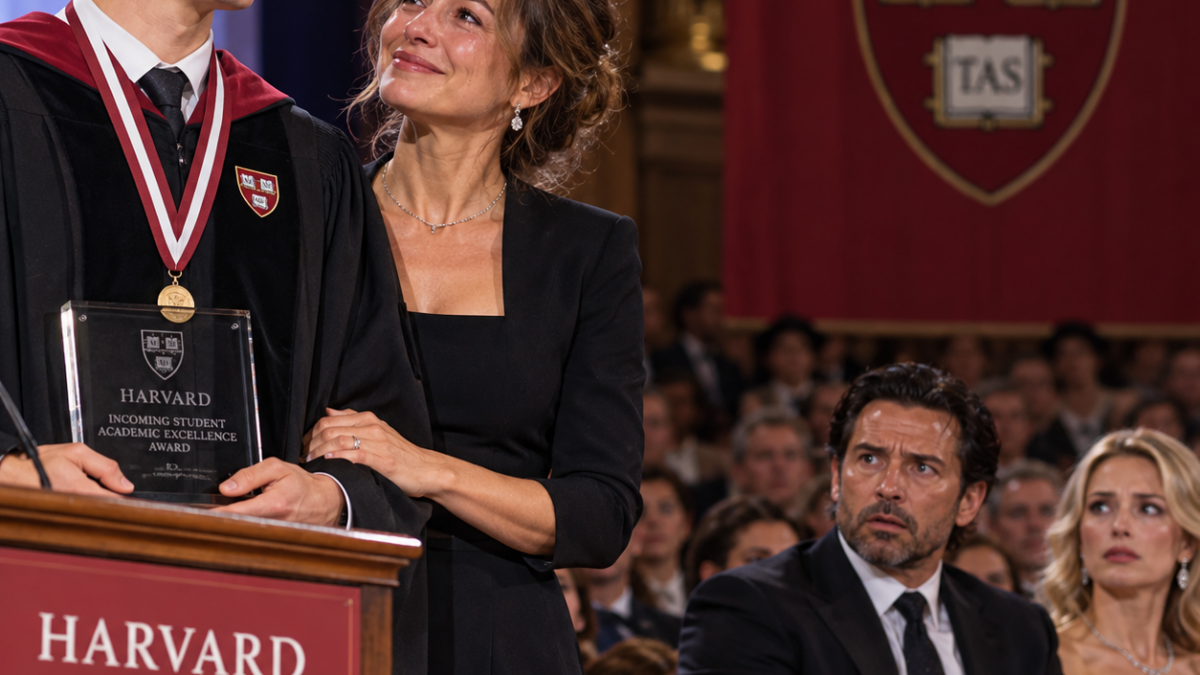
He walked onto the stage.
Vincent applauded.
Polite.
Unaware.
Noah accepted his award.
Then he approached the microphone.
He had been asked to speak for two minutes.
He’d practiced with me the night before.
He began:
“People sometimes talk about academic achievement as if intelligence is the whole story.”
His voice was steady.
“It’s not.”
“Success is continuing when nobody is watching.”
“When there is no applause.”
“When the outcome is uncertain.”
“When the problem is harder than you expected.”
Vincent’s head tilted slightly.
He did that when listening carefully.
Noah did it too.
My stomach twisted.
Then Noah said:
“There is one person who deserves to share this moment with me.”
I knew what was coming.
Still wasn’t ready.
“My mom.”
He looked toward our row.
“Mom, please come up here.”
People turned.
I stood.
And Vincent saw me.
The expression on his face changed so completely that I almost stopped walking.
His entire body went rigid.
Sophia followed his gaze.
Her face lost color.
Ethan looked confused.
I walked toward the stage.
One step.
Then another.
Vincent looked at me.
Then Noah.
Then me again.
I watched the arithmetic happen.
Noah.
Eighteen.
Divorce.
Eighteen years.
Dark hair.
Eyes.
Jaw.
The same small crease beside the left eyebrow Vincent had.
The same one Noah inherited.
By the time I reached the stage, Vincent was no longer applauding.
He looked like somebody had emptied his chest.
Noah hugged me.
The host smiled.
“Ms. Bennett, congratulations.”
“Thank you.”
“Raising such an accomplished young man must have been extraordinary.”
“It has been.”
“Was your husband able to support you along the way?”
There are moments when one sentence can open a door you thought you’d buried.
I looked at Noah.
He knew my standard answer.
Then I looked toward Vincent.
His eyes were fixed on me.
Sophia looked terrified.
I lifted the microphone.
“My husband died the day my son was born.”
The auditorium became quiet.
The host whispered:
“I’m so sorry.”
I smiled.
“Thank you.”
Noah squeezed my hand.
The ceremony moved on.
But Vincent did not.
He sat there as though the room had vanished around him.
When we stepped offstage, Noah whispered:
“Mom.”
“I know.”
“Why is that man staring at us?”
I closed my eyes briefly.
Then:
“Because that’s Vincent Moretti.”
Noah froze.
He knew the name.
I had told him his father’s identity when he turned sixteen.
Not everything.
Enough.
I had shown him one photograph.
Old.
Wedding picture cropped so only Vincent remained.
Noah had stared for a long time.
Then asked:
“Does he know?”
“No.”
He had not asked to contact him.
I didn’t push.
Now his father sat thirty yards away.
Noah looked over.
Vincent was still staring.
Then Noah whispered:
“Oh.”
One word.
The same kind that can change a life.
We returned to our seats.
The rest of the ceremony took forty-five minutes.
I remember none of it.
When people stood at the end, Vincent moved immediately.
Sophia grabbed his arm.
He pulled away.
Not violently.
Just decisively.
He came toward us.
Every instinct I had from eighteen years earlier returned.
Run.
Protect Noah.
Don’t let the Moretti world touch him.
Then Noah said:
“Mom.”
I looked at him.
“Let him come.”
That was not my decision anymore.
So I stayed.
Vincent stopped several feet away.
Up close, age had changed him.
Lines around the eyes.
Gray.
A scar near his chin I didn’t remember.
But his eyes were the same.
And they were full of tears.
“Claire.”
My name sounded broken in his mouth.
“Vincent.”
He looked at Noah.
Then back at me.
“Is he…”
I didn’t answer for him.
I looked at Noah.
Noah looked at Vincent.
Then said:
“My mother says you’re my father.”
Vincent’s face collapsed.
Not dramatic.
No shouting.
His shoulders simply dropped.
He covered his mouth.
For a moment, he couldn’t speak.
Then:
“I didn’t know.”
Noah said nothing.
Vincent looked at me.
“You never told me.”
“No.”
“Why?”
“Not here.”
Sophia reached us.
Ethan behind her.
Sophia’s expression was controlled again.
Almost.
“Vincent.”
He ignored her.
She looked at Noah.
Then at me.
“Claire.”
I said:
“Don’t.”
One word.
She stopped.
Ethan stared between all of us.
“What is happening?”
Vincent finally turned.
“This is my son.”
Ethan looked at Noah.
Then laughed once.
Not because it was funny.
Disbelief.
“What?”
Vincent said it again.
“My son.”
Sophia closed her eyes.
Ethan looked at her.
“Mom?”
She said:
“We should discuss this privately.”
His face changed.
“You knew?”
I saw it.
That tiny hesitation.
Sophia said nothing.
Ethan’s eyes widened.
“You knew.”
Vincent turned toward her slowly.
“Sophia.”
She looked at him.
“I knew Claire was pregnant.”
Every sound around us seemed to disappear.
I stared at her.
Vincent did too.
“What?”
Sophia’s face tightened.
“I found out after the divorce.”
“How?”
She looked at me.
I had no idea.
Then she said:
“You sent a letter to your attorney.”
My stomach dropped.
I remembered.
Two weeks after learning I was pregnant, I had written to my divorce lawyer.
Not to tell Vincent.
To ask whether pregnancy affected any remaining settlement issues.
I told him explicitly not to contact Vincent until I decided what to do.
Sophia apparently gained access through Harold Pierce.
Vincent stepped closer.
“You knew Claire was carrying my child?”
Sophia whispered:
“I suspected.”
“That’s not what you said.”
“I knew she was pregnant.”
“Did you know the baby was mine?”
“I assumed.”
Vincent looked like he might be sick.
Ethan said:
“Mom, what else do you know?”
Sophia glanced around.
People were noticing.
She whispered:
“Not here.”
For once, everyone agreed.
Harvard staff provided a private conference room after Vincent’s security people quietly requested space.
I hated that his world could still rearrange rooms.
But I also wanted privacy.
Inside were:
Me.
Noah.
Vincent.
Sophia.
Ethan.
Nobody else.
Vincent remained standing.
I sat beside Noah.
Sophia sat across from us.
Ethan stayed near the door.
Then Vincent asked:
“Claire, is Noah biologically mine?”
“Yes.”
His eyes closed.
I watched eighteen years hit him again.
“When?”
“Conceived before the divorce.”
“You knew before you left Chicago?”
“No.”
“I found out after.”
“How long after?”
“About three weeks.”
“Why didn’t you tell me?”
Noah shifted beside me.
I looked at him.
This was not the conversation I wanted him hearing as though he were evidence in someone else’s case.
I said:
“Because I had just discovered Ethan.”
Vincent flinched.
“I know.”
“You had built an entire relationship with another woman around a child I never knew existed.”
“I thought if I told you about Noah, he would spend his life being compared.”
“He wouldn’t have.”
“You can’t know that.”
Vincent looked at Ethan.
Then back at me.
“I would’ve loved him.”
“You loved Ethan too.”
“Yes.”
“That was the problem.”
His face hardened slightly.
“I don’t understand.”
“I did.”
“I knew Sophia.”
“I knew myself.”
“I knew what our lives would become.”
“Two mothers.”
“Two sons.”
“One man trying to prove he wasn’t favoring anyone.”
“Every birthday measured.”
“Every school compared.”
“Every room poisoned.”
Sophia looked away.
Vincent whispered:
“You had no right to make that decision for me.”
There it was.
The sentence I’d known would eventually come.
“You’re right.”
That surprised him.
I continued.
“I had the right to leave.”
“I had the right to raise Noah away from the life I didn’t want for him.”
“But I should have told you he existed.”
Noah looked at me.
I forced myself to keep going.
“I was angry.”
“Afraid.”
“Proud.”
“And I convinced myself silence was protection.”
“It wasn’t entirely.”
“Some of it was punishment.”
Vincent stared at me.
The truth hurt.
It should.
Then Noah spoke.
“I need everybody to stop talking about me like I was a custody problem before I could walk.”
Silence.
My son looked at Vincent.
Then me.
“I understand why Mom left.”
“I understand why she didn’t want me in whatever this was.”
He gestured toward the room.
“But I’m eighteen.”
“So whatever happens next is mine too.”
Vincent nodded immediately.
“Yes.”
Noah looked at him.
“Don’t say yes because you’re trying to impress me.”
Vincent almost smiled.
“I wasn’t.”
“Good.”
Then Noah asked:
“Did you know Mom was struggling financially?”
Vincent’s expression changed.
“What?”
I looked at Noah.
He knew enough.
Years of careful budgeting had never been a secret.
He continued.
“Did you?”
Vincent looked at me.
“I sent money.”
I stared.
“What?”
“Every month.”
“For eighteen years.”
I thought I’d heard him wrong.
“No.”
Vincent’s face tightened.
“Yes.”
“No, you didn’t.”
“Claire.”
“I never received anything.”
Sophia went still.
That was the moment everything shifted.
Vincent looked toward her.
Very slowly.
“Sophia.”
She shook her head.
“No.”
Ethan frowned.
“What?”
Vincent’s voice dropped.
“I authorized ten thousand dollars a month to Claire beginning after the divorce.”
My stomach turned.
Ten thousand.
Every month.
Eighteen years.
More than two million dollars before investment growth.
I thought about:
Daycare.
Medical bills.
The year my car transmission failed.
Noah’s braces.
Math-camp fees.
College application travel.
Nights I lay awake counting money.
I looked at Sophia.
“You intercepted it.”
She stood.
“No.”
Vincent said:
“Sit down.”
She stared at him.
He didn’t raise his voice.
She sat.
Then he pulled out his phone.
Called someone.
“Get me the Bennett support file.”
Pause.
“Now.”
Noah looked uncomfortable.
I touched his hand.
He was eighteen.
Brilliant.
Still my child.
Vincent ended the call.
Sophia said:
“You’re humiliating all of us.”
Ethan laughed.
“Mom, I think we’re past that.”
She looked at him.
“Ethan.”
“No.”
His voice sharpened.
“You knew about him.”
He pointed at Noah.
“You knew Dad had another son.”
“And you said nothing.”
Sophia whispered:
“I was protecting you.”
I nearly laughed.
Different mother.
Same excuse.
Noah looked at me.
He heard it too.
Protection.
The word adults use when fear wants to sound noble.
Vincent said:
“How did you know about the payments?”
Sophia looked away.
She didn’t answer.
His phone rang.
He put it on speaker.
A man introduced himself from Moretti family accounting.
Vincent asked for payment history.
The man confirmed:
Monthly transfers had been processed to a Bennett-designated support structure.
Vincent asked:
“Whose authorization?”
Pause.
“Originally yours, sir.”
“Subsequent routing instructions came through Mr. Pierce.”
“Based on documents represented as Ms. Bennett’s authorization.”
I said:
“I signed nothing.”
Another pause.
“Understood.”
Vincent looked at Sophia.
“Where is Harold?”
She said nothing.
That became the beginning of an investigation far larger than the Harvard room.
But in that moment, I didn’t care about money.
Not yet.
I looked at Vincent.
“Why did you send it?”
His expression softened.
“Because I thought you’d refuse it if it came directly from me.”
“I would’ve.”
“I know.”
“So I asked Harold to create a structure that would transfer money without requiring contact.”
“Why?”
He stared at me.
“Because you were my wife for seven years.”
“That didn’t stop being true because you hated me.”
I looked away.
Noah said:
“She didn’t hate you.”
I turned.
“Noah.”
He shrugged.
“You didn’t.”
Vincent looked at me.
I hated my son for approximately two seconds.
Then loved him again.
The Harvard weekend ended without resolution.
How could it not?
Vincent asked whether he could speak with Noah alone.
Noah said no.
Not yet.
He asked for Noah’s number.
Noah said:
“Give me yours.”
Vincent did.
No demand.
No pressure.
Good.
Sophia left with Ethan.
Not together exactly.
Same hallway.
Ten feet apart.
That image told me something had broken.
Vincent approached me before we left.
“Claire.”
“Yes?”
“I am sorry.”
“For what?”
His eyes filled.
“Which part?”
Fair.
Then:
“I am sorry I made you feel like leaving was your only safe option.”
I nodded.
“That doesn’t excuse what I did.”
“No.”
“It doesn’t.”
He accepted it.
That mattered.
Then he said:
“Can I hug him?”
He meant Noah.
I looked at my son.
Noah heard.
He considered.
Then shook his head.
“Not yet.”
Vincent’s face fell.
But he nodded.
“Okay.”
That night, Noah and I sat in our hotel room with takeout cartons between us.
Neither of us ate much.
Finally he said:
“Were you ever going to tell me about Ethan?”
“Yes.”
“When?”
“When you asked to contact Vincent.”
“So never if I didn’t?”
I swallowed.
“Maybe.”
He looked disappointed.
That hurt more than Vincent’s anger.
“Mom.”
“I know.”
“No.”
“You don’t get to say that.”
He sounded exactly like me.
I stopped.
Noah continued.
“I love you.”
“You raised me.”
“You gave me everything.”
“But you still decided what information I was allowed to have about my own family.”
I had no defense.
“You’re right.”
He stared.
“You really mean that?”
“Yes.”
“I thought I was protecting you.”
“Again.”
There it was.
I almost smiled.
Didn’t.
“I need to stop using that word.”
“Probably.”
We sat quietly.
Then:
“Do you regret raising me alone?”
“No.”
“Do you regret not telling him?”
I took longer.
“Yes.”
That answer surprised him.
“I didn’t for years.”
“But looking at him today…”
I stopped.
Noah waited.
“I realized I stole something from both of you.”
“A choice.”
“Yes.”
He nodded.
Then:
“I don’t know if I want him.”
I understood.
“You don’t have to decide.”
“Good.”
“But I want to know him.”
“That makes sense.”
“Does that hurt you?”
“Yes.”
He looked at me.
I smiled sadly.
“But that isn’t your responsibility.”
That was one of the hardest sentences I’d ever spoken.
Three days after returning to Madison, Noah texted Vincent.
I didn’t ask what he wrote.
At dinner, Noah told me:
“He asked if we could meet.”
“When?”
“Next weekend.”
“Where?”
“Here.”
My fork stopped.
“He’s coming to Madison?”
“Yes.”
“Okay.”
Noah watched me.
“You don’t have to be there.”
“I know.”
“Will you?”
“If you want me.”
“I think I do.”
So Vincent came.
No entourage.
No Sophia.
No driver waiting visibly outside.
One black sedan parked half a block away because apparently old habits die slowly.
I opened the door.
For a second, we were thirty-one again.
Then Noah appeared behind me.
Vincent looked past my shoulder.
His face changed.
“Hi.”
Noah said:
“Hi.”
Awkward.
Human.
Good.
We sat at my kitchen table.
The same table where Noah opened his Harvard acceptance.
Vincent brought nothing.
No gift.
No expensive watch.
No envelope.
I appreciated that.
He asked Noah about school.
Math.
Research.
Harvard.
Noah asked about Vincent’s businesses.
Then:
“Do you actually do what newspapers say you do?”
I almost choked on coffee.
Vincent looked at me.
“Don’t look at her,” Noah said.
“I’m asking you.”
Vincent leaned back.
“Some of what has been written is true.”
“Some exaggerated.”
“Some things I did in the past I am not proud of.”
“Are you a criminal?”
Vincent answered:
“I’ve been involved in conduct that would fit that word.”
Noah stared.
“You could just say yes.”
“Yes.”
I almost smiled.
Vincent did too.
Then Noah asked about Ethan.
Vincent’s face softened.
“He’s a good man.”
“What happened with him?”
“What do you mean?”
“Mom said you knew about him before you married her.”
Vincent looked at me.
Then back at Noah.
“I did.”
“Why hide him?”
“Cowardice.”
Noah didn’t expect that.
Neither did I.
Vincent continued.
“I was afraid Claire would leave.”
“So you lied until she left.”
“Yes.”
“That was stupid.”
“Yes.”
Noah looked almost disappointed that Vincent kept agreeing.
Then:
“Did you love Sophia?”
Vincent’s expression changed.
“I cared for her.”
“That isn’t what I asked.”
“No.”
He answered carefully.
“Not the way I loved your mother.”
Noah glanced at me.
I looked down at my coffee.
Then he asked:
“So why stay with her after the divorce?”
Vincent sighed.
“Because Ethan was six.”
“Because Sophia and I had built a strange version of a family around him.”
“Because I had just lost Claire and believed I deserved whatever came next.”
“And because I was weak in a different way than people assumed.”
That was more honest than the Vincent I had left.
Noah noticed.
The first meeting lasted ninety minutes.
When Vincent stood to leave, Noah walked him to the door.
Vincent paused.
No hug.
Then Noah said:
“Maybe next weekend.”
Vincent looked at him.
“Whenever you want.”
Then left.
In the driveway, he sat in the car for fifteen minutes before it moved.
I watched from the window.
I shouldn’t have.
I did.
The accounting investigation moved quickly.
Harold Pierce resigned.
Then hired an attorney.
Records showed forged instructions had redirected my payments into a trust account controlled through an entity Sophia managed.
Not all funds went directly to her.
Some had paid expenses for Ethan.
Schooling.
Travel.
Properties.
Investments.
Other transfers were personal.
The total misdirected over eighteen years was staggering.
Vincent offered me everything immediately.
I refused.
He looked at me across my attorney’s conference table.
“Claire.”
“I don’t want blood money.”
“It was not criminal revenue.”
“It came from legitimate holdings.”
“Still.”
“It was intended for you.”
“I survived without it.”
His jaw tightened.
“That doesn’t mean you should have had to.”
I looked at him.
“For once, don’t decide what I should accept.”
He stopped.
Then nodded.
“What do you want?”
Good.
Progress.
I said:
“An accounting.”
“Every dollar.”
“Every transfer.”
“Then we decide what belongs to Noah legally.”
Vincent agreed.
Independent forensic accountants reviewed it.
Not his people.
Not mine.
Professionals jointly selected by counsel.
The final figure exceeded two million in principal alone.
Investment growth made the theoretical value much higher.
I did not take all of it.
Part went into a trust for Noah’s education and future.
Part into restitution under the civil resolution.
A substantial amount was eventually redirected by agreement into scholarships for first-generation college students and emergency assistance for single parents.
Why?
Because I knew exactly what thirty dollars could mean when payday was four days away.
Vincent matched the donation separately.
I did not ask him to.
For once, I let a good choice simply be his.
Sophia’s consequences were not cinematic.
She wasn’t dragged away from a gala in handcuffs.
There were civil suits.
Financial investigations.
Forgery allegations.
Tax questions.
Her attorney negotiated.
Some claims settled.
Others proceeded.
Harold cooperated.
That worsened her position.
Eventually she entered agreements requiring repayment and faced criminal consequences for conduct prosecutors could prove.
Not every missing dollar became a separate dramatic count.
Real cases are slower and less satisfying than revenge fantasies.
Ethan was devastated.
That mattered more to me than Sophia.
He had spent his whole life believing his mother had built stability around him.
Now he learned some of that stability had been funded by money stolen from another woman.
And indirectly from his half brother.
He called Noah six weeks after Harvard.
Noah told me afterward.
“What did he want?”
“To apologize.”
“For what?”
“I asked him that.”
“What did he say?”
“For existing inside a lie.”
My chest hurt.
Ethan had done nothing wrong.
I told Noah:
“Make sure he knows that.”
“I did.”
The brothers met without us.
Boston.
Coffee shop.
No security.
No parents.
No Sophia.
No Vincent.
When Noah came home for winter break, I asked only:
“How was it?”
“Weird.”
“Good weird?”
“Mostly.”
He smiled.
“He’s not what I expected.”
“What did you expect?”
“More Moretti.”
I laughed.
“He probably says the same about you.”
They became friends slowly.
Not instant brothers.
That would’ve been dishonest.
There was jealousy.
Ethan had eighteen years of Vincent.
Noah had none.
Noah had me fully.
Ethan grew up between Sophia and Vincent’s complicated relationship.
Each had something the other imagined was better.
One night, Noah told me:
“I used to think Ethan got everything.”
“And?”
“He thought I did.”
That is family in one sentence.
Comparison thrives on incomplete information.
Vincent and Noah’s relationship developed slower.
At first:
Monthly lunch.
Phone calls.
Emails about books.
Vincent discovered Noah liked chess.
He almost cried.
Apparently he’d taught Ethan too.
Noah told me:
“Dad cheats.”
I stopped breathing.
It was the first time he’d called him Dad.
He didn’t notice.
I did.
“Does he?”
“Yes.”
“He calls it strategy.”
“That sounds like him.”
Vincent called me later that night.
His voice was shaking.
“He called me Dad.”
“I know.”
“He told you?”
“He didn’t notice.”
Vincent was silent.
Then:
“I don’t deserve that.”
“Don’t make him reassure you.”
He exhaled.
“You’re right.”
That became our strange relationship.
Not married.
Not romantic.
But parents.
Eighteen years late.
Learning.
Vincent came to Noah’s Harvard move-in.
I almost said no.
Then remembered:
Ask Noah.
Noah wanted him there.
So we both went.
Vincent carried boxes.
Badly.
A man who could command hundred-million-dollar deals somehow did not understand dorm-room furniture.
He tried to pay someone to assemble a desk.
Noah said:
“No.”
Vincent said:
“Why?”
“Because you need character development.”
I laughed so hard I had to sit down.
Vincent glared.
Then assembled the desk.
Crooked.
Noah kept it that way all year.
Ethan visited that evening.
The three of them went to dinner.
I stayed at the hotel.
That hurt.
Then I recognized the hurt for what it was.
Loss of control.
Not loss of love.
Noah was building relationships that did not require me in the room.
That’s what children are supposed to do.
I had spent eighteen years making sure he never needed anyone else to feel chosen.
Now I had to let him choose others.
Harder than it sounds.
Vincent and I eventually had the conversation we’d avoided since Harvard.
It happened in Madison.
Rain.
Coffee.
Same kitchen.
Noah away at school.
Vincent stood by the window.
“Why did you say your husband died the day Noah was born?”
I had forgotten.
The stage.
The microphone.
That sentence.
I answered honestly.
“Because the man I married was gone.”
Vincent looked down.
“That hurt.”
“I know.”
“Was it meant to?”
I thought.
“Partly.”
He nodded.
“I deserved some of it.”
“That’s not the same as it being right.”
He looked at me.
There it was.
Growth.
I continued.
“I used widowhood as a shortcut.”
“It kept people from asking questions.”
“Teachers.”
“Doctors.”
“Other parents.”
“Noah knew the truth when he was old enough.”
“But publicly, it was easier to say his father was dead than explain why he didn’t exist in our lives.”
Vincent’s voice went quiet.
“I would’ve come.”
“I know that now.”
“You knew then.”
I looked at him.
“Maybe.”
He sat.
“Claire.”
“Yes?”
“I sent letters.”
“I never got them.”
“What?”
“After the divorce?”
“Yes.”
I stared.
More Sophia.
Not necessarily.
We investigated.
Some letters went to my old Chicago address.
Others through attorneys.
My attorney had received two and, respecting my instruction that I wanted no personal contact, filed them without forwarding.
That one was on me.
Vincent had written:
I know you don’t want me in your life. I will respect that. If you ever need anything, ask. If you never speak to me again, know that I am sorry.
Another:
I wake up reaching for you.
I read those letters eighteen years late.
They did not change history.
But they changed one belief.
I had thought Vincent stopped caring the moment I left.
He hadn’t.
We had both lived inside stories built partly from silence.
Sophia exploited some of it.
We created the rest ourselves.
I said:
“I’m sorry.”
Vincent looked surprised.
“For what?”
“For believing the worst version of you every time I had incomplete information.”
He almost smiled.
“You had evidence.”
“Yes.”
“Still.”
He leaned back.
Then:
“I’m sorry I gave you enough reasons that the worst version always seemed plausible.”
That was the closest thing to peace we’d had.
Not reconciliation.
Peace.
Noah thrived at Harvard.
Not effortlessly.
That’s important.
He failed his first advanced proof-based math exam.
Called me at midnight.
“I don’t belong here.”
I smiled.
“Good.”
“Mom.”
“You finally found a room where everyone is smarter than you.”
“This is not supportive.”
“It is.”
He got a B-minus in the course.
Proudest grade of his life.
Vincent sent him champagne.
I confiscated it because Noah was nineteen.
Vincent said:
“France would disagree.”
“We are not in France.”
“Authoritarian.”
“You survived organized crime but fear me.”
“Correct.”
By sophomore year, Noah joined a research group.
By junior year, he studied abroad.
By senior year, he had offers for graduate programs.
He chose mathematics research over finance.
Vincent pretended not to be disappointed.
Ethan worked in the Moretti legitimate businesses.
Very good at it.
The brothers joked that they’d split the family skills.
One got numbers.
One got money.
I told them both that distinction was suspicious.
Sophia and Ethan’s relationship took years to repair.
At first he refused contact.
Then therapy.
Then carefully limited visits.
I never interfered.
She was his mother.
What she did to me did not erase twenty-four years of being his mother.
Again:
Two truths.
People are rarely only one thing.
I never became friends with Sophia.
There was no need.
But five years after Harvard, she wrote to me.
Handwritten.
No lawyer.
No excuse.
She admitted what she’d done.
Not every detail.
Enough.
She wrote:
I told myself I was protecting Ethan’s place in Vincent’s life. The truth is I was terrified that if Vincent knew about Noah, he would leave us completely. I turned your son into a threat before he was even born.
I stopped reading there.
Cried.
Then finished.
She apologized for the money.
The lies.
The years.
She did not ask forgiveness.
Good.
I replied with four sentences.
I received your letter. What happened cannot be undone. Noah and Ethan are building their own relationship, and I will not interfere with that. I hope you use whatever life comes next to become someone you can live with.
That was all.
No absolution.
No hatred.
Finished.
Vincent changed too.
His businesses became cleaner over time.
Not because Harvard magically reformed him.
Age.
Pressure.
Legal risk.
Noah.
Ethan.
Maybe me.
He stepped back from the darker parts of his family network.
Sold interests.
Cooperated through lawyers when necessary.
Paid penalties where required.
A life built on power doesn’t become respectable through one emotional revelation.
It takes decisions.
Years.
Losses.
Some people left him.
Some relationships broke.
He accepted it.
At sixty-two, Vincent looked less feared and more tired.
I preferred him that way.
Noah graduated Harvard summa cum laude.
Vincent sat beside me.
Not Sophia.
Ethan was on his other side.
When Noah crossed the stage, Vincent cried openly.
I whispered:
“Chicago’s feared man.”
He looked at me.
“You’ve been talking to Elena Marchetti?”
I laughed.
Wrong story.
Wrong family.
But the joke felt familiar somehow.
Then Noah found us.
He hugged me first.
Always.
Then Vincent.
No hesitation now.
“Dad.”
Vincent closed his eyes.
Hugged him.
Ethan joined.
Three men with the same eyes.
Different histories.
One family.
Complicated.
Real.
After graduation, Noah pulled me aside.
“I want you to know something.”
“What?”
“I never felt deprived.”
My throat tightened.
He continued.
“I was curious.”
“Sometimes angry.”
“Sometimes I wished you’d told him.”
“But I never felt unloved.”
I couldn’t speak.
He smiled.
“You kept your promise.”
“What promise?”
“I don’t know.”
“The one you always acted like you made.”
I did.
The hospital room.
Newborn Noah.
You will never have to beg anyone to choose you.
I hugged him.
Then said:
“I kept it badly.”
“What do you mean?”
“I protected you from one kind of hurt by taking away a choice.”
He thought.
Then:
“Maybe.”
“You still gave me enough safety to disagree with you when I got older.”
That was more generous than I deserved.
I accepted it anyway.
Vincent never remarried.
People assumed that meant he waited for me.
Romantic nonsense.
His relationship with Sophia had already been fractured long before Harvard.
After the financial investigation, it ended completely.
He dated later.
So did I.
I had one serious relationship with a professor named David Chen for six years.
Good man.
We separated kindly when our lives changed.
No tragedy.
No betrayal.
Vincent and I did not reunite romantically.
That surprised everyone who loves neat endings.
We loved each other.
Somewhere.
In a way altered by time.
But love does not require returning to the same house.
What we built instead was honest.
Family dinners.
Graduations.
Birthdays.
Grandchildren later.
No secret rooms.
No missing children.
No intercepted payments.
No pretending.
When Noah married at thirty-one, he asked Vincent and me to walk him down the aisle together.
I laughed.
“You know that’s usually not how grooms enter.”
“I don’t care.”
Vincent said:
“Your mother hates breaking convention.”
I stared at him.
“You spent half your life breaking federal law.”
He smiled.
“Different convention.”
Noah’s wife, Grace, loved both his fathers.
Yes.
Fathers plural eventually.
Because Ethan’s stepfather later became close too.
Families grow sideways.
Nobody draws the diagram correctly.
At the wedding, Vincent wore a black tuxedo.
I wore dark green.
We stood on either side of Noah.
Before walking, Vincent whispered:
“Claire.”
“Yes?”
“Thank you.”
“For what?”
He looked at our son.
“For raising him.”
I swallowed.
“You’re welcome.”
Then:
“I’m sorry I wasn’t there.”
I looked at him.
“You didn’t know.”
“I still wish I had been.”
“I know.”
Noah heard us.
“Can we walk before both of you ruin my wedding?”
We walked.
Years later, Vincent became ill.
Heart failure.
Manageable at first.
Then not.
Noah flew home.
Ethan too.
I visited the hospital because neither son should have to manage that alone.
Vincent looked smaller in a hospital bed.
Power does that.
Strip away the room.
The suit.
The men waiting outside.
You get a human body.
He looked at me.
“Claire.”
“Vincent.”
“Still beautiful.”
“Still manipulative.”
He smiled.
Then:
“Sit.”
I did.
He asked:
“Do you regret it?”
“What?”
“Not telling me.”
I knew immediately.
I could have softened.
Didn’t.
“Yes.”
His eyes filled.
“I regret the years you lost.”
“I regret Noah didn’t know you.”
“I regret deciding for both of you.”
Then:
“But I don’t regret leaving.”
He nodded.
“I understand.”
“Do you regret Ethan?”
“No.”
“Do you regret Sophia?”
He thought.
“Parts.”
Fair.
Then:
“Do you regret me?”
His eyes opened wider.
“No.”
“Never.”
I smiled.
“Good answer.”
He reached for my hand.
I let him.
Then he said:
“You know what I hated most about Harvard?”
“What?”
“That I recognized him.”
My throat tightened.
“Immediately?”
“Not immediately.”
“When you stood.”
“I saw his face after seeing yours.”
“And suddenly I knew.”
He closed his eyes.
“I had spent eighteen years believing you vanished because you wanted nothing from me.”
“Then there was my son.”
“So much of me.”
“And none of his life had me in it.”
I squeezed his hand.
“You got years afterward.”
“Yes.”
His smile returned faintly.
“Not enough.”
“No.”
“Never enough.”
Vincent lived another eighteen months.
Long enough to meet Noah’s first child.
A girl.
Claire Sophia Bennett.
I objected to Sophia.
Noah laughed.
“Not for her.”
“It’s Grace’s grandmother.”
Fine.
Vincent held the baby.
Cried.
Of course.
He died at sixty-eight.
Both sons with him.
I was there too.
Sophia was not.
That wasn’t punishment.
It was simply where relationships had ended.
After the funeral, Ethan gave me an envelope.
“Dad left this for you.”
I opened it at home.
One page.
Vincent’s handwriting.
Claire,
I spent half my life believing power meant preventing people from leaving me. You were the first person who proved that love can leave and still be real.
I lost eighteen years with Noah because you were afraid of the life I had built.
You were wrong not to tell me.
But you were not wrong to be afraid.
That distinction took me too long to understand.
Thank you for giving our son a life where my name was not the first thing people saw.
And thank you for letting me become his father after I had missed the chance to become his dad when he was little.
There is a difference.
I know now.
V.
I read it twice.
Then folded it.
No dramatic tears.
I’d cried enough across the years.
I put it beside the old Harvard program.
That program remained in a drawer for decades.
Noah’s name printed beneath the award.
The day everything opened.
People who heard the story always focused on the stage.
The reveal.
Vincent counting back eighteen years.
Sophia going pale.
The hidden son.
The missing money.
But that wasn’t the part that mattered most.
The important part came afterward.
When everybody had to stop using protection as an excuse.
I had used it.
Sophia had used it.
Vincent had too, in his own way.
We all believed love gave us permission to control what other people knew.
I hid Noah because I wanted to protect him.
Sophia hid money and information because she wanted to protect Ethan’s place.
Vincent hid Ethan because he wanted to protect our marriage.
Every one of us created the very damage we claimed to be preventing.
Noah was the first person who refused the pattern.
He asked questions.
He chose relationships himself.
He loved Ethan without competing.
He knew Vincent without worshipping him.
He loved me without pretending I had been right about everything.
That was his greatest intelligence.
Not mathematics.
Not Harvard.
Perspective.
When Noah was forty, he became a professor.
I attended his first major public lecture.
Sat in the third row.
Afterward, a student asked him what had shaped his career most.
I expected something academic.
A teacher.
A theorem.
A book.
Instead he said:
“My mother taught me persistence.”
Then:
“My father taught me that lost time changes what you do with the time you still have.”
I looked down.
Later I told him:
“You didn’t need to mention us.”
He smiled.
“I know.”
“Then why?”
“Because it was true.”
That answer felt like the final correction to our family.
Truth.
Not the version that protects.
Not the version that punishes.
The real thing.
Years after Vincent died, I returned to Harvard for Noah’s faculty appointment ceremony.
Different building.
Different stage.
Same kind of lights.
I sat beside Ethan.
We had become something like family.
Not close.
Comfortable.
He leaned over.
“You nervous?”
“For what?”
“Noah’s speech.”
“Why?”
“He might expose another family secret.”
I laughed.
“No more.”
“Please.”
Noah walked onto the stage.
Older.
Confident.
Still tilted his head when concentrating.
Vincent’s habit.
My son.
His son.
Our son.
The applause rose.
I thought about that first Harvard auditorium.
Vincent’s face.
Sophia’s hands.
My microphone.
My lie about my husband dying.
All the things we thought we needed to hide.
Then I looked at Noah.
Nothing hidden now.
That was the legacy.
Not Moretti money.
Not Harvard.
Not the scandal.
Clarity.
When the ceremony ended, Noah came down.
Hugged me.
Then Ethan.
We walked outside together.
No security.
No reporters.
No confrontation.
Just a cold Massachusetts afternoon.
Noah asked:
“Dinner?”
I said:
“Your treat.”
He laughed.
“I’m a professor.”
“Exactly.”
Ethan said:
“Dad would’ve paid.”
I looked at him.
“No.”
He smiled.
“Worth trying.”
We walked toward the restaurant.
And for the first time in my life, the Moretti name followed behind us instead of leading the way.
That was what I had wanted for Noah all along.
I just wish I’d understood sooner that protecting his future did not require erasing his past.
The day Vincent saw Noah on that Harvard stage, I thought the truth had finally caught up with us.
I was wrong.
Truth doesn’t catch you once.
It keeps arriving.
In conversations.
Documents.
Apologies.
Questions from your children.
Letters left after death.
It asks you to look again at the decisions you once called necessary.
Some remain understandable.
Some become indefensible.
Most are both.
I was right to leave Vincent.
I was wrong to hide his son.
Vincent was right that Ethan deserved his father.
He was wrong to build our marriage around a secret.
Sophia loved Ethan.
She also harmed people to protect what she thought belonged to him.
No one escaped complexity.
That’s real family.
No heroes.
No perfect villains.
Just people making choices.
Then living long enough to understand them.
And whenever I remember that Harvard stage, I no longer see Vincent’s shock first.
I see Noah under the lights.
Eighteen years old.
Holding an award he’d earned without Moretti money, Moretti influence, or even the knowledge that his father would be sitting in the room.
He looked into the audience.
Found me.
And asked me to stand beside him.
For eighteen years, I had believed I was the only parent who had chosen him.
I eventually learned something better.
Noah had never needed to compete for Vincent’s love.
He only needed the truth soon enough to decide whether he wanted it.
I gave him that choice late.
Vincent received his chance late.
But late was not never.
They got years.
Phone calls.
Arguments.
Chess games.
Graduation.
A wedding.
A granddaughter.
Ordinary time.
And in the end, that became more important than the eighteen years they lost.
Because lost time can teach you two things.
You can spend the rest of your life mourning what should have happened.
Or you can stop wasting the time still standing in front of you.
Vincent chose the second.
So did Noah.
Eventually, so did I.








