My Sister-in-Law Destroyed Grandma’s Lake House for Her Wedding—So I Sent Her One Last Wedding Gift.k
PART2:
Kelsey was Mark’s younger sister.
Thirty-two.
Beautiful.
Social.
Funny when she wanted to be.
And one of the most exhausting people I had ever met when something stood between her and whatever she wanted.
She had always been the family member whose crises somehow became everybody else’s assignments.
Car problem?
Mark handled it.
Apartment deposit?
Their parents helped.
Missed deadline?
Someone called in a favor.
Forgot Mom’s birthday?
Kelsey bought flowers three days later and somehow the story became how busy she had been.
I had learned early that confronting her rarely accomplished anything.
So I stayed out of it.
Mark loved his sister.
Their mother, Denise, had spent most of Kelsey’s life protecting her from consequences.
Their father, Paul, was quieter but usually gave in because disagreement exhausted him.
I wasn’t interested in becoming the outsider who constantly criticized the family’s youngest daughter.
Then the wedding happened.
Kelsey had planned it for nearly a year.
The venue was a restaurant and event space called Harbor & Vine.
Outdoor terrace.
Lake view.
Private dining room.
About seventy guests.
Flowers.
Live band.
Everything arranged.
Two days before the ceremony, a pipe burst in the building after an overnight plumbing failure.
Water damaged the kitchen and part of the reception space.
The restaurant canceled every event for the weekend.
Kelsey called Mark first.
I knew because he came into my office while I was working.
His expression told me this was about to become my problem.
“Natalie.”
“What?”
“Kelsey’s venue flooded.”
I looked up.
“What?”
“Burst pipe.”
“That’s awful.”
“She has nowhere to hold the wedding.”
I already knew what came next.
I said nothing.
Mark sat down.
“Every venue is booked.”
“It’s September.”
“Yes.”
“Wedding season.”
“Yes.”
“And?”
He looked at me.
“The lake house.”
“No.”
The answer came so fast he actually blinked.
“Natalie.”
“No.”
“You haven’t even thought about it.”
“I have.”
“For three seconds.”
“Enough.”
He exhaled.
“It’s one afternoon.”
“No, Mark.”
“The yard is huge.”
“Not for seventy people.”
“Maybe sixty-five.”
“That’s not better.”
“She can rent tents.”
“Where are people parking?”
“They’ll figure it out.”
“Bathrooms?”
“Portable units.”
“Food?”
“Caterer.”
“Alcohol?”
“Insurance?”
“Noise?”
“Neighbors?”
“Mark, this isn’t just a big backyard.”
He rubbed his face.
“I know.”
“Do you?”
“Yes.”
Then:
“But she’s my sister.”
There it was.
The sentence that had solved most Kelsey problems since childhood.
She’s family.
I said:
“Family doesn’t make my property an emergency venue.”
He frowned.
“It’s not just property to you.”
“Exactly.”
“I know what the place means.”
“Then why are you asking?”
“Because she’s getting married in forty-eight hours.”
I turned back toward my computer.
“No.”
He left angry.
Twenty minutes later, Kelsey called.
I almost didn’t answer.
Then I thought perhaps hearing me directly would end it.
“Natalie.”
She was crying.
Real crying.
At least partly.
“I know Mark asked.”
“He did.”
“I wouldn’t ask if I had another option.”
“I know.”
“I called twelve venues.”
“Everybody is booked.”
“The church has another wedding.”
“The hotel ballroom is being renovated.”
“One place wanted sixteen thousand dollars for a last-minute cancellation opening.”
I listened.
Then:
“The lake house would be perfect.”
“Kelsey.”
“I’ll take care of everything.”
“No one will touch anything.”
“We’ll stay outside.”
“Guests use rented bathrooms.”
“The caterers bring their own setup.”
“Cleanup crew comes Sunday morning.”
“Nothing inside except maybe the bridal party changing.”
That was more organized than Mark’s pitch.
Still:
“I don’t know.”
“Please.”
I could hear panic now.
Not entitlement.
Panic.
“I’ve already lost deposits.”
“People flew in.”
“Grandma Denise’s sister came from Arizona.”
“Ethan’s grandparents drove from Tennessee.”
Ethan was her fiancé.
Nice man.
I liked him.
He had spent the previous year looking permanently surprised by how expensive weddings could become.
Kelsey continued:
“I’ll sign whatever you want.”
“Deposit.”
“Cleaning.”
“Anything.”
“I swear to you, Natalie.”
“This isn’t going to become a free-for-all.”
I closed my eyes.
Grandma’s note floated through my head.
Don’t be afraid to live in it.
Would Grandma have let someone hold a wedding there?
Probably.
She loved family gatherings.
She also would have personally supervised every flower arrangement and threatened anyone who stepped on the peonies.
I said:
“I need rules.”
“Yes.”
“Absolutely.”
“No one touches Grandma’s garden.”
“Of course.”
“No decorations attached to the house.”
“Fine.”
“No indoor party.”
“Only changing.”
“No smoking anywhere on the property.”
“Okay.”
“No dragging tables across the lawn.”
“We’ll use protective flooring.”
“No lake access after dark.”
“Yes.”
“You remove all trash.”
“Yes.”
“And Kelsey?”
“What?”
“If a vendor says they need something from the property, you ask me.”
“Anything.”
“I mean it.”
“I know.”
She started crying harder.
“Thank you.”
I still felt uneasy.
Mark came back later.
I told him I’d agreed.
He hugged me.
“You saved her.”
“I haven’t saved anyone.”
“It’s a venue.”
“I’m serious.”
“I know.”
“You need to help me make sure she follows the rules.”
“I will.”
That should have been my warning.
I was asking Mark to enforce boundaries against the person he had spent his entire life rescuing.
That evening, I wrote everything down.
Nothing formal enough to qualify as a commercial venue contract.
I wasn’t running a business.
But I wanted clarity.
Kelsey signed an agreement acknowledging she was a guest using the property for a one-time private family event.
She accepted responsibility for damage caused by her, her guests, or vendors.
No garden removal.
No furniture removal without permission.
No indoor reception.
No alterations.
Professional cleanup.
No fires.
No unauthorized access to storage rooms.
She signed without reading most of it.
I noticed.
Should have stopped her.
Didn’t.
She hugged me instead.
“You’re the best.”
I told her:
“Please don’t make me regret this.”
She smiled.
“You won’t.”
Saturday morning, I woke at 6:12 to sixteen missed notifications.
Not from Kelsey.
My mother.
Aunt Julia.
My cousin.
Then Mom called again.
My aunt Linda had collapsed at home.
Possible stroke.
Ambulance.
Emergency department.
Linda was my mother’s younger sister.
She had no children and lived alone.
I got dressed in five minutes.
Mark was already at the lake house helping set up.
I called him from the car.
“I’m going to St. Mary’s.”
“What happened?”
“Aunt Linda.”
“Hospital.”
“Is she okay?”
“I don’t know.”
“Do you need me?”
I hesitated.
He was supposed to walk Kelsey down part of the aisle with their father as part of some family arrangement.
“No.”
“Stay there.”
“Are you sure?”
“Yes.”
“Please watch the house.”
“I will.”
That was the second time I said it.
Watch the house.
He said:
“I’ve got it.”
I spent almost twelve hours at the hospital.
Linda had experienced a transient ischemic event rather than a major stroke.
Scary.
Treatable.
Doctors admitted her overnight for monitoring and testing.
By the time she stabilized, it was nearly eight.
The wedding ceremony had already happened.
Reception underway.
Mark texted photographs.
Kelsey beneath a flower arch.
Sunset behind the lake.
Ethan in a navy suit.
Guests smiling.
It looked beautiful.
One picture showed Grandma’s porch lights glowing behind them.
I felt relieved.
Maybe I had worried for nothing.
I texted Mark:
Everything okay there?
He replied:
Beautiful. Don’t worry. Focus on Linda.
I did.
I slept at Mom’s that night because I was too tired to drive another hour to the lake house.
Mark stayed overnight at a hotel near the wedding with his family.
I returned Sunday around 10:30.
The first thing I saw was a champagne bottle in the driveway.
Green glass.
Empty.
I slowed.
Then another near the ditch.
Two plastic cups beside the mailbox.
My stomach tightened.
I parked.
Got out.
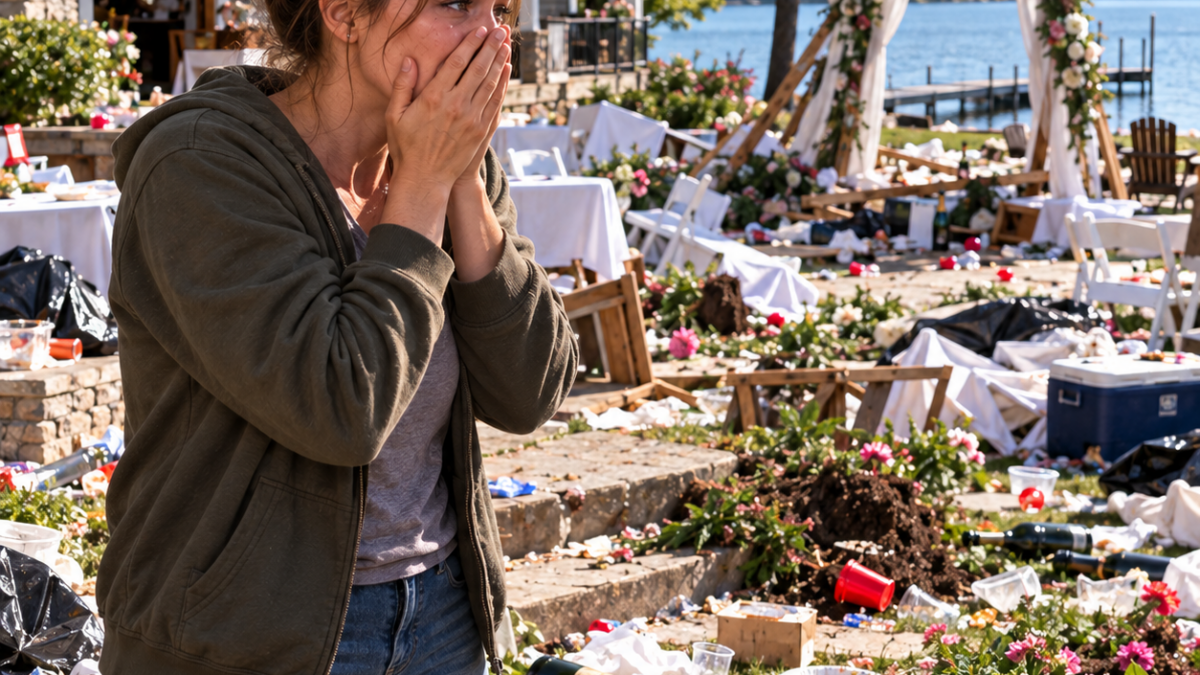
The lawn looked like a festival had been dismantled badly.
Deep depressions where tables had stood.
Mud.
Trampled grass.
Two long tracks where something heavy had been dragged.
Paper napkins moved across the yard in the breeze.
Disposable plates near the shrubs.
Cans.
Cups.
A crushed floral box.
Then I looked toward Grandma’s garden.
Stopped.
For several seconds, I couldn’t understand what I was seeing.
The peonies were gone.
Not flattened.
Gone.
Three hydrangea branches had been cut nearly to the main stems.
The climbing roses Grandma had trained along the white trellis had been stripped.
Lavender had been pulled.
I followed the destruction visually across the yard.
Then saw the wedding arch near the lakeshore.
Covered in flowers.
Grandma’s flowers.
I walked toward it.
Pieces of root still clung to one arrangement.
They hadn’t just cut blooms.
Someone had uprooted entire plants.
I touched one.
Peony.
Grandma planted those when I was nine.
I remembered holding a watering can that was too heavy while she told me not to drown them.
My throat closed.
Then I smelled garbage.
The back porch door was open.
I went inside.
The kitchen floor was sticky.
Plastic cups covered the counter.
Empty champagne bottles sat in the sink.
Food containers.
Cocktail napkins.
A serving tray with dried sauce.
Someone had used Grandma’s old ceramic mixing bowl as an ice bucket.
Three cabinet doors stood open.
One dining chair was outside.
One of the handmade couch cushions lay on the floor with a dark stain across the fabric.
I picked it up.
Wine.
Probably.
The living room rug had footprints.
A folding table blocked the hallway.
Someone had stacked boxes against Grandma’s china cabinet.
One box leaned into the glass.
I moved it.
No crack.
Small mercy.
Then I entered the downstairs bathroom.
Towels on the floor.
Makeup smeared on the counter.
Wet tissue.
Someone’s false eyelash stuck beside the sink.
The upstairs was worse.
Every bedroom had been used.
Clothes hangers.
Cups.
Food.
Glitter.
One bridesmaid dress bag across my bed.
Grandma’s dresser had a ring stain from a drink.
The house didn’t look robbed.
It looked disrespected.
That difference hurt more.
Nothing needed to be stolen for the place to feel violated.
I walked back outside.
Called Mark.
No answer.
Called again.
He answered on the third attempt.
“Natalie?”
“What happened here?”
Silence.
“What do you mean?”
“Don’t.”
I could hear people talking behind him.
Family breakfast.
“What happened to Grandma’s garden?”
Another silence.
“Natalie.”
“What happened?”
“The florist needed more flowers.”
I couldn’t speak.
Mark continued too quickly.
“Kelsey’s order got shorted.”
“There weren’t enough arrangements.”
“And they used my garden?”
“She asked.”
“She asked who?”
“I don’t know.”
“Mark.”
“She asked me.”
I closed my eyes.
“And you said yes.”
“She was crying.”
“So you let a florist rip out Grandma’s plants?”
“I thought they were cutting flowers.”
“You thought?”
“I didn’t realize they’d take entire plants.”
“I told you specifically.”
“I know.”
“No.”
“You don’t.”
“Because if you knew, you would have said no.”
He lowered his voice.
“Can we talk when I get there?”
“What about the house?”
“What?”
“The garbage.”
“The bedrooms.”
“The kitchen.”
“The furniture.”
“Was anyone supervising anything?”
He hesitated.
“We were all busy.”
I laughed once.
Cold.
“Busy.”
“The cleanup crew is coming.”
“When?”
“I thought this morning.”
“It’s almost eleven.”
“I’ll call Kelsey.”
“No.”
“I’ll call her.”
I hung up.
Kelsey answered cheerfully.
“Natalie!”
“What happened to my house?”
Silence.
Then:
“Oh.”
That “oh” told me everything.
“You’ve seen it.”
“Yes.”
“Look, cleanup is arranged.”
“When?”
“I don’t know.”
“Today.”
“The company said Sunday.”
“It is Sunday.”
“I just got married, Natalie.”
“I’m not tracking cleaners.”
“You ripped out my grandmother’s flowers.”
“They were flowers.”
I actually pulled the phone away from my ear.
“What?”
“The florist was short.”
“We needed the arch.”
“You needed?”
“It was my wedding.”
“That doesn’t make my garden inventory.”
“Oh my God.”
She sounded irritated now.
“You said we could use the property.”
“I said specifically not to touch the garden.”
“I wasn’t thinking about your garden rules while trying to save my wedding.”
“Then restore it.”
“Excuse me?”
“Every plant you removed.”
“Every damaged piece of furniture.”
“Every stain.”
“Every bag of garbage.”
“Everything.”
“Come back and clean it.”
She laughed.
Not nervous laughter.
Actual laughter.
“Natalie.”
“What?”
“I just got married.”
“Congratulations.”
“I am not spending my first married Sunday picking up cups.”
“Then pay someone competent.”
“Isn’t that what homeowners do after hosting?”
“I didn’t host.”
“You used my house.”
“You agreed.”
“Under conditions.”
“Don’t start with your paperwork.”
I felt my pulse in my neck.
“Kelsey.”
“What?”
“You need to make this right.”
Her voice changed completely.
Sharp.
Dismissive.
“It was my wedding.”
“I did whatever I had to do.”
“I don’t care what you think about some flowers.”
“And instead of wasting your time calling me, you probably should have started cleaning already.”
For the first time in our relationship, I had nothing to say to her.
Not because she had won.
Because something became very simple.
I ended the call.
Then I did not clean.
That was important.
Old Natalie would have.
I would have put on gloves, filled garbage bags, cried in private, and spent two days fixing what everyone else damaged because fixing things myself felt easier than confronting people.
I did something else.
Photographs.
Every room.
Every stain.
Every bottle.
Every scraped floor.
Every damaged plant.
Wide shots.
Close-ups.
Video walking through the property.
I photographed the wedding arch before touching anything.
The roots.
Cut stems.
The old garden beds.
Then I texted Mark.
Do not allow anyone onto the property without checking with me first.
He called immediately.
“Natalie.”
“I’m documenting.”
“We can fix this.”
“Yes.”
“Kelsey will pay for cleaning.”
“She just told me to clean it myself.”
“She doesn’t mean things when she’s upset.”
“Then she shouldn’t say them.”
He sighed.
“She’s on an emotional high.”
“Stop.”
“What?”
“Stop explaining her to me.”
He went quiet.
I continued:
“You knew my rules.”
“Yes.”
“You let her use the garden.”
“I made a mistake.”
“Yes.”
“You also told me everything was fine last night.”
“I didn’t want to worry you while Linda was in the hospital.”
“That part I understand.”
“But this morning?”
“I was going to deal with it.”
“How?”
Silence.
Exactly.
I said:
“Stay with your family today.”
“I need space.”
“Natalie—”
“Please.”
He eventually said:
“Okay.”
I called a cleaning company.
Not to clean immediately.
To document and estimate.
Then a landscaper.
Then a furniture restoration specialist.
The cleaning company owner, Denise Harper—no relation—walked through the house Monday morning.
She stopped in the kitchen.
“How many people?”
“About seventy.”
“Inside?”
“Apparently all of them.”
She photographed.
Quoted deep cleaning.
Carpet and rug cleaning.
Upholstery.
Waste removal.
Kitchen sanitation.
$2,850.
Furniture restorer:
$1,275 for the dresser, two chairs, couch cushion, and inspection of the china cabinet.
Carpet specialist:
$840.
Then landscaper.
His name was Luis Mendoza.
He walked Grandma’s garden silently.
Kneeling occasionally.
Touching exposed roots.
He finally said:
“Some can be saved.”
“Which?”
He pointed.
Hydrangeas.
Stressed but alive.
Roses could recover with careful pruning.
Lavender?
Several destroyed.
Peonies?
Four mature plants uprooted.
Maybe two recoverable if replanted quickly.
Others damaged badly.
I asked:
“Can you make it exactly as it was?”
Luis looked at me.
“No.”
I appreciated that answer.
Plants are not furniture.
A thirty-year-old peony is not replaced by buying another container at a nursery.
He could restore the garden.
Not time.
We developed a plan.
Replant salvageable roots.
Replace lost varieties as closely as possible.
Repair soil compaction.
Reseed lawn.
Aerate.
Repair irrigation damage.
Replace two crushed edging stones.
Cost:
A little over $6,000.
More after monitoring.
I sat on Grandma’s porch after he left.
Numbers in front of me.
The damage was not financially catastrophic.
Maybe $12,000 to $15,000 once everything was finished.
Painful.
But the money wasn’t why I was furious.
The money could be replaced.
The peonies couldn’t.
That afternoon, Mark came home.
He stopped when he saw the paperwork on the table.
“What’s this?”
“Estimates.”
He sat.
Read.
His face changed.
“Twelve thousand?”
“Probably more.”
“For a party?”
“For damage.”
He looked toward the yard.
“Natalie.”
“What?”
“I’ll pay half.”
I stared.
“Why?”
“Because I told the florist yes.”
That was the first good thing he had said since I returned.
I sat across from him.
“Tell me exactly what happened.”
He rubbed his face.
“The florist arrived around nine.”
“One shipment was missing.”
“Something with refrigeration.”
“Kelsey lost it.”
“She wanted the arch full.”
“The florist said she could supplement with local flowers if we had permission.”
“Kelsey pointed at the garden.”
“I said don’t destroy anything.”
“And then?”
“I left.”
“Where?”
“Rental chairs were late.”
“Dad needed help.”
“Ethan’s suit bag was missing.”
“Whatever.”
“When I came back, the arch was covered.”
“Did you see the holes in the garden?”
“I didn’t look.”
There it was.
Not malice.
Inattention.
“What about inside?”
“The weather got hot.”
“People went in.”
“The caterer used the kitchen.”
“The bridal party used upstairs.”
“Kelsey said you wouldn’t care.”
“And you?”
“I should have stopped it.”
“Yes.”
He stared at the table.
“I’m sorry.”
I believed him.
That didn’t fix it.
“What happened to the cleanup crew?”
He winced.
“Kelsey canceled them.”
My jaw tightened.
“Why?”
“She said they wanted another nine hundred dollars because the house was included.”
“She thought you could handle inside.”
There it was.
I actually laughed.
“Of course.”
Mark closed his eyes.
“I didn’t know.”
“Would it have mattered?”
“Yes.”
I looked at him.
“Really?”
He met my eyes.
“Yes.”
That answer mattered.
I slid the estimates toward him.
“Kelsey is going to get copies.”
“She won’t pay.”
“Then she won’t pay voluntarily.”
He looked at me.
“You’re going to sue her?”
“If necessary.”
He stared.
“She’s my sister.”
“And this is my property.”
“I know.”
“Do you?”
He flinched.
Good.
Not because I wanted to hurt him.
Because I needed him to stop hiding inside family vocabulary.
“She caused damage after signing responsibility for damage.”
“Then laughed when I asked her to fix it.”
“Her being your sister doesn’t change the invoice.”
He nodded slowly.
“Okay.”
I almost didn’t believe him.
Then:
“I’ll tell her.”
“No.”
“What?”
“I will.”
The special wedding gift came together that night.
Not because I wanted a prank.
Not because I planned to mail garbage to her house.
I considered that for maybe twelve seconds.
Tempting.
Also stupid.
I wanted something she could not laugh away.
I bought a white presentation box.
Nice one.
Magnetic lid.
Gold ribbon.
Wedding style.
Inside, I placed:
A printed photograph of the garden before the wedding.
A photograph after.
A copy of the agreement she signed.
The professional cleaning estimate.
Landscape restoration estimate.
Furniture and carpet estimates.
A preliminary total.
$11,965.
Below it:
Additional costs subject to final invoices.
Then a letter.
Kelsey,
You told me that because it was your wedding, you were entitled to do whatever you wanted with my property.
You were not.
You agreed in writing to protect the house, garden, and furnishings and to pay for damage caused by the event.
The enclosed estimates represent the first documented restoration costs.
Please confirm within ten days whether you intend to reimburse these expenses voluntarily.
If you choose not to, I will pursue the remedies available to me.
Congratulations on your marriage.
Natalie.
I read it twice.
No insults.
No:
Entitled brat.
No:
You destroyed Grandma.
No:
I hope your honeymoon is miserable.
Facts.
I put one additional item on top.
A small empty seed envelope.
On the front I wrote:
Grandma Evelyn’s peonies.
Nothing inside.
That was perhaps petty.
I kept it.
The box was delivered to Kelsey and Ethan’s post-wedding brunch gift opening the following Sunday.
I did not attend.
That part became distorted later.
People told the story as though I marched into a crowded reception hall and forced her to open it publicly.
No.
Mark’s family had arranged a casual brunch because many relatives were still in town.
Kelsey had told people to bring wedding gifts there if they hadn’t brought them to the lake.
I sent mine with Mark.
He said:
“Are you sure?”
“Yes.”
“She’ll open it.”
“I know.”
“In front of everyone.”
“That’s her choice.”
He looked at me.
“Natalie.”
“What?”
“You know she opens every gift publicly.”
“Yes.”
“So this is deliberate.”
I thought.
Then:
“I am not hiding the consequences to protect her from embarrassment.”
That was the truth.
He took the box.
Three hours later, my phone began vibrating.
First:
Denise, Mark’s mother.
Then Paul.
Then an unknown number.
Then Kelsey.
I ignored all of them.
Mark came home around four.
He put his keys on the counter.
“You were right.”
“About?”
“She opened it.”
I waited.
“How bad?”
He sat.
“Very.”
I tried not to feel satisfaction.
Failed a little.
“What happened?”
“She thought the box was jewelry.”
“Of course.”
“She opened it.”
“Saw the seed envelope.”
“Asked if it was some kind of joke.”
“Then read the first page.”
“Mom asked what was wrong.”
“Kelsey tried to close the box.”
“Ethan took it.”
That surprised me.
“He read everything.”
“And?”
“He asked her if she’d really signed the agreement.”
“What did she say?”
“That you tricked her.”
I laughed.
Mark continued:
“Then Dad asked what happened to Grandma’s garden.”
“Grandma?”
“Your grandmother.”
“He meant the garden.”
“He’d seen it before.”
“Mom started saying weddings are stressful.”
“Ethan asked how twelve thousand dollars of damage happened.”
“Kelsey said the estimates were inflated.”
“Then Aunt Monica said she saw the florist pulling plants.”
Interesting.
Mark continued:
“And then one of the bridesmaids said Kelsey told them it was fine because it would all grow back.”
I closed my eyes.
Of course.
“Then?”
“Ethan got angry.”
“At me?”
“No.”
“At Kelsey.”
“He asked whether she’d canceled the cleanup service.”
“She said yes.”
“Then what?”
“She said you were being vindictive.”
“He asked her why you should clean their wedding mess.”
I looked at Mark.
“Ethan said that?”
“Yes.”
Good man.
Then:
“Kelsey started crying.”
“Mom yelled at me for bringing the box.”
“I told her you sent it.”
“She said I should have protected my sister.”
I stared.
“And what did you say?”
Mark looked ashamed.
“I asked who’s been protecting my wife.”
That hit me harder than I expected.
I looked away.
He continued:
“Mom didn’t answer.”
Good.
Kelsey called again that evening.
I finally answered.
She started immediately.
“You humiliated me.”
“No.”
“You sent that box knowing everyone would see it.”
“I sent documentation of what happened.”
“At my wedding brunch.”
“A week after you told me to clean your garbage.”
“You could have handled it privately.”
“I tried.”
“No.”
“You screamed at me.”
“I asked you to clean my property.”
“You were aggressive.”
I almost laughed.
“Kelsey.”
“What?”
“Are you paying?”
Silence.
“I’m not paying twelve thousand dollars for flowers and cleaning.”
“Then I will proceed through counsel.”
“You wouldn’t.”
“Try me.”
She hung up.
I did not call back.
The next morning, Ethan called.
“Natalie.”
“Hi.”
“I’m sorry.”
“You didn’t do it.”
“It’s my wedding too.”
“Still not your property damage automatically.”
He sighed.
“I didn’t know.”
“I believe you.”
“Kelsey told me you gave her free use of everything.”
“She said the garden was available.”
“I thought the flowers were purchased.”
I closed my eyes.
“Ethan.”
“Yeah?”
“Did you see her cancel the cleanup?”
“No.”
“Did you know people were inside?”
“I thought the house was part of the agreement.”
That made sense.
Kelsey had been giving different versions to different people.
He continued:
“I want to pay for half.”
“No.”
“Why?”
“Because I don’t know what you’re responsible for yet.”
“It was my wedding.”
“So?”
He was quiet.
I said:
“Talk to Kelsey.”
“If you personally want to contribute later, that’s your choice.”
“But don’t pay me to make her behavior disappear.”
He understood.
“I think we have a bigger problem.”
“I’m sorry.”
So was I.
I hired a lawyer named Rebecca Stone.
Not to “destroy” Kelsey.
To send a proper demand.
Rebecca reviewed my written agreement.
Photographs.
Invoices.
Messages.
The recorded call?
I hadn’t recorded Kelsey’s first phone call.
Didn’t matter.
I had texts afterward.
One especially useful message Kelsey sent Mark after the brunch:
Natalie is insane if she thinks I am paying to replace flowers she was going to dig up eventually.
I had never said that.
Another:
She agreed to let me use the place. That includes decorating.
Rebecca read it.
“She’s not helping herself.”
“No.”
“Any proof she knew the garden was excluded?”
I showed the signed agreement.
Paragraph four.
Gardens and planted landscaping may not be cut, removed, relocated, or incorporated into event decorations without owner’s written approval.
Rebecca looked at me.
“That is unusually specific.”
“I was worried.”
“You were correctly worried.”
She sent the demand.
Kelsey had twenty days.
No payment.
Instead, her attorney responded.
The letter argued the written agreement was an informal family arrangement.
No consideration.
No commercial rental.
Certain terms ambiguous.
Some damage caused by unidentified guests or vendors.
Costs excessive.
Also, Kelsey claimed I had “ratified” broader property use by not attending the wedding and not objecting during the event.
Rebecca read that sentence twice.
Then:
“I love letters.”
“Why?”
“They tell you where arguments are going before you’re trapped in a courtroom.”
“Is that argument good?”
“Not particularly based on what you’ve shown me.”
“But family agreements can be messy.”
“We still document.”
We did.
The florist was next.
Her name was Olivia Chen.
She owned Fern & Vine Floral.
I called politely.
Explained.
She became quiet.
Then:
“Kelsey told us those were cutting gardens specifically available to us.”
“They weren’t.”
“Oh.”
“Did Mark authorize anything?”
“He said not to destroy plants.”
My stomach tightened.
“So why did you remove roots?”
Olivia paused.
Then:
“Kelsey specifically told my team we could pull four peony clumps for the arch bases because the owner was redesigning the garden after summer.”
I laughed.
Not happily.
“Did she put that in writing?”
Another pause.
“Yes.”
She forwarded the text.
Kelsey:
Owner says garden is all fair game. Take whatever helps, including whole plants. She’s changing it next year anyway.
I stared at the screen.
That ended the remaining ambiguity for me.
Not an overwhelmed bride making decisions in chaos.
She had invented permission.
Olivia sounded horrified.
“We’ll cooperate.”
“I’m not blaming your staff if you relied on what the event organizer told you.”
“I still should’ve confirmed with the property owner.”
“Yes.”
That mattered too.
Olivia’s insurer eventually became involved because her crew physically removed the plants.
Her company offered to participate in restoration.
I did not demand that they carry everything.
Kelsey’s representation had caused the problem.
But businesses have responsibilities too.
Rebecca handled it.
Then came the cleanup company.
Kelsey had booked them.
Then canceled via email at 8:46 p.m. during the reception.
Reason:
OWNER HANDLING RESIDENCE CLEANUP. OUTDOOR VENDOR TRASH ONLY.
The company replied:
Our service package includes post-event cleanup only if full property access is maintained. Cancellation acknowledged.
That email was almost worse than the garden lie.
She knew.
During the event.
She deliberately changed the cleanup arrangement.
Then told me the next morning I should have started cleaning.
Rebecca added it to the file.
Mark read it too.
He sat at our kitchen table for a long time.
“I don’t understand her.”
I said:
“You’ve spent your whole life not needing to.”
He looked up.
“What does that mean?”
“When Kelsey creates a problem, someone fixes it.”
“You.”
“Your parents.”
“Ethan.”
“Friends.”
“Whoever.”
“So she never has to understand herself very deeply.”
Mark looked hurt.
Not because I was wrong.
Because he knew he had participated.
“I helped.”
“Yes.”
He nodded.
No defense.
Our marriage did not magically become stronger because he finally sided with me.
We fought.
A lot.
I was angry that he had allowed the florist into the garden.
He was ashamed.
Shame made him defensive.
I accused him of always choosing Kelsey.
He said that wasn’t fair.
Sometimes it wasn’t.
Sometimes it was.
Eventually we went to couples counseling.
Not because our marriage was collapsing.
Because the wedding exposed a family pattern we had successfully avoided discussing for eight years.
Our therapist, Dana, asked Mark:
“What happens in your family when Kelsey hears no?”
He laughed without humor.
“Somebody eventually changes it to yes.”
“Who?”
“Usually Mom.”
“Sometimes me.”
“Dad tries to disappear.”
“And what happens if nobody changes it?”
Mark thought.
“She escalates.”
There.
The entire lake-house problem.
Kelsey had heard:
Don’t touch the garden.
Then faced a flower shortage.
Instead of accepting the limitation, she converted my no into an imaginary yes.
That had worked her whole life.
Why would a wedding be different?
The civil dispute lasted seven months.
Not because the facts were unclear.
Because money makes people suddenly interested in nuance.
Kelsey’s insurer denied parts of her claim.
The florist’s commercial liability carrier accepted limited responsibility for physical landscaping damage subject to policy terms.
The catering company admitted one worker damaged the dresser while moving supplies.
Their insurer paid for restoration.
The cleaning company wasn’t responsible because Kelsey had canceled them.
Guest damage was harder to assign individually.
Rather than sue seventy people, we pursued the person who had contracted for and controlled the event under the agreement.
Eventually, mediation.
Kelsey.
Ethan.
Their attorney.
Me.
Mark.
Rebecca.
Mediator.
No family parents.
Thank God.
Kelsey entered looking furious.
She had barely spoken to me for months.
Ethan looked exhausted.
The mediator separated us initially.
Offers moved.
The total documented costs had reached $14,870.
Garden restoration and monitoring.
Cleaning.
Furniture.
Rug.
Lawn.
Drainage compaction.
Waste hauling.
Legal costs were a separate question.
Insurance recoveries covered approximately $3,700 from vendors.
That left a little over $11,000 disputed between us, depending on allocations and fees.
Kelsey’s first offer:
$1,500.
I laughed when Rebecca told me.
Second:
$3,000.
Rejected.
Then $5,000.
Rebecca asked:
“What do you want?”
“Actual restoration costs.”
“Not punishment?”
“No.”
“Emotional damages?”
“No.”
“Public apology?”
I thought.
“No.”
“What about written acknowledgment?”
That mattered.
“Yes.”
Kelsey eventually entered the joint session.
Her attorney clearly hated the idea.
The mediator allowed it because both sides agreed.
Kelsey sat opposite me.
For the first time since the brunch.
She said:
“You’re really going to take this all the way over plants.”
I looked at her.
“No.”
“Then what?”
“You keep calling them plants because that makes your choice sound small.”
“They were plants.”
“Yes.”
“And it was my property.”
“You lied to the florist.”
“You canceled cleanup.”
“You brought guests inside after agreeing the reception would remain outdoors.”
“You authorized changes Mark didn’t have authority to authorize.”
“Then when I called, you told me to clean it myself.”
She rolled her eyes.
“I was exhausted.”
“Exactly.”
“You always have a reason for what you do.”
She stared.
I continued:
“But your reason doesn’t become my obligation.”
Silence.
Ethan looked down.
The mediator said nothing.
Kelsey folded her arms.
“I already apologized.”
I looked at Rebecca.
She raised an eyebrow.
I looked back.
“When?”
“Through Mark.”
“No.”
“Mom told you.”
“No.”
“I said I was sorry things got out of hand.”
“That isn’t the same.”
“What do you want me to say?”
I almost answered immediately.
Then stopped.
I didn’t want to script remorse.
So I said:
“Whatever is true.”
She looked at me.
Long time.
Then:
“I thought because you weren’t there, nobody would stop me.”
Honest.
Ugly.
Useful.
She continued:
“And I thought if I apologized afterward, eventually everyone would move on.”
Mark shifted beside me.
Kelsey glanced at him.
“You always do.”
He didn’t answer.
She looked back at me.
“You don’t.”
“No.”
“I hate that.”
“I know.”
Then, quietly:
“I shouldn’t have told the florist she could use the garden.”
“No.”
“I shouldn’t have canceled cleaning.”
“No.”
“I shouldn’t have told you to clean it.”
“No.”
Her eyes filled.
“And I shouldn’t have acted like Grandma’s house didn’t matter because she wasn’t my grandmother.”
That one surprised me.
I said nothing.
She continued:
“I thought you were being controlling about the house.”
“Maybe I am protective.”
“You are.”
I almost smiled.
“But I knew your rules.”
She whispered.
“I just thought my wedding mattered more.”
There it was.
The truth.
Not a villain speech.
A hierarchy.
Her wedding mattered more.
To her.
So she treated it as though that ranking applied to everyone.
I asked:
“Do you still think it did?”
“No.”
I believed her.
Not completely.
Enough.
We settled.
Kelsey and Ethan paid the remaining documented restoration balance after vendor contributions.
Their payment was structured over six months because writing an $11,000 check immediately would have caused real financial strain.
I did not need them to sell a car.
The agreement included reimbursement of a portion of my legal expenses.
No punitive windfall.
No lien on their home.
No public humiliation clause.
Kelsey signed a written acknowledgment that the lake house and landscaping had been used beyond the permission I granted.
That mattered mostly because future family arguments could not rewrite the story.
The settlement also included something Rebecca initially thought was unusual.
Kelsey would participate in one full restoration day at the lake house with Luis’s landscaping team.
Not as forced labor.
Voluntary term she offered during mediation.
I almost rejected it.
Then accepted.
Three weeks later, she arrived at 8:00 on a Saturday.
Jeans.
Old sweatshirt.
No makeup.
Luis gave her gloves.
We worked mostly separately.
Replanting.
Mulch.
Repairing edging.
Moving soil.
At one point, she carried a new peony toward the old bed.
She asked:
“Here?”
I looked.
“Three feet left.”
She moved.
Then:
“Was this one like your grandmother’s?”
“Same variety.”
“Will it look the same?”
“No.”
She froze.
I continued:
“Eventually it might be close.”
“How long?”
“Years.”
Her face changed.
That was the first moment I thought she truly understood.
Not when she saw the invoice.
Not at mediation.
Standing with a small replacement plant where a mature peony had lived for decades.
“You can’t just buy it back.”
She said.
“No.”
“I didn’t know.”
“You didn’t ask.”
She nodded.
We planted it.
No hug.
No dramatic forgiveness.
Work.
At lunchtime, Luis left us alone while he picked up more soil.
Kelsey sat on Grandma’s porch step.
I brought water.
She looked toward the lake.
“I remember this place from when you and Mark first started dating.”
“Yes.”
“You wouldn’t let me sleep on the couch.”
“You had fake tanning lotion all over your legs.”
She laughed.
“I forgot that.”
“I didn’t.”
Then she became quiet.
“I always thought you were weird about the house.”
“I am weird about the house.”
“No.”
“I mean…”
She looked toward the garden.
“I thought you acted like everything in it was sacred.”
“Not everything.”
“The kitchen blender is from Target.”
She laughed.
Then:
“Why didn’t you just say no to the wedding?”
“I did.”
Her smile disappeared.
“Oh.”
“You remember?”
“Mark asked.”
“I said no.”
“You called.”
“I still wasn’t comfortable.”
“You promised.”
She looked down.
“So I wore you down.”
“Yes.”
That bothered her.
Good.
Then she asked:
“Do you regret saying yes?”
I thought.
“Yes.”
She nodded.
I continued:
“But not for the reason you think.”
“What reason?”
“I regret saying yes after I already knew I didn’t want to.”
She looked at me.
“That part is mine.”
Important.
Kelsey violated conditions.
Mark failed to enforce boundaries.
But I had also overridden my own instincts because I did not want to disappoint a family member during a crisis.
That did not make the damage my fault.
It did teach me something.
A reluctant yes does not become safer because everyone is grateful.
I said:
“Next time I mean no, I’m going to leave it as no.”
Kelsey nodded.
“Fair.”
There was no next wedding.
Thankfully.
The lake house recovered slowly.
The lawn came back first.
By spring, you could barely see the damaged areas.
Furniture restoration turned out well.
Grandma’s dresser still had a faint mark in certain light.
I kept it.
The couch cushion couldn’t be fully cleaned.
I found extra fabric folded inside Grandma’s sewing cabinet.
Enough to recreate the cover.
My mother cried when she saw it.
The roses recovered.
Hydrangeas surprised us.
Luis’s pruning worked.
Lavender returned after replacement.
Peonies took longest.
The first year, almost nothing.
Second year, leaves.
Third, two blooms.
I photographed them.
Almost sent the picture to Kelsey.
Then decided not to.
She saw them herself that summer.
By then she and Ethan had a daughter named Maisie.
Two years old.
They came to the lake for a family cookout.
Yes.
I invited them.
That surprised people.
Why would you ever let Kelsey back?
Because boundaries are not exile.
She asked before bringing the portable crib.
Asked where to park.
Asked whether Maisie could pick dandelions.
I laughed.
“Dandelions yes.”
“Peonies?”
“She keeps both hands attached.”
“Understood.”
At one point, Maisie ran toward the garden.
Kelsey caught her.
“Careful.”
She knelt.
“These flowers belong to Aunt Natalie’s grandma.”
I heard from the porch.
Something in my chest shifted.
No speech.
No apology.
Changed behavior.
I cared more about that.
Mark and I took longer.
I had forgiven his immediate mistake before I trusted his judgment again.
Those are different.
He had spent decades cushioning Kelsey’s consequences.
One wedding did not rewrite that habit.
Counseling helped.
So did conflict.
Six months after the settlement, Kelsey called Mark asking for $4,000 because she had underestimated daycare expenses after changing jobs.
Old Mark would have transferred it before telling me.
Instead, he said:
“I love you.”
“I can’t give you four thousand dollars.”
“I can help you work through options.”
Kelsey got angry.
Hung up.
Called Denise.
Denise called Mark furious.
“You have the money.”
He said:
“That doesn’t mean she has a right to it.”
I listened from the kitchen.
Almost applauded.
Didn’t.
After the call, he looked at me.
“That felt terrible.”
“Boundaries often do at first.”
“Is this what you’ve been doing?”
“Yes.”
“Awful hobby.”
“Gets easier.”
He smiled.
Our marriage improved.
Not because I “won” against his sister.
Because Mark learned that loving someone did not require making their consequences disappear.
I learned not to recruit him as the person responsible for enforcing my boundaries.
If my answer was no, I gave it myself.
Denise struggled most.
For nearly a year, she treated me as though I had damaged the family by pursuing reimbursement.
At Christmas she said:
“I still think suing family over a wedding was extreme.”
I put down my coffee.
“We didn’t go to trial.”
“You hired a lawyer.”
“Yes.”
“Family should handle things privately.”
“We tried.”
“She laughed.”
Denise sighed.
“Kelsey was under stress.”
“I’m sure.”
“She didn’t intend to hurt you.”
“Intent didn’t regrow the garden.”
“You always have to be right.”
That sentence irritated me enough that I nearly left.
Then I asked:
“Denise, if I borrowed your car, returned it with twelve thousand dollars of damage, and told you to fix it yourself, would asking me to pay be about being right?”
She stared.
“That’s different.”
“How?”
She opened her mouth.
Closed it.
Mark said nothing.
Good.
I did not need him to rescue me.
I continued:
“I love Kelsey.”
“I don’t think she’s evil.”
“I think she behaved badly.”
“She eventually took responsibility.”
“Why are you still trying to remove that responsibility from her after she finally accepted it?”
Denise went quiet.
That question landed.
The following year, she never brought it up.
Progress.
Ethan and Kelsey’s marriage survived.
I mention that because people love predicting disaster.
Surely someone entitled enough to destroy a garden must get divorced.
No.
People are more complicated.
Ethan set firmer boundaries too.
According to Mark, they had difficult months after the wedding.
The lie about permission bothered him more than the bill.
Eventually they attended counseling.
Kelsey changed jobs.
Became more responsible with money.
Not transformed into a saint.
Still Kelsey.
Still occasionally dramatic.
Still capable of turning a minor inconvenience into a family emergency.
But after the lake house, people stopped automatically solving those emergencies.
That changed the incentives.
She adapted.
One Thanksgiving, she arrived late.
Denise started rearranging the entire meal around her.
Then stopped herself.
“We’re eating.”
Kelsey walked in twenty minutes later.
“Why did you start?”
Dinner had started without her.
For the first time in her life, the answer was:
“Because dinner was at five.”
She stared.
Then sat down.
Nobody died.
This sounds unrelated to the lake house.
It wasn’t.
Family systems are built from thousands of little responses.
The wedding was simply the expensive moment when ours became impossible to ignore.
Grandma’s lake house remained mine.
I never turned it into an event venue.
People asked.
A cousin wanted an engagement party.
I said no.
A coworker offered to rent it for a small wedding.
No.
Not because weddings are dangerous.
Because I realized I did not enjoy strangers using the property.
That answer was enough.
I did let my cousin hold a fifteen-person anniversary dinner there several years later.
Why?
Because I wanted to.
Nobody pressured me.
We set tables on the porch.
Used caterers.
Garden untouched.
Cleanup done before anyone left.
Beautiful.
Consent changes the emotional weight of generosity.
When you freely choose yes, giving feels good.
When someone extracts yes from reluctance, gratitude can feel like obligation.
Grandma’s note still hangs in my office:
Take care of it, but don’t be afraid to live in it.
For a while after Kelsey’s wedding, I misunderstood “take care of it” as protect everything.
No parties.
No guests.
No risks.
Then I realized that would allow one terrible weekend to control the house.
Grandma would have hated that.
So people came back.
Children swam.
Friends slept on couches.
We spilled wine once.
I cleaned it.
No crisis.
A dog tracked mud across the kitchen.
Fine.
The point wasn’t keeping the property pristine.
The point was respect.
Accidents are different from entitlement.
If Kelsey had accidentally broken a chair and immediately said:
I’m sorry, I’ll replace it,
there would have been no lawsuit.
If guests had made a mess and she returned Sunday morning with garbage bags, I would probably tell this story as a funny family disaster.
If the florist had misunderstood one plant and Kelsey had cried when she saw the damage, we would have replanted together.
What changed everything was:
It was my wedding, so I did whatever I wanted.
That sentence converted a mess into a boundary.
Years later, she remembered it.
We were sitting by the lake while Maisie and Mark skipped stones.
Kelsey said:
“Do you remember what I told you the morning after my wedding?”
“Yes.”
“I think about it sometimes.”
“Why?”
“Because I actually believed it.”
I looked at her.
“What?”
“That because it was my wedding, normal rules shouldn’t apply.”
She laughed quietly.
“That’s insane.”
“It wasn’t unusual for you.”
“I know.”
Then:
“Mom made everything special for me.”
“Birthday.”
“Graduation.”
“Breakup.”
“Bad grade.”
“Wedding.”
“I think I started believing any important feeling I had was an emergency everyone else had to solve.”
That was unusually self-aware.
I said:
“You weren’t born that way.”
“No.”
“Ethan says the same thing.”
“He would.”
She looked at me.
“I still hate that box.”
I smiled.
“Good.”
“The empty seed envelope was cruel.”
“A little.”
“A lot.”
“Fine.”
She laughed.
Then:
“I deserved the bill.”
“Yes.”
“You enjoy that answer too much.”
“Still.”
She shook her head.
Then:
“Thank you for not hating me forever.”
“I never hated you.”
“I would’ve hated me.”
“No.”
“You would’ve hated what you did.”
“Different.”
That is something I learned.
Separating people from actions makes accountability easier, not softer.
If Kelsey had to become a permanently terrible person before I could demand repayment, I would either demonize her or excuse her.
Neither helped.
She was my sister-in-law.
She did something selfish and damaging.
She owed repair.
She repaired.
Then life continued.
Simple.
Not easy.
That distinction matters.
The original white wedding box became family legend.
Nobody knows where it ended up.
I assumed Kelsey threw it away.
Years later, Maisie was eight and came to the lake house carrying a small box.
Gold ribbon.
I stared.
“Where did you get that?”
“Mom’s closet.”
Kelsey came running behind her.
“Maisie!”
Too late.
Maisie opened it.
Empty.
Except for one folded copy of my old letter.
Kelsey grabbed it.
“Nothing interesting.”
Maisie protested.
“Mom!”
I laughed so hard I had to sit down.
Kelsey glared.
“You find this funny?”
“Yes.”
“I kept it.”
“Apparently.”
“Why?”
She looked embarrassed.
Then:
“I don’t know.”
I did.
People keep objects that mark the moment their self-story changed.
My red folder in another part of my life.
Kelsey’s white box here.
Not trophies.
Markers.
She put the letter back.
Took the box home.
Maisie never learned the full story until she was older.
When she did, Kelsey told her.
Not me.
That mattered.
Apparently Maisie asked:
“Why did you steal Aunt Natalie’s flowers?”
Kelsey replied:
“Because I thought wanting something badly meant I could take it.”
Excellent answer.
No:
Misunderstanding.
No:
Aunt Natalie overreacted.
No:
The florist did it.
She owned it.
I never expected that when I mailed the box.
I expected war.
For a while, I got it.
Then something better.
Not because the box taught her magically.
Consequences did.
Being challenged.
Paying.
Working in the garden.
Watching replacement plants struggle.
Hearing people say no and survive her disappointment.
All of that.
The box was only the beginning.
Grandma’s garden is different now.
It had to be.
Some original plants remain.
Others were replaced.
A storm took one hydrangea years later.
Rabbits destroyed lavender one spring.
A tree fell across the corner during a November windstorm and crushed part of the border.
Nature did what nature does.
For a long time, every loss reminded me of the wedding.
Eventually it stopped.
Gardens change.
Grandma knew that better than anyone.
She moved plants constantly.
Divided perennials.
Replaced dead shrubs.
Complained about deer.
Maybe preserving the garden exactly as she left it was never possible.
What mattered was care.
That realization helped me let go of the fantasy of perfect restoration.
Luis had told me on day one:
I cannot make it exactly as it was.
I hated him for five seconds.
Then appreciated him forever.
Money can compensate damage.
Repair can restore use.
But restoration is not time travel.
Understanding that made Kelsey’s responsibility clearer too.
She could not return Grandma’s original peonies to thirty years of growth.
What she could do was acknowledge, pay, replant, and change behavior.
That was enough for forgiveness eventually.
Not forgetting.
Enough.
Mark and I celebrated our twentieth anniversary at the lake house.
Small dinner.
Eight people.
Kelsey came early.
She helped set tables.
I watched her carry a centerpiece toward the porch.
She stopped beside the garden.
Then shouted:
“Natalie!”
“What?”
“Can I cut three hydrangeas?”
I stared.
“Three?”
“Three.”
“Which plant?”
She pointed.
“That one.”
“Cut above the second leaf node.”
She looked alarmed.
“You do it.”
I laughed.
“No.”
“You wanted flowers.”
“Too much pressure.”
Eventually I showed her.
She cut three.
No more.
Put them in a vase.
At dinner, I looked at the arrangement and thought about the wedding arch years earlier.
Same garden.
Same person.
Completely different act.
Permission.
That is what made the difference.
Grandma’s lake house taught me more about permission than any legal agreement did.
Kelsey thought permission to use the property meant permission to redesign it around her needs.
I thought saying yes once meant I couldn’t complain without seeming ungenerous.
Mark thought family loyalty meant solving Kelsey’s crisis even when the cost landed on me.
Denise thought keeping peace meant preventing consequences.
Everyone was stretching permission.
The settlement forced us back to plain language.
Yes to the wedding.
No to the garden.
Yes to outdoor use.
No to converting the house into reception space.
Yes to guests.
No to abandoned garbage.
A yes to one thing is not a yes to everything.
That sounds obvious until someone really wants more.
I became better at saying:
“That isn’t what I agreed to.”
No speech.
No apology.
Just clarification.
At work.
Family.
Friendships.
Everywhere.
A decade after the wedding, Aunt Linda—the aunt whose hospitalization made me miss the ceremony—asked whether I regretted going to the hospital.
I stared.
“Of course not.”
“If you’d been at the wedding, none of the damage would’ve happened.”
“Probably.”
“So part of you ever wishes you’d stayed?”
“No.”
Not even once.
Linda needed me.
The wedding did not require my supervision to earn basic respect.
That distinction mattered.
For a while, Mark blamed himself by saying:
“If only you had been there.”
I stopped him.
“No.”
“If I needed to physically guard the house to keep Kelsey from violating the agreement, then the problem was never my absence.”
Exactly.
Adults do not become entitled to damage things because the owner leaves.
I refused to convert Kelsey’s choice into my failure to supervise.
That lesson was important beyond property too.
Victims often become detectives of their own prevention.
If I had stayed.
If I had watched.
If I had locked that room.
If I had been clearer.
If I had said no harder.
Maybe.
Prevention matters.
But responsibility belongs where the choice happened.
Kelsey knew the rules.
She broke them.
End of that part.
The florist changed her business procedures too.
Olivia contacted me a year later.
She had added an owner-verification clause for private-property events.
If clients wanted plants harvested from the venue, the property owner had to approve in writing.
She said:
“I never want another garden situation.”
“Good.”
She also offered me discounted flowers for years.
I rarely accepted.
No hard feelings.
Her crew had trusted the client.
They should have verified something unusual.
They learned.
Again:
Accountability without eternal punishment.
The cleaning company used the cancellation email as a training example.
The caterer added a property-use confirmation to its event checklist.
Everybody learned something expensive from Kelsey’s wedding.
That made me laugh.
The wedding became operational education.
Ethan joked once:
“Most people just get a photo album.”
“We got risk-management procedures.”
He could laugh eventually.
Their wedding photos are beautiful.
Yes.
Even the arch.
For years, I couldn’t look at it.
Then one Christmas, Kelsey gave Denise a framed photograph from the ceremony.
I saw the arch.
Grandma’s flowers everywhere.
My stomach tightened.
Then released.
The image could not hurt the garden anymore.
It was simply evidence of a day people later understood differently.
I didn’t ask her to remove it.
Memory does not need editing to protect me.
I know what happened.
The photo can remain beautiful.
The behavior can remain wrong.
Both can be true.
That took me years.
The special gift became less satisfying as the story aged.
At first, I loved remembering Kelsey’s face opening the box.
I imagined it constantly.
Justice.
Then I realized humiliation was the least useful part.
The important content wasn’t the white box.
It was the invoice.
Documentation.
Agreement.
Photos.
A clear request:
Fix what you damaged.
If Kelsey had opened it alone, the obligation would have been the same.
The crowd simply prevented her from controlling the story immediately.
That helped.
But I don’t think public embarrassment is a universal solution.
It can make people defensive.
Kelsey was defensive for months.
What finally changed her was not everyone seeing the bill.
It was paying it.
Working the soil.
Seeing that replacement peony.
Experiencing no as a boundary other people were allowed to keep.
That was the education.
If I could do the whole thing again, I would change one decision.
I would say no to the wedding.
Not because Kelsey had proven she couldn’t be trusted yet.
Because my original answer was already no.
I didn’t want seventy people there.
I worried about the garden.
I worried about the house.
I changed my answer because Mark begged and Kelsey panicked.
I treated their emergency as evidence that my boundary was unreasonable.
It wasn’t.
The flooded venue was unfortunate.
Not my responsibility to solve.
Could I help?
Yes.
Was I required?
No.
That is the sentence I wish younger me had understood.
Compassion is voluntary.
The moment someone treats it as an obligation, it starts becoming extraction.
I still help people.
Probably too much.
But I ask myself:
Am I saying yes because I want to?
Or because I am afraid of what happens when I say no?
Excellent question.
Often annoying.
Useful.
Grandma Evelyn would probably have laughed at the entire story.
Not the garden damage.
She would have been furious about that.
But the family drama?
Absolutely.
She had a blunt way of reducing complicated conflict.
Once, when I was twelve, a cousin borrowed my bicycle without asking and bent the wheel.
I cried.
Grandma made him help repair it.
My aunt said:
“They’re children.”
Grandma replied:
“Excellent time to learn.”
I think about that often.
Kelsey learned later than twelve.
Still learned.
A few summers ago, we were all at the lake.
Maisie, now a teenager, was helping Luis’s son repair the garden edging.
Kelsey brought iced tea.
I sat on the porch.
Mark was grilling.
Ethan complained about mosquitoes.
Denise slept in a chair.
Normal family afternoon.
Maisie uncovered a metal plant marker while digging.
Old.
Rusty.
She wiped it clean.
EVELYN’S PEONY — 1996.
My breath caught.
Grandma’s handwriting had faded, but the label remained.
Maisie brought it to me.
“Was this hers?”
“Yes.”
“Do you want me to put it back?”
I looked toward the replacement peonies.
Some descended from salvaged root divisions.
Some new.
Which plant was technically Grandma’s original?
Hard to know anymore.
I said:
“Put it in the middle.”
She did.
Kelsey stood beside me.
Neither of us said anything.
The garden didn’t need perfect historical accuracy.
The marker belonged there.
So did the new plants.
Memory and change sharing soil.
That evening, Kelsey stayed after everyone left.
She and I picked up plates.
Actual cleanup.
She carried trash.
I wiped tables.
At one point she held up an empty champagne bottle.
“Trauma?”
I smiled.
“Manageable.”
She laughed.
Then:
“Do you still have the original damage photos?”
“No.”
“You deleted them?”
“Most.”
“Why?”
“Didn’t need them.”
She looked surprised.
“I thought you’d keep them forever.”
“Why?”
“Evidence.”
“Case is over.”
“Still.”
I shrugged.
“The garden is outside.”
“That’s the evidence I prefer.”
She looked through the window.
Peonies.
Hydrangeas.
Roses.
Lavender.
Changed.
Alive.
Then:
“I’m glad you didn’t forgive me too fast.”
That surprised me.
“Why?”
“I would’ve learned nothing.”
“Maybe.”
“No.”
She smiled.
“You’re supposed to disagree politely.”
“I’m retired from that.”
She laughed.
I am not proud that it took lawyers.
I am not ashamed either.
Sometimes family disputes resolve with conversation.
Sometimes conversation fails because the person causing harm assumes relationship protects them from consequence.
Then formal process creates the boundary conversation couldn’t.
The lawyer did not destroy our family.
The lawsuit threat did not destroy Kelsey’s marriage.
The invoice did not make me cruel.
It put numbers around responsibility.
Once responsibility became real, everyone finally stopped arguing over whether my feelings were too strong.
That was useful.
The garden didn’t care whether I was “too sensitive.”
Restoration still cost what it cost.
The couch cushion didn’t care whether Kelsey was stressed.
It was stained.
The contract didn’t care whether weddings were emotional.
It contained a rule.
Facts can give exhausted people something solid to stand on when families start negotiating reality.
I learned that.
Mark did too.
When his father died years later, property division became complicated.
Paul left a fishing boat to Mark and Ethan jointly.
Yes.
Terrible idea.
Kelsey wanted to keep it at her house.
Mark wanted to sell.
Old family pattern began immediately.
Then Mark said:
“We’re getting the title and documents before anybody decides.”
I almost cried with pride.
Kelsey said:
“Fine.”
No screaming.
They eventually sold the boat.
Split proceeds.
Civilization.
People can change.
Families too.
Slowly.
The lake house will eventually go to my daughter, Emma.
Grandma never met her.
I tell Emma stories.
Pancakes.
Rainstorms.
Sewing cushions.
Garden.
I did not tell her the wedding story until she was old enough to understand without turning Aunt Kelsey into a cartoon villain.
When I finally did, Emma said:
“She pulled out Grandma’s peonies?”
“Yes.”
“Why didn’t you kill her?”
I laughed.
“Excellent emotional reaction.”
Then we talked about the actual ending.
“Did she pay?”
“Yes.”
“Help fix it?”
“Yes.”
“Apologize?”
“Eventually.”
Emma thought.
“Then okay.”
Kids reduce complexity efficiently.
I told her:
“You don’t have to let family use something just because they ask.”
“I know.”
“Do you?”
“Yes.”
“Can I use your car?”
“No.”
“Excellent.”
She smiled.
Grandma’s handwritten note remains framed at the lake house.
Take care of it, but don’t be afraid to live in it.
I added nothing.
No plaque about boundaries.
No framed lawsuit.
No special white box.
The house does not need to become a museum of the worst thing Kelsey did there.
It is bigger than that weekend.
Grandma’s laughter existed there.
My childhood.
My marriage.
Emma learning to swim.
Mark burning steaks.
Kelsey replanting peonies.
Maisie finding the old marker.
All of it.
Property becomes meaningful because life accumulates inside it.
That is why disrespect hurts.
And why reclaiming it means adding better memories rather than preserving only the injury.
Sometimes I still find glitter.
I’m serious.
Years later.
Between floorboards.
Inside a porch crack.
Behind the old china cabinet when we moved it.
Wedding glitter apparently has a half-life longer than uranium.
The first time, I got angry.
Now I laugh.
One Christmas I mailed Kelsey a tiny envelope containing three pieces.
She called.
“You’re sick.”
“You left these.”
“Twelve years ago.”
“Storage fee is substantial.”
She laughed so hard Ethan asked what happened.
That is how I know healing happened.
Not because we forgot.
Because memory stopped controlling the emotional temperature.
I still would never lend Kelsey the lake house for a wedding.
She knows.
Once she joked about renewing vows there.
I looked at her.
She immediately said:
“Kidding.”
Good reflex.
The peonies bloomed heavily last May.
More flowers than Grandma’s originals produced in my memory.
Maybe memory lies.
Maybe Luis is better at gardening than Grandma was.
I would never say that near her grave.
I cut several stems.
Yes.
Cut them.
Put them in a vase on the kitchen table.
No permission required.
My garden.
My choice.
Kelsey arrived later with Maisie.
She saw the vase.
“Those are Grandma’s.”
“Some descendants.”
She looked scandalized.
“You cut them?”
“Yes.”
“After everything?”
I smiled.
“That’s the point.”
The garden was not protected because flowers must never be touched.
It was protected because nobody else gets to decide what is taken from it.
I wanted the flowers inside.
So I cut them.
That distinction still matters.
Kelsey sat down.
Looked at the vase.
Then at me.
“I really was awful.”
“Yes.”
“Natalie.”
“What?”
“You could occasionally say, ‘You were young and overwhelmed.’”
“You were thirty-two.”
She laughed.
“Fine.”
Then:
“Do you still think about the wedding gift?”
“Sometimes.”
“I hated you when I opened it.”
“I assumed.”
“I thought you were trying to ruin my marriage.”
“That wasn’t the goal.”
“I know now.”
She touched one peony carefully.
“You know what I thought when I saw the empty seed packet?”
“What?”
“That you were the meanest person alive.”
“Reasonable.”
“Then later I realized there weren’t any seeds.”
“Peonies aren’t meaningfully replaced that way.”
“I know that now too.”
She smiled.
“Luis educated me aggressively.”
Good.
I think the box worked because it contained no garbage.
No revenge item.
No destroyed wedding photograph.
No insult.
Just consequences.
The empty envelope was the only theatrical part.
Everything else was documentation.
That is probably why the story lasted.
Kelsey could argue with me.
She could argue with Mark.
She could say the wedding was stressful.
She couldn’t argue with a professional estimate.
She couldn’t un-sign the agreement.
She couldn’t make the florist’s text disappear.
She couldn’t uncancel the cleaning company.
Facts removed the room where excuses normally lived.
That is useful whenever someone survives by making every conflict emotional.
Move from:
You’re selfish.
You’re unfair.
You’re ruining everything.
To:
Here is what happened.
Here is what you agreed.
Here is what it costs to repair.
What will you do?
Simple.
Not easy.
I wish I had learned it earlier.
The morning after the wedding, standing amid bottles and trampled grass, I thought I wanted to punish Kelsey.
I wanted her to feel what I felt.
Violation.
Disrespect.
Loss.
That impulse was real.
The white box started there.
Then somewhere between the landscaper’s estimate and Rebecca’s letter, punishment became less interesting.
Repair mattered more.
That changed the outcome.
If I had mailed her trash, I would have had a satisfying ten minutes and a larger family war.
If I had posted wedding photos online calling her names, maybe strangers would have applauded.
Nothing would grow back faster.
If I had destroyed something of hers, I would have become another person using property to communicate anger.
Instead, I sent the bill.
Not glamorous.
Effective.
That is the wedding gift she never forgot.
Not because it embarrassed her.
Because it was probably the first gift anyone had ever given Kelsey that said:
I love you enough not to rescue you from what you did.
Years later, when she described the story to Maisie, that was how she framed it.
“Aunt Natalie made me pay for the garden.”
Maisie asked:
“Were you mad?”
“Very.”
“Was she right?”
Kelsey paused.
Then:
“Yes.”
I was in the next room.
I didn’t say a word.
Didn’t need to.
The lake was bright outside.
Grandma’s garden moved in the breeze.
A few peonies were blooming beside the porch.
The same ground Kelsey had once treated as free decoration because no one was there to stop her.
Now she stood beside her daughter explaining why that had been wrong.
That was worth more to me than any judgment.
Grandma’s house survived.
So did our family.
Not unchanged.
Better in some ways.
More honest.
The lawn recovered.
Furniture repaired.
Garden grew again.
Kelsey paid what she owed.
Mark learned that loving his sister did not require handing her my boundaries.
I learned that saying no is not a failure of generosity.
And every time somebody in the family asks to use the lake house now, they hear the same answer before anything else:
“Ask me what you want to do.”
Not:
We’re family.
Not:
It’s only one day.
Not:
You won’t mind.
Ask.
Then wait for the answer.
Sometimes it’s yes.
Sometimes no.
Both are complete sentences.
That may be the most valuable thing Kelsey’s wedding left behind.
The flowers were replaced.
The money was repaid.
The white box disappeared into her closet.
But the family’s old assumption—that Kelsey’s emergencies automatically belonged to everyone else—never fully recovered.
Good.
Some things shouldn’t.








