Someone Left a Blind Dog Outside My Clinic—Then I Saw Who Was on the Camera.K
PART2:
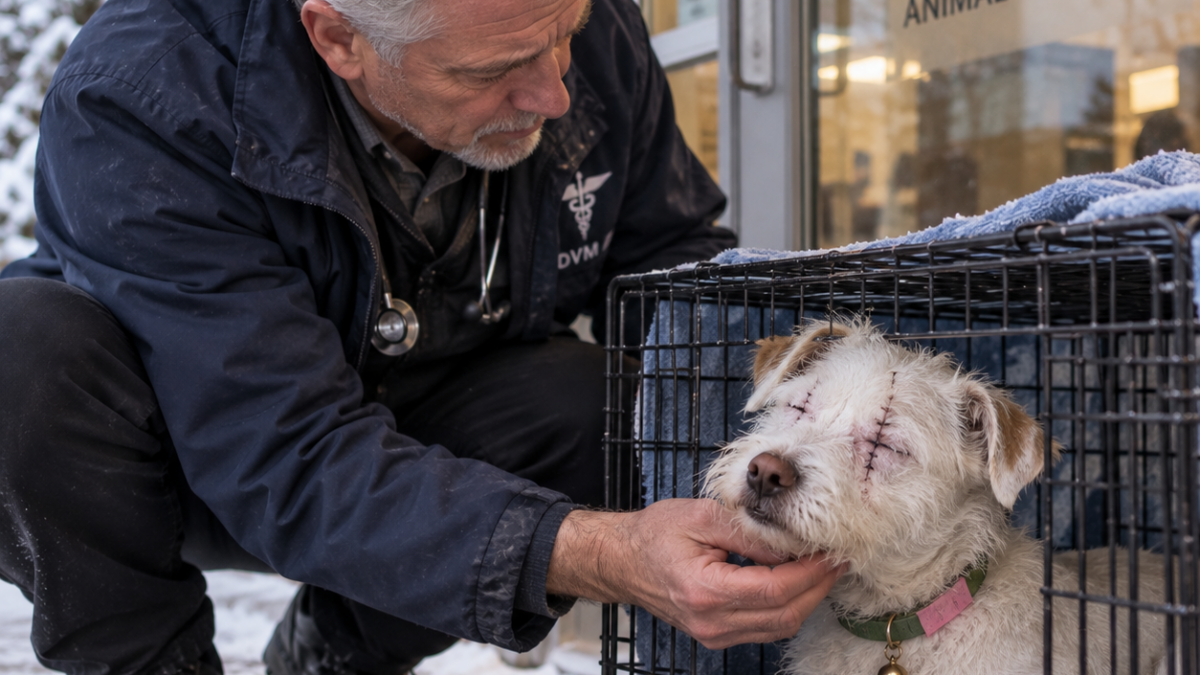
The incisions were straight.
Not jagged.
Not improvised.
The tissue around them was clean.
Very little swelling.
No infection.
The knots were small and uniform.
Absorbable monofilament.
The kind of surgical suture most people cannot buy at a drugstore.
I touched the skin around the right socket carefully.
The dog leaned into my hand.
No flinch.
No panic.
His tail moved once.
Then again.
Rosa watched.
“Doesn’t that make it worse?”
“What?”
“Someone knew how to do it properly.”
I didn’t answer.
I lifted his lip.
Good color.
Listened to his heart.
Normal rhythm.
Mild dehydration.
A little underweight.
No obvious bruising.
His front nails were recently trimmed.
His fur had been brushed.
He smelled faintly of chlorhexidine and laundry detergent.
Not fear.
Not urine.
Not filth.
Then I checked the crate.
No note.
No name.
No microchip.
But three details stood out.
A spotless blue surgical towel folded over the plastic floor.
A small pharmacy bag containing pain medication with the label peeled away.
And a tiny brass bell attached to his collar with pink medical tape.
I held the bell between my fingers.
Rosa said:
“What?”
I turned the collar.
The tape had been wrapped twice around the bell loop, then folded back on itself to form a little pull tab.
A simple trick.
Tiny thing.
Most people wouldn’t notice.
I did.
Because I had taught someone that trick years earlier.
When I was younger, I used to show new technicians how to secure temporary bells, catheter lines, and light dressings so they could be removed without scissors near an anxious animal.
Wrap.
Fold.
Leave a tab.
“Marcus?”
Rosa asked.
“I’ve seen this before.”
“The bell?”
“The tape.”
She frowned.
“That could be anyone.”
“Maybe.”
But I already felt something changing inside me.
I walked to the reception desk.
Opened the security system.
Selected the front camera.
Scrolled backward.
5:20.
Nothing.
5:00.
Nothing.
Then:
4:51 a.m.
A car stopped beyond the camera’s clearest angle.
Older compact sedan.
Dark color.
A slight figure in a gray hooded coat walked toward the entrance carrying the crate in both hands.
She placed it carefully on the mat.
Then she knelt.
Not for a few seconds.
For almost three minutes.
Her forehead rested against the wire.
One hand reached through the bars.
The dog pressed his head against her fingers.
Then she stood.
Turned.
The porch light caught her face.
I froze the image.
My fingers stopped moving.
Rosa came behind me.
“Oh my God.”
I heard her say it.
I could not answer.
The woman on the screen was thirty-three now.
Thinner than I remembered.
Hair shorter.
Face tired.
But I knew her.
There are faces you identify through age, weight loss, bad lighting, grief, and years.
Her name was Natalie Brooks.
Seven years earlier, she had been my best veterinary technician.
And almost a daughter to me.
Then one afternoon she had disappeared from Valley View without saying goodbye.
I had not seen her since.
Rosa whispered:
“Natalie?”
I nodded.
“What is she doing here?”
“I don’t know.”
“Why didn’t she come inside?”
“I don’t know.”
“Why didn’t she call?”
I stared at the paused image.
Natalie’s hand was still touching the crate.
Even frozen, I could see the way she held the wire.
Like letting go hurt.
Rosa said:
“Marcus.”
I closed the footage.
“Call the number we have for her.”
“It hasn’t worked in years.”
“Try.”
She did.
Disconnected.
I still had an emergency contact from Natalie’s old employment file.
Her older sister, Rachel.
That number went straight to voicemail.
I left a message.
“This is Dr. Marcus Hale from Valley View.”
“I need to speak with Natalie.”
“She left a dog here this morning.”
“The dog is safe.”
“Please call me.”
Then I went back to the terrier.
He was standing now.
Carefully exploring the exam table with his nose.
I placed a towel roll near one edge so he wouldn’t step off.
He touched it.
Backed up.
Reoriented.
Smart.
Adaptable.
I rang the brass bell gently.
His head turned.
Then he walked toward the sound.
Rosa smiled through tears.
“He knows that bell.”
“Yes.”
Blind dogs often adapt remarkably well.
Smell.
Sound.
Memory.
Whiskers.
Air movement.
Floor texture.
People sometimes imagine blindness means constant terror.
It doesn’t.
Dogs don’t mourn vision the same way we imagine we would.
They learn the world differently.
This dog had already begun.
That told me the surgery had not happened yesterday.
Probably five to seven days earlier.
Maybe longer.
I examined the medication.
Carprofen.
Dose appropriate.
Gabapentin.
Also appropriate.
Whoever had cared for him after surgery knew exactly what had been prescribed.
I sent bloodwork.
Then called the two emergency veterinary hospitals in Spokane and Spokane Valley.
No matching dog.
Then several specialty clinics.
No luck.
At 10:13, Rachel Brooks called.
Her voice sounded cautious.
“Dr. Hale?”
“Yes.”
“You said Natalie was there?”
“No.”
“She left a dog outside.”
Silence.
“Rachel?”
“Is he okay?”
The question came too quickly.
“You know about him.”
Another silence.
Then:
“His name is Oliver.”
I closed my office door.
“Where is Natalie?”
“I don’t know.”
“That isn’t good enough.”
“Marcus—”
“You don’t get to call me Marcus and tell me you don’t know where she is after she abandoned a postoperative blind dog outside my clinic at four-fifty in the morning.”
Rachel started crying.
That took some anger out of me.
Not all.
Enough.
“She didn’t abandon him.”
“He was in a crate on frozen concrete.”
“She knew you’d arrive early.”
“She could have rung my doorbell.”
“She couldn’t face you.”
“Why?”
Rachel’s breathing shook.
Then she said:
“She thinks you hate her.”
I sat down.
For seven years I had imagined what I would say if Natalie came back.
Anger had been part of most versions.
Hate never had.
“I don’t hate her.”
“She doesn’t know that.”
“Then tell me where she is.”
“I promised I wouldn’t.”
“Rachel.”
“I promised.”
“Is she in danger?”
Pause.
“Yes.”
Everything inside me changed.
“What kind?”
“I can’t explain this over the phone.”
“Then come here.”
“I’ll be there in an hour.”
Rachel arrived in forty-three minutes.
Same eyes as Natalie.
Older by six years.
Hair pulled into a messy knot.
No makeup.
She sat in my office clutching her purse with both hands.
Before I asked anything, she said:
“Natalie didn’t do the surgery.”
“I know.”
“You know?”
“She isn’t a veterinarian.”
“She assisted.”
That did not surprise me.
“What happened to Oliver?”
Rachel looked toward the closed office door.
“He belonged to a man named Dean Rourke.”
“Boyfriend?”
She shook her head.
“Landlord.”
That was not what I expected.
Natalie had been living in a small rental property outside Airway Heights for about a year.
Cheap.
Isolated.
The owner, Dean, lived in the main house and rented out a converted garage apartment behind it.
He had several dogs over the years.
Oliver was the last.
“What happened to his eyes?”
I asked.
“Glaucoma.”
Rachel rubbed her forehead.
“Really bad.”
“Dean wouldn’t take him anywhere.”
“He said the dog was old.”
“How old?”
“Six.”
I stared.
Rachel continued.
“Natalie noticed he was walking into things.”
“Eyes looked cloudy.”
“Then one started swelling.”
“She begged Dean to take him to a vet.”
“He refused.”
“So she took him.”
“Where?”
“Low-cost clinic in Cheney.”
“Whose name?”
“Dr. Priya Deshmukh.”
I knew Priya.
Good veterinarian.
Very good surgeon.
I called immediately.
She remembered Oliver.
Severe bilateral glaucoma.
Intraocular pressure dangerously high.
Both eyes already blind.
Pain significant.
Enucleation had been medically necessary.
“Who authorized treatment?”
I asked.
There was a pause.
“Natalie brought him.”
“She said the owner had surrendered him to her.”
“Did she have paperwork?”
Priya became quieter.
“She had a handwritten surrender form.”
My stomach tightened.
“From Dean?”
“Yes.”
“Did you verify it?”
“We called the number.”
“A man confirmed surrender.”
“Marcus, what is this?”
“I don’t know yet.”
Priya told me Natalie had assisted during recovery because she had veterinary experience.
That explained the clean towel.
Medication.
Tape.
Bell.
“Did Natalie pay?”
I asked.
“Most of it.”
“How?”
“Cash.”
That didn’t sound like the Natalie I had known.
She had never had much money.
Rachel answered that after I hung up.
“She sold her car.”
I stared.
“The one on the camera?”
“Borrowed from me.”
“Why?”
“Because Dean changed his mind.”
“About surrendering Oliver?”
“Yes.”
“When?”
“After the surgery.”
That made no sense.
“He refused to treat the dog.”
“Then after Natalie paid for surgery, he decided Oliver was valuable again?”
Rachel looked at me.
“Not valuable.”
“Useful.”
I waited.
Rachel’s voice dropped.
“Dean breeds terriers.”
“Backyard breeding.”
“Nothing official.”
“Oliver was one of his stud dogs.”
I felt sick.
“Blind.”
“After the glaucoma, Dean said he’d use him one more season.”
I stared at her.
“He wanted to breed a dog with likely inherited glaucoma?”
“Natalie told him exactly that.”
“He didn’t care.”
“She refused to return Oliver.”
“What did Dean do?”
Rachel looked down.
“He hit her.”
There are moments when rage becomes so clean it feels cold.
I leaned back.
“Where is Natalie?”
Rachel shook her head.
“I told you.”
“She’s hiding.”
“From Dean?”
“Yes.”
“Why leave Oliver?”
“Because she entered a domestic violence shelter last night.”
I said nothing.
The pieces rearranged again.
“Domestic violence?”
“He isn’t her boyfriend.”
“No.”
Rachel wiped her face.
“But he’s been controlling her for almost a year.”
“Rent.”
“Transportation.”
“Money.”
“Threats.”
“He started making her help with the dogs because he learned she’d been a vet tech.”
“She tried to leave more than once.”
“He threatened to report her for stealing animals.”
“Threatened her sister.”
“Threatened to destroy her old veterinary license records.”
“She doesn’t have a license.”
“I know.”
“But people who are scared don’t always evaluate threats logically.”
That sentence was painfully true.
I stood.
Walked to the window.
Oliver was in the treatment room with Rosa.
I could see him through the glass partition.
He was following the sound of her fingers tapping the floor.
His tail wagged.
Rachel continued.
“After the surgery, Dean demanded Oliver back.”
“Natalie refused.”
“He shoved her into a wall.”
“Then he told her he’d call the sheriff and say she forged the surrender.”
“Did she?”
Rachel didn’t answer.
I turned.
“Did Natalie forge it?”
Her face told me before her mouth did.
“Yes.”
I closed my eyes.
There it was.
Not a clean rescue story.
A frightened woman had falsified a surrender document to obtain medically necessary treatment for a dog whose owner refused care.
Morally understandable.
Legally dangerous.
Very dangerous for Priya too, even though she’d reasonably verified by phone with someone pretending to be Dean.
“Who answered the clinic’s verification call?”
I asked.
Rachel whispered:
“Me.”
I stared.
She started crying again.
“I know.”
“I know it was wrong.”
“You impersonated him?”
“Yes.”
“Why?”
“Because Oliver was screaming at night.”
That stopped me.
Dogs with severe glaucoma can experience extraordinary pain.
People often underestimate it because they don’t see blood.
Pressure builds inside the eye.
Headaches.
Nausea.
Constant pain.
I had treated dogs who stopped eating because of it.
Rachel said:
“Natalie would sit outside his kennel at two in the morning.”
“He would press his head into her hands.”
“Dean said he’d shoot him if he got too annoying.”
“We panicked.”
I sat down again.
I wasn’t going to solve everything morally in one conversation.
I said:
“We need a lawyer.”
Rachel looked terrified.
“For Natalie?”
“For all of you.”
“And we need to protect Oliver legally.”
“Can Dean take him?”
“Not today.”
“Why?”
“Because right now Oliver is my patient, and I have credible information suggesting neglect and violence.”
“But ownership?”
“Ownership is going to need documentation.”
I called Spokane County animal protection.
Then an attorney I’d worked with on cruelty cases.
I did not call Dean.
Did not warn him.
Did not post anything.
Didn’t turn Oliver into a social-media rescue story before the facts existed.
That afternoon, an animal protection officer named Leslie Nguyen came to Valley View.
She photographed Oliver.
Reviewed records.
Called Priya.
Collected copies.
Then asked Rachel for a written statement.
The following morning, deputies and animal control visited Dean Rourke’s property.
What they found changed everything.
Seven dogs.
Four in outdoor runs.
Three inside a detached structure.
Two needed immediate veterinary care.
One female terrier had a severe untreated skin infection.
Another had dental disease so advanced she struggled to eat.
None had current veterinary records.
The property was dirty enough to trigger additional investigation.
Dean insisted all animals were well.
Then demanded Oliver back.
Animal control refused immediate transfer while the neglect case was reviewed.
He became furious.
Threatened Natalie.
Threatened me.
Threatened Priya.
That helped nobody except the investigators.
Oliver remained at Valley View under protective hold.
And Natalie?
Still gone.
The shelter would not disclose her location.
Correctly.
I sent a message through Rachel.
Only four words.
Oliver is safe. So are you.
No demand.
No anger.
No:
Call me.
No:
Explain yourself.
Just that.
Three days passed.
Then a week.
Oliver recovered beautifully.
The sutures dissolved.
His appetite improved.
He gained almost a pound.
We learned his language.
One bell by the back door for outside.
Different bell near his food area.
Textured mats in front of transitions.
A light cedar-oil scent on his bed—not on his body, just enough to help him identify the location.
We never moved furniture unexpectedly.
He mapped the clinic within days.
The first morning he walked from the kennel room to my office without touching a wall, Rosa cried.
“You’re going to cry every time he does something normal?”
I asked.
“Yes.”
“Good.”
Oliver became popular with everyone.
He knew Rosa by her peppermint gum.
Knew me by coffee and apparently orthopedic-shoe rubber.
Knew Javier, our kennel assistant, because Javier hummed constantly.
Whenever the front bell rang, Oliver tilted his head.
I started noticing something else.
If a woman entered wearing a certain floral perfume, he immediately stood.
Listened.
Waited.
Then lay down when he realized it wasn’t Natalie.
He missed her.
That was obvious.
The brass bell remained on his collar.
I considered removing it.
Didn’t.
He seemed comfortable with it.
And every time I saw the little pink tape tab, I remembered Natalie at twenty-three.
Her first month at Valley View.
Terrified of making mistakes.
She had started as a kennel assistant.
No degree.
No experience beyond volunteering at a shelter.
But she noticed everything.
She knew which dog hadn’t urinated.
Which cat stopped eating.
Which old Labrador needed two towels beneath his elbows instead of one.
I taught her restraint.
Blood draws.
Anesthesia monitoring.
Bandaging.
Medication calculations.
She eventually became certified.
Best technician I’d ever had.
Then her mother died.
Pancreatic cancer.
Fast.
Natalie started arriving late.
Then missing shifts.
Then one Friday she didn’t come at all.
I called.
No answer.
Rosa called.
No answer.
I drove to her apartment.
Empty.
Lease terminated.
Rachel told me Natalie needed space.
I was angry.
Not because she left.
Because she vanished.
I took it personally.
I thought after everything I’d taught her, after every Christmas she spent with my family, after every emergency surgery where we stood shoulder to shoulder, she owed me at least goodbye.
For years, I told myself that anger was justified.
Looking back, I had confused love with entitlement too.
Maybe Natalie didn’t disappear because we meant nothing.
Maybe she disappeared because we meant too much.
The first real contact came eleven days after Oliver arrived.
A letter.
Hand-delivered by Rachel.
No return address.
My name in Natalie’s handwriting.
I waited until closing.
Then opened it.
Dr. Hale,
She had always called me Dr. Hale when emotional.
I am sorry I left him outside. I knew you would hate that. I also knew you would be there before the cold became dangerous. I watched from the parking lot until your office light came on.
That explained why the camera didn’t show her car leaving immediately.
She had waited.
His name is Oliver. Please keep the bell. He uses it to understand where his own body is when he shakes his head. I know that probably sounds foolish to you.
It didn’t.
I did something illegal to get him surgery. I know that. I lied because he was in pain and Dean was going to let him stay that way. I don’t expect you to defend what I did. I only ask you not to let Dean take him back if there is any lawful way to stop it.
Then:
I left Valley View seven years ago because I was ashamed. After Mom died, I started taking pills. First hers. Then anything I could get. I stole medication from the clinic twice. You never knew. Maybe you did. I don’t know.
I stopped reading.
My hands began shaking.
I remembered inventory discrepancies.
Small.
Nothing controlled enough to trigger an obvious crisis at the time.
I had blamed vendor counts.
I was afraid you would discover it. I was more afraid you would look at me differently. So I ran before you could. I got clean, then relapsed, then got clean again. I have been sober four years. I wanted to call you hundreds of times. Every year it became harder because the apology got older.
I covered my mouth.
Rosa sat across the office.
She didn’t ask.
Just waited.
I continued.
Dean knew I had worked in veterinary medicine. At first he was kind. He gave me cheap rent and let me help with his dogs. Then everything became something I owed him. When I tried to move, he threatened to tell people I was stealing medication again. He knew about my past because I told him. He used it every time I tried to leave.
Then:
Oliver was the first thing I stopped being afraid for myself about.
I had to stop again.
When his eyes got bad, Dean said a blind dog wasn’t worth a vet bill. Then after the surgery, he decided he could still breed him because “eyes don’t matter for that.” I couldn’t give him back.
Then the line that broke me:
I left Oliver with you because the last place I remember feeling safe before my life went wrong was Valley View.
I lowered the letter.
Rosa was crying.
So was I.
I finished.
I don’t know if I will ever be brave enough to walk through your front door again. Please tell him I didn’t leave because I stopped loving him.
Natalie
I went into the kennel room.
Oliver was asleep.
I sat on the floor.
His nose lifted.
He stood.
Walked toward me.
Found my knee.
Then climbed awkwardly into my lap as though he had done it his entire life.
I put one hand against his chest.
“You idiot.”
I whispered.
I wasn’t sure whether I meant him.
Natalie.
Myself.
Probably all three.
The animal-cruelty investigation against Dean developed slowly.
That was frustrating but necessary.
Ownership records showed Oliver had indeed originally belonged to him.
However, investigators also documented substantial neglect before the surgery.
Dean had refused veterinary care despite obvious signs of severe eye pain.
Multiple witnesses confirmed Natalie repeatedly asked him to seek treatment.
Another tenant had heard Dean threaten to shoot Oliver rather than pay for care.
The forged surrender complicated matters.
Natalie admitted exactly what she had done through counsel.
No excuses.
Rachel admitted impersonating Dean during the phone confirmation.
Priya cooperated fully.
Her documentation showed she’d believed in good faith that ownership had been legally transferred.
The prosecutor ultimately handled the false-document issue separately from Dean’s neglect case.
Natalie was not treated as though forging a surrender form magically became legal because she had good intentions.
But context mattered.
So did cooperation.
So did the fact that the document had been used to obtain necessary medical treatment rather than money or property for profit.
I stayed out of charging decisions.
My role was Oliver.
That was enough.
The other dogs seized from Dean’s property went into foster care while the case proceeded.
He eventually surrendered several voluntarily.
Months later, a court order prevented him from owning or breeding animals for a period defined by the case outcome.
Oliver’s ownership became part of a negotiated resolution.
Dean relinquished all claim.
The document arrived at Valley View on a Thursday afternoon.
One page.
Legal language.
Signature.
I read it twice.
Then carried it to Oliver.
“You’re free, buddy.”
He wagged his tail.
Completely unimpressed by jurisprudence.
Natalie still had not returned.
Three months had passed.
Then one snowy afternoon in February, the front door opened.
The reception bell rang.
Oliver was asleep beneath Rosa’s desk.
His head came up.
A woman stood just inside the entrance.
Gray coat.
Short hair.
Thinner than the old Natalie.
Healthier than the woman on the camera.
She looked at me.
I couldn’t move.
Neither could she.
Rosa whispered:
“Oh my God.”
Natalie smiled nervously.
“Hi.”
I had imagined this moment for seven years.
In every imagined version, I had a speech.
Some angry.
Some forgiving.
Some dignified.
The real moment gave me nothing.
So I said:
“You look terrible.”
Natalie laughed.
Then started crying.
“That sounds like you.”
I walked around the desk.
Stopped several feet away.
She wiped her face.
“I’m sorry.”
“I know.”
“For the dog.”
“I know.”
“For leaving.”
“I know.”
“For the medication.”
“I know.”
“I don’t expect—”
Oliver’s bell jingled.
Everything stopped.
He was standing.
His nose moved.
Once.
Twice.
Then his entire body changed.
His ears lifted.
Tail started moving so hard his back legs shifted with it.
Natalie covered her mouth.
“Oliver.”
The dog ran.
Not cautiously.
Not feeling his way.
Ran toward her voice.
He hit the leg of a waiting-room chair.
Bounced off.
Corrected.
Kept going.
Natalie dropped to her knees.
Oliver found her.
He climbed against her chest.
Whining.
Licking her chin.
His little body shook so hard his bell sounded continuously.
Natalie wrapped both arms around him.
“I didn’t leave you.”
she sobbed.
“I didn’t leave you.”
“I am sorry.”
“I am so sorry.”
Nobody in the waiting room remained dry-eyed.
Not one person.
Even Mr. Abernathy, who had brought in a constipated beagle and had complained for ten minutes about our prices, was openly crying.
I walked back behind the counter because some moments do not need another person standing inside them.
Natalie sat on the floor with Oliver for almost half an hour.
Eventually, she looked at me.
“Can we talk?”
We went into my office.
Oliver came too.
Of course.
Natalie had been living in transitional housing connected to the shelter.
Working part-time at a grocery warehouse.
Attending counseling.
Sober.
Safe.
She had a protection order against Dean.
Her attorney had handled the forgery matter.
She was rebuilding.
Slowly.
“I want to pay you for Oliver.”
she said.
“No.”
“Marcus.”
“No.”
“You performed all his follow-up care.”
“We did.”
“I owe you.”
“You already sold your car for his surgery.”
“That doesn’t mean your work is free.”
“You can pay me another way.”
She looked suspicious.
“How?”
“Come back.”
Her face went still.
“To Valley View?”
“Yes.”
“I can’t.”
“Why?”
“I stole from you.”
“Seven years ago.”
“Twice.”
“You admitted it.”
“I ran.”
“Yes.”
“You should hate me.”
“I tried.”
That made her laugh once.
Then cry again.
I continued:
“I was angry for years.”
“I thought your leaving meant I didn’t matter.”
“That was arrogant.”
She shook her head.
“You mattered too much.”
“I know that now.”
I leaned forward.
“I am not offering you your old job tomorrow.”
“You’ve been out of clinical work for years.”
“Your certification needs review.”
“You need boundaries.”
“I need to know you are stable.”
“And you need to know whether being back here is actually healthy for you.”
She nodded.
“But if you want it, we can build a path.”
“What kind?”
“Volunteer first.”
“Then continuing education.”
“Then supervised work.”
“Then we’ll see.”
Natalie looked at Oliver.
“What about him?”
I smiled.
“He appears to have already decided who his person is.”
Her face changed.
“I can’t have a dog where I’m staying.”
“I know.”
“We’ll foster him here.”
“Until?”
“Until you can.”
She stared.
“You would do that?”
Rosa’s voice came through the half-open door.
“He already has his own bed in my office.”
Natalie laughed.
I said:
“You left him in the safest place you knew.”
“You were right about that part.”
She lowered her eyes.
“I almost walked in.”
“That morning?”
“Yes.”
“I stood across the parking lot for twenty minutes before I carried him over.”
“Why didn’t you?”
“Because I remembered the last version of myself you knew.”
I looked at her.
“I remember more than that.”
That became the beginning.
Not a miraculous reset.
Not instant forgiveness.
Not Oliver healing every human problem.
Natalie volunteered two mornings a week.
At first she cleaned kennels.
Did laundry.
Restocked supplies.
She did not touch medication inventory.
That was deliberate.
Not punishment.
Structure.
Trust rebuilt with design, not sentiment.
She attended counseling.
Continued recovery meetings.
Completed veterinary-technician continuing education.
Her old certification required reactivation and updated coursework.
She did it.
Slowly.
Month by month.
Oliver remained with us for six more months.
He became the unofficial hospital greeter.
Patients hated him.
Owners loved him.
Blind terriers apparently have no respect for personal space.
He learned every room.
Could navigate from reception to the back door without touching a wall.
Rosa added textured mats near every major threshold.
I attached a second small bell to my office door so he knew when it opened.
He learned to follow voices.
He played with toys that rattled.
His favorite was a rubber ball with a bell inside.
If anyone felt sorry for him, Oliver usually solved that by stealing something from them.
One afternoon, a mother brought in her twelve-year-old daughter with their elderly spaniel.
The girl stared at Oliver.
“Where are his eyes?”
“They were removed because they hurt him.”
“Is he sad?”
I looked at Oliver.
He was trying to climb into the girl’s backpack because it contained crackers.
“No.”
I said.
“He’s mostly hungry.”
She laughed.
Then sat on the floor.
Oliver immediately found her.
That was what he did.
He met people where they were.
Without seeing any of them.
By August, Natalie had saved enough money for a small apartment.
Pet-friendly.
One bedroom.
Ground floor.
Ten minutes from Valley View.
The day she received the keys, she came into my office.
Held them up.
“I think he’s coming home.”
I looked beneath my desk.
Oliver was asleep on my shoe.
My chest tightened.
I had known this day would come.
That did not mean I had prepared for it.
“Probably.”
Natalie smiled.
“You’re going to miss him.”
“No.”
“You’re lying.”
“Completely.”
Rosa organized what she called a going-home package.
Bed.
Textured runner.
Food.
Bell toys.
Medication records.
Emergency numbers.
Enough supplies to make it appear Oliver was being deployed to another continent.
Then she added a blue surgical towel.
Fresh.
Folded.
Natalie saw it.
Stopped.
Rosa said:
“He should have one that isn’t associated with freezing on the doorstep.”
Natalie hugged her.
I pretended to review a chart.
The last item was the brass bell.
The original.
Same faded green collar.
I had replaced the pink tape once when it wore out.
Same method.
Wrap twice.
Fold.
Leave a tab.
Natalie noticed.
“You remembered.”
“I taught you.”
She smiled.
“I know.”
Before leaving, Natalie crouched.
“Oliver.”
He walked toward her.
She clipped on the leash.
He looked back toward my voice.
I sat on the floor.
He came over.
Pressed his forehead against my chest.
Stayed there for several seconds.
Then sneezed directly on my shirt.
“Beautiful.”
I said.
Natalie laughed.
I kissed the top of his head.
“Go home.”
And he did.
I expected Valley View to feel empty after that.
It did.
For about two days.
Then Natalie started bringing him to work.
Apparently separation was optional.
By the following spring, she was officially back on staff.
Part-time first.
Then full-time.
Not my best technician.
Not immediately.
She was rusty.
Medicine had changed.
Equipment had changed.
Protocols had changed.
But her instincts had not.
She still noticed everything.
Which cat hadn’t eaten.
Which dog was guarding one hip.
Which frightened animal needed everyone to stop staring.
Young technicians started learning from her.
One afternoon, I heard her teaching a new assistant how to attach a temporary bell.
“Wrap twice.”
“Then fold the tape back.”
“Make a little tab so you can remove it without scissors.”
I stood in the doorway.
She saw me.
Stopped.
“What?”
“Nothing.”
She smiled.
“Old man.”
“Former addict.”
Rosa gasped theatrically from across the treatment room.
Natalie laughed so hard she had to sit down.
That was how I knew we had healed enough to stop walking around every old wound as though it might explode.
Not forgotten.
Not erased.
Integrated.
There is a difference.
Dean Rourke’s case ended later that year.
I will not pretend the outcome repaired everything.
It didn’t.
He faced consequences for neglect and other conduct established in the case.
Restrictions were imposed.
Animals were rehomed.
The breeding operation ended.
Natalie’s protection order remained.
The forged surrender matter ended with consequences too.
She accepted them.
No self-righteous speech about doing the right thing.
No claiming law should disappear because Oliver had been suffering.
She said:
“I made a choice.”
“I would make a different legal choice now.”
“But I still would not leave him screaming in that kennel.”
I understood.
Sometimes moral urgency and legal process collide.
The answer is not to romanticize breaking rules.
It’s to build better lawful options for the next person.
After Oliver’s case, Priya, Natalie, our county shelter, and several local clinics created an emergency veterinary-care fund for animals caught in ownership disputes, domestic violence situations, and severe neglect cases.
Not huge.
Enough to matter.
A legal aid organization partnered with us.
If someone showed up saying:
“This animal needs care, but the owner refuses and is threatening me,”
we had a number to call.
A process.
Temporary protective options.
Documentation.
No forged surrender form needed.
I considered that one of the most important things to come from Oliver.
Not a viral story.
A procedure.
Procedures are rarely emotional.
They save people anyway.
Two years after Oliver first appeared on my doorstep, Valley View held an open house.
Nothing fancy.
Coffee.
Cookies.
Tours for clients.
Adoption booth from the county shelter.
Natalie stood near the entrance with Oliver.
He wore a new green collar.
The old brass bell remained.
A little girl asked:
“Why does he have a bell?”
Natalie crouched.
“So he can hear himself move.”
“Does he know he can’t see?”
Natalie thought.
Then:
“He knows his world.”
“That is enough.”
The girl touched his back.
Oliver rolled over immediately.
He understood children as potential stomach-rub providers.
I watched from the hallway.
Rosa came beside me.
“You know you’re staring.”
“I am supervising.”
“You’re sentimental.”
“I am a doctor.”
“Same thing at your age.”
I ignored her.
Then Natalie looked across the room.
Found me.
Not with eyes like Oliver.
With the awareness of someone who knows exactly where home is.
She smiled.
I smiled back.
Seven years earlier, she had left without goodbye because shame convinced her we would reject the person she had become.
Two years earlier, she returned before dawn but could only make it as far as the doormat.
Then one snowy afternoon, she walked through the front door.
That progression mattered more to me than any apology.
Sometimes healing is measured in distance.
Parking lot.
Doormat.
Lobby.
Treatment room.
Home.
Oliver aged.
His muzzle turned cream instead of white.
He developed arthritis in his back.
Then a heart murmur.
Nothing unusual.
Nothing tragic.
Just time.
He remained fearless.
At ten, he still stole food.
At eleven, he slept more.
At twelve, Natalie carried him up stairs.
We managed pain.
Adjusted medication.
Added rugs.
Built ramps.
Blindness had never been his biggest limitation.
Age eventually was.
When the end came, it came gently.
He stopped eating breakfast.
For Oliver, that was alarming enough to cancel civilization.
Natalie brought him in.
Bloodwork.
Ultrasound.
Advanced abdominal cancer.
Likely only weeks.
Maybe less.
Natalie sat on the floor beside him.
Same way she had in the waiting room years earlier.
I sat across from her.
“What would you do?”
she asked.
Not:
Can you fix it?
She knew better.
I looked at Oliver.
He was curled against her leg.
Comfortable for the moment.
“I would give him good days.”
“How many?”
“He’ll tell us.”
She nodded.
He gave her twelve.
Twelve beautiful days.
Chicken he wasn’t technically supposed to eat.
Slow walks.
Sunlight.
Sleeping beside her.
A visit to Valley View where every staff member pretended not to know why Natalie had brought him.
On the twelfth morning, he couldn’t stand comfortably.
He refused chicken.
Turned his head away from water.
Natalie called.
We opened early.
Just us.
Rosa.
Me.
Natalie.
Oliver.
She brought the original blue surgical towel.
Not the one from the doorstep.
The replacement Rosa had given her.
She spread it beneath him.
His brass bell sounded softly when he shifted.
Natalie held his head.
“I left you once.”
she whispered.
“I won’t leave now.”
I placed the catheter.
She kissed his forehead.
He was asleep before the final medication.
Peaceful.
Exactly as he had been the first morning I touched him.
No fear.
No struggle.
His head rested against Natalie’s hand.
The bell moved once.
Then stopped.
Rosa cried openly.
So did Natalie.
So did I.
We cremated him privately.
Natalie kept the ashes.
The green collar went into a small wooden box.
But she gave me the brass bell.
“I want this here.”
she said.
“Why?”
“Because this was the safe place.”
I attached it to the corner of our reception desk.
Pink tape.
Two wraps.
Folded tab.
It still hangs there.
Clients sometimes ring it accidentally.
New employees ask why we keep a tiny bell attached to the desk.
Rosa usually says:
“Ask Dr. Hale.”
I usually say:
“Long story.”
Sometimes I tell it.
Not always.
Because Oliver’s story is not really about a blind dog abandoned outside a hospital.
That is just where it starts.
It is about how quickly we can misunderstand what we see.
A crate on a frozen doorstep looked like cruelty.
The stitches looked like mutilation.
Natalie’s disappearance looked like indifference.
Her silence looked like rejection.
The forged paper looked like simple dishonesty.
None of those first impressions contained the entire truth.
That doesn’t mean every action was justified.
Natalie still made mistakes.
So did Rachel.
So did I.
Compassion doesn’t require pretending otherwise.
It requires looking long enough to understand why people made the choices they did and then helping them make better ones next time.
I had spent seven years angry because Natalie disappeared.
She had spent seven years ashamed because she believed returning required becoming the person she had been before things went wrong.
Neither of us understood something simple.
You don’t return by becoming your old self.
You return as the person who survived being gone.
Oliver taught me that.
He lost both eyes.
There was no restoring them.
No miracle surgery.
No dramatic moment when he suddenly saw again.
His old life was impossible.
So he built another one.
Sound.
Scent.
Touch.
Memory.
Trust.
He did not spend his days mourning the world he couldn’t recover.
He learned the world that remained.
Natalie did the same.
Maybe I did too.
I’m sixty-four now.
Still at Valley View, though everyone keeps telling me retirement is a concept worth exploring.
Rosa threatens to lock me out one day.
Natalie is our lead technician.
That still makes me smile.
She owns a small house now.
Nothing fancy.
Fenced yard.
Two rescue dogs.
One cat missing half an ear.
She has been sober more than ten years.
She still attends meetings.
Still talks openly about it when appropriate.
No shame.
Not anymore.
Sometimes new technicians learn her history and become awkward around her.
She deals with that faster than I do.
“Yes.”
she tells them.
“I stole medication once.”
“Twice.”
“I got addicted.”
“I ran away.”
“Then I got better.”
“Now hand me that catheter.”
Simple.
Human beings are more durable when allowed to tell the whole story.
The tiny brass bell has tarnished.
I could polish it.
I don’t.
The green collar is gone.
Oliver is gone.
But the bell stays.
Every November, on the anniversary of the morning I found him, Natalie brings coffee before sunrise.
We stand outside the front entrance.
Usually freezing.
Usually complaining.
At 4:51, she always becomes quiet.
The first year she said:
“I still remember setting the crate down.”
“What were you thinking?”
“That if I rang the bell, you would answer.”
“Why didn’t you?”
“I was scared.”
“Of me?”
“Yes.”
“That is offensive.”
She laughed.
“I know.”
Then:
“I also knew you’d come early.”
“So you trusted me enough to leave him.”
“Just not enough to face me.”
“Exactly.”
The contradiction used to bother me.
Now it doesn’t.
People can trust you and still fear disappointing you.
Love you and still hide.
Need you and still run.
Human emotions are terrible at being logically consistent.
One year, I asked:
“What made you finally walk through the door?”
She thought for a long time.
Then:
“Oliver.”
“He did it first.”
I frowned.
“What?”
“He walked toward me without seeing me.”
“He didn’t need proof I was still the same person.”
“He just knew my voice.”
I didn’t answer.
There are things veterinarians learn from animals that sound sentimental until you’ve lived long enough to see them happen repeatedly.
Recognition is one of them.
Dogs don’t care about the story you tell yourself in the mirror.
They know smell.
Voice.
Hands.
Whether you are safe.
Whether you came back.
Oliver knew Natalie.
Immediately.
Seven years could not confuse him.
Blindness could not confuse him.
Shame could not confuse him.
He heard her say his name.
That was enough.
Sometimes I think about the first assumption Rosa made when she saw him.
“What kind of monster does that?”
I understood.
I thought the same thing.
Then I discovered the eyes had been removed to end pain.
The person who left him had paid for surgery by selling what little she owned.
She had slept beside him through recovery.
Attached a bell so he could orient himself.
Folded a clean towel beneath him.
Measured his pain medicine.
Waited in the parking lot to make sure I arrived.
Then left because fear told her she wasn’t allowed to come inside.
The same scene looked completely different once we knew the whole story.
That stays with me more than anything.
In veterinary medicine, people often bring us an animal and a story.
“Suddenly stopped eating.”
“Bit without warning.”
“Won’t walk.”
“Acts aggressive.”
“Is lazy.”
“Is bad.”
Our job is to look underneath the label.
Pain.
Fear.
Neurological disease.
Arthritis.
Dental infection.
History.
Context.
People deserve some of that curiosity too.
Not endless excuses.
Not freedom from consequences.
Curiosity.
What happened here?
What am I not seeing?
I wish I’d asked those questions about Natalie seven years earlier.
Instead, when she disappeared, I made it about myself.
She left me.
She didn’t trust me.
She didn’t care enough to say goodbye.
All understandable feelings.
None complete.
I know better now.
The front camera still covers the doormat.
Better resolution these days.
Color at night.
Cloud storage.
Every time somebody leaves an animal after hours—and unfortunately, it still happens—I feel that old coldness in my chest.
Most cases are simpler.
Unwanted cat.
Stray litter.
Dog someone can’t afford.
We encourage people to contact shelters rather than abandon animals.
But I always check the details.
Always.
Because once, a blind white terrier arrived without a note.
And the person who left him wasn’t trying to get rid of him.
She was trying to place the thing she loved most inside the only safe place she could still remember.
The morning Oliver died, after Natalie left with his ashes, I sat alone in the exam room.
The blue towel was still on the table.
One small white hair stuck to it.
I picked it up.
Then laughed at myself.
Thirty-one years in veterinary medicine.
Thousands of animals.
You learn not to keep fur like relics.
Still, I put that one hair inside the wooden frame behind my veterinary-school diploma.
Nobody knows.
Now you do.
The bell is less secret.
It hangs where everyone can see it.
Sometimes a nervous dog hears it and tilts its head.
Sometimes a child touches it.
Sometimes Natalie passes reception and taps it with one finger.
A tiny sound.
Bright.
Clear.
I once thought the most important thing about Oliver was that somebody had taken his eyes.
I was wrong.
The important thing was everything he still knew without them.
He knew safety.
He knew kindness.
He knew Natalie’s footsteps.
And after months apart, with an entire room full of people between them, he knew exactly where to run when she finally came home.








