The Abandoned Dog Couldn’t Close His Jaw—Then I Saw the Three Empty Bowls Lined Up Against the Wall.K
PART2:
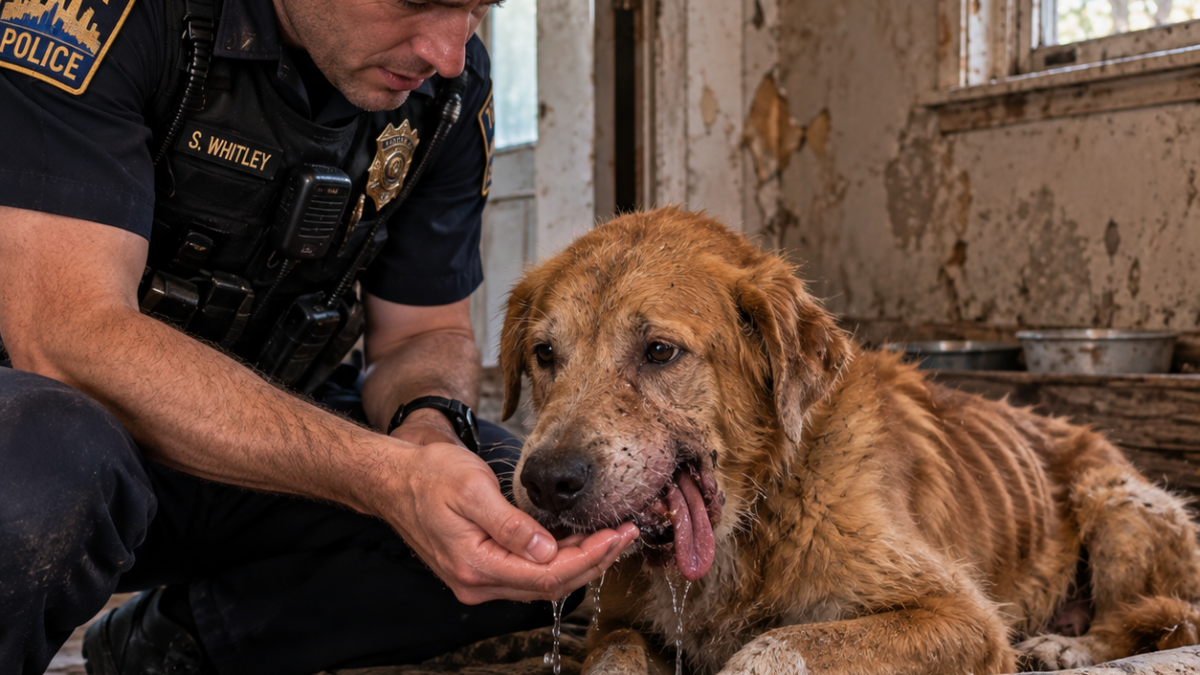
He was a golden retriever mix.
Or at least I thought he was.
There wasn’t enough dog left to be sure.
Reddish-gold fur.
Every rib visible.
Hip bones sharp beneath the coat.
Small notch missing from his right ear.
One front paw white to the ankle, as though he’d stepped into a bucket of paint.
His lower jaw hung crooked toward the left.
It couldn’t close.
His tongue drooped from one side.
Dry.
Cracked.
He looked at me.
And wagged.
Barely.
Thump.
Pause.
Thump.
I had seen neglected animals before.
Dogs tied outside in summer with no water.
Puppies abandoned near dumpsters.
Animals taken from hoarding houses.
But something about that tail got through every layer of professional distance I’d built over eight years.
“Hey, buddy.”
I crouched.
His eyes followed me.
“It’s okay.”
I reached for the metal flashlight on my duty belt.
The moment it cleared the holder, he slammed backward into the wall.
Hard.
His legs scrambled.
He tried making himself smaller.
His whole body shook.
I froze.
The flashlight wasn’t even pointed at him.
I slowly placed it on the floor.
Pushed it away.
“Okay.”
“No flashlight.”
“Got it.”
His shaking gradually eased.
Then his tail moved again.
That was Rusty.
Terrified.
Starved.
In obvious pain.
And somehow still willing to believe the next person might be kind.
I opened my water bottle.
Pouring directly into his mouth seemed dangerous with the jaw injury.
So I poured a little into my cupped hand.
He leaned forward immediately.
Desperate.
His tongue lapped at the water.
Most of it spilled from the side of his mouth.
He tried again.
Faster.
Frantic.
Water ran down his chest.
He barely swallowed anything.
“Easy.”
I gave him tiny amounts.
He kept trying.
Then I noticed the closet.
The door stood half-open.
Deep claw marks covered the inside.
Some near the bottom.
Others almost shoulder-high on me.
Dogs.
More than one.
Different sizes.
I turned toward the three bowls.
Then back to Rusty.
My stomach tightened.
I radioed dispatch.
Requested animal welfare assistance.
Then called my sergeant directly.
“I’ve got an injured dog in a vacant house.”
“How bad?”
“Very.”
“And I think there were others.”
“What makes you think that?”
“Three bowls.”
“Claw marks.”
“Different heights.”
Pause.
“Take photos.”
“I am.”
I photographed the room.
Bowls.
Closet.
Floor.
Door.
Rusty from a respectful distance.
Then I took off my department rain jacket.
The dog watched carefully.
No sudden movements.
I spread the jacket on the floor.
Let him smell it.
He didn’t move.
I slid one hand beneath his chest.
Another beneath his hindquarters.
The moment I lifted him, he went rigid.
Then something unexpected happened.
He pushed the top of his head against my chest.
Not struggling.
Not biting.
Just leaning.
I carried him through the house.
He weighed almost nothing.
Outside, Opal Jenkins was standing on her porch.
Pink housecoat.
Gray hair tied loosely behind her head.
One hand covered her mouth.
“Oh, Lord.”
She stepped toward the porch rail.
“That’s him?”
“Yes, ma’am.”
She began crying.
“I knew.”
“I knew something was wrong.”
“How long has the house been empty?”
“Three weeks.”
“The young man left in the middle of the night.”
“Truck loaded.”
“Another car with him.”
“I didn’t see them come back.”
“You ever see dogs there?”
Her eyes narrowed.
“Yes.”
“How many?”
“Three.”
That confirmed it.
“What did they look like?”
“The gold one.”
She pointed at Rusty.
“A black dog.”
“Bigger.”
“And a little white one.”
“Terrier maybe.”
“Do you know their names?”
She thought.
“The little one was Peanut.”
“I heard him yell that once.”
“The black one…”
She closed her eyes.
“Bear.”
“I think Bear.”
Rusty’s head shifted when she said the names.
Just slightly.
I noticed.
Opal did too.
“Oh, baby.”
She whispered.
I put Rusty into the back seat of my cruiser on the rain jacket.
Animal welfare wasn’t going to arrive quickly enough.
I told dispatch I was transporting him to the emergency veterinary hospital on South Memorial.
Technically not the most ordinary use of a patrol car.
My sergeant said:
“Go.”
I drove carefully.
Rusty lay curled against the seat.
Every red light, I looked back.
He watched me through the security partition.
At one point, I said:
“You’re going to make it.”
He thumped his tail once.
I had no idea whether that was true.
At the emergency hospital, a veterinary technician met me with a stretcher.
Rusty panicked when he saw the metal frame.
So I carried him inside.
They asked for a name.
I didn’t know one.
The tech looked at his coat.
“Rusty?”
“Works.”
She wrote it on the intake sheet.
Dr. Elaine Foster examined him.
X-rays.
Blood work.
Fluids.
Pain medication.
I waited in the lobby in a damp uniform shirt because my rain jacket was still covered in dog hair and dirt in the cruiser.
About forty minutes later, Dr. Foster came out carrying the X-rays.
She placed one image against the light box.
I didn’t need veterinary training to know the jaw looked terrible.
Multiple fractures.
Old enough that some edges had begun healing in the wrong position.
Dr. Foster pointed.
“No vehicle did this.”
“You’re certain?”
“Yes.”
“Fall?”
“No.”
She looked at me.
“Someone struck him.”
“With what?”
“Something hard.”
“Tool.”
“Pipe.”
“Bat.”
“Possibly more than once.”
“How long ago?”
“Several weeks.”
The timing matched Opal’s description of the renter leaving.
Dr. Foster continued.
“The biggest immediate problem is dehydration and malnutrition.”
“His jaw prevents him from drinking normally.”
“He’s been surviving on very little.”
“How?”
She shook her head.
“I don’t know.”
“Rainwater.”
“Moisture.”
“Maybe something in the house.”
“Dogs can survive longer than you’d expect.”
“Not indefinitely.”
I looked at the film.
Then pictured the three bowls.
“What happens now?”
“We stabilize him.”
“Once he’s stronger, surgery.”
“Can you fix the jaw?”
“I think so.”
“Perfectly?”
“No promises.”
“He may always look different.”
“He may have trouble eating.”
“But if infection hasn’t destroyed too much tissue, I think we can give him a functional mouth.”
Then she said:
“One more thing.”
“What?”
“He’s scared of metal objects.”
“I noticed.”
“He’s especially reactive when somebody raises anything cylindrical.”
Flashlight.
Pipe.
Tool.
My stomach turned.
I called Detective Michelle Reyes.
She handled property crimes and sometimes animal cruelty cases depending on circumstances.
We’d worked together before.
I explained what we had.
“Do you have a suspect?”
“Former renter.”
“Name?”
“Not yet.”
“Get landlord records.”
“Photos?”
“Yes.”
“Vet willing to document?”
“She already is.”
“Other animals?”
“Two missing.”
“That changes it.”
Exactly.
An injured abandoned dog was already serious.
Three dogs.
Two missing.
Possible deliberate assault.
Different investigation.
I returned to East 11th Street.
By then, animal welfare officer Tara Benson was there.
So was the property manager.
He unlocked the front properly.
Former tenant:
Dylan Rusk.
Twenty-nine.
Six-month lease.
Stopped paying two months earlier.
Eviction notice prepared.
Then disappeared before formal removal.
The manager said Dylan had listed one dog when he applied.
“Which one?”
“No idea.”
“Size?”
“Medium.”
“Breed?”
“Mixed.”
No help.
Inside, Tara and I documented everything.
She knelt beside the bowls.
“Three.”
“Neighbor saw three.”
She looked at the closet marks.
“Dogs were shut in here.”
“How can you tell?”
“Look at the lower edge.”
Wood worn smooth.
“Repeated contact.”
“Not one incident.”
She opened the closet wider.
No clothes.
No boxes.
Scratches.
Stains.
In one corner:
A piece of white fur caught beneath a splinter.
Tara bagged it.
Then we found a black nylon collar behind the filthy mattress.
No tags.
Large.
Another collar hung from a kitchen cabinet handle.
Small red collar.
Metal tag missing.
Three dogs.
Rusty had been found without a collar.
I photographed both.
The house began telling a story.
Not complete.
But ugly.
The refrigerator was unplugged.
No dog food.
No water.
Trash bags.
Beer cans.
One broken broom.
A metal tire iron near the back door.
I stopped when I saw it.
Rust.
Black rubber grip.
About two feet long.
I didn’t touch it.
Called crime scene.
People sometimes imagine police immediately pick up the dramatic object.
No.
You protect it.
Photograph it.
Let evidence personnel collect it properly.
I stepped around.
Tara looked at Rusty’s room.
Then the tire iron.
“Could be nothing.”
“Yes.”
“Could be.”
We both knew.
Opal had been watching from her porch all afternoon.
I went over.
She insisted I come inside for coffee.
Her house smelled like cinnamon and furniture polish.
Family photographs everywhere.
She sat across from me.
“I should have called sooner.”
“You called four times.”
“I heard them before that.”
“The dogs?”
“Yes.”
“Sometimes barking.”
“Sometimes fighting?”
“No.”
She shook her head.
“Not fighting each other.”
“What did it sound like?”
She looked uncomfortable.
“Yelping.”
“Then the young man shouting.”
“Do you know Dylan?”
“Not really.”
“He never spoke much.”
“Visitors?”
“Sometimes.”
“Truck?”
“Blue Chevrolet.”
“Old.”
“Dented passenger door.”
I wrote.
“Anything strange before he left?”
She thought.
Then:
“The black dog disappeared first.”
“When?”
“Maybe a month before Dylan left.”
“Bear?”
“Yes.”
“He used to stand at the fence.”
“Then one day he wasn’t there.”
“Peanut?”
“Little white dog disappeared two or three days before Dylan moved.”
“Rusty remained?”
“I heard him.”
“Never saw him after that.”
“What did Dylan do?”
Opal looked through the window toward the vacant house.
“He covered the back windows.”
That mattered.
Then she said:
“Officer?”
“Sam.”
“Sam.”
“Are the other two dead?”
I didn’t answer.
Because I didn’t know.
“I’m going to find out.”
That became a promise I hadn’t intended to make.
The following two days were mostly paperwork.
People rarely understand how much police work consists of phone calls and waiting for somebody else to answer another phone.
Landlord records.
Utilities.
Vehicle registration.
Prior addresses.
Animal-control contacts.
Dylan Rusk had three previous municipal citations involving dogs.
Two roaming-animal complaints.
One failure to provide proof of vaccination.
Nothing suggesting serious cruelty.
His blue Chevrolet was registered to his mother at an address in Broken Arrow.
We went there.
Mother hadn’t seen him in weeks.
Said he was staying with girlfriend named Madison.
Didn’t know where.
When I showed a photo of Rusty, she started crying.
“Oh God.”
“You know this dog?”
“That’s Copper.”
So Rusty finally had his real name.
“Copper?”
“Yes.”
“Dylan got him two years ago.”
“Where?”
“Somebody online.”
“Do you know the other dogs?”
She nodded.
“Bear was Madison’s.”
“Peanut belonged to Dylan’s ex.”
“Why was Peanut with him?”
“She couldn’t keep him.”
“Do you know where Bear and Peanut are now?”
“No.”
She covered her mouth.
“Dylan told me they got adopted.”
“When?”
“Bear over the summer.”
“Peanut last month.”
“By who?”
“I don’t know.”
“Did you believe him?”
She didn’t answer.
That was answer enough.
I called Dr. Foster.
“Rusty’s name is Copper.”
She said:
“Rusty responds better.”
“Does he?”
“Watch.”
She put the phone near him.
“Rusty?”
I heard a tail thumping against something.
Then:
“Copper?”
Nothing.
I smiled despite everything.
“Rusty it is.”
Names aren’t only what somebody first gives you.
Sometimes they’re what you answer to once you’re safe.
The tire iron went to the lab.
Dr. Foster couldn’t scientifically say that specific object caused Rusty’s injury merely from shape.
But forensic examination found dog hair and biological material consistent with canine origin on the shaft.
DNA comparison would take time.
I wasn’t waiting for it to find the other dogs.
Madison Hale turned up because her employer recognized Dylan’s description from an officer inquiry.
She worked at a nail salon in south Tulsa.
Twenty-seven.
Nervous.
At first defensive.
“I don’t know where Dylan is.”
“I’m not here to arrest you.”
“Then why?”
“Bear.”
Her face changed instantly.
“What about Bear?”
“When did you last see him?”
“July.”
“You told people he was adopted?”
“Dylan said he gave him away.”
“Did you see who took him?”
“No.”
“Did you agree?”
She looked down.
“We were fighting.”
“Dylan said Bear bit him.”
“Did he?”
“No.”
“Bear never bit anybody.”
“What happened?”
Madison rubbed both hands together.
“Dylan hated when dogs got into the trash.”
“One night Bear did.”
“Dylan hit him.”
“With what?”
She looked at me.
“Flashlight.”
Metal flashlight.
My stomach tightened.
“How many times?”
“Once.”
“Maybe twice.”
“I grabbed it.”
“Bear ran.”
“What happened after?”
“I left for my sister’s.”
“Next day, Bear was gone.”
“Dylan said somebody from Facebook took him.”
“You believed that?”
“I wanted to.”
She started crying.
“Do you have photos of Bear?”
Hundreds.
Black Labrador-shepherd mix.
White patch on chest.
Large.
Maybe seventy pounds.
She sent them.
Then:
“Peanut?”
Madison knew him too.
Little white terrier mix.
Tan ears.
Ten pounds.
“Dylan hated Peanut.”
“Why?”
“He barked.”
That sentence frightened me.
“Who was Peanut’s original owner?”
“Rachel Moss.”
“Phone?”
Madison gave it.
Rachel hadn’t heard from Dylan.
She’d asked for Peanut back three times.
He told her the dog had run away.
Different story from the one he told his mother.
Lies multiply.
That helps investigations.
Bear was adopted.
Bear ran away.
Peanut was adopted.
Peanut ran away.
Eventually someone has to decide which lie they want to keep.
We put the missing dogs into local databases.
Sent photos to shelters.
Rescues.
Veterinary clinics.
No match.
Then I remembered Opal.
Black dog disappeared a month before Dylan moved.
Peanut disappeared two or three days before.
Different timelines.
Maybe different outcomes.
I drove back to East 11th.
Walked the neighboring alleys.
Talked to residents.
A man three houses behind Dylan remembered seeing a black dog loose near his garage during summer.
Large.
White patch.
“He got into my trash.”
“I yelled.”
“He ran toward the drainage ditch.”
“When?”
He checked photographs on his phone because he’d taken one to show his wife.
July 18.
Bear disappeared around July 17 or 18.
Maybe Dylan hadn’t given him away.
Maybe Bear escaped after being hit.
That was better than the alternative.
We circulated the photo wider.
Two days later, an animal rescue volunteer named Marcy called.
“Detective Reyes gave me your number.”
“I think I saw that dog.”
“Where?”
“North Tulsa.”
“When?”
“August.”
She had been feeding a stray black dog behind a tire shop.
Wouldn’t come close.
White patch.
Scar near left eye.
Then one day he disappeared.
She had photos.
It was Bear.
Madison confirmed instantly.
Alive in August.
That gave me hope.
Then Marcy said:
“Hold on.”
“Another rescue may know him.”
An hour later, we found Bear.
Not physically.
On a computer.
A rescue group in Owasso had trapped him in early September.
Microchip was unregistered.
They named him Shadow.
He had been adopted by a retired couple.
Alive.
Safe.
I called Madison.
She cried so hard she couldn’t speak.
I told her the adopters didn’t have to give him back automatically.
Legal ownership would need sorting.
She said:
“I don’t care.”
“Just tell me he’s okay.”
“He’s okay.”
One missing dog found.
Peanut remained.
Meanwhile, Rusty went into surgery.
Dr. Foster and a veterinary dental specialist repaired what they could.
Removed damaged tissue.
Stabilized the jaw.
His mouth would never align perfectly.
But he would be able to drink.
Eat soft food.
Eventually maybe normal kibble.
I visited two days afterward.
He was asleep in a kennel.
Bandages.
Feeding tube temporarily.
I didn’t want to wake him.
I turned to leave.
His tail started thumping.
Eyes still closed.
Thump.
Thump.
Dr. Foster smiled.
“He knows your footsteps.”
“That’s impossible.”
“Sure.”
She handed me a treat he couldn’t eat yet.
“Save it.”
The evidence against Dylan grew.
But we still had to find Dylan.
His phone was off.
Car gone.
No current employment.
Then came a break from the least dramatic source imaginable.
Parking ticket.
Broken Arrow officer ran the blue Chevrolet after finding it parked overnight near an apartment complex.
Registered owner showed no wants because Dylan wasn’t the registered owner.
But officer entered an informational note.
Vehicle possibly used by Dylan Rusk.
Address associated with a woman named Jenna Cole.
Detectives obtained surveillance.
Dylan was there.
We didn’t storm the building.
No tactical drama.
Michelle and two officers arrested him in the parking lot when he went out for cigarettes.
He said:
“This is about a dog?”
Michelle answered:
“Several things.”
At interview, Dylan denied hurting Rusty.
Said dog was injured when he “got into it with Bear.”
Veterinary evidence didn’t support that.
Jaw trauma pattern was more consistent with blunt impact.
Then he said Rusty had been hit by a car.
Second story.
Then:
“I wasn’t even there.”
Third.
Michelle placed a photograph of the three dry bowls on the table.
Then Bear.
Then Peanut.
“Where’s the little dog?”
Dylan leaned back.
“Ran away.”
“When?”
“Couple weeks before I moved.”
“Your mother says you told her Peanut was adopted.”
He shrugged.
“Maybe.”
“Which?”
“I don’t remember.”
“Rachel says you told her Peanut ran away.”
“Then he ran away.”
“Where?”
“House.”
“Front?”
“Back?”
“Which day?”
He became angry.
“You’re seriously doing all this over dogs?”
Michelle didn’t move.
She’d been a detective twelve years.
Silence was one of her best tools.
Dylan filled it.
“Peanut was useless.”
There.
Not a confession.
But something.
Michelle asked:
“What happened to him?”
“He barked all night.”
“What happened?”
“I put him outside.”
“When?”
“Before I left.”
“Where?”
“Somewhere.”
“You put a ten-pound dog somewhere outside?”
Dylan smiled.
“I don’t know.”
“Maybe ask the old lady.”
He believed being vague protected him.
Sometimes it does.
Sometimes one careless detail does the opposite.
Ask the old lady.
Opal.
Why would she know?
Michelle changed direction.
“What did you drive when you left?”
“My truck.”
“Where’d you stop?”
“No idea.”
“Gas?”
“Probably.”
“Which station?”
He looked away.
There were only a few likely routes from East 11th toward Broken Arrow.
We requested surveillance where available.
Most had already overwritten footage.
Three weeks is a long time for commercial cameras.
But one convenience store kept thirty days.
At 2:13 a.m. on the night Opal remembered Dylan leaving, his blue Chevrolet entered.
Truck bed full.
Passenger:
A woman.
Cab camera showed Dylan.
And on the passenger’s lap:
Small white dog.
Peanut.
Alive when he left the house.
That changed everything.
We identified the passenger.
Jenna Cole.
The apartment woman.
She came in with an attorney.
Told us the truth.
Or enough of it.
Dylan had brought Peanut in the truck.
Kept complaining the dog wouldn’t stop whining.
They stopped near a closed gas station east of Tulsa.
Dylan put Peanut out.
Drove away.
Jenna said she screamed at him.
Wanted to go back.
He refused.
“Where?”
She gave us the intersection.
I drove there before sunrise the next day.
Strip mall.
Vacant lot.
Drainage ditch.
Busy road.
No dog.
I walked businesses when they opened.
Asked employees.
Showed photo.
At a small auto-parts store, the manager stopped.
“I know that dog.”
My heart jumped.
“When?”
“Few weeks back.”
“Little thing was hiding behind our dumpster.”
“What happened?”
“A lady took him.”
“Who?”
“No idea.”
“Customer.”
“Older woman.”
“Silver SUV.”
I stood there feeling both relief and frustration.
Alive after abandonment.
Maybe rescued.
But by whom?
The manager remembered the woman bought windshield-washer fluid.
Cash.
No loyalty account.
No name.
Then a cashier said:
“She wore scrubs.”
Blue medical scrubs.
Hospital system logo.
That narrowed it slightly.
We posted Peanut’s photo in local community groups.
Tulsa animal-rescue pages.
Neighborhood pages near the store.
Three days passed.
Nothing.
Then my department email received a message.
Subject:
I think this is my daughter’s dog.
The sender was Claire Dunham.
Her daughter, Lily, was eleven.
Claire worked as a respiratory therapist.
Blue scrubs.
Drove a silver Honda CR-V.
She had found Peanut behind the auto-parts store before dawn after finishing a hospital shift.
He was trembling.
Dirty.
No collar.
She took him home intending to contact a shelter later.
Then Lily fell in love.
They posted found-dog notices.
No one answered.
Veterinarian found no chip.
They named him Winston.
The attached photo showed Peanut asleep in an eleven-year-old girl’s lap under a purple blanket.
Safe.
I called Rachel first.
She cried.
Then I explained.
The Dunhams had cared for him for almost a month.
Rachel still legally owned him.
This could become painful.
Rachel asked one question:
“Does the little girl love him?”
“Yes.”
Long silence.
Then:
“Can I meet them?”
The meeting happened at a rescue office.
I stayed out of most of it.
Not police business once ownership was resolved voluntarily.
Rachel walked in.
Peanut recognized her.
Ran.
Tail wagging.
She knelt.
Held him.
Cried.
Then Lily started crying too.
Rachel looked at her.
Asked:
“Do you sleep with him?”
Lily nodded.
“Every night.”
“Does he still bark when somebody knocks?”
“Yes.”
“Good.”
Rachel smiled through tears.
“He’s supposed to.”
Then Rachel did something I respected enormously.
She transferred ownership to the Dunhams.
Not because she didn’t love Peanut.
Because she’d originally given him to Dylan during a housing crisis believing it was temporary.
Now the dog was safe.
Loved.
Sleeping in a child’s bed.
She said:
“I’ve already lost him once.”
“I’m not making him lose another home.”
They kept the name Peanut as a middle name.
Winston Peanut Dunham.
Lily insisted.
So now we had all three dogs.
Bear alive.
Peanut alive.
Rusty alive.
The three bowls no longer represented three possible graves.
For the first time since entering that house, I slept through the night.
Dylan’s case moved slowly.
Animal-cruelty cases can be difficult.
Animals can’t testify.
Timelines depend on veterinary evidence, witnesses, digital records, physical evidence.
We had more than most.
Dr. Foster documented Rusty’s fractures.
The tire iron carried canine biological material.
Additional testing matched Rusty.
Madison described Dylan striking Bear with a metal flashlight during an earlier incident.
Jenna described Dylan abandoning Peanut beside a road.
Opal described prolonged crying from inside the house and Dylan leaving Rusty behind.
Photos documented starvation and dehydration.
Property manager established the date Dylan abandoned the rental.
Dylan’s own changing stories hurt him.
Prosecutors ultimately filed felony animal-cruelty charges related to Rusty, along with additional counts arising from the abandonment and neglect.
I won’t pretend the courtroom resolved everything neatly.
His attorney challenged evidence.
Argued Rusty’s injury might have happened differently.
Argued the tire iron could contain dog material from ordinary contact.
Argued Dylan believed somebody would discover Rusty.
There were hearings.
Motions.
Delays.
Eventually, Dylan accepted a plea agreement.
Felony cruelty.
Abandonment-related offenses.
Probation conditions after jail time.
Restitution.
Restrictions on possessing animals.
Was it enough?
People ask officers that question about sentencing all the time.
I learned years ago to be careful.
My job was to find facts.
Preserve evidence.
Tell the truth about what I found.
A judge handled punishment within the law.
I was more interested in what happened to Rusty.
He stayed at the veterinary hospital for eleven days.
Then transferred to a medical foster home through Tulsa Animal Welfare’s rescue network.
His foster was a woman named Danielle Brooks.
Forty-six.
Middle-school counselor.
Owned an old beagle named Marvin.
Danielle had experience with dogs recovering from trauma.
The first time I visited Rusty there, I brought the treat Dr. Foster had given me.
By then he could eat soft food.
Danielle opened the door.
Rusty appeared behind her.
He looked different.
Still thin.
Jaw still visibly crooked.
But his coat was cleaner.
Eyes brighter.
He saw me.
Stopped.
Then came running.
Not fast.
His legs were still weak.
But running.
He hit my knees hard enough that I stumbled.
Tail going everywhere.
I crouched.
“Hey, pal.”
He pushed his forehead into my chest exactly like the day I’d carried him from the house.
I gave him the treat.
He chewed awkwardly.
Dropped half.
Picked it up.
Tried again.
Danielle said:
“He doesn’t understand giving up.”
I looked at the crooked jaw.
“No.”
“He doesn’t.”
There was one problem.
Metal objects.
Still terrified him.
Flashlight.
Broom handle.
Umbrella.
If Danielle picked up anything long and metallic, Rusty disappeared.
One afternoon, I was sitting in her backyard when a neighbor dropped a rake.
The metal handle hit concrete.
Rusty flattened himself.
Eyes wide.
Started trembling.
I felt something ugly rise in me.
Danielle sat on the grass.
Didn’t approach.
Didn’t force him.
Just waited.
Marvin the beagle walked over.
Sniffed the rake.
Then lay down beside it.
Rusty watched.
Five minutes.
Ten.
Eventually he crept forward.
Danielle tossed a treat near the rake.
He took it.
Next day, another treat.
Weeks.
That’s how fear left him.
Not dramatically.
In inches.
People like miracle-rescue stories.
Dog saved.
Tail wagging.
Happy music.
Trauma rarely works that way.
Rusty could be joyful and terrified within the same minute.
A slammed cabinet sent him running.
A raised male voice made him crouch.
If someone reached too quickly toward his face, he’d freeze.
But he loved people.
That was the astonishing part.
He should have had every reason not to.
He still greeted strangers with a wag.
Cautiously.
But he tried.
I visited more often than necessary.
At least that’s what Danielle claimed.
“You know you don’t have to keep checking on him.”
“I’m not checking.”
“What are you doing?”
“Community relations.”
“With one dog?”
“Very targeted program.”
She rolled her eyes.
Truth:
I liked him.
I had always liked dogs.
Never owned one as an adult.
Patrol schedules made it difficult.
Apartment living.
Long shifts.
Excuses.
Rusty started waiting by Danielle’s window when my cruiser pulled up.
That became dangerous emotionally.
One Saturday, Danielle said:
“We should talk.”
“That phrase is never good.”
“He’s ready for adoption.”
I looked at Rusty.
He was sleeping with his head on Marvin.
“Okay.”
Danielle watched me.
“What?”
“Nothing.”
“You’re doing the face.”
“What face?”
“The one where you want to say something.”
“I don’t.”
She nodded.
“Fine.”
Then:
“I have three approved applications.”
My stomach dropped.
Which was ridiculous.
This was the goal.
Rescue.
Recovery.
Home.
“What kind?”
“Families.”
“One retired couple.”
“One woman with another dog.”
“One guy who works from home.”
“Good.”
“Yeah.”
“Good.”
Rusty woke.
Saw me.
Tail started thumping.
Danielle said:
“You can apply.”
I laughed.
“I work patrol.”
“You also have a house now.”
I’d recently bought a small place.
Fenced yard.
Still worked long hours.
“That’s not fair to him.”
“Maybe.”
“He needs somebody around.”
“Probably.”
“So no.”
Danielle nodded.
Then:
“That’s very responsible.”
“Thank you.”
“I hate it.”
“So do I.”
One of the approved adopters came the following week.
Nice couple.
Retired.
Large fenced yard.
Had owned golden retrievers for thirty years.
Everything perfect.
Rusty met them.
He was polite.
Wagged.
Accepted treats.
I told myself:
This is right.
They filled out the final paperwork.
Then Dr. Foster requested one more follow-up before adoption because Rusty’s jaw hardware needed checking.
At the clinic, something happened.
A veterinary assistant came through the hallway carrying a long metal instrument stand.
One wheel caught.
Stand tipped.
Metal clanged.
Rusty panicked.
He pulled backward.
Leash slipped from the assistant’s hand.
He bolted.
Down hallway.
Through reception.
The front automatic door opened for someone entering.
Rusty shot outside.
I wasn’t there.
Danielle called me.
I arrived fifteen minutes later.
Staff searching parking lots.
Nearby businesses.
Rusty gone.
I don’t remember making a conscious decision.
I parked.
Took off running.
Called units in the area.
Asked dispatch to broadcast the dog description.
Technically, yes.
A patrol officer used police radio to help find a rescue dog.
No regrets.
Rain started.
Light October rain again.
Of course.
We searched blocks.
Then I stopped.
Thought.
Rusty terrified.
Running.
Where would he go?
Dogs often return to familiar scent or location.
But Danielle’s house was miles away.
Clinic unfamiliar.
Then I remembered the first house.
East 11th.
Trauma site.
Terrible place.
But known.
Could he possibly head that direction?
Too far.
Still.
I drove.
When I turned onto East 11th, Opal was outside with an umbrella.
She waved both arms.
“Sam!”
I stopped.
“What?”
“He’s here.”
My heart jumped.
“Where?”
She pointed toward her porch.
Rusty was underneath it.
Curled against the brick foundation.
Wet.
Shaking.
He had traveled more than three miles.
Across traffic.
In rain.
Back to the street where he’d nearly died.
I crouched at the edge of Opal’s porch.
“Rusty.”
His head lifted.
Tail moved.
Thump.
Then he crawled toward me.
I wrapped him in my jacket.
Again.
Exactly like the first morning.
Opal stood above us.
“How’d he get here?”
“I don’t know.”
She shook her head.
“Maybe he knew you’d come.”
That sentence followed me all night.
The retired couple withdrew their adoption.
Not because Rusty had escaped.
Because they worried his trauma needs were more than they were prepared for.
Fair.
Responsible.
Danielle asked again:
“You sure you don’t want to apply?”
I looked at Rusty.
His wet head against my knee.
I said:
“No.”
Then:
“Yes.”
She smiled.
“I knew you were exhausting for a reason.”
The adoption wasn’t automatic.
I had to do the same process everyone did.
Application.
References.
Home inspection.
Work schedule.
Backup-care plan.
I arranged a dog walker for long shifts.
My sister agreed to help.
Sergeant agreed I could occasionally bring Rusty to the station during administrative training days.
Danielle approved.
Animal Welfare approved.
Dr. Foster approved medically.
Then one Tuesday afternoon, Rusty came home with me.
He walked through my front door.
Sniffed the living room.
Kitchen.
Hall.
Bedroom.
Then returned to the entrance and looked at me.
“That’s it.”
“This is home.”
Tail thump.
I placed three bowls in the kitchen.
Water.
Food.
And an empty one.
People asked why.
I wasn’t sure.
Maybe because three bowls had been the first clue.
Maybe because Bear and Peanut were part of his story even though they’d never live with us.
Eventually the empty bowl became a toy bowl.
Rusty dropped tennis balls in it.
One day, I realized that was better.
The first night, he wouldn’t sleep in the dog bed.
He slept beside the front door.
Second night too.
Third.
Almost two weeks.
Then one night, I woke at 2:30 and found him beside my bed.
He looked at me.
I lifted one corner of the blanket.
“I am going to regret this.”
Rusty climbed up.
Turned around three times.
Lay against my legs.
I did regret it.
He snored.
Loudly.
Because of the jaw.
Sounded like an idling lawn mower.
I slept terribly.
He slept perfectly.
That became our arrangement.
His jaw healed as much as it could.
Always crooked.
Tongue always slipped out slightly.
When he drank, some water spilled.
I put a rubber mat under the bowl.
When he ate, he tilted his head.
He eventually handled normal food mixed with softer pieces.
He gained twenty-four pounds.
His coat became thick.
Golden-red.
White paw bright.
He looked less like the animal from that room every month.
The flashlight fear lasted longest.
Understandable problem for a police officer’s dog.
My equipment lived near the door.
Rusty didn’t like the metal flashlight.
So I stopped leaving it where he could see it.
Then started gradual desensitization.
Flashlight on floor.
Treat twenty feet away.
Next week fifteen.
Never raised.
Never pointed.
Months later, Rusty could walk past it.
One year later, I picked it up slowly.
He watched.
Didn’t run.
I put it down.
He came over.
Sniffed it.
Then looked at me.
That moment nearly meant more than the day he was adopted.
Trust is not the absence of memory.
It’s deciding memory doesn’t control every next moment.
Bear stayed with his adoptive couple.
Madison visited once.
They allowed it.
She cried.
Bear recognized her immediately.
Jumped.
Knocked her down.
Licked her face.
She left him there.
Said:
“He’s happy.”
That was the right decision for her.
Peanut—Winston Peanut—became inseparable from Lily.
Rachel visited occasionally.
The Dunhams sent photos.
Birthday hat.
Christmas sweater.
First camping trip.
Three dogs.
Three homes.
That could have been the end.
But Opal remained part of the story.
I visited her after every Rusty appointment at first.
She always asked:
“How’s that boy?”
I brought Rusty once he was healthy enough.
She opened the door.
He saw her.
Tail went wild.
She sat.
He put his head in her lap.
Opal cried.
“I heard you every night.”
She whispered.
“I’m sorry it took them so long.”
Rusty didn’t care.
He licked her wrist.
Crooked jaw and all.
After that, we visited Sundays.
Opal bought dog biscuits.
Too many.
Rusty knew exactly which cabinet.
He would walk in and stare at it.
She said:
“He’s thin.”
“He’s sixty-four pounds.”
“He looks thin.”
“Opal.”
“Don’t argue with an eighty-one-year-old woman about feeding.”
I lost.
The vacant house eventually sold.
Renovated.
New family.
Before work began, I asked permission to retrieve one thing.
The three bowls.
They were evidence initially.
After the case closed, property owner didn’t want them.
I cleaned them.
One large.
One medium.
One small.
I gave the large one to Bear’s family.
The small one to Lily.
Kept Rusty’s.
His medium bowl had a dent on one side.
We used it for water.
Years later, he still spilled water around it.
I never replaced it.
Dr. Foster once said:
“You know they sell bowls that reduce splash.”
“I know.”
“Why don’t you buy one?”
“This one works.”
She looked at me.
“Sentimental.”
“No.”
“Sure.”
Police officers are terrible liars in veterinary clinics.
Rusty became known around the precinct.
First:
The jaw dog.
Then:
Sam’s dog.
Eventually:
Officer Rusty.
He was not a police dog.
Very important distinction.
No certification.
No training.
No duty deployment.
He did occasionally visit the station.
He had a small vest that said:
FRIENDLY — NOT K9
Somebody bought it as a joke.
He became surprisingly useful.
Not operationally.
Humanly.
After ugly calls, officers would sit beside him.
Rusty didn’t ask questions.
One young officer had her first fatal crash.
Came back to the station.
Sat in the report room.
Couldn’t stop shaking.
Rusty walked over.
Put his crooked chin on her knee.
She stayed like that twenty minutes.
Later she said:
“He looks like he survived something.”
He had.
Maybe that’s why people trusted him.
Nothing about Rusty pretended the world was harmless.
His face carried evidence that it wasn’t.
Yet he wagged anyway.
That’s different from innocence.
More powerful.
The animal-cruelty case drew local attention once charges became public.
People wanted interviews.
I mostly declined.
Dr. Foster spoke about reporting suspected cruelty.
Animal welfare talked about abandonment.
I didn’t want Rusty becoming spectacle.
Enough had been done to him without turning his broken jaw into entertainment.
But I agreed to one event.
Tulsa shelter fundraiser.
Rusty attended.
The organizers placed a donation jar beneath a sign with his before-and-after photos.
No graphic image.
Just:
First day.
Then healthy.
The money funded emergency veterinary care for abandoned animals.
Rusty spent most of the event trying to steal cheese from a catering table.
A reporter asked:
“Why do you think he trusted you?”
“I don’t know.”
“Did your police training help?”
“No.”
“What did?”
“I put the flashlight down.”
She waited for more.
There wasn’t more.
Sometimes that’s what trust requires.
Stop doing the thing they’re afraid of.
Let them decide the next inch.
Years passed.
I made detective eventually.
Not because of Rusty.
Though Michelle joked he solved more than I did.
Opal turned eighty-five.
Then eighty-six.
She slowed down.
Pink housecoat remained.
The Sunday visits continued.
One winter afternoon, she gave me an envelope.
“What’s this?”
“Don’t open until you’re home.”
“Why?”
“Because I said.”
I obeyed.
Inside was a note.
Sam,
For four nights I called because I could hear a dog crying and couldn’t get to him. The day you walked into that house was the day I stopped feeling helpless. Thank you for believing an old woman who kept calling.
Then:
Take care of that boy. He forgave the world faster than I did.
I kept the note in my desk.
Opal died the following spring.
Peacefully.
Her niece called.
Rusty and I went to the funeral.
He waited outside the church with my sister.
Afterward, Opal’s niece brought him one final bag of biscuits.
“Found them in Aunt Opal’s cabinet.”
Of course.
Rusty ate three before we reached the car.
The rest lasted less than a week.
Around that time, his first gray hairs appeared.
White around the muzzle.
Hard to see because of his coloring.
His jaw became more arthritic with age.
Dr. Foster changed his food.
Softer.
Warmer.
More expensive.
I complained.
Paid.
Rusty continued waiting by the door when I came home.
Tail.
Thump.
Thump.
Same as the first room.
That’s what got me.
The body changed.
The tail didn’t.
Once, during a thunderstorm, the power went out.
I searched a drawer.
Pulled out an old metal flashlight.
Forgot.
Rusty was behind me.
I turned.
He saw it.
For one second, his body stiffened.
The old fear.
Then he looked at me.
Walked forward.
Touched his nose to the flashlight.
Sat.
I switched it on.
Pointed beam toward ceiling.
He didn’t move.
I cried in my dark kitchen.
Not dramatically.
Just tears.
Rusty sat waiting.
Probably hoping for food.
Healing isn’t erasing the first response.
Sometimes healing is having a second one.
He lived almost nine years after I found him.
Dr. Foster estimated he was about three when rescued.
Maybe four.
That made him twelve or thirteen near the end.
His back legs weakened.
Hearing faded.
Still noticed refrigerators.
That part seems universal.
He stopped climbing onto the bed.
I put a thick mattress beside mine.
He slept there.
One morning, he didn’t want breakfast.
Rusty always wanted breakfast.
I knew.
Dr. Foster knew too.
Cancer.
Spleen.
Already spread.
Surgery might buy weeks.
Maybe a few months.
Hard recovery.
Crooked jaw.
Age.
I sat on the clinic floor.
Rusty’s head in my lap.
Dr. Foster sat beside us.
Same woman who had shown me the X-ray nearly nine years earlier.
She said:
“You gave him a very good life.”
I hated the sentence.
People say it when there are no more useful things left to say.
“I don’t want a good life.”
“I want more.”
“I know.”
Rusty looked up.
Tongue hanging from the same crooked side.
Tail moved once.
Thump.
That dog.
Even then.
Wagging.
I took him home for one more weekend.
My sister came.
Danielle came.
Michelle.
Dr. Foster stopped by unofficially.
Bear had died two years earlier.
His family sent a picture.
Winston Peanut was still alive, old and mostly deaf.
Lily was twenty now.
In college.
She drove home and brought him.
So for the first time since East 11th Street, two of the three dogs were together.
Rusty and Peanut.
They sniffed.
Peanut barked.
Rusty wagged.
Did they remember?
I don’t know.
I won’t invent a miracle because the real moment was enough.
Two dogs once abandoned by the same man were now elderly, surrounded by people who loved them.
That was enough.
Monday morning, I drove Rusty to Dr. Foster.
I brought the old medium bowl.
I don’t know why.
Habit.
Evidence.
History.
Something.
He lay on a blanket.
I held his head.
Told him:
“You’re okay.”
“Good boy.”
“You’re okay.”
His breathing slowed.
Then stopped.
I kept my hand on his white paw for a long time.
When I walked out, I carried the empty bowl.
I had spent most of my career learning how to walk away from rooms where something terrible had happened.
That morning I couldn’t make my feet move in the parking lot.
Eventually I sat in the car.
Placed the bowl in the passenger seat.
Drove home alone.
The house was unbearable.
No nails on the floor.
No water around the bowl mat.
No crooked snore.
No tail hitting the cabinet when I came through the door.
People say silence is peaceful.
Sometimes silence is the loudest thing in a house.
For weeks, I didn’t move Rusty’s bed.
I kept expecting to step around him.
My sister suggested adopting another dog.
I said no.
Then Danielle called.
“I have a problem.”
“I don’t want a dog.”
“I didn’t say dog.”
“You’re Danielle.”
“Everything you call a problem is a dog.”
She laughed.
Then:
“Shelter has an older golden mix.”
“Seven.”
“Missing one eye.”
“Nobody’s interested.”
“No.”
“His name is Henry.”
“No.”
“He doesn’t like flashlights.”
I closed my eyes.
“You’re manipulative.”
“Occupational requirement.”
I didn’t adopt Henry that day.
Or that week.
I did meet him.
Then fostered.
Temporary.
We all know how temporary works.
Henry wasn’t Rusty.
Thank God.
He shouldn’t have been.
Different dog.
Different history.
Different habits.
He hated bananas.
Loved tennis balls.
Slept upside down.
No interest in my bed.
But when he first came home, I put Rusty’s medium bowl down.
Henry drank.
Water spilled everywhere.
I laughed.
For the first time in weeks, the house sounded alive.
That was enough to begin again.
I still have the photograph from East 11th Street.
Not the worst one.
I never framed that.
The one I keep is from about six months later.
Rusty in my backyard.
Weight back.
Coat shining.
White paw lifted.
Crooked jaw obvious.
Tennis ball beside him.
His mouth couldn’t form the expression people interpret as a normal dog smile.
Didn’t matter.
His whole body looked happy.
I keep Opal’s note beside it.
And sometimes I think about those three bowls.
That was the mystery that haunted me most.
Large.
Medium.
Small.
Three dogs.
One dying in the corner.
For days, I believed those bowls might be the only evidence that Bear and Peanut had existed at all.
Instead:
Bear lived out his life with a retired couple who let him sleep on their couch.
Peanut became Winston Peanut Dunham and grew old beside a girl who became an adult with him.
Rusty became the dog everybody at Tulsa PD knew.
The dog with the crooked jaw.
The dog who feared metal.
The dog who still wagged.
Three empty bowls.
Three surviving dogs.
That matters to me.
Not because every rescue story ends that way.
They don’t.
I worked enough cases to know some endings are far worse.
That’s why I refuse to turn Rusty’s story into some easy lesson about good always winning.
Sometimes officers arrive too late.
Sometimes animals aren’t found.
Sometimes evidence isn’t enough.
Sometimes people who hurt animals never face consequences.
Rusty was lucky.
Bear was lucky.
Peanut was lucky.
But luck wasn’t the whole story.
Opal kept calling.
A rescue volunteer kept feeding Bear.
Someone trapped him.
Claire stopped for a frightened terrier behind a dumpster.
Her daughter loved him.
Dr. Foster repaired Rusty’s jaw.
Danielle taught him how to stop fearing metal.
Michelle followed the lies.
Rachel chose Peanut’s stability over her own grief.
Dale and everyone at the clinic kept Rusty alive when he should have been dead.
None of those acts were spectacular alone.
Together they changed three lives.
That’s what rescue usually looks like.
Not one hero.
A chain of people who each refuse to walk past.
The first link was an eighty-one-year-old woman in a pink housecoat who kept calling.
I wish Opal had known how important that was.
Maybe she did eventually.
Her fourth call reached me.
But the first three mattered too.
They proved she wasn’t imagining it.
They created a record.
They showed persistence.
That’s another thing I tell young officers now.
When the same elderly person calls four times about something that sounds minor, don’t automatically think nuisance caller.
Ask why they’re still calling.
Maybe they’re lonely.
Maybe they’re confused.
Or maybe they’re the only person hearing a dog cry through a wall.
Listen.
The world often sends warnings in unimpressive voices.
A whimper.
An old woman.
A dry bowl.
A scratch on a closet door.
A frightened reaction to a flashlight.
Those details solve things.
Not always dramatic evidence.
Details.
I still drive East 11th occasionally.
Different assignment now.
Different life.
The old rental isn’t abandoned anymore.
Yellow paint.
New roof.
Family lives there.
Swing in the yard.
One afternoon, I saw a dog behind the fence.
Healthy mutt.
Barking.
Water bowl near the porch.
I stopped at the curb.
Just for a moment.
The owner came outside.
Looked suspicious.
Fair.
I waved.
“Sorry.”
“Used to know somebody who lived here.”
Not exactly true.
But close enough.
I drove away.
I don’t need that house frozen as a crime scene forever.
Places get another life too.
Rusty’s room probably belongs to a child now.
Good.
Let it.
The scratches on the closet door were sanded away.
Good.
I have the photographs.
The court has the records.
The house doesn’t need to remember for us.
My medium dog bowl still sits in the kitchen.
Henry uses it.
He’s older now too.
Sometimes he noses a tennis ball into the empty large bowl I keep near the pantry.
People ask why I have an extra bowl.
I usually say:
“Long story.”
Because it is.
But on certain nights, when the house is quiet and Henry is asleep, I remember the first time Rusty looked at me from that corner.
Jaw hanging.
Tongue dry.
Every rib showing.
He had no reason to trust anyone.
I reached for a flashlight.
He panicked.
So I put it down.
That’s where our whole relationship began.
Not when I carried him.
Not at the vet.
Not at the adoption.
The moment I noticed what frightened him and decided my convenience mattered less than his fear.
People talk about earning a dog’s trust like it’s something complicated.
Sometimes it’s simple.
Stop.
Lower your hand.
Move the frightening thing away.
Wait.
Let them choose.
Rusty chose to wag.
He kept choosing it for almost nine years.
That’s the thing I remember more than the broken jaw.
The wag.
Weak against a dirty floor.
Then stronger in Danielle’s kitchen.
Wild when my cruiser pulled up.
Thumping beside my bed.
One last time in the clinic.
People sometimes called Rusty forgiving.
I don’t know if dogs think in those terms.
Maybe he wasn’t forgiving the world.
Maybe he simply refused to let one cruel person become his definition of every person who came afterward.
I’d like to believe humans can learn that.
Not forget.
Not excuse.
Just refuse to give the worst person that much ownership over the future.
Rusty never met Dylan again.
Good.
His healing did not require confrontation.
It required distance.
Safety.
Food.
Water.
Medicine.
Consistency.
People who kept showing up.
That’s another thing the world gets wrong.
Closure is overrated.
You don’t always need the person who hurt you to explain themselves.
Sometimes the real ending is that they no longer get access to your life.
Rusty’s life after that house became so much larger than the person who nearly ended it.
That was justice too.
The court handled Dylan.
Life handled Rusty.
And life was generous.
He got Opal’s biscuits.
Danielle’s backyard.
Dr. Foster’s care.
My bed.
Station cheese.
A ridiculous vest.
Children at fundraisers.
Hundreds of tennis balls.
Rainy walks.
Sunny mornings.
Nine Christmases.
Nine birthdays we invented because nobody knew his real one.
Nine years of water spilled around the same dented bowl.
A dog is not his injury.
I learned that because strangers always asked about the jaw first.
“What happened?”
Then they’d hear the story.
But if they stayed long enough, the jaw stopped being interesting.
They noticed how he leaned against people.
How he stole cheese.
How he snored.
How he hated vacuum cleaners but loved thunderstorms.
How he waited at the window.
How he nudged your hand if you stopped scratching too soon.
That’s who Rusty was.
The jaw was something done to him.
Not him.
That distinction matters for animals.
And people.
I wish I’d understood it earlier in my career.
Police meet people on their worst days.
Victim.
Suspect.
Addict.
Runaway.
Homeless.
Angry.
Broken.
It’s easy to mistake the condition in front of you for the whole person.
Rusty made that harder.
You look at a dog whose face was permanently changed by violence and assume his story is violence.
Then he spends nine years proving you wrong.
His story was mostly ordinary.
That’s what made it beautiful.
He slept.
Ate.
Walked.
Got muddy.
Begged.
Shed everywhere.
Threw up once on my dress shoes ten minutes before court.
Stole an entire rotisserie chicken from the counter.
I investigated that crime thoroughly.
Suspect showed no remorse.
He once carried one of my socks into the yard and buried it.
Different dog story, same sock problem apparently.
He chased squirrels.
Never caught one.
Barked at delivery trucks.
Loved children.
Hated inflatable Halloween decorations.
Ordinary.
That’s what rescue should aim for.
Not turning an animal into a symbol forever.
Giving them enough safety that eventually they’re just a dog.
Rusty got to be just a dog.
For almost nine years.
That was the win.
A few weeks before he died, I took him to East 11th one last time.
Not planned.
We were nearby.
Opal already gone.
House renovated.
I parked across the street.
Rusty struggled getting out.
Old hips.
I helped.
He stood on the sidewalk.
Looked at the house.
I watched for some sign.
Fear.
Recognition.
Anything.
He sniffed a patch of grass.
Then peed on a mailbox post.
I laughed.
“That’s your closure?”
He looked at me.
Tail wagged.
Then walked back to the car.
Maybe dogs are wiser than we are.
I had expected the place to matter.
Rusty was interested in smells.
Then leaving.
So we left.
That’s the ending I like best.
Not the courtroom.
Not the arrest.
Not even the adoption.
An old dog standing across from the house where somebody left him to die.
Looking at it for maybe five seconds.
Then turning away because there were better places to go.
I followed.
And I never looked back either.








