The Fake HOA Cop Kept Ramming Grandpa’s Fence—Then He Tried It One More Time.k
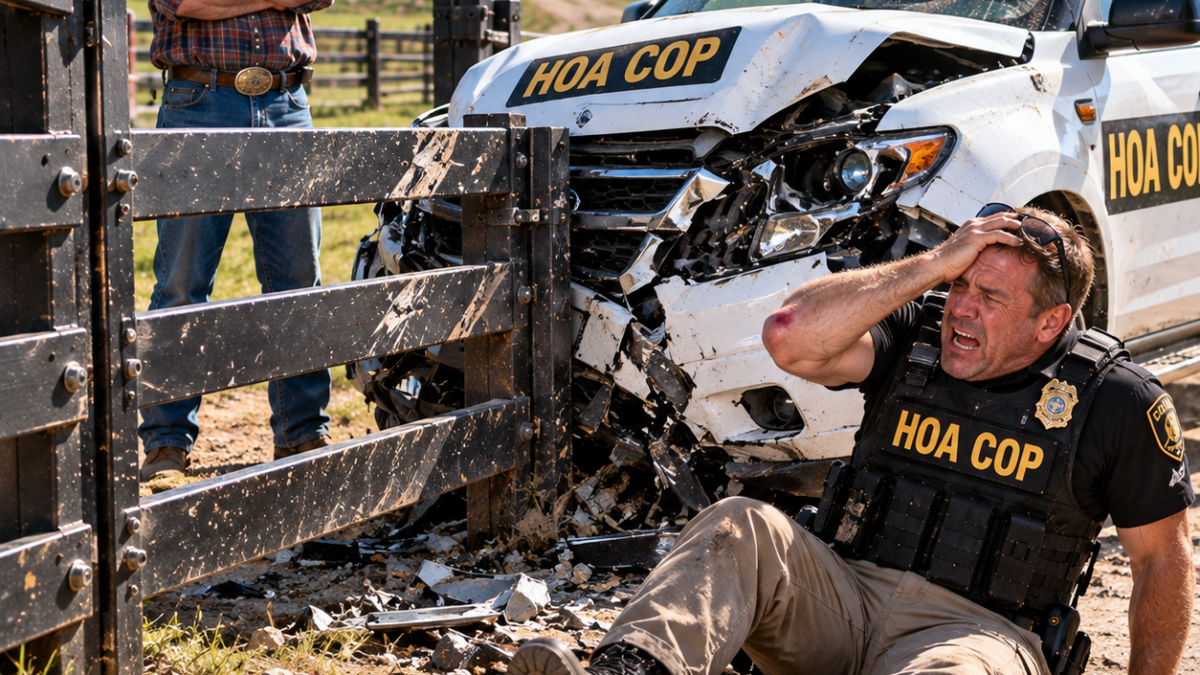
part2:
It came from the east pasture.
Wood snapping.
An engine revving.
Then gravel spraying.
Grandpa and I were standing near the machine shed.
We looked at each other.
He set down the wrench in his hand.
“That’s the fence.”
We drove out in his old Ford.
About two hundred yards from the county road, a four-foot section of split-rail fencing had been destroyed.
Fresh tire tracks led straight toward the break.
Then curved back toward the road.
White paint marked one rail.
Grandpa crouched.
Ran two fingers over it.
“Somebody hit this hard.”
I looked toward Sage Hill.
“You think one of their contractors?”
“Maybe.”
We repaired it.
New rails.
Checked posts.
No shouting.
No call to Linda yet.
Accidents happen.
Next morning?
Same sound.
Same section.
Another impact.
This time, I got there quickly enough to see a white SUV disappearing up the road.
Yellow lettering on the side:
SAGE HILL HOA PATROL
I stared.
“Grandpa.”
“I saw.”
He looked at the broken fence.
Then at the road.
“Get the camera from the barn.”
Not a security camera.
Just my old trail camera.
We mounted it on a tree facing the damaged section.
I also photographed the tire tracks.
Grandpa called Sage Hill’s management office.
Linda answered.
He put the call on speaker.
“This is Henry Cole at Cedarline Ranch.”
Pause.
“Yes?”
“One of your vehicles hit my fence this morning.”
“What vehicle?”
“White SUV with your association name on it.”
Another pause.
“Our patrol does routine boundary inspections.”
“Your patrol drove through my fence.”
“If there was contact, it may have resulted from improper placement.”
Grandpa looked at me.
I could see the exact moment his patience changed shape.
“Linda.”
“Yes?”
“My fence has been in the same recorded location longer than Sage Hill has existed.”
“I suggest you review your boundary.”
“I already did.”
“Then you know we’re evaluating historical access rights.”
“No.”
“I know you’re making claims you haven’t documented.”
Linda’s voice cooled.
“Our legal position is under review.”
“Then review it from your side.”
He hung up.
The third morning, the trail camera caught everything.
White SUV.
Same driver.
He slowed near the fence.
Looked around.
Then deliberately turned toward it.
Accelerated.
Hit the rails.
Backed away.
Paused.
Then drove off.
I watched the clip twice.
“That’s intentional.”
Grandpa nodded.
“Yep.”
“You calling the sheriff?”
“Yep.”
Sheriff Colton Daws had known Grandpa most of his life.
Colton wasn’t some movie sheriff who arrested people because a rancher complained.
He asked questions.
Wanted the video.
Wanted the survey.
Wanted the exact property line.
Good.
We gave him everything.
He watched the footage.
Then said:
“That’s not an accidental bump.”
“No.”
Grandpa agreed.
“Do you know the driver?”
“No.”
“I’ve seen him at Sage Hill.”
Colton took a copy of the video.
“We’ll identify him.”
“What do we do if he comes back?”
Grandpa asked.
“Call us.”
“Don’t block him with a vehicle.”
“Don’t confront him in the road.”
“Don’t touch him.”
“Document.”
Grandpa nodded.
That’s important.
The story people later told made it sound like Grandpa decided to build some hidden trap designed to wreck a car.
That’s not what happened.
We had livestock.
A damaged fence created actual risk.
Cattle could reach the road.
Wildlife moved through that section.
The rails needed replacing.
And after three deliberate impacts, rebuilding the same lightweight section without addressing the repeated damage would’ve been foolish.
Grandpa called a fencing contractor named Earl McKenna.
Then he called our insurance agent.
Then a county land-use officer.
He explained that vehicles were repeatedly striking a boundary fence and asked what restrictions applied if we upgraded that section.
Earl recommended a proper ranch barrier set back fully inside our surveyed property line, designed primarily to protect livestock and prevent accidental vehicle intrusion.
Visible.
Not concealed.
No spikes.
No hidden obstacles.
No trap.
County had no objection as long as we stayed inside our property and did not obstruct the public right-of-way.
We did.
We also installed reflective warning markers.
A large sign:
PRIVATE PROPERTY — NO VEHICLE ACCESS
Another:
FENCE AHEAD
Grandpa added two more cameras.
One obvious.
One less obvious.
“I want the whole approach.”
he said.
Not:
I want him hurt.
Not:
Let’s teach him with steel.
He wanted evidence.
That distinction became extremely important later.
The replacement fence was stronger than the split rails.
Steel ranch panels inside a timber façade.
Heavy posts.
Professional installation.
Designed to stop livestock and resist repeated vehicle impact.
The visible wooden rails maintained the ranch appearance.
There was nothing secret about the fact a substantial barrier now stood there.
Reflectors made that clear.
The next morning, nothing happened.
Same the morning after.
I started thinking maybe the police contact had finally ended it.
Then Linda arrived.
Black Lexus.
She stopped outside the gate.
Didn’t enter.
Good.
Grandpa and I walked over.
Linda lowered her window.
“You changed the fence.”
Grandpa said:
“Yes.”
“Without Sage Hill approval.”
Grandpa almost smiled.
“Linda.”
“What?”
“You still haven’t shown me anything giving Sage Hill authority over this land.”
“The old access corridor is being researched.”
“Research it.”
“You’ve obstructed inspection.”
“No.”
“I put a fence on my ranch.”
She looked past us.
“This escalation is unnecessary.”
Grandpa stared.
“My fence got hit three mornings in a row.”
“Your patrol vehicle made incidental contact during inspection.”
I laughed.
Could not help it.
Linda turned.
“Something funny?”
“The video.”
Her face changed.
Only for a second.
“What video?”
Grandpa said:
“The one showing your driver turn toward the fence and accelerate.”
Linda’s expression hardened.
“You filmed HOA personnel?”
“I filmed my land.”
“We’ll need a copy.”
“The sheriff already has one.”
That landed.
Linda adjusted her sunglasses.
“I don’t appreciate threats.”
Grandpa said:
“That wasn’t one.”
“That’s information.”
She drove away.
Nothing happened for two more days.
Then Monday morning, just after seven, I heard the engine.
I was feeding horses near the barn.
Same distinctive roar.
I stepped outside.
White Sage Hill SUV.
It approached slowly at first.
The cameras recorded everything.
The driver stopped approximately thirty yards from the fence.
He got out.
Same man from the earlier footage.
Dark sunglasses.
Black vest.
Patch reading:
HOA SECURITY
Fake badge clipped near the chest.
He walked toward the barrier.
Kicked one post.
Then another.
Looked at the warning sign.
Grandpa appeared on the porch with a hammer because he’d been repairing a loose board on the tack-room door.
The later internet versions made that hammer sound like some threat.
It wasn’t.
Grandpa never moved toward the driver.
Never raised it.
Never said anything violent.
The man called:
“You rebuilt it.”
Grandpa answered:
“Stay off my property.”
The driver smirked.
“We have inspection authority.”
“Show it.”
“Linda already told you.”
“Linda doesn’t own my ranch.”
The man kicked the post again.
“You people don’t learn.”
Grandpa said:
“Leave.”
The driver walked back to his SUV.
That’s when I took out my phone.
Started recording too.
I thought he would drive away.
Instead, he sat behind the wheel.
Engine running.
Then revved it.
Grandpa looked toward me.
“Back up.”
We moved farther from the fence.
I remember thinking:
He’s not actually going to do it again.
He had stopped.
He had gotten out.
He had looked at the upgraded barrier.
There were reflectors.
Signs.
A visible steel frame.
The man knew.
Then the SUV backed several yards.
Straightened.
Engine revved harder.
I shouted:
“Don’t do it!”
Maybe he heard.
Maybe not.
The vehicle accelerated.
Straight toward the fence.
I will never forget the impact.
Metal.
Wood.
Glass.
A deep, violent crash that echoed across the pasture.
The reinforced section bent but remained upright.
One post shifted.
The wooden façade splintered.
The SUV’s front end absorbed most of the force.
Airbags deployed.
The vehicle bounced backward and stopped several feet away.
Steam or coolant mist rose from beneath the crumpled hood.
For maybe two seconds, nobody moved.
Then I ran toward the road.
Not to drag the driver out.
To see whether the vehicle was on fire.
Grandpa yelled:
“Stay back!”
Right.
Unknown condition.
Possible fuel.
Possible airbag chemicals.
Driver might be injured.
I stopped about fifteen feet away.
The driver’s door opened.
He stumbled out.
Blood at his forehead from a superficial cut.
He dropped to one knee.
Then sat on the ground.
“What the hell?”
he yelled.
Grandpa stayed on our side of the fence.
“You drove into it.”
The man looked at the barrier like it had personally betrayed him.
“You reinforced it!”
Grandpa’s voice remained calm.
“Yes.”
The driver pointed.
“You can’t do that.”
“To my fence?”
“You knew I’d hit it.”
That sentence mattered.
I called 911.
“My name is Noah Cole.”
“Cedarline Ranch.”
“We have a vehicle collision at our east property boundary.”
“The driver deliberately struck our fence.”
“He’s out of the vehicle.”
“He appears injured.”
“Send medical and law enforcement.”
The dispatcher asked whether anyone had weapons.
“No.”
“Any fire?”
“No visible flames.”
“Stay away from the vehicle.”
“We are.”
The driver kept shouting.
“My head.”
“I need an ambulance.”
“One’s coming.”
I said.
Then:
“Sit still.”
He looked at me.
“You set me up.”
Grandpa shook his head.
“You drove at a fence marked with warning signs.”
“You changed it because of me.”
“I changed it because you broke it three times.”
“Same thing!”
No.
It wasn’t.
The cameras captured that too.
Sheriff Colton Daws arrived before the ambulance.
No siren.
Lights only.
Two deputies behind him.
He walked toward the scene.
Looked at the SUV.
Then the fence.
Then me.
“Everybody okay?”
“Driver hit his head.”
I said.
Colton approached the man carefully.
“Name?”
“Travis.”
“Last name?”
“Mercer.”
“What happened, Travis?”
Travis looked toward Grandpa.
“They built a reinforced barrier knowing I was conducting inspections.”
Colton looked at the road.
Then the signs.
Then the tire path.
“Did you drive into it?”
“It was supposed to be a breakaway fence.”
Grandpa laughed once.
Colton looked at him.
Grandpa stopped.
Travis continued:
“They changed it.”
Colton asked:
“Did you intentionally strike the previous fence sections?”
“No.”
I said:
“We have video.”
Colton looked at me.
“From today too?”
“Yes.”
“Don’t erase anything.”
“Already backed up.”
Paramedics arrived.
Checked Travis.
He was dazed but alert.
Possible concussion.
Cuts from glass.
No catastrophic injury.
They placed a cervical collar as a precaution and prepared to transport him.
Before he left, Colton asked:
“Who told you to inspect this boundary by driving through the fence?”
Travis looked toward the ambulance.
“Nobody said drive through it.”
“Then why did you?”
Silence.
“Travis.”
“Linda said the fence was illegally blocking HOA access.”
“That isn’t what I asked.”
Travis rubbed his forehead.
“I was told to keep testing access until they stopped blocking the corridor.”
Colton looked toward Grandpa.
Then me.
“Linda Caroway?”
Travis nodded.
“Vice president.”
Colton said:
“That’s enough for now.”
No dramatic instant confession.
No handcuffs while paramedics loaded him.
No sheriff announcing he’d “bury the HOA.”
Medical came first.
Evidence next.
That’s how it should work.
We gave deputies the camera recordings.
All of them.
Including the earlier impacts.
The newest footage showed Travis:
Stopping.
Exiting.
Examining the fence.
Reading or at least facing visible warnings.
Kicking the barrier.
Returning to the SUV.
Backing up.
Accelerating.
Impact.
That sequence destroyed any argument that he’d accidentally lost control during routine inspection.
The investigation started that morning.
It did not end that morning.
That’s another part the internet always gets wrong.
Nobody drove immediately to Linda’s house and arrested her because Travis said her name.
Deputies needed to establish what Linda actually instructed.
There was a difference between:
Inspect the boundary.
And:
Ram the fence.
One could be annoying but lawful if done from authorized areas.
The other could be criminal.
Investigators needed proof.
The proof came from phones.
Emails.
Sage Hill records.
And, eventually, Travis himself.
His full interview happened after the hospital released him.
With counsel.
He admitted the first impact had been intentional.
So had the second.
And the third.
Why?
Linda wanted pressure placed on Cedarline Ranch while the HOA investigated what she called a “legacy access corridor.”
She believed if our fence repeatedly required repairs, Grandpa might eventually leave the gap open long enough for HOA contractors to establish regular passage.
That’s what Travis said.
It sounded ridiculous.
Until investigators found Linda’s emails.
The old access-road claim came from a preliminary subdivision concept prepared before Sage Hill’s development.
A dashed line crossed part of what later remained Cedarline Ranch.
The final recorded subdivision plan did not include that road.
No easement was recorded.
No county right-of-way existed.
But Linda convinced herself the old concept represented a right Sage Hill had somehow inherited.
She sent the board attorney questions.
The attorney repeatedly answered:
We have not located a recorded access easement across the Cole parcel.
Linda didn’t like that.
One email to Travis read:
Continue perimeter verification. Their fence cannot be allowed to create permanent exclusion while access research is unresolved.
Another:
Test the existing opening points. If the barrier is unstable or improperly placed, document it.
That language was vague enough to argue over.
Then investigators found a text.
Travis:
Rails break easy. Old man keeps rebuilding.
Linda:
Then keep making the point until he understands the corridor cannot stay blocked.
That was harder to explain.
Another:
Don’t injure anyone. Pressure the property, not the people.
Important.
Linda did not tell Travis to hurt Grandpa.
She apparently believed that sentence protected her.
It didn’t make repeated intentional property damage lawful.
Then, after the second impact:
Travis:
He called sheriff.
Linda:
Nothing changes. HOA has a duty to preserve access claim. Keep documenting physical obstruction.
Travis:
By driving through it?
Linda waited eleven minutes before replying.
Use judgment.
That message became central.
Her defense later argued:
Use judgment meant stop damaging things.
Prosecutors argued the entire conversation showed she knew exactly what he was doing and refused to stop it.
The board records made Linda’s position worse.
Sage Hill president Richard Fulton genuinely did not know Travis was deliberately ramming our fence.
He knew Linda had hired a private patrol company.
He knew there was an access dispute.
He thought patrol employees were photographing the boundary.
When Sheriff Daws interviewed him, Richard stared at the video.
Then said:
“He did that before?”
“Three times.”
Colton answered.
Richard looked physically ill.
“Linda told us the ranch owner kept damaging the patrol vehicle during inspections.”
That stopped everyone.
“What?”
Colton asked.
Richard pulled up an HOA incident report.
Travis had filed damage claims after each fence collision.
First:
Vehicle side/front contact resulting from unsafe unauthorized barrier extension.
Second:
Community patrol vehicle damaged by improperly maintained ranch obstruction.
Third:
Repeated hazardous fence placement causing collision during boundary verification.
Grandpa read copies later.
His face went red.
Not because Travis damaged our fence.
Because Travis blamed the fence afterward.
Each report helped Linda justify repairs to the HOA SUV using association money.
Insurance claims followed.
That created another layer.
Now investigators weren’t looking only at trespass and property damage.
They were examining whether false information had been submitted in connection with vehicle-damage reimbursement.
The patrol SUV belonged to Sage Hill.
Not Travis.
The association had paid deductibles.
Repair expenses.
Rental vehicle charges.
Residents’ dues had funded a fake enforcement campaign most residents didn’t know existed.
Fiona Grant, Sage Hill’s treasurer, discovered the total.
Nearly $19,000 over several months.
Not all tied to fence collisions.
But enough.
Fiona called an emergency board meeting.
Grandpa and I did not attend.
We weren’t Sage Hill members.
That mattered.
I wasn’t going to walk into their clubhouse demanding control over their board any more than I wanted Linda controlling our ranch.
Richard Fulton presented the video.
Then the emails.
Linda defended herself.
According to the minutes we later received through counsel, she said:
“The Cole fence was obstructing an access corridor historically intended for community use.”
A board member asked:
“Recorded where?”
Linda:
“We are still researching title.”
“Then why was Travis driving through it?”
“He used poor judgment.”
Fiona asked:
“Did you know he had hit it before?”
Linda said:
“I knew contact occurred.”
“Did you tell the board?”
“No.”
“Why?”
“Because it was an ongoing enforcement matter.”
Richard apparently stopped the meeting.
“Enforcement of what?”
Silence.
That question should have been asked months earlier.
The board suspended Linda immediately pending investigation.
They also terminated the patrol contract.
Not dissolved the HOA.
Not abolished every security function overnight.
They stopped the disputed operation.
Then hired outside counsel.
Grandpa’s attorney, Rachel Monroe, entered the story at that point.
Grandpa resisted hiring her.
“Waste of money.”
I said:
“You’ve already repaired the fence four times.”
“Fair.”
Rachel practiced real-estate and civil litigation.
She reviewed everything.
Then said:
“This is not primarily an HOA case.”
Grandpa frowned.
“They’re the HOA.”
“The boundary issue is.”
“The repeated vehicle impacts are property-damage claims.”
“The false access assertions are another issue.”
“Insurance reimbursement may be another.”
“And if Travis falsely represented himself as law enforcement, that’s separate again.”
That last part needed clarification.
Travis’s SUV had HOA COP in oversized yellow lettering during some of the earlier encounters.
His vest carried a shield-shaped badge.
He used phrases like:
“HOA officer.”
“Boundary enforcement.”
But he had never directly told Grandpa:
I am a police officer.
The state law on impersonation required specific elements.
Sheriff Daws refused to promise a charge before prosecutors reviewed the facts.
Good.
Ultimately, prosecutors did not rely on some cartoonish “fake cop” charge as the center of the case.
They focused on what could actually be established.
Repeated intentional damage.
Trespass.
Reckless driving.
False reporting related to vehicle incidents.
And conspiracy or complicity issues involving Linda where evidence supported them.
The county also reviewed the patrol company’s licensing and representations.
Administrative consequences followed.
The company lost its contract.
Later, its state security authorization was suspended after regulators found training and operational problems beyond our case.
Travis’s case resolved first.
He pleaded guilty to multiple property-damage counts, reckless vehicle operation, and false-reporting-related conduct.
His attorney emphasized that he had no prior felony record.
That Linda had encouraged the pressure campaign.
That nobody had been physically hurt in the earlier incidents.
That the final crash injured mainly him.
All true.
Prosecutors emphasized repeated deliberate conduct after warnings.
Also true.
He received a custodial sentence measured in months rather than decades, followed by supervision.
He owed restitution for fence repairs, certain documented losses, and costs attributable to the incidents.
Not some invented $22,500 “fine for hitting steel.”
Actual damages had to be documented.
Our fence repairs were.
So were camera replacements, labor, and some associated expenses.
His medical injuries were not punishment imposed by court.
They were consequences of driving into a visible barrier he’d already inspected.
The SUV itself was badly damaged.
Insurance became complicated because intentional acts can affect coverage.
Sage Hill eventually had to absorb part of the vehicle loss through its own finances and civil recovery efforts.
Residents were furious.
They should have been.
Their dues had paid for the SUV.
Linda’s criminal case took longer.
Prosecutors did not charge her with personally ramming the fence.
She hadn’t.
They charged offenses based on evidence that she encouraged repeated property interference, knew Travis was intentionally striking the barrier, allowed false reporting to continue, and used HOA authority she did not actually possess to pressure the ranch.
Some charges changed before final resolution.
Her attorneys argued she believed an access right existed.
That matters.
Mistake of law and mistaken property assumptions don’t automatically become crimes.
But belief in an easement did not authorize deliberate destruction while the easement remained unproved.
The emails mattered.
So did the board attorney’s repeated statements that no recorded right had been found.
Linda eventually accepted a plea agreement covering conspiracy-related property damage, harassment or coercive conduct supported by the record, and financial misconduct tied to HOA vehicle reports.
She received less than the wild “nine months exactly” rumor that circulated online in some versions and more consequence than she expected when this began.
There was supervised custody, probation afterward, restitution, and a prohibition under Sage Hill’s settlement from holding association office there again.
State law did not magically ban her from every HOA forever.
Sage Hill removed her.
That was enough for us.
Our civil case settled separately.
Grandpa wanted one thing.
A recorded agreement acknowledging no Sage Hill access right across the ranch unless a future right was legally acquired.
Rachel said:
“We cannot make them admit no possible easement could ever exist in human history.”
Grandpa stared at her.
“Lawyers.”
Rachel smiled.
“What we can get is acknowledgment that Sage Hill has identified no current recorded easement, has no permission to enter Cedarline Ranch, and will not direct agents onto the property absent future lawful authority.”
Grandpa nodded.
“That.”
We got it.
Written.
Signed by the board.
Reviewed by both lawyers.
Recorded where appropriate for notice.
There was also money.
Fence repairs.
Legal fees.
Property damage.
Security costs.
The amount wasn’t glamorous.
Nobody became rich.
Grandpa didn’t care.
When the settlement check arrived, he looked at it and said:
“Buy cattle.”
I laughed.
“That’s your legal strategy?”
“Always.”
We replaced the damaged section again.
Not bigger.
Not more aggressive.
Earl McKenna repaired it to the same safe ranch standard.
Visible steel-supported barrier.
Reflectors.
Warning signs.
No hidden danger.
County setback maintained.
Rachel made sure photographs documented the final condition.
Then Grandpa did something I didn’t expect.
He removed the sign that said:
FENCE AHEAD
I asked:
“Why?”
“Don’t need it now.”
“You sure?”
He pointed down the road.
“They know.”
I laughed.
The smaller sign remained.
PRIVATE PROPERTY — NO VEHICLE ACCESS
That one stays there today.
Sage Hill changed too.
Richard Fulton remained president for one more year.
He apologized directly to Grandpa.
Not:
“We’re sorry this misunderstanding occurred.”
Grandpa would’ve thrown him out for that.
Richard said:
“I delegated something I did not supervise.”
“I accepted Linda’s explanation of the boundary without reading the title opinion myself.”
“I am sorry our association damaged your property.”
Grandpa looked at him.
Then:
“You going to do it again?”
“No.”
“Then we’re done.”
That was Grandpa’s idea of reconciliation.
Richard laughed nervously.
I think he expected more.
There wasn’t more.
Fiona became president after him.
One of her first actions was requiring any future claim against non-HOA property to receive written review from association counsel before staff or contractors contacted the owner.
Another required all security vehicles to avoid police-like markings.
No more:
HOA COP
The replacement vehicle said:
SAGE HILL COMMUNITY SERVICES
Boring.
Excellent.
Contractors couldn’t use shield badges.
Couldn’t represent themselves as officers.
Couldn’t enter neighboring private property without permission or independent legal authority.
Again:
Basic.
But sometimes basic rules only become obvious after someone abuses the space where nobody wrote them down.
Sage Hill also reviewed every old “enforcement” incident Linda had handled.
Most involved ordinary HOA members.
Fence color.
Parking.
Landscaping.
Nothing criminal.
Those remained normal association matters.
A few involved boundary properties outside Sage Hill.
Those notices were withdrawn if jurisdiction couldn’t be established.
The association didn’t implode.
Property values didn’t collapse.
The pool stayed open.
The clubhouse stayed standing.
People continued arguing about mailboxes.
Life went on.
That’s important because stories like this often pretend justice requires destroying everyone connected to the wrongdoer.
It doesn’t.
Most Sage Hill residents didn’t know Travis was hitting our fence.
They shouldn’t lose their homes or savings because Linda overstepped.
The goal was stopping the conduct.
Clarifying the boundary.
Repairing the damage.
Holding the responsible people accountable.
That happened.
Grandpa went back to ranching.
At least he tried.
For months, every engine approaching from the east made him look up.
He would pretend otherwise.
But I’d see it.
Pickup.
Delivery truck.
Utility van.
His eyes went to the fence.
Then back to whatever he was doing.
One afternoon I asked:
“You expecting Travis?”
“He’s in custody.”
“I know.”
“Then why do you keep looking?”
Grandpa stared.
“Habit.”
That was all he’d admit.
I’m younger.
I could call it hypervigilance.
He’d call that nonsense.
Habit was his word.
Fine.
The fence became just a fence again slowly.
Calves leaned against it.
Birds landed on the top rail.
Snow piled beneath it.
Grass grew around the posts.
The most dramatic object in the county went back to doing the job fences have done forever.
Keeping certain things in.
Keeping other things out.
Marking where one person’s responsibility ends and another person’s begins.
A year after the case ended, a Sage Hill resident named Jeremy Walsh drove to our gate.
He stayed in his truck until I walked over.
Good start.
“You Noah?”
“Yes.”
“I’m on the new access committee.”
I laughed.
“Bad opening.”
He grinned.
“Not that access.”
“What then?”
“Emergency wildfire evacuation.”
That got my attention.
Sage Hill had one main exit.
County emergency management had encouraged subdivisions near timber to explore secondary evacuation options.
Jeremy held out a folder.
“We want to ask whether Cedarline would consider a temporary emergency-only evacuation agreement along the north pasture during a declared wildfire emergency.”
I stared at him.
“You’re asking.”
“Yes.”
“Not claiming an old road?”
“No.”
“Not sending a patrol SUV?”
“Absolutely not.”
Grandpa joined us.
Jeremy explained.
County emergency manager involved.
Surveyor.
Insurance.
Defined route.
Emergency only.
No daily traffic.
No development access.
No recreational use.
Grandpa listened.
Then said:
“Have the county send it to Rachel.”
Jeremy nodded.
“That’s why I’m here.”
Months later, we signed a limited emergency agreement.
People were shocked.
“You let the HOA use ranch property after everything?”
No.
We let people escape a fire if necessary.
Different.
Permission given freely.
Specific purpose.
Written limits.
Recorded terms.
Grandpa said:
“A gate doesn’t mean nobody ever comes through.”
“It means somebody asks who opens it.”
That became my favorite thing he ever said.
Better than the handshake line.
The emergency route has been used once.
Not for fire.
A county drill.
Sage Hill residents drove slowly through the designated lane under supervision.
No one touched our pastures.
No one claimed permanent rights.
At the end, the gate closed.
Done.
That’s what cooperation looks like when nobody confuses it with control.
Travis wrote Grandpa a letter after release.
Grandpa didn’t want it.
Then read it anyway.
Travis said he’d taken the patrol job because he liked the authority.
Not the pay.
The vest.
Vehicle.
Badge.
People moving when he approached.
He wrote:
Linda never told me I was police. I knew I wasn’t. I liked that some people couldn’t tell the difference.
That was honest.
He admitted the first fence hit began almost as a dare.
Linda wanted the “obstruction challenged.”
He wanted to show he could do it.
The fence broke.
Nobody immediately stopped him.
So the second time felt easier.
Then the third.
Then he started believing our repairs were aggression against him.
That’s the psychology that stayed with me.
He destroyed our fence.
Then became offended when we made it harder to destroy.
He wrote:
The day I hit the new fence, I had already decided you built it to embarrass me. I never considered that you built it because I kept driving through the old one.
Grandpa read that twice.
Then said:
“At least he figured it out.”
“Going to answer?”
“No.”
“Why?”
“What would I say?”
I didn’t know.
So he didn’t.
No need to turn every accountability story into a friendship.
Years passed.
Grandpa got older.
Cedarline didn’t.
Or maybe land ages differently.
At eighty-three, he stopped riding a horse alone.
At eighty-five, he finally let me handle most cattle sales.
At eighty-seven, he still walked to the east fence with a cane.
One morning, I found him resting his forearms on the top rail.
Sage Hill houses visible across the ridge.
“What are you thinking?”
I asked.
“That fence is ugly.”
I laughed.
“You designed it.”
“Still ugly.”
“We can replace the timber facing.”
“Waste of money.”
“Then stop complaining.”
He smiled.
Then:
“You remember what I told you when you were little?”
“A fence is a handshake.”
“Yeah.”
He tapped the rail.
“This one got punched a few times.”
I laughed.
“Still standing.”
“That’s not why it matters.”
“What matters?”
He looked toward Sage Hill.
“They finally learned which side was theirs.”
That was Grandpa.
Simple.
No speech about justice.
No revenge.
Boundary.
That’s all he’d wanted.
Grandpa died two winters later.
Peacefully.
At home.
I found him in his chair one morning with the television still on and coffee gone cold beside him.
He was ninety.
Cedarline Ranch passed to me.
That felt impossible.
For most of my life, the ranch had seemed to belong to Grandpa the way mountains belong to geology.
Then suddenly the deed said Noah Cole.
The first week after the funeral, people kept asking:
“What are you going to do with the ranch?”
Nothing.
What kind of question was that?
Then I realized they meant:
Sell?
Develop?
Divide?
Lease?
I didn’t know.
So I did nothing.
Best decision sometimes.
Spring came.
Cattle calved.
Fence needed repair.
Life continued.
One Saturday, I went to the east boundary.
The reinforced section needed paint.
I brought a brush.
Halfway through, a golf cart approached from Sage Hill’s side.
My body tensed.
Even after all those years.
Then I recognized Fiona.
Older.
White hair now.
She stopped at the boundary.
Didn’t cross.
“Noah.”
“Fiona.”
She held up a folder.
I laughed.
“No.”
She smiled.
“This is not enforcement.”
“What?”
“Wildfire agreement renewal.”
“Fine.”
“Send it to Rachel.”
“Rachel retired.”
“Then whoever replaced her.”
“You really are Henry’s grandson.”
I looked at the fence.
“Unfortunately.”
Fiona stepped closer but remained on her side.
“I miss him.”
“Me too.”
She looked at the repaired section.
“Are you keeping this thing forever?”
“Probably.”
“Good.”
“Why?”
“Historical monument.”
“Absolutely not.”
She laughed.
Then:
“You know Sage Hill tells the story differently now.”
“I bet.”
“No.”
“Not the old version.”
“What version?”
She said:
“We use it during board orientation.”
I stared.
“Seriously?”
“New board members get the boundary map and a summary of the incident.”
“What does it say?”
She recited:
Never direct association enforcement beyond recorded jurisdiction without legal review.
I smiled.
“Boring.”
“Exactly.”
Grandpa would’ve approved.
Maybe.
He would’ve complained about attorney fees first.
I renewed the wildfire agreement.
The ranch remains outside Sage Hill.
No dues.
No architectural committee.
No golf-cart rules.
No mailbox standards.
We have our own problems.
Broken pumps.
Fence repairs.
Cattle escaping at the worst possible hour.
A roof that always seems to need something.
Real rural life isn’t the quiet fantasy suburban people imagine.
Still, it’s ours.
The steel-supported fence remains.
Not because I’m afraid of another Travis.
Because it works.
We replaced damaged wood.
Repainted.
Added a normal livestock gate.
Nothing sinister.
No trap.
I want that clear.
If anyone approaches today, they see the barrier long before reaching it.
Reflectors.
Sign.
Open sightline.
A person would have to make a deliberate choice to hit it.
That’s what Travis did.
That’s why his crash became evidence against him instead of evidence against us.
Visibility matters.
Warnings matter.
Intent matters.
The popular retelling got almost everything emotionally right and procedurally wrong.
People love saying Grandpa built a “secret steel wall” and waited for the HOA cop to destroy himself.
No.
Grandpa repaired a repeatedly damaged fence.
Strengthened it lawfully.
Added warnings.
Added cameras.
Reported the prior attacks.
Then stayed away while the same man chose to ram it again.
That version isn’t as gleeful.
It is better.
Because Grandpa wasn’t trying to hurt Travis.
He was trying to stop losing a fence.
There’s a moral difference.
And a legal one.
I learned more from that distinction than from the crash itself.
Years later, I spoke with Sheriff Daws about it.
He was retired by then.
We were at a county fair.
He said:
“You know what saved Henry a lot of trouble?”
“Video?”
“That.”
“And the warnings.”
I nodded.
He continued:
“If he’d hidden something dangerous in the road hoping Travis would hit it, we’d have had a different conversation.”
“He didn’t.”
“I know.”
“That’s my point.”
“He protected his property.”
“He didn’t create an ambush.”
Then Colton smiled.
“Also, Travis was an idiot.”
I laughed.
“Thought you weren’t supposed to say that.”
“Retired.”
Apparently retirement creates constitutional freedom.
Colton died a few years later.
Good man.
Sage Hill dedicated a bench to him near its clubhouse because he’d helped with community safety programs after everything.
I found that funny.
The same sheriff Linda once treated as an obstacle ended up memorialized inside the HOA.
Life is strange.
Linda disappeared from public view after completing her sentence and supervision.
Last I heard, she moved closer to her daughter.
No comeback campaign.
No second showdown.
Good.
I don’t hate her.
I hated what she did.
Those are different.
People ask:
“How can you not hate someone who sent a man to ram your family fence?”
Because hate is maintenance.
The ranch already gives me enough maintenance.
Also, Linda lost more by her own choices than anything I could add.
Position.
Trust.
Money.
Freedom for a period.
Reputation.
I don’t need to spend mornings keeping that alive.
Travis?
Same.
He made repeated choices.
Paid for them.
Hopefully became better.
Not my job.
My job is Cedarline.
That answer feels almost too simple.
Maybe simplicity is what age gives you.
When I was younger, I wanted every conflict to end with someone clearly defeated.
Now?
I want the gate closed.
Cattle where they belong.
Coffee hot.
Neighbors respectful.
That’s enough.
A local high-school civics teacher once asked if she could bring students to the ranch to talk about property rights.
I said no.
Then she explained.
Not politics.
Not anti-HOA.
A unit about deeds, easements, recorded rights, private contracts, and how different layers of authority interact.
I agreed.
Twenty students arrived in a bus.
We stood near the east fence.
I held up our survey.
Asked:
“What gives me the right to say Sage Hill can’t use this road?”
One student said:
“You own it.”
“Not enough.”
He frowned.
I explained.
Ownership exists within law.
There could be an easement.
County right-of-way.
Utility right.
Court order.
Recorded agreement.
Emergency authority in certain circumstances.
You have to check.
Then:
“What did Sage Hill have?”
A girl answered:
“An old map?”
“Yes.”
“Did that create an easement?”
“No.”
“Exactly.”
Then I showed them the recorded plat.
The teacher asked:
“What about the fence?”
I said:
“It sits inside our property.”
“Built under applicable rules.”
“Visible.”
“Legal.”
“Why does that matter?”
Another student:
“Because owning land doesn’t mean you can build anything you want.”
I smiled.
Finally.
Someone understands.
The lesson wasn’t:
Property owner always wins.
It was:
Authority has sources.
Find them.
That’s what Linda refused to do.
She started with the outcome she wanted.
Sage Hill access.
Then worked backward looking for language to justify it.
Historical corridor.
Community safety.
Boundary inspection.
Enforcement.
Nothing changed the missing fact.
No recorded easement.
Had Sage Hill approached Grandpa honestly and offered money for access?
Maybe he’d have refused.
Maybe not.
I once asked.
Years before he died.
“What if they offered enough?”
“How much?”
“I don’t know.”
“Million dollars?”
He thought.
“For that narrow strip?”
“Yes.”
He laughed.
“I’d move the cows.”
So much for sacred land.
I stared.
“You’d sell?”
“I’d negotiate.”
“But you said—”
“Noah.”
He pointed at me.
“Property rights include the right to say yes.”
That shut me up.
Another lesson.
Boundaries aren’t about permanent refusal.
They’re about who gets to decide.
Linda’s mistake wasn’t wanting access.
It wasn’t believing the road would help residents.
It wasn’t even challenging the fence through lawyers.
Her mistake was deciding Grandpa’s refusal was illegitimate because it interfered with her preferred outcome.
Once she crossed that mental line, physical lines became easier to cross.
Travis’s SUV did the rest.
Today, the emergency evacuation agreement lets Sage Hill cross a designated northern route if county emergency management activates it.
They have permission for that.
The east fence?
No access.
Different land.
Different agreement.
Different purpose.
People sometimes ask if that’s inconsistent.
No.
Consent is specific.
You can let your neighbor borrow your truck Tuesday and still call it theft if he takes it next month without asking.
Permission isn’t ownership.
That’s another simple idea that causes remarkably complicated disputes.
The fence itself has needed repairs over the years.
Weather.
Rust.
One cow somehow bent a section while trying to reach grass on the other side even though identical grass existed beneath her feet.
Cows have no respect for property law.
Every time I work on that section, I see the small weatherproof camera box Grandpa mounted years ago.
The original camera is gone.
Technology obsolete.
I left the box.
Not as a monument.
Because removing it would leave screw holes.
At least that’s what I tell myself.
Truth?
It reminds me of Grandpa standing beside the damaged rails saying:
“I want proof.”
That was his best instinct.
Not stronger steel.
Evidence.
He didn’t trust Linda’s version.
Didn’t even trust his own anger.
Camera.
Survey.
Sheriff.
Documents.
That’s why the story survived exaggeration.
The facts were preserved.
One morning last fall, I heard an engine from the east.
Loud.
Fast.
My body reacted before my brain.
I stepped outside.
A white SUV came down the county road.
For one irrational second, I saw Travis again.
Then it slowed.
Turn signal.
Pulled into Sage Hill.
Ordinary family.
Kayaks on the roof.
Kids in back.
I stood there laughing at myself.
Then looked toward the fence.
Still standing.
But the important thing wasn’t that the fence had beaten anybody.
It hadn’t.
Steel didn’t defeat Sage Hill.
A crash didn’t destroy an HOA.
What ended the problem was much less satisfying if you want revenge.
Recorded property rights.
Video.
Emails.
Board review.
Lawyers.
Investigation.
Consequences proportional to proven conduct.
Then better rules.
That’s how durable endings happen.
Not by humiliating everyone.
By making the next abuse harder.
Sage Hill’s current board president is a man named Aaron Patel.
Accountant.
Painfully careful.
He sends boundary-related correspondence through counsel if it touches neighboring property.
Once he called me himself.
“Noah?”
“Yes.”
“Tree fell from Sage Hill onto your fence.”
“I saw.”
“We’re arranging removal.”
“Good.”
“Our insurer needs access from your side for two hours.”
“When?”
“Thursday?”
“Send it in writing.”
He laughed.
“I knew you’d say that.”
“Then why call?”
“Neighbor courtesy.”
Fair.
He emailed.
I approved.
Crew entered Thursday.
Removed tree.
Repaired damage.
Left.
No conflict.
No patrol SUV.
No fake badge.
Nobody ramming anything.
Sometimes the happiest ending is boring competence.
Grandpa would’ve hated how much I sound like an attorney now.
He’d blame Rachel.
Rachel would accept credit.
I keep Grandpa’s original one-sentence letter in my desk.
There is no easement on my land. Stay off it.
Harsh.
Clear.
Maybe too short.
But correct.
Beside it sits Sage Hill’s later acknowledgment.
Several paragraphs of legal language saying essentially the same thing.
I find that funny.
Grandpa needed ten words.
Lawyers needed four pages.
Both got there.
The photograph most people remember from the incident shows Travis sitting beside the damaged SUV with the reinforced fence behind him.
I hate that photograph.
Not because I feel sorry for him.
Because it makes the story look like the collision was the point.
It wasn’t.
The point began before the crash.
A neighborhood organization believed an old planning idea mattered more than a recorded boundary.
Its vice president decided authority could be created through repetition.
Its contractor learned that official-looking clothes and a labeled SUV made people hesitate.
Then property damage became “inspection.”
Fence ramming became “boundary testing.”
Repairs became “obstruction.”
Language shifted until wrong conduct sounded administrative.
That’s dangerous.
Not only in HOAs.
Anywhere.
Companies.
Government.
Families.
Organizations.
People can make almost anything sound reasonable if they choose the label first.
Grandpa refused the label.
“That’s my fence.”
Simple.
Travis hit it.
Not:
Tested access.
Hit it.
Linda ordered pressure.
Not:
Preserved community rights.
Pressure.
We repaired damage.
Not:
Escalated enforcement.
Once the words became accurate, the dispute became easier to see.
That is the lesson I kept.
Name the act before debating the justification.
Someone drives an SUV into your fence.
Start there.
Then ask why.
Not the reverse.
I’m sixty-one now.
Cedarline Ranch is still three hundred acres.
Developers call occasionally.
Prices are absurd.
My daughter Claire thinks I should sell part of it eventually.
Maybe.
Unlike Grandpa, I have no illusion that land must remain untouched forever to honor the people before me.
But any sale will be deliberate.
Surveyed.
Negotiated.
Signed.
Recorded.
No one will get it because they rammed a fence enough times.
That’s the inheritance Grandpa actually left.
Not acreage.
Choice.
When Claire was sixteen, I told her:
“Someday this ranch may be yours.”
She said:
“Do I have to keep cows?”
“No.”
“Can I build houses?”
“If zoning allows and you want.”
“Can I sell it?”
“Yes.”
She looked surprised.
“Grandpa would’ve hated that.”
“No.”
“He would’ve hated someone else deciding for you.”
That’s different.
The famous fence still marks the eastern line.
One summer, Claire asked why I didn’t replace it with something prettier.
I said:
“It works.”
She said:
“So does a prison fence.”
Fair.
We added new wood facing.
Looks better.
Steel remains inside.
Safe.
Visible.
Nothing hidden.
I stood beside it after we finished.
Claire stepped back.
“Grandpa would’ve liked this.”
“Too pretty.”
“Probably.”
Then she asked:
“Did he really tell the guy the fence would teach him a lesson?”
“No.”
“What?”
“Internet story.”
“So what did he actually say?”
I thought.
The real words were less dramatic.
After Travis was taken to the hospital, Grandpa stood beside the damaged section.
Sheriff Daws had already left.
The morning was quiet again.
Grandpa placed one hand on the top rail.
Looked at the tire marks.
Then said:
“I wish he’d just listened.”
That’s all.
I wish he’d just listened.
No victory line.
No smirk.
No celebration.
Because Grandpa never wanted a wrecked SUV.
He wanted people to stop driving through his fence.
That’s the truth.
And I think it makes him stronger than the legend.
Anybody can enjoy seeing an enemy crash.
It takes a different kind of person to look at unnecessary damage and recognize it never needed to happen.
Years later, when I finally understood that, the whole story changed for me.
The fence wasn’t the weapon.
It was the boundary.
The cameras weren’t revenge.
They were memory.
The sheriff wasn’t Grandpa’s personal enforcer.
He was the person responsible for investigating what evidence showed.
The HOA wasn’t destroyed.
It corrected itself after one leader abused authority.
And Travis wasn’t defeated by steel.
He was defeated by his own decision to accelerate toward something that had been visible, documented, and clearly not his to cross.
That is why Cedarline is peaceful again.
Not because our fence is stronger than Sage Hill.
Because everyone finally understands where the line is.
And most importantly, why it matters.








