The HOA Paved a New Road Three Feet Onto My Land—Then I Asked Karen to Show Me One Survey.k
PART2:
Not an inch.
Not the sort of tiny discrepancy two neighbors could argue about forever because nobody could decide whether the lawn mower was cutting the right strip of grass.
It was feet.
I didn’t have professional equipment in my hands, so I wasn’t going to pretend I could announce an exact measurement from eyeballing it.
But the problem was obvious enough that I walked directly toward the crew supervisor.
His name was Rick Dalton.
I’d seen him around the project for weeks.
Orange vest, radio clipped high on his chest, coffee permanently in one hand, and the expression of a man who believed every conversation was delaying something expensive.
“Rick.”
He turned.
“Morning, Caleb.”
“You’ve got a boundary problem.”
He glanced toward the road.
“What problem?”
“That asphalt crosses onto my parcel.”
He looked where I pointed.
Then back at me.
“No, it doesn’t.”
There was something almost impressive about how quickly he answered.
No hesitation.
No checking.
Just no.
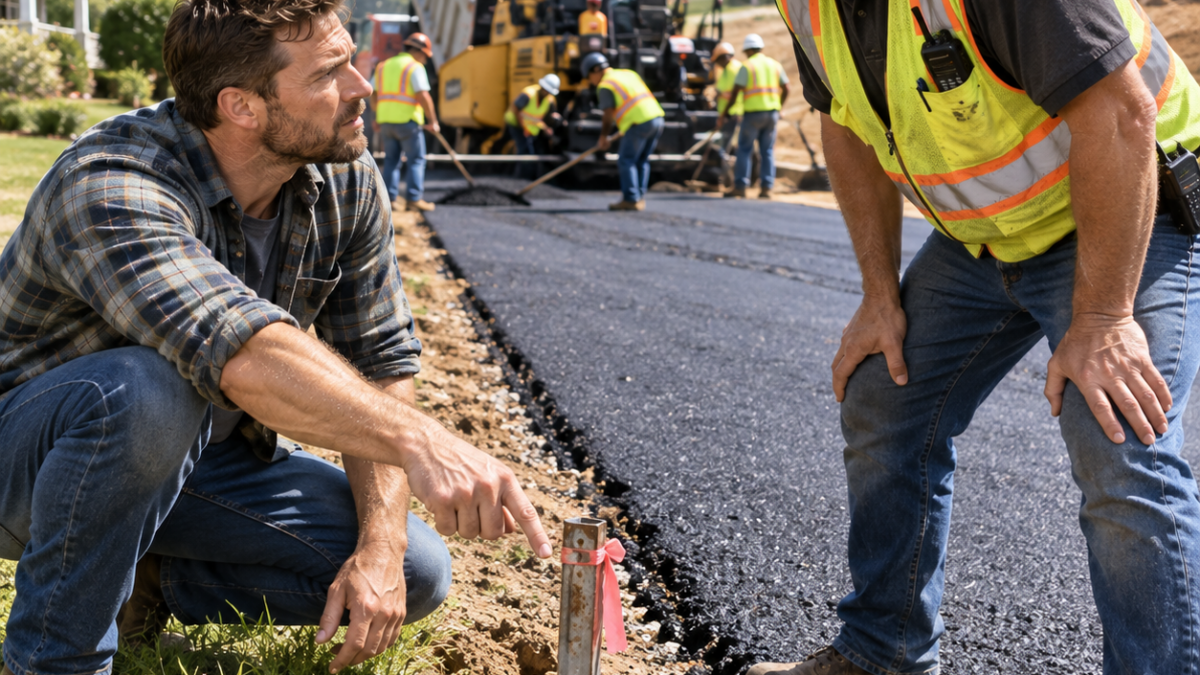
I said, “There’s a survey monument right there.”
He sighed.
“Show me.”
We walked toward it.
I brushed away grass until the old steel witness stake was visible, then pointed farther down to the corner monument referenced on my survey.
Rick barely bent over.
“The survey we’re building from puts the line farther your direction.”
“How much farther?”
“Enough that we’re inside the HOA parcel.”
“Can I see the survey?”
“You’d need to ask Briar Ridge.”
“You’re paving the road.”
“I didn’t survey it.”
“Exactly.”
His expression changed.
“Caleb, we’re not shutting down a paving operation because of an old metal stake in the grass.”
“I didn’t ask you to trust the stake.”
“What are you asking?”
“Check the boundary before you put any more asphalt over it.”
He crossed his arms.
“We already checked it.”
“Who?”
“Our engineering team.”
“Then show me the certified boundary.”
“You need to deal with Karen.”
That told me everything I needed to know about who was actually driving the decision.
I looked toward the paving machine.
“Rick, I’m telling you right now that I believe you’re crossing my deed line.”
“And I’m telling you we’re following the approved plans.”
“Approved by who?”
“County permit, HOA, engineer. Everybody.”
A voice came from behind us.
“Is there a problem?”
I didn’t need to turn around.
Karen.
She approached wearing white pants completely unsuitable for a construction site and carrying a blue binder with the Briar Ridge logo on the front.
Rick said:
“Caleb thinks the road is over his line.”
Karen looked toward the stake.
Then at me.
“No.”
Same speed.
Same confidence.
I almost smiled.
“You measured it?”
“Our professionals did.”
“Can I see their boundary survey?”
“The construction plans have already been approved.”
“That’s not what I asked.”
Her mouth tightened.
“You’ve been told before that Briar Ridge has legal control over its common infrastructure.”
“Yes.”
“This roadway is association infrastructure.”
“Yes.”
“So please don’t interfere.”
I stared at her.
“Karen, the issue isn’t whether your HOA can build a road on HOA land.”
“Then what is the issue?”
“You appear to be building part of it on mine.”
She opened the binder.
Pulled out a site plan.
Blue lines.
Lot boundaries.
Road alignment.
Drainage.
Utilities.
She tapped one line with a manicured fingernail.
“This is the approved boundary.”
I leaned closer.
“What survey is that based on?”
“The development survey.”
“Who signed it?”
She turned the page slightly away from me.
“Caleb, I am not going to conduct a document review in the middle of active construction.”
I pointed toward the asphalt.
“I’d recommend doing one before the crew goes another hundred feet.”
Her expression hardened.
Then she said the sentence that eventually made half of Briar Ridge furious with her.
“Community infrastructure cannot be held hostage every time an adjoining owner decides he dislikes progress.”
I looked at her.
“I don’t dislike progress.”
“You’ve complained repeatedly.”
“About you sending me HOA rules that don’t apply to my land.”
“They address neighborhood appearance.”
“Not my neighborhood.”
“We share a boundary.”
“Exactly.”
I pointed toward the road.
“And boundaries work both ways.”
Rick stepped in before Karen answered.
“Here’s what I’ll do. I’ll call the site engineer.”
“Before paving continues?”
His eyes shifted.
That was the answer.
I said:
“Rick.”
“We have asphalt in trucks.”
“I understand.”
“Do you know what happens if that material cools?”
“No.”
“We lose the load.”
“That sounds expensive.”
“It is.”
“Then confirming the property line sounds cheap.”
He rubbed the back of his neck.
Karen cut in.
“No.”
Rick looked at her.
She said:
“The HOA approved today’s work. Continue.”
I stared at her.
“You’re authorizing them to keep paving after I’ve told you there’s a boundary dispute?”
“I’m authorizing our contractor to follow the approved plan.”
“Put that in writing.”
That finally slowed her down.
“Excuse me?”
“Email me.”
“Why?”
“Say exactly what you just said. That I’ve notified you I believe the roadway is encroaching on my property and you’re instructing the contractor to continue without rechecking the boundary.”
Karen stared.
Rick looked away.
For several seconds nobody spoke.
Then Karen said:
“I don’t take legal instructions from you.”
“Neither does my property line.”
I walked home.
I heard the paving machine restart before I reached the porch.
For about ten minutes, I was furious.
Then I realized anger wasn’t useful.
I opened the fireproof document box from my office.
Pulled out my closing papers.
Deed.
Title policy.
Old subdivision plat.
Survey.
I laid everything across the kitchen table.
Same line I’d understood for nine years.
Same monuments.
Same bearings.
Same dimensions.
But I wasn’t a licensed surveyor.
I wasn’t going to make the mistake Karen had just made and treat confidence as measurement.
So I called Jordan Price.
Jordan had surveyed two nearby farms and came recommended by an attorney I’d used years earlier.
She could be there the following morning.
Then I called the county planning and zoning office.
I explained that the permitted private roadway serving Briar Ridge appeared to be crossing a neighboring parcel not owned by the association.
The woman who answered didn’t declare me right.
Good.
She said:
“Do you have a current certified survey?”
“Tomorrow.”
“Send it when you have it. We can compare the as-built work with the approved site plan.”
“Can you stop them today?”
“Not because you called and said there’s a dispute.”
Fair.
“Should I call police?”
“For what?”
“They’re paving on my land.”
“If there’s no confrontation or immediate safety issue, a property-line dispute is generally civil. If someone threatens you or refuses to leave an area clearly outside their permitted work after notice, circumstances may change. But we don’t send police to establish boundaries.”
Also fair.
I thanked her.
Then went outside and photographed everything.
Every old marker.
Road edge.
Construction stakes.
Distances using a tape measure—not as legal proof, just documentation.
I photographed the entire stretch from multiple angles.
At one point Rick watched me.
He walked over.
“You lawyering up?”
“Surveying first.”
“Caleb, this can probably be handled without all that.”
“I tried ten minutes ago.”
He sighed.
“Karen gets… intense.”
“That sounds like your problem.”
“Unfortunately it’s everybody’s problem.”
That was the first honest thing anyone from Briar Ridge had said.
He looked toward the fresh asphalt.
“I did call our engineer.”
“And?”
“He says his crew laid out the road from the civil plans.”
“Not the boundary?”
“Plans include the boundary.”
“That isn’t what I asked.”
Rick laughed once.
“You and Karen are going to kill each other.”
“No.”
I looked at the asphalt.
“One of us is going to measure.”
Jordan arrived at seven-thirty the next morning.
She drove an old Ford pickup with survey equipment organized more carefully than most operating rooms.
Karen appeared twenty minutes later.
Of course she did.
She walked toward us from the Briar Ridge side.
“What is this?”
Jordan continued setting up.
I said:
“Licensed boundary survey.”
“You cannot interfere with HOA property.”
Jordan stopped.
Looked at Karen.
“Is this your parcel?”
Karen pointed toward the development.
“Yes.”
Jordan nodded.
“Then I’ll remain on Mr. Mercer’s land unless I need lawful access elsewhere.”
Karen turned to me.
“You could have simply requested our survey.”
“I did.”
“No, you demanded documents from a contractor.”
“I asked you too.”
“You were confrontational.”
“I asked who signed it.”
She folded her arms.
“Your survey doesn’t override ours.”
Jordan said without looking up:
“That’s true.”
Karen smiled.
I almost did too.
Jordan continued:
“Surveys don’t win because somebody orders a newer one. We compare the deeds, monuments, recorded plats, controlling calls, and field evidence.”
Karen’s smile weakened.
“Exactly.”
Jordan finally looked at her.
“So if your survey is available, I’d love a copy.”
Karen said:
“I’ll speak to counsel.”
Then left.
Jordan watched her go.
“She seems fun.”
“You have no idea.”
For the next five hours, I mostly stayed out of Jordan’s way.
That was harder than it sounds.
There’s a special anxiety in paying a professional to verify something you’ve already argued about publicly.
Every confident statement I had made started replaying in my head.
What if the old markers weren’t original?
What if my closing survey had missed a later boundary adjustment?
What if Briar Ridge’s parcel had an easement?
What if I had spent twenty-four hours acting like the stubborn neighbor only to discover Karen was technically right?
Around noon Rick came over.
“You finding what you expected?”
Jordan kept looking through the instrument.
“I’m finding measurements.”
Rick looked at me.
I looked away because I didn’t want him to see me smile.
By three, Jordan had located the controlling corners.
Then she walked the road.
Measured.
Checked.
Measured again.
Finally, she called me over.
“You’ve got your deed?”
“In the house.”
“I have the copy you sent.”
She opened it on her tablet.
Then pointed toward the road.
“Underlying parcel boundary falls here.”
She had marked the line with temporary stakes.
I looked.
The asphalt edge crossed them.
“By how much?”
“Varies.”
“Worst point?”
“A little under three feet.”
My shoulders dropped.
“How far?”
She checked her notes.
“Roughly a hundred and seventy-five feet of pavement is across your line to some degree. Most of it less than the maximum.”
I stared at the black road.
Three feet doesn’t sound dramatic when you say it alone.
A kitchen counter is roughly three feet high.
A person takes one step and covers about that much.
But stretch three feet down nearly sixty yards, pave it, compact it, engineer drainage around it, and incorporate it into a permanent private road serving an HOA.
Suddenly three feet becomes very real.
Jordan said:
“There’s another issue.”
Of course there was.
“What?”
She walked toward one of Briar Ridge’s construction stakes.
Their stake labeled the apparent boundary several feet onto my side.
Jordan crouched.
“This isn’t a monument.”
“What is it?”
“Layout stake.”
“So?”
“Somebody laid out construction from a line offset incorrectly from the deed boundary.”
“Could it be based on another survey?”
“Possibly.”
“Can you tell?”
“Not without seeing it.”
Then she pointed at one of my older iron monuments.
“This one matches the record calls and the controlling corners.”
“So the road’s over.”
“In my professional opinion, yes.”
“Enough for the county?”
“Send them the signed survey when I finish it.”
The county inspector arrived the next morning after Jordan delivered a preliminary certified sketch.
His name was Paul Brennan.
He made something clear before stepping out of his truck.
“I’m not here to adjudicate title between you and the HOA.”
“I understand.”
“I’m here because the permitted roadway is supposed to remain inside the development parcel shown on its approved plan.”
“Understood.”
“If the certified field survey shows the as-built road crossing that boundary, that’s a permit compliance issue.”
“Good.”
Karen arrived before he finished speaking.
She brought an attorney this time.
Not her HOA counsel.
A land-use attorney named Craig Hensley.
That was when I knew the board had finally understood this wasn’t about aesthetics.
Hensley was polite.
He asked for Jordan’s survey.
She provided it.
He asked whether she had reviewed Briar Ridge’s recorded plat.
“Yes.”
“Did you identify any easement benefiting Briar Ridge across the Mercer parcel?”
“No.”
“Any public right-of-way?”
“No.”
“Any deed overlap?”
“Not from the records provided.”
Then he asked:
“Would you agree boundary disputes can involve competing monuments or title evidence?”
“Absolutely.”
Good lawyer.
No theater.
Karen interrupted.
“The road was built from a certified survey.”
Hensley looked at her.
“I’d like to see it before we characterize it.”
Her face tightened.
“We’ve already provided everything.”
He said:
“Karen.”
One word.
She stopped.
Rick brought the contractor’s plan set.
Paul Brennan compared it against the permit drawings.
Then Jordan’s field markers.
He walked the full length.
Measured several offsets.
Finally he said:
“The road as constructed is not staying within the parcel boundary shown on the approved permit set.”
Karen immediately said:
“So the contractor built it wrong.”
Rick turned.
“No.”
She looked at him.
Rick continued:
“We built the alignment staked for us.”
“By your survey crew.”
“By the layout file supplied through the civil engineer.”
Hensley held up one hand.
“Everybody stop assigning fault for five minutes.”
Best sentence of the week.
Brennan said:
“Regardless of why, the paved surface crosses the approved parcel line. Work affecting this segment stops until it’s corrected or legal access is established.”
Karen stared.
“Legal access.”
“Easement, boundary agreement if appropriate, revised approved plan—whatever lawful solution applies. That’s between the owners and your professionals.”
She pointed toward my property.
“It’s three feet.”
Brennan looked at her.
“Approximately.”
“We’re talking about three feet.”
“Yes.”
“Do you understand what removing this does to our entrance alignment?”
“I’m not your engineer.”
“It affects drainage.”
“Then your engineer needs to redesign drainage.”
“We’ve already paid for paving.”
Brennan nodded toward the road.
“I can see that.”
Karen’s face reddened.
“This is absurd.”
I finally spoke.
“Yesterday it was important enough to pave.”
She turned toward me.
“Do not start.”
“I didn’t.”
“You called the county over three feet.”
“No.”
I looked at her.
“Your road crossed my property. The number happens to be three feet.”
“Most reasonable people would’ve negotiated.”
“You never asked.”
“We’re asking now.”
That surprised me.
Hensley looked toward her.
So did Rick.
Karen apparently hadn’t planned to say it.
I asked:
“What are you offering?”
“Temporary construction access while we review.”
“No.”
Her expression hardened.
“Caleb.”
“You paved first.”
“We believed the road was inside our parcel.”
“Then review it from yours.”
Hensley said:
“Could we discuss options after the survey teams reconcile their work?”
“Yes.”
Karen glared.
“You are deliberately delaying twenty-two homeowners.”
There it was.
Not thirty-five families this time.
Twenty-two homes in Briar Ridge were already occupied.
Seven more were under construction in the new phase.
People.
Children.
Mortgages.
I knew what she was doing.
If the road became a homeowner problem instead of an HOA mistake, then saying no to Karen could be framed as hurting families.
I said:
“Is this road their only access?”
“No.”
That came from Rick.
Karen turned.
He continued carefully.
“Existing main entrance remains operational. This is the secondary connection for Phase Two.”
I looked at Karen.
“So nobody is trapped.”
Her jaw tightened.
“Emergency access planning depends on redundancy.”
“Then build the secondary access on property you control.”
“You’re being impossible.”
Brennan closed his clipboard.
“Issue is documented. No more work on the affected section until revised approval.”
That ended the field argument.
It did not end Karen.
The first HOA letter arrived at my house the next afternoon.
Yes.
An HOA violation letter.
From an HOA I did not belong to.
I stood in my kitchen reading it twice because the absurdity took time to process.
NOTICE OF INTERFERENCE WITH COMMUNITY SAFETY INFRASTRUCTURE
It accused me of obstructing a planned emergency-access corridor and warned that Briar Ridge reserved “all legal remedies, including recovery of delay costs.”
At the bottom:
Karen Whitlock, President.
I called Hensley.
He answered personally.
“Mr. Mercer.”
“Did you write this?”
Pause.
“What letter?”
I sent him a photograph.
He called back fourteen minutes later.
“No.”
“Thought so.”
“Do not respond directly to Ms. Whitlock.”
“I wasn’t planning to.”
“For clarity, you are not subject to Briar Ridge covenant enforcement based on the documents I’ve reviewed.”
“I know.”
“I’m saying it anyway.”
“Thank you.”
Then:
“The board is meeting tonight.”
“About the road?”
“Yes.”
“Can I attend?”
“It’s a private association meeting.”
“Fair.”
“But I expect we’ll contact you afterward.”
They did.
At 9:18 p.m., Hensley emailed.
Briar Ridge wanted permission for both surveyors to perform a joint boundary reconciliation.
Reasonable.
I agreed.
Their licensed surveyor arrived two days later.
His name was Marcus Lee.
He looked unhappy before he got out of his truck.
Not because of me.
Because professionals hate inheriting other people’s field mistakes.
Jordan met him.
They compared deeds.
Plat.
Control points.
Monuments.
Coordinates.
Then Marcus asked for the original construction layout file.
Rick emailed it.
Marcus stared at his tablet.
Then said:
“There.”
Jordan leaned closer.
“What?”
“Offset.”
They walked me through it.
A drafting technician working from the development boundary had created a construction line offset from the planned pavement edge.
But somewhere between the civil drawing and the staking file, the offset direction had been reversed.
Instead of moving the road inward from the boundary, the layout shifted it outward.
Toward me.
Three feet.
Not precisely three everywhere because the road curved.
But enough.
A small digital mistake.
One sign.
One coordinate transformation.
One assumption.
Then nobody checked the physical monuments before grading.
Marcus said:
“My boundary agrees with Jordan’s.”
That sentence ended the survey dispute.
Karen was standing nearby.
She stared at him.
“You’re saying our own survey confirms his?”
“Yes.”
“Then why did your company stake the other line?”
“We didn’t.”
“What?”
“Our firm performed the boundary survey and subdivision plat. We did not create the contractor’s final roadway stakeout file.”
Rick said:
“Civil consultant did.”
Marcus nodded.
“The boundary layer appears correct in the original base file. The offset error shows up later.”
Karen looked between everyone.
“So who’s paying?”
Nobody answered.
That was not my question to solve.
The developer’s civil consultant.
Road contractor.
HOA.
Professional liability insurers.
Maybe several of them.
They could spend months deciding.
My boundary did not need to wait.
Then Karen tried something different.
She came to my house alone the following evening.
No lawyer.
No binder.
She carried an envelope.
I opened the door but did not invite her inside.
“Karen.”
“Caleb.”
She held out the envelope.
“Board authorized an offer.”
I took it.
Twenty-five thousand dollars.
In exchange, I would grant Briar Ridge a permanent easement covering the paved encroachment plus another five feet for maintenance and drainage.
I read the draft twice.
“That isn’t three feet.”
“Maintenance requires working room.”
“So your mistake turns into an eight-foot permanent burden on my property.”
“It’s compensation.”
“What happens if the road widens later?”
“It can’t without whatever the easement allows.”
“This draft says roadway, utilities, drainage, maintenance, repair, replacement, and related improvements.”
“Standard language.”
“To you.”
I handed it back.
“You don’t want twenty-five thousand dollars?”
“Not for this.”
“How much?”
“I haven’t offered to sell.”
She stared.
“Caleb, you don’t use that strip.”
“That isn’t the point.”
“What is the point?”
“You still think my boundary becomes negotiable only after you cross it.”
“We made a mistake.”
“Your contractor made a mistake.”
“Fine.”
“Then you continued paving after I asked you to check it.”
Her eyes narrowed.
“You had no proof that morning.”
“Neither did you.”
She stopped.
That was the entire story right there.
Two people believed different things.
Only one of us had asked to stop and verify before covering the disagreement in asphalt.
Karen said:
“If you force removal, homeowners pay for it.”
“Why?”
“HOA reserve funds.”
“Isn’t the contractor responsible?”
“That’s being reviewed.”
“So you don’t know homeowners will pay.”
“Eventually costs fall somewhere.”
“Yes.”
I leaned against the doorway.
“Probably where the contract puts them.”
She looked toward the road.
“I don’t understand why you’re enjoying this.”
That actually angered me.
“I’m not.”
“You’ve been smiling through every meeting.”
“Because some of what you’ve said is ridiculous.”
“This could cost tens of thousands of dollars.”
“I know.”
“Then why aren’t you upset?”
“I am.”
I lowered my voice.
“I didn’t ask anyone to build a road on my property, Karen.”
She said nothing.
“I didn’t design it.”
Silence.
“I didn’t stake it.”
Nothing.
“I did exactly what you keep accusing me of refusing to do.”
“What?”
“I told you there was a problem before the paving crew finished.”
Her eyes moved away.
That landed.
I continued:
“If Rick had stopped when I showed him the marker, maybe they lose asphalt trucks and a workday.”
She looked at me again.
“If you had paused when I asked for the survey, maybe the mistake gets fixed before half the road is paved.”
“You don’t know that.”
“No.”
I nodded.
“I don’t.”
Then:
“But I do know I didn’t create it.”
Karen left with the envelope.
Two days later, Briar Ridge’s insurer got involved.
Then the civil engineering firm’s insurer.
Then the paving contractor’s attorney.
Suddenly everyone became much more interested in exact dates.
When did Caleb first notify Rick?
Who was present?
When did Karen direct work to continue?
What portion had already been paved at that moment?
What did the crew know?
Were photographs available?
Yes.
Mine.
The timestamp on my first photograph showed the road had crossed the line but paving farther south was still underway.
Sam Ridley, a Briar Ridge resident whose house overlooked the construction area, had security-camera footage.
That showed me speaking with Rick and Karen.
Then me walking away.
Then paving continuing.
Karen found out about that footage at the next board meeting.
According to Sam, she said:
“So now everyone is spying on the HOA?”
Sam answered:
“My camera points at my driveway.”
The room apparently became very quiet.
He sent me the clip afterward.
I saved it.
Not because I wanted revenge.
Because insurance disputes have a way of turning memory into theater.
Records help.
Karen’s warning letter accusing me of interfering also became useful.
It proved she knew about the boundary dispute almost immediately.
Hensley was not pleased when he learned she had sent it without counsel.
He called.
“I need to ask you something.”
“Okay.”
“Did Ms. Whitlock ever threaten to fine you personally?”
“She sent the letter.”
“Anything else?”
“She told me Briar Ridge would pursue remedies.”
“Did she state an amount?”
“No.”
“Did she ever claim your land was subject to the declaration?”
“Repeatedly suggested community standards mattered to it. Never produced anything showing membership.”
He sighed.
“Okay.”
“Problem?”
“I’m advising the board to stop communicating with you except through counsel regarding the road.”
“That works for me.”
And just like that, Karen disappeared from my mailbox.
The next two weeks were strangely quiet.
Construction continued elsewhere.
The affected road section sat untouched.
Fresh black asphalt.
Orange paint marking my surveyed boundary.
Traffic cones.
Every time I passed, I thought about how finished it looked.
That was what had fooled everyone.
Professional work creates psychological authority.
Straight curb line.
Compacted base.
Drainage swales.
Fresh asphalt.
Workers in reflective vests.
Plans in binders.
County permit numbers.
All of it told your brain:
Somebody checked this.
But somebody hadn’t.
Or somebody had checked one layer and assumed the next layer carried it correctly.
The original boundary survey was right.
The construction offset wasn’t.
Nobody compared the physical layout against the monuments before paving.
One small error traveled downstream until it became blacktop.
That bothered me professionally even though I wasn’t an engineer.
How many bad decisions become expensive because each person assumes the previous person checked?
Then one Monday morning I woke to a mechanical scream.
Not a truck.
Not a bulldozer.
A road saw.
I stepped onto the porch.
Workers stood along the affected section.
The property line had been painted across the pavement using Jordan and Marcus’s agreed survey.
A huge cutting machine sat at the northern end.
Rick stood beside it.
He looked toward my house.
I walked down.
No Karen.
That told me something.
Rick met me near the cones.
“We’re removing it.”
I looked at the line.
“All of it?”
“Everything outside the boundary plus enough inside to rebuild the edge properly.”
“What about the entrance?”
“Redesign.”
“Drainage?”
“Redesign.”
“That sounds expensive.”
He gave me a long look.
Then laughed.
“Don’t.”
“Sorry.”
“No, you’re not.”
“A little.”
He shook his head.
Then:
“For what it’s worth, I should’ve stopped that first morning.”
I hadn’t expected that.
“You were working from a layout.”
“I was.”
“You had trucks full of asphalt.”
“Yes.”
“You trusted the file.”
“Yes.”
Then he looked toward the old marker.
“But you showed me that.”
I said nothing.
He continued.
“I should’ve at least called the surveyor before I let another load go down.”
I nodded.
“Probably.”
“That’s your victory speech?”
“I don’t have one.”
“Good.”
Rick turned.
Then stopped.
“Karen thinks you did this to embarrass her.”
“I know.”
“I told her nobody spends this much time and money over revenge unless they’re already rich.”
I smiled.
“I’m definitely not.”
“She doesn’t understand why you wouldn’t take the twenty-five.”
“Do you?”
He looked at the road.
“Yes.”
“Why?”
“Because then we’d learn the wrong lesson.”
That surprised me.
“Which lesson?”
“That if we build far enough first, we can buy permission afterward.”
Exactly.
I held out my hand.
Rick shook it.
Then the saw started.
The blade dropped into the asphalt.
The noise was enormous.
A high metallic scream becoming a deep grinding roar.
Black dust.
Water spray.
Workers moving carefully along the painted survey line.
I stood well back.
No celebration.
No victory dance.
Nothing about watching expensive work destroyed felt especially joyful.
These guys had built it.
Some had probably stayed late getting the surface right.
Now they were cutting apart pavement barely two weeks old because one offset had gone the wrong direction.
After the saw came jackhammers.
Then an excavator.
Chunks of asphalt lifted from my side.
Loaded into trucks.
Haul away.
The road edge became rough.
Then gravel.
Then exposed base.
By afternoon, the black strip that had crossed my property was gone.
Karen arrived around four.
She stood on Briar Ridge’s side of the line staring at the mess.
I was repairing a section of fence nearby.
She walked toward me.
“Happy?”
I looked up.
“No.”
She glanced at the torn road.
“Could’ve fooled me.”
“What do you want me to say?”
“That this was excessive.”
“According to both surveyors, it wasn’t theirs to leave.”
“Three feet.”
I set down the drill.
“Why do you keep saying that like small trespasses count less?”
“Because nobody was using that strip.”
“I was.”
“For what?”
“Being my land.”
She actually laughed.
“That’s not a use.”
“It doesn’t need one.”
She stared.
I continued.
“If I paved three feet into Briar Ridge’s common lawn, would you leave it?”
“That’s different.”
“Why?”
“Because that’s association property.”
“And this is mine.”
Silence.
I said:
“You keep coming back to the idea that your project mattered more because it was expensive.”
Karen’s face tightened.
“It serves twenty-two families.”
“The existing entrance serves them.”
“Eventually the second entrance improves emergency access.”
“Then it deserves to be built correctly.”
She crossed her arms.
“You’re impossible.”
“Maybe.”
Then:
“But the line’s still there.”
She walked away.
The redesign took almost a month.
Engineers moved the road inward.
Not merely three feet.
Once they examined sight distance, drainage, shoulder requirements, and the revised approach, they shifted portions more substantially.
They adjusted a culvert.
Moved a light pole foundation.
Regraded the edge.
No part of the completed pavement crossed my parcel.
That should have ended everything.
Instead, the HOA’s annual meeting turned the mistake into a neighborhood war.
Briar Ridge residents discovered the road correction had caused a substantial project delay.
Karen blamed “an adjacent landowner’s boundary objection.”
That phrase reached me through Sam.
He texted:
You might want to see tonight’s packet.
He sent photographs.
Under:
SECONDARY ENTRANCE DELAY
The board summary said:
Construction was delayed due to an external boundary challenge raised after paving commenced.
Technically true.
Carefully incomplete.
No mention that I had raised it while paving was still active.
No mention both surveyors agreed the HOA’s construction layout was wrong.
No mention Karen had instructed work to continue.
Then came:
Potential financial impact to association remains under review.
Residents assumed dues were going up.
People got angry.
A woman I’d never met posted in the Briar Ridge group that “the farmer next door” had forced the HOA to tear up a road over “a couple inches.”
By lunch, three feet had become two inches.
By dinner, I had supposedly demanded $100,000.
I had demanded zero.
The next morning a handwritten note appeared in my mailbox.
HOPE YOUR THREE FEET WAS WORTH IT.
No signature.
I photographed it.
Then threw it away.
Emily—my sister, not wife; I was single then—called after hearing the story from our mother.
“You’re being hated by suburban moms.”
“Apparently.”
“How does it feel?”
“Specific.”
“Did you really make them rip up the road?”
“No.”
“You called the county.”
“Yes.”
“They ripped it up because of that.”
“They ripped it up because it was on my land.”
“Same difference to Facebook.”
She laughed.
Then:
“You okay?”
“Yeah.”
“Actually?”
I looked out the kitchen window.
“Mostly annoyed.”
“Don’t start fighting with residents.”
“I won’t.”
“Promise?”
“Yes.”
“Because you enjoy being technically correct.”
“That’s a character strength.”
“It’s why you’re divorced from normal conversation.”
I wasn’t divorced.
She meant socially.
Probably.
I stayed out of the group.
Hensley did not.
The HOA attorney apparently became unhappy with Karen’s summary.
At the next meeting, he insisted the board issue a clarification.
Sam recorded the audio legally from his seat and later told me what happened.
Hensley said:
“For accuracy, the boundary objection was substantiated by both the adjoining owner’s licensed surveyor and the association’s survey professional.”
Karen said:
“That doesn’t change the cost.”
“No.”
“It doesn’t change that the complaint delayed the project.”
Hensley answered:
“The construction error delayed the project.”
People went quiet.
Karen looked at him.
He continued:
“Mr. Mercer’s objection identified the error.”
That distinction mattered.
A resident asked:
“When did the HOA know?”
Karen said:
“Once the county became involved.”
Rick was attending to answer construction questions.
He raised his hand.
Karen ignored him.
A homeowner called:
“Rick?”
He stood.
“Caleb told me the morning paving started.”
Karen said:
“He raised an unverified concern.”
Rick nodded.
“Yes.”
Then:
“And I continued work.”
“Because our plans showed the line.”
“Yes.”
Another resident asked:
“Could the rest have been stopped before paving?”
Rick looked uncomfortable.
“Some of it.”
“How much?”
“We’d already laid part of the section. Not all.”
Karen stepped in.
“We are not conducting hindsight accusations against contractors.”
Hensley said:
“Correct. But the board needs an accurate timeline for insurance.”
There it was.
Insurance.
Not drama.
The room suddenly cared about facts.
The HOA’s policy might cover certain losses caused by professional errors.
The contractor and design consultant had their own coverage.
But if Karen knowingly directed work to continue after a boundary dispute was raised, carriers wanted to know.
That did not mean she personally owed the whole road cost.
It meant the sequence mattered.
Residents began asking better questions.
Who created the incorrect layout file?
Who reviewed it?
Did the civil consultant carry professional liability coverage?
Did the contractor have a duty to verify monuments?
What costs actually belonged to the HOA?
Had reserve money been spent yet?
For the first time, the road became what it should have been from the beginning.
A technical and contractual problem.
Not a personality contest between Karen and me.
The final allocation took months.
The civil engineering consultant’s insurer accepted a substantial portion because the offset error originated in the construction layout data.
The contractor absorbed some costs under its quality-control obligations.
The HOA paid a smaller amount related to redesign choices that went beyond simple correction and to portions not covered elsewhere.
No giant special assessment.
No families bankrupted.
No apocalypse.
Karen had spent weeks telling everyone that respecting my boundary would devastate the neighborhood.
It didn’t.
It inconvenienced them.
Cost money.
Delayed Phase Two.
Then life moved on.
That should have humbled her.
It didn’t happen immediately.
Karen remained president.
She won the next election by four votes.
I heard because Sam texted:
THE EMPIRE SURVIVES.
I replied:
Please stop trying to make me care.
He sent:
You care.
Unfortunately, yes.
Not about her election.
About what happened next.
Karen proposed a new “perimeter coordination policy.”
Because apparently one boundary dispute had convinced her that Briar Ridge needed procedures for dealing with adjoining landowners.
Reasonable idea.
Her draft wasn’t reasonable.
It claimed the HOA could enter a ten-foot “maintenance coordination zone” outside association property when work affected shared drainage, fencing, landscaping, or road safety.
Outside association property.
Without owner consent.
Hensley killed it immediately.
I only learned because Sam sent me another recording.
Karen said:
“We cannot be paralyzed every time exterior work reaches a property line.”
Hensley responded:
“You cannot create access rights over land the association doesn’t own.”
“I’m talking about maintenance.”
“The label doesn’t create the right.”
“What if there’s an emergency?”
“Then actual emergency doctrines, municipal authority, utility rights, easements, or owner consent govern depending on facts. Your policy cannot invent them.”
I almost applauded from three hundred yards away.
The proposal died.
That meeting mattered more than the road removal.
Because for the first time Karen’s own board publicly rejected the idea that HOA convenience could manufacture authority.
Something had shifted.
People had learned the line was not symbolic.
A year passed.
Briar Ridge finished Phase Two.
The secondary road opened.
Residents used it.
Ambulances could use it.
Fire engines could use it.
Nobody drove through my yard.
Amazing.
Rick came by once after construction wrapped.
No vest.
Pickup truck.
He stood near the boundary.
“Looks better.”
“It does.”
“Drainage holding?”
“So far.”
“We moved that swale more than originally planned.”
“I noticed.”
He pointed toward one old iron stake.
“You going to put a monument fence around those now?”
I laughed.
“Maybe razor wire.”
“You joke.”
“Mostly.”
Then he said:
“You know the guy who made the offset mistake?”
“No.”
“Twenty-four-year-old CAD tech.”
That surprised me.
“I assumed senior engineer.”
“No. Tech made the change. Engineer missed it in review.”
“Did he get fired?”
“No.”
“Good.”
Rick looked surprised.
“Really?”
“He made a drafting mistake.”
“It cost a fortune.”
“And how many other people had chances to catch it?”
Rick smiled.
“Fair.”
He continued.
“The engineer took responsibility. Company changed review procedure.”
“Good.”
“Tech still there.”
“Also good.”
People love stories where somebody gets fired.
Sometimes someone deserves it.
Sometimes the better outcome is fixing the system that allowed one mistake to pass through five layers.
The tech reversed an offset.
The professional review missed it.
Construction staking used it.
Rick trusted it.
Karen defended it.
I challenged it.
The expensive part came from every layer after the first error.
Punishing only the youngest person would’ve taught almost nothing.
Rick said:
“He knows your name.”
“That seems unnecessary.”
“He calls this the Mercer Line.”
“That is deeply annoying.”
“It’s now part of their QA training.”
“What?”
“They show the base boundary and the reversed offset.”
I stared.
Rick grinned.
“Congratulations. You’re educational material.”
I hated that.
Also secretly liked it.
The old road story faded.
Then Karen found a new way to remind everyone why limits matter.
Two years after the asphalt incident, Briar Ridge wanted to install a privacy fence along part of the western common area.
The landscaping committee proposed placing it six inches inside the association boundary.
Good.
Then Karen argued that putting it directly on the boundary would maximize common space.
A board member named Angela Moore said:
“Which survey are we using?”
The room reportedly laughed.
Karen did not.
That one question settled it.
They used the verified survey.
Fence went a foot inside their land.
No conflict.
That’s what institutional memory looks like.
A joke.
A question.
A corrected procedure.
No crisis required.
I eventually met Angela.
She walked over one afternoon while I was fixing my mailbox.
“You’re Caleb?”
“Depends.”
She smiled.
“I’m on the Briar Ridge board.”
“That answer just became no.”
She laughed.
“I wanted to say thank you.”
“For what?”
“The road mess.”
“I didn’t do anything for your board.”
“Yes, you did.”
“How?”
“You made us learn what an HOA actually owns.”
I stopped working.
She continued.
“Karen talked for years as if ‘community interest’ was a legal category that solved everything.”
“Sounds familiar.”
“After the road, our attorney made us review every easement.”
“That sounds miserable.”
“It was.”
She smiled.
“Also necessary.”
“What’d you find?”
“Two old utility easements nobody understood. One drainage agreement that needed updating. A walking-trail license everyone thought was permanent but actually renews every ten years.”
“That seems useful.”
“It was.”
She leaned against the mailbox post.
“Karen hates you.”
“I know.”
“She also talks about you constantly.”
“That feels worse.”
“She says you weaponized technicalities.”
I laughed.
“What technicality?”
Angela pointed toward the ground.
“The property line, apparently.”
Exactly.
The word technicality became one of my least favorite words after that.
People use it when a rule becomes inconvenient after being ignored.
A signature requirement.
Notice.
A boundary.
A recorded easement.
A vote.
Sometimes technical requirements are pointless bureaucracy.
Sometimes they’re the whole mechanism preventing somebody from taking something because doing it correctly feels slow.
A property line is not a philosophical suggestion.
It tells you where your right to act stops.
Three feet mattered because without that line, there was no principle preventing six.
Or ten.
Or a drainage ditch.
Or a fence.
Or anything else somebody could call too minor to contest.
That doesn’t mean every boundary disagreement needs litigation.
Most don’t.
Neighbors compromise constantly.
I would’ve discussed a narrow easement before construction.
Might even have agreed.
But there is a difference between asking before you build and offering money after you’ve created pressure.
Karen never understood why that mattered.
At least not then.
Four years after the road incident, she knocked on my door.
I hadn’t spoken with her in almost a year.
She looked different.
No binder.
No board polo.
I said:
“Karen.”
“Caleb.”
“You need something?”
“I’m moving.”
That surprised me.
“Okay.”
“My husband got a position in Pittsburgh.”
“Congratulations.”
She nodded.
Then:
“I resigned from the board.”
I had heard.
Didn’t say so.
She looked toward the western edge of my property.
“You still angry?”
“No.”
She seemed disappointed.
“Really?”
“Mostly stopped thinking about it.”
“I haven’t.”
That surprised me more.
“Why?”
“Because everybody remembers it.”
“The road?”
She nodded.
“Every time someone questions a boundary, they say ‘Remember Caleb.’”
I laughed.
“Sorry.”
“You aren’t.”
“A little.”
She almost smiled.
Then:
“I was wrong.”
I waited.
Karen was not a woman who enjoyed those words.
She continued.
“Not about believing the plans initially.”
“No.”
“I still think any reasonable board would’ve relied on the professional plans.”
“I agree.”
That surprised her.
I said:
“The problem wasn’t believing them.”
She nodded.
“The problem was refusing to check once you raised a conflict.”
“Yes.”
She looked down.
“I thought stopping would make me look incompetent.”
That was probably the most important sentence she ever said to me.
“I had pushed the road for months. People complained about the cost. Emergency-access concerns. Construction schedule. Then you walked over with an old metal stake and basically said the whole alignment might be wrong.”
“I didn’t say whole alignment.”
“You know what I mean.”
“I do.”
She continued.
“If I’d stopped everything and you were wrong, people would’ve said I wasted money because some farmer pointed at a rusty pin.”
“Probably.”
“So I kept going.”
“And then?”
“Then I needed you to be wrong.”
There it was.
Not greed.
Not secret plan.
Ego tied to a decision.
She said:
“Every new piece of evidence felt like something you were doing to me.”
“Jordan’s survey?”
“Yes.”
“The county?”
“Yes.”
“Your own surveyor?”
She laughed bitterly.
“That one was difficult.”
I smiled.
She continued.
“By the time Marcus confirmed your line, I wasn’t thinking about the property anymore.”
“What were you thinking?”
“That everyone was watching me lose.”
I leaned against the doorframe.
“And now?”
“Now I think stopping the paving truck would’ve been cheaper.”
I laughed.
“By a lot.”
She smiled.
Then said:
“I’m sorry I sent that interference letter.”
“That was ridiculous.”
“Yes.”
“You knew I wasn’t in the HOA.”
“Yes.”
“Then why?”
“I wanted something official in writing.”
“To scare me?”
She thought.
“Yes.”
At least she said it.
I nodded.
“Thank you.”
She looked surprised.
“That’s it?”
“What else?”
“I don’t know.”
“You apologized.”
“Yes.”
“I believe you.”
“Do you forgive me?”
I almost laughed.
Not cruelly.
The question just felt much bigger than the remaining injury.
“Karen, I don’t think about you enough to maintain a formal position.”
She stared.
Then laughed.
A real one.
“That may be worse.”
“Probably.”
She held out her hand.
I shook it.
Then she walked away.
No dramatic friendship.
No redemption speech.
Just two people acknowledging what the fight had actually been about.
She moved the next month.
Angela became HOA president.
Briar Ridge got quieter.
At least from my side.
I stayed on my property.
Nine years became ten.
Then twelve.
The old witness stakes rusted more.
I eventually replaced part of the fence but left the controlling monuments undisturbed.
Jordan advised me to install witness posts nearby so nobody accidentally damaged them during mowing.
I did.
Bright fiberglass.
Impossible to miss.
One of them has a small aluminum tag.
PROPERTY MONUMENT — DO NOT DISTURB
Not decorative.
Not dramatic.
Effective.
My nephew visited once and asked why I had “warning signs for sticks.”
I told him:
“One of those sticks cost an insurance company more than your college tuition.”
He respected it after that.
The funny part is that the road itself became completely ordinary.
Cars.
Delivery trucks.
Kids on bicycles.
Garbage collection.
Nobody using it knows the pavement had once been cut apart.
The redesigned edge is smooth now.
Grass grew back on my side.
If you didn’t know what happened, you’d never see it.
That’s probably the best outcome.
A corrected mistake should eventually stop looking like a battlefield.
Once, during a neighborhood yard sale at Briar Ridge, I walked down the public shoulder near their entrance.
A resident I’d never met recognized me.
“You’re the property-line guy.”
I sighed.
“Apparently.”
He pointed at the road.
“That really used to be on your land?”
“Yes.”
“How much?”
“Almost three feet at the widest.”
He whistled.
“My wife says she would’ve taken the money.”
“Maybe she would’ve been smarter.”
“How much did they offer?”
“Twenty-five.”
His eyes widened.
“You turned down twenty-five grand over three feet?”
“When you say it like that, I sound insane.”
“You kind of do.”
I laughed.
Then asked:
“You own your house?”
“Yeah.”
“If I offered you twenty-five thousand for a permanent eight-foot access easement along your backyard after I’d already built on it, automatic yes?”
He stopped.
“Oh.”
“Exactly.”
Context changes numbers.
He nodded.
Then:
“Still might take it.”
“Fair.”
That’s the part I appreciate now.
Reasonable people can choose differently.
Another owner might have negotiated.
Taken money.
Recorded an easement.
Moved on.
There would’ve been nothing shameful about that if the terms worked.
I didn’t want the road burden.
That didn’t make me morally superior.
It made me the owner making a different choice.
Property rights matter partly because they preserve that choice.
Not because land is sacred.
Because consent matters.
I eventually sold a different ten-foot strip on the southern edge of my property to the county for a drainage improvement.
People laughed when they heard.
“Thought nobody gets your land.”
Wrong lesson.
The county asked.
Surveyed.
Appraised.
Explained the project.
Gave me drawings.
Negotiated restoration.
Paid a fair amount.
Recorded the right.
I signed.
That was easy.
Angela joked:
“So you do know how easements work.”
“Apparently.”
“Karen would be furious.”
“She’d say I was inconsistent.”
“No.”
Angela smiled.
“She’d know the difference now.”
Maybe.
I hope so.
The county drainage crew actually found one of my witness posts during construction.
Foreman knocked on my door.
“We need to work near this line.”
I followed him.
He showed me.
“Survey says we stay eighteen inches clear, but it’ll be tight.”
“Okay.”
“If conditions change, we’ll stop and call.”
Fourteen words.
That’s all it takes sometimes.
No conflict.
No road saw.
No lawyers.
Ask.
Verify.
Stop if reality differs from plan.
That’s what the Briar Ridge project had failed to do.
Years later, Rick invited me to speak for twenty minutes at a contractor safety and quality meeting.
I said no.
Then he bribed me with barbecue.
I went.
The slide behind me showed the original road plan.
Then the incorrect staking offset.
Then a photograph of fresh asphalt crossing my boundary.
Rick introduced me:
“This is the man who cost us a lot of money.”
Everyone laughed.
I said:
“No. Your spreadsheet cost you money.”
More laughter.
Then I told them the actual story.
Not Karen as villain.
Not Rick as idiot.
A system that kept moving.
The first error was tiny.
A wrong-direction offset.
Then schedule pressure.
Then material timing.
Then assumption.
Then pride.
Every stage made stopping harder.
I said:
“By the time the county inspector arrived, everybody treated the asphalt like evidence.”
One supervisor asked:
“Meaning?”
“It looked finished, so people subconsciously assumed the decision beneath it had been settled.”
Several nodded.
I continued.
“A completed mistake is still a mistake.”
Rick stood in the back with his arms folded.
Then I said the line that made it into their training handout:
“The cheapest time to question a bad line is before you pave it.”
Not profound.
Just expensive enough to remember.
Afterward a young guy approached.
Mid-twenties.
Nervous.
“I’m the CAD tech.”
I knew immediately.
“The offset?”
He nodded.
“I figured.”
“Rick told you?”
“No.”
“You look like you’re waiting for me to punch you.”
He laughed awkwardly.
“I wanted to apologize.”
“You don’t owe me one personally.”
“I made the error.”
“Yes.”
“I still feel awful.”
“Good.”
He looked surprised.
I continued.
“Not forever.”
“Oh.”
“Feel bad long enough to change how you check work.”
He nodded.
“Our software now flags negative offsets on parcel boundaries.”
“There you go.”
“Senior engineer reviews every property-line shift.”
“Better.”
He looked toward the floor.
“I almost quit.”
“Why?”
“Cost.”
“Would quitting restore the asphalt?”
“No.”
“Then what does it fix?”
He thought.
“Nothing.”
“Exactly.”
He shook my hand.
I never saw him again.
I hope he’s still designing things correctly.
That’s another part revenge stories usually get wrong.
Someone makes an expensive mistake, so the satisfying ending is firing them.
Sometimes.
Other times the person who has made one memorable mistake—and actually learned from it—is the person most likely never to repeat it.
Systems should distinguish negligence, dishonesty, and ordinary human error.
Karen’s error was not the same as the technician’s.
The technician entered the wrong offset.
Karen was warned there might be a problem and resisted checking because stopping felt like loss of control.
Rick was between those positions.
He trusted his plans too much and schedule too much, but once official measurements arrived, he stopped arguing and corrected the work.
Different responsibilities.
Different lessons.
That’s how I think about the whole thing now.
Not heroes and villains.
Boundaries and decisions.
The road incident also changed how Briar Ridge handled records.
Angela told me the board began requiring a property-rights exhibit for any future project touching the subdivision perimeter.
Not just construction drawings.
A separate sheet showing:
Association-owned land.
Recorded easements.
Public rights-of-way.
Adjacent private parcels.
Document references.
No one on the board could approve perimeter work without seeing it.
Karen would have called that bureaucracy.
Maybe.
It also takes about five minutes.
Five minutes is cheaper than jackhammers.
The HOA later built a walking path near another neighbor’s property.
The contractor noticed an old fence didn’t align with the mapped boundary.
Work stopped.
They called a surveyor.
Fence was eight inches off.
The neighbor and HOA signed a simple boundary acknowledgment.
Trail shifted.
One-day delay.
Angela texted me:
WE LEARNED.
I replied:
PROUD OF YOU.
She sent:
DON’T GET EMOTIONAL.
That’s what success looks like.
Not never making mistakes.
Catching them while they’re still cheap.
My property itself changed over the years.
I renovated the farmhouse.
Built a workshop.
Planted apple trees along the northern side.
The strip beside Briar Ridge’s road stayed mostly grass.
The famous three feet.
I did nothing special with it.
Karen would’ve hated that.
All that money.
All that conflict.
Then I used the land for absolutely nothing dramatic.
Sometimes people asked:
“So what did you win?”
I hated that framing.
I didn’t win three feet.
I already had it.
What I preserved was the ability to decide what happened there.
That’s different.
Nobody hands you a trophy for keeping what was already yours.
Nor should they.
One spring I planted wildflowers along the strip.
Not as a message.
Emily gave me seed.
I scattered it.
By June there were black-eyed Susans and purple coneflowers beside the pavement.
Drivers probably assumed Briar Ridge landscaped them.
That amused me.
One evening I stood there while a family walked along the road.
Their little girl pointed at the flowers.
“Pretty.”
Her father said:
“Don’t pick those. That’s the neighbor’s property.”
I almost laughed.
Institutional memory traveling through parenting.
Wonderful.
The road never caused another dispute.
No cracks from the correction.
Drainage works.
Emergency vehicles have used it.
Briar Ridge’s houses gained value.
My property did too.
The disaster Karen predicted never happened.
Neither did the disaster some anti-HOA neighbors hoped for.
No association bankruptcy.
No multimillion-dollar verdict.
No bulldozed clubhouse.
Just correction.
That is less exciting.
Also healthier.
My favorite moment came almost seven years after the original paving.
A contractor arrived to repave Briar Ridge’s road.
Different company.
Different supervisor.
Before any truck unloaded asphalt, a woman in a reflective vest walked over to my door.
“Mr. Mercer?”
“Yes.”
“I’m Dana Brooks, project survey lead.”
“Okay.”
“We’re milling and resurfacing Briar Ridge’s secondary entrance next week.”
I stared.
She continued.
“Your boundary runs close to the pavement, so I’d like permission to locate the witness posts from your side before we establish control.”
I smiled.
She looked confused.
“Something funny?”
“No.”
“Is that okay?”
“Yes.”
“I’ll need access for about twenty minutes.”
“Fine.”
“I can give you our insurance certificate if you want.”
“No need.”
“Great.”
She turned.
I said:
“Dana.”
She looked back.
“Thank you for asking.”
Her expression became even more confused.
“Of course.”
Exactly.
Of course.
She measured.
Crew milled.
Repaved.
Never crossed the line.
Nobody wrote a story about it.
That’s the goal.
Good procedure usually produces no story.
Bad procedure produces mine.
If I had to reduce the entire thing to one moment, it wouldn’t be the county inspector saying the road crossed my property.
It wouldn’t be the saw cutting the asphalt.
It wouldn’t be Karen apologizing years later.
It would be the first morning.
Rick and me standing beside that old metal marker.
Fresh asphalt steaming nearby.
I said:
“Check the boundary.”
He said:
“We’re building off the survey we were given.”
Neither statement was absurd.
His problem was not trusting professional plans.
My problem would have been assuming an old stake alone settled the matter.
The correct answer was sitting between us.
Stop long enough to verify.
Ten minutes.
Maybe an hour.
Maybe a lost truckload of asphalt.
Instead, everyone kept moving.
That’s what made three feet expensive.
Not because three feet is inherently enormous.
Because once the road crossed the line, leaving it there would’ve required me to accept a permanent consequence created by someone else’s refusal to pause.
People call that stubbornness.
Sometimes it is.
Sometimes boundaries are worth negotiating.
Sometimes compromise is smarter.
But compromise only means something if both sides still have a choice.
Build first, then say removing it is too expensive?
That’s not compromise.
That’s pressure.
Karen eventually understood that.
Rick understood it sooner.
The HOA learned it through invoices.
I learned something too.
Being right does not require being loud.
I never blocked the bulldozers.
Never parked my truck across the road.
Never threatened workers.
Never ripped out stakes.
Never tried to physically stop construction.
I took photographs.
Found my deed.
Hired a surveyor.
Called the county.
Then let measurement do what argument couldn’t.
That felt almost disappointing at the time.
I wanted Karen to understand.
I wanted Rick to admit it.
I wanted the whole project to recognize I wasn’t being difficult.
None of that actually mattered.
The line existed whether they respected me or not.
That’s the beauty of good records.
They reduce how much depends on personality.
My deed didn’t care that Karen thought I was stubborn.
Jordan’s measurements didn’t care that Rick had asphalt cooling in trucks.
The county permit didn’t care that the HOA had already scheduled landscaping.
Geometry is wonderfully indifferent to urgency.
That may be why I like property surveys now.
I didn’t before.
They were closing paperwork.
Lines on paper.
Numbers I signed beside.
After Briar Ridge, I understood what they really are.
Memory with coordinates.
A way for strangers years apart to agree where one person’s authority ends.
My original surveyor had retired before the dispute.
Never met Karen.
Never saw Briar Ridge.
Yet his work still helped answer a question almost a decade later.
Jordan verified it.
Marcus independently agreed.
The county enforced its permit.
The contractor corrected the work.
No one needed my feelings.
That’s a good system.
Not perfect.
But good.
I keep the final survey in the fireproof box now.
Paper copy.
Digital scan.
Cloud backup.
Emily says I’m ridiculous.
Maybe.
She once asked:
“What if somebody moves the stakes?”
“Monuments aren’t the only evidence.”
“You sound like Jordan.”
“I paid enough to become annoying.”
She laughed.
Then:
“What if another HOA appears?”
“Then I move.”
I won’t.
Probably.
The western horizon isn’t empty anymore.
Briar Ridge’s roofs rise above the old field.
At night I can see porch lights through the trees.
I thought I’d hate that.
I don’t.
Families live there.
Kids grow up there.
People walk dogs.
Someone plays terrible drums in one garage.
Life.
You don’t own the horizon because you can see it.
I understood that before construction.
I still do.
Briar Ridge had every right to build on its property.
Every right to pave its roads.
Install lights.
Plant ornamental trees I personally think look ridiculous.
Make architectural rules for the people who agreed to live under them.
My objection was never that they existed.
It was simpler.
Their rights ended at the same place mine began.
Three feet isn’t much distance.
Sometimes it’s the width of a doorway.
Sometimes the space between two people having an argument.
Sometimes a narrow strip of grass beside a new black road.
But a boundary doesn’t become less real because somebody with a bigger project finds it inconvenient.
Karen tried plans.
Deadlines.
HOA authority.
Community safety.
Twenty-two homeowners.
Twenty-five thousand dollars.
None of those things moved the line.
Neither did my anger.
What moved the outcome was measurement.
Documentation.
And eventually, people willing to admit a completed project could still be wrong.
Years later, I asked Rick what the correction ultimately cost.
He wouldn’t give me the exact number.
“More than fifty?”
He smiled.
“I’m not answering.”
“More than a hundred?”
“Caleb.”
I laughed.
He said:
“Enough.”
Then:
“You know what’s funny?”
“What?”
“The survey check we added afterward costs about four hundred bucks.”
I stared.
“Four hundred.”
“For that size project, yes.”
“How long?”
“Maybe an hour in the field if control’s already established.”
I laughed so hard he got annoyed.
“Don’t.”
“I’m sorry.”
“No, you’re not.”
“Four hundred dollars.”
“Shut up.”
That became the perfect ending for me.
Not whatever the insurers paid.
Not the road saw.
Four hundred dollars.
Roughly what it would have cost to stop and independently verify the boundary before paving.
People sometimes believe expensive disasters require expensive prevention.
Often they don’t.
Sometimes the prevention is one person willing to be inconvenient for ten minutes.
One survey check.
One phone call.
One question.
Are we sure?
Those words can save astonishing amounts of money.
They can also irritate people who are already committed to being right.
That’s usually when they’re most valuable.
Today the old steel marker still sits in the grass.
Rustier.
The fiberglass witness post beside it is newer.
The Briar Ridge pavement remains safely on the other side.
Sometimes when I’m mowing, I slow down around that spot.
Not because I’m sentimental about property monuments.
Okay.
Maybe a little.
I remember Karen standing there with her blue binder saying community infrastructure couldn’t be held hostage by an adjoining landowner.
I remember Rick saying they weren’t tearing up a road over an old stake.
I remember wondering for one uncomfortable night whether maybe I had misunderstood my own deed.
Then Jordan’s instrument.
Marcus’s confirmation.
Brennan’s inspection.
Road saw.
Dust.
Jackhammers.
A very expensive black ribbon being cut back to where it should have been in the first place.
The lesson wasn’t that HOAs are evil.
They aren’t inherently.
The lesson wasn’t that developers are careless.
Most would rather avoid exactly this kind of mistake.
It wasn’t even that three feet should always trigger a war.
The lesson was that authority stops somewhere.
Every authority.
Mine too.
Briar Ridge could govern its common property.
It could hire contractors.
Approve roads.
Collect dues.
Enforce valid rules against its members.
It could not extend those powers across a survey line simply because a project schedule preferred the extra room.
And I could protect my boundary.
I could document.
Survey.
Object.
Call the county.
Negotiate or refuse.
But I couldn’t invent facts either.
That’s why I hired Jordan instead of declaring victory over a rusty stake.
Limits work both directions.
That’s what makes them legitimate.
I walked that boundary last week.
Nothing wrong.
Wildflowers gone for winter.
Road quiet.
One of the Briar Ridge kids rode past on a bicycle and waved.
I waved back.
He has no idea that the asphalt beneath him once became the most expensive three-foot mistake in the neighborhood.
Good.
He doesn’t need to.
The adults fixed it.
That is what adults are supposed to do.
And every time I pass that marker, I still think about the morning Rick looked at the finished pavement and told me they weren’t going to tear up a brand-new road because of an old piece of metal in the grass.
He was right about one thing.
The stake itself didn’t decide anything.
The deed did.
The surveys did.
The measurements did.
The permit did.
Reality did.
The stake merely gave me enough reason to ask everyone to stop and look.
They didn’t.
So eventually the road had to.








