The HOA President Ordered My 70,000-Volt Lines Cut—Then Every House She Controlled Went Dark.K
PART2:
Crowfoot Line Works had been around longer than Vivien had been HOA president.
Renton inherited the company from his father in 2019. His father had done legitimate vegetation management for us for years.
Tree trimming.
Right-of-way clearing.
Brush control.
Routine inspections in remote sections where wind, snow, or falling timber could interfere with our distribution system.
Nothing glamorous.
Nothing suspicious.
When Renton took over, I renewed the contract.
I had no reason not to.
The agreement I signed in April 2022 paid Crowfoot Line Works a fixed annual rate for vegetation management along specified Big Timber Electric corridors.
The relationship appeared normal.
Then my wife found a number that didn’t belong.
Freda wasn’t merely my wife.
She was our chief operating officer, and she had a better instinct for financial irregularities than anyone I’d ever worked with.
We also owned a small lot inside Crooked Creek Estates where Big Timber Electric maintained a satellite engineering office.
Because of that lot, Freda received HOA newsletters.
One Saturday morning in June 2023, she sat across from me at the kitchen table with coffee in one hand and the latest issue of the Crooked Creek Estates Community Voice in the other.
She had been reading quietly for maybe ten minutes when she stopped.
“Orin.”
Something in her voice made me look up.
“What?”
She slid the newsletter across the table.
“Read that.”
I followed her finger.
Under community maintenance expenditures was a line item:
Vegetation management around community power infrastructure — Crowfoot Line Works LLC — $4,000 monthly.
I read it twice.
Then looked at her.
“That’s wrong.”
“I know.”
“We handle the Crooked Creek lateral ourselves.”
“I know.”
“Crowfoot doesn’t touch that infrastructure.”
“I know.”
I picked up the paper.
“Maybe they’re trimming HOA-owned landscaping around our equipment.”
“For four thousand dollars a month?”
I frowned.
She continued.
“There’s no HOA-owned power infrastructure.”
She was right.
Big Timber Electric owned and maintained the electrical system.
The association didn’t hire contractors to perform work on energized utility corridors.
It couldn’t.
“Which issue is this?”
“June.”
“First time you’ve seen it?”
“No.”
That got my attention.
Freda stood.
Walked to the office.
Returned with another newsletter.
April.
Same line.
Same amount.
Four thousand dollars.
Crowfoot Line Works.
I stared at the page.
“When did this start?”
“I don’t know.”
“Find out.”
By evening, she had every Crooked Creek newsletter we had kept since 2021 spread across the kitchen table.
We went backward.
June 2023.
April.
January.
October.
July.
April.
January.
Then August 2021.
There it was.
Same line.
Four thousand dollars per month.
Vegetation management around community power infrastructure.
Vivien had become HOA president three months earlier.
I leaned back.
Freda started calculating.
“Twelve months is forty-eight thousand.”
“Yes.”
“Twenty-four months…”
“Ninety-six.”
She looked up.
“They’ve paid her husband’s company almost a hundred thousand dollars.”
“For work we’re doing.”
“For free as part of normal utility service.”
I stared through the kitchen window toward the southern corridor.
The lines stretched across our property beneath the evening sky.
Everything about the billing looked wrong.
But wrong isn’t the same thing as prosecutable.
That distinction mattered.
The HOA was paying Crowfoot.
Big Timber Electric wasn’t.
We had not been billed.
We were not the direct financial victim.
The homeowners were.
“What do you want to do?” Freda asked.
“Nothing yet.”
Her eyes narrowed.
“Nothing?”
“Watch.”
“For how long?”
“Until I know whether this is stupidity or fraud.”
“Forty-eight thousand dollars a year looks like fraud.”
“Probably.”
“Probably?”
I pointed at the newsletter.
“I want records.”
“We have records.”
“I want a pattern.”
Freda studied me.
Then nodded.
“Fine.”
So we watched.
Every quarter, another newsletter arrived.
Every month, another four thousand dollars appeared in the HOA budget.
Crowfoot Line Works kept billing.
Vivien kept authorizing.
The work remained nonexistent.
By January 2025, the total had reached roughly $164,000.
Forty-one months.
Same contractor.
Same president.
Same fictional service.
Still, I didn’t move.
Freda hated that.
One January evening, she put the latest statement in front of me.
“How long are we going to let this continue?”
“We’re not letting it continue.”
“We are watching it continue.”
“There’s a difference.”
“Tell that to the homeowners paying for it.”
That bothered me.
Because she was right.
But I still needed someone inside Crooked Creek willing to say what had happened.
That person walked into our headquarters on February 21, 2025.
Her name was Roshene Pruitt.
Sixty-six years old.
Retired agricultural extension agent from Montana State University.
She had lived in Crooked Creek since the development opened.
She carried a thick manila folder.
Our receptionist called me.
“There’s a woman here asking for you.”
“Appointment?”
“No.”
“What’s her name?”
“Roshene Pruitt.”
I knew it.
Not personally.
From old HOA budget records.
“Send her back.”
Roshene walked into the conference room, closed the door herself, and placed the folder on the table.
“I think your company is being used to steal money.”
That was her opening sentence.
No small talk.
I liked her immediately.
“Show me.”
She did.
Forty-one months of budget statements.
Newsletters.
Meeting minutes.
Handwritten notes from her time on the HOA budget committee.
She had served from 2020 through early 2022.
Then Vivien removed her for what the letter called an “incompatible budget oversight philosophy.”
Roshene slid that letter toward me.
“What does that mean?”
“It means I asked questions.”
“What questions?”
“Why we were paying her husband’s company four thousand dollars a month.”
I looked up.
“You challenged it in 2021?”
“Yes.”
“What happened?”
“Vivien said Crowfoot had been retained for specialized vegetation management around electrical infrastructure.”
“Did she provide a contract?”
“No.”
“Invoices?”
“Yes.”
“For actual locations?”
“No.”
“What did the invoices say?”
“Monthly vegetation management service.”
“Nothing else?”
“Nothing.”
“And you voted against it?”
“I was the only no.”
“Then?”
“They ratified the contract.”
“And four months later you were removed.”
“Yes.”
She folded her hands.
“I have waited three years for somebody who knows enough about the electrical system to prove the work never happened.”
I leaned back.
“You’re willing to testify?”
“Yes.”
“In writing?”
“Yes.”
“Under oath?”
“Yes.”
“In court?”
She didn’t blink.
“Anywhere.”
Freda joined us twenty minutes later.
Roshene walked her through everything again.
When she left, Freda closed the conference-room door.
“Now?”
I knew what she meant.
“We have the witness.”
“Yes.”
“The budgets.”
“Yes.”
“The invoices.”
“Yes.”
“So now?”
I stared at the whiteboard.
Something still bothered me.
Vivien had been trying to get those lines removed since 2021.
Meanwhile, money was flowing from her HOA to her husband’s utility contractor.
Those two facts might have been unrelated.
I didn’t believe they were.
“I think she escalates.”
Freda crossed her arms.
“To what?”
“I don’t know.”
“That is not comforting.”
“She keeps writing about those lines.”
“She wants them buried.”
“No.”
I shook my head.
“She wants them gone.”
“Same result.”
“Not the same path.”
The HOA had recently filed a community improvement plan with the county.
One line referred to future “visual infrastructure modification” coordinated with right-of-way contractors.
Vague.
Legally meaningless.
But strange.
Especially given who Vivien’s husband was.
“I think she’s going to use Crowfoot.”
Freda stared.
“To do what?”
“Touch the lines.”
Her face changed.
“Orin.”
“I know.”
“You think she’d actually interfere with energized transmission?”
“I think she believes anything can be called landscaping if she says it confidently enough.”
“That’s insane.”
“So is paying your husband $164,000 for work he doesn’t perform.”
That night, neither of us slept well.
Then our daughter Ingrid brought home a piece of copper.
And everything changed.
Ingrid was twenty-eight.
Journeyman lineman.
She had grown up around substations, bucket trucks, transformers, and people who respected electricity because they’d seen what happened when someone didn’t.
A repair crew had been dispatched to northern Stillwater County after Crowfoot Line Works reported storm damage.
They replaced roughly sixteen hundred feet of conductor.
The paperwork said wind damage.
Ingrid climbed the damaged section.
Cut out a piece.
Then stared at the end.
A weather break is ugly.
Frayed.
Stretched.
Torn.
This one was clean.
Too clean.
She brought the conductor back.
Set it on Freda’s desk.
“Mom.”
Freda looked up.
“What?”
“This didn’t break.”
She picked it up.
“What do you mean?”
“It was cut.”
“With what?”
“Hydraulic cable cutter.”
Freda called me.
I came downstairs.
Ingrid turned the conductor so I could see.
Flat compression.
Distinct jaw marks.
My stomach went cold.
“How certain?”
“Certain enough that I wouldn’t sign a weather-damage report.”
We stopped talking about HOA billing.
For three days, Freda and Ingrid lived inside six years of outage records.
Eighty-three incidents classified as weather damage or vandalism.
They cross-referenced dates.
Locations.
Crew dispatches.
Crowfoot inspection schedules.
On the third night, Freda called me into the conference room.
Maps covered the wall.
Colored pins.
Printouts.
Spreadsheets.
Ingrid stood beside a county map with a black marker.
“Sixty-one of the eighty-three outages were first reported by Crowfoot crews.”
I stared.
“Sixty-one?”
“Yes.”
“How many remote?”
“Fifty-seven.”
She circled clusters.
“All more than a mile from populated roads.”
“Copper missing?”
“Yes.”
“How much?”
Freda answered.
“About thirty-eight thousand feet over six years.”
I sat down.
Market value:
Approximately $2.3 million.
But the copper itself was only one part.
Every outage required repair.
Replacement conductor.
Crew labor.
Equipment.
Emergency dispatch.
Lost service.
Insurance claims.
And because Crowfoot had been the inspection contractor first reporting many outages, portions of deductible reimbursement had been routed under contractual provisions that benefited their company.
I looked at the cut conductor on the table.
For years, we’d thought someone was stealing copper opportunistically.
Maybe scrap thieves.
Maybe vandals.
Maybe isolated contractor misconduct.
Now the pattern looked organized.
Crowfoot crews went into remote corridors.
Conductor was cut.
Copper disappeared.
Crowfoot reported “damage.”
We repaired it.
Insurance paid part.
Customers absorbed the rest through normal rate recovery.
Crowfoot benefited again.
And the same family running that contractor had an HOA president paying the company for fictional vegetation work.
I called our attorney, Casper Granger.
He arrived at the ranch Saturday morning.
Casper was not an excitable man.
That was why I liked him.
He read Roshene’s HOA file.
Then Freda’s financial analysis.
Then Ingrid’s outage cross-reference.
Then looked at the conductor cut.
He sat back.
“This is bigger than you.”
“I assumed.”
“Potential racketeering.”
Freda asked:
“Federal?”
“Yes.”
“Utility sabotage.”
“Mail fraud.”
“Wire fraud.”
“Insurance fraud.”
“Conspiracy.”
He looked at me.
“You need federal law enforcement.”
“When?”
“Yesterday.”
He gave me a name.
Special Agent Alyssa Helms.
FBI Helena Field Office.
She had apparently been investigating a rural Montana copper-theft pattern for years without enough technical evidence to connect the incidents.
Then Casper mentioned someone else.
Walton Hardesty.
Seventy-one.
Cattle rancher outside Reed Point.
In March 2023, one of his transmission lines had been cut.
The day before the outage, Walton had personally seen a Crowfoot Line Works worker on his pasture.
He reported it to the sheriff.
No corroboration.
Case closed.
I drove to his ranch Sunday afternoon.
Walton met me on his porch holding coffee in a paper cup.
Old cattle hat.
Face burned dark from decades outdoors.
I told him who I was.
Before I finished, he said:
“I’ve been waiting two years.”
“For what?”
“For somebody to believe me.”
I didn’t say I believed him yet.
I said:
“Tell me exactly what you saw.”
He did.
Truck.
Logo.
Time.
Worker near the pole.
Toolbox.
No scheduled Crowfoot work on his parcel.
The next morning, conductor cut.
Copper gone.
Walton had written everything down.
He still had the original notes.
“You’ll testify?”
He looked offended.
“Son, I’ll tell it to anybody willing to finally listen.”
On March 11, Special Agent Alyssa Helms opened the formal federal investigation.
She came to Big Timber herself.
No theatrics.
Dark suit.
Practical shoes.
Leather portfolio.
Two investigators with her.
She spent four hours in our conference room.
Read.
Listened.
Asked questions.
Then asked them again in different ways.
She examined the copper under magnification.
She compared Crowfoot inspection routes to outage maps.
She read Roshene’s budget notes.
At the end, she closed the folder.
“I’ve been chasing this pattern since 2021.”
Nobody spoke.
She pointed toward Ingrid.
“Your daughter found the technical signature I’ve been missing.”
Then toward Roshene’s documents.
“And your HOA witness gives us a financial motive and related fraud pattern.”
I asked:
“How much do you already have?”
“Enough to know Crowfoot has appeared around incidents in four counties.”
“Enough to charge?”
“Not the case I want.”
Freda said:
“What do you need?”
Alyssa looked at me.
“A clean current event.”
“What kind?”
“Deliberate interference with active infrastructure.”
I already knew where this was going.
“The southern corridor.”
“Yes.”
Vivien had been writing about it for four years.
The community plan referenced visual modification.
Crowfoot had access.
The family had motive.
Alyssa believed they would escalate.
I asked:
“What if they don’t?”
“Then we proceed on the historical case.”
“And if they do?”
Her expression hardened.
“Then we catch them touching live infrastructure in real time.”
The next four months were the longest of my life.
Kell became central.
My son was twenty-five and ran day shift at the SCADA control center.
Supervisory Control and Data Acquisition.
To most people, that sounds like an alphabet soup computer job.
In reality, SCADA is the nervous system of a utility.
Voltage.
Load.
Breaker status.
Fault detection.
Remote switching.
Cameras.
Alarms.
Kell knew our system the way a rancher knows his cattle.
The southern easement had been monitored by cameras since 2014.
My father installed them after storm damage went unseen too long.
Eleven years of footage.
The cameras had recorded more than weather.
One of our review technicians, Brida Bjornson, spent six weeks going through archived Crowfoot inspection visits.
Twenty-three old visits matched twenty-three later outage reports.
And in those sequences, Renton Crowfoot or his crews appeared at locations that later suffered suspicious cuts.
That changed the investigation.
The government no longer had only a pattern.
It had timestamps.
Vehicles.
People.
Movement.
Locations.
Federal investigators expanded the case.
Insurance auditors traced roughly $740,000 in questionable reimbursements.
State commercial-crimes investigators found additional theft events we hadn’t identified.
Roshene quietly built an HOA recall effort.
Thirty-eight residents signed before anyone publicly knew why.
Everything remained sealed.
Vivien continued conducting HOA business as though nothing was happening.
She sent newsletters.
Complained about landscaping.
Argued about architectural standards.
And kept staring at our transmission corridor.
Sometimes I wondered whether waiting was wrong.
Freda did too.
One evening she said:
“What if somebody gets hurt?”
“That is the part keeping me awake.”
“Then why not stop them now?”
“Because they’re already under investigation.”
“That isn’t an answer.”
I looked at her.
“If we warn Vivien, they destroy records.”
“Maybe.”
“If we terminate Crowfoot immediately, they know.”
“Maybe.”
“If federal agents move on only part of the pattern, other people walk.”
She stared at me.
“And if they cut a live line?”
“Kell trips it.”
“You hope.”
“I trust him.”
That wasn’t enough for her.
It wasn’t enough for me either.
But this was no longer my investigation.
Safety protocols were built around any potential action.
Protective relays.
Remote isolation.
Repair crews staged.
Sheriff coordination.
Federal teams nearby.
Nobody wanted a cut.
But investigators believed the Crowfoots were going to attempt one whether we watched or not.
If so, we would be ready.
By August, Vivien started making mistakes faster.
The first came in a certified HOA letter demanding that Big Timber Electric relocate or remove the southern transmission infrastructure within thirty days to comply with new Crooked Creek “visual standards.”
Casper laughed when he read it.
Not because it was funny.
Because it was useful.
“No HOA architectural standard overrides a recorded utility easement.”
“I know.”
“She knows?”
“She should.”
He forwarded it immediately.
The second mistake happened August 9.
Vivien drove her white Navigator to the ranch.
She didn’t come to the house.
Instead, she walked the southern easement for forty-seven minutes photographing poles, conductor spans, and boundary markers.
She didn’t know investigators had lawful access to a shared online folder involved in the case.
Her photographs appeared inside a directory labeled:
Crooked Creek Future Beautification.
Alongside them was a work specification.
Southern Easement Clearance.
Six spans.
Three poles.
Contractor:
Crowfoot Line Works LLC.
Target date:
Thursday, August 14.
Start:
11:00 a.m.
I read it in the conference room with Alyssa.
She said:
“There it is.”
I didn’t feel satisfaction.
I felt sick.
“Six spans?”
“That’s what the document says.”
“They cut six spans live, somebody could die.”
“They won’t get six.”
“How sure are you?”
“We stop them after the first actionable cut.”
I looked at her.
“I want protection cleared immediately.”
“It will be.”
“Crew staged?”
“Yes.”
“Fire?”
“Alerted without operational details.”
“Sheriff?”
“Yes.”
“Kell?”
“Already has the switching plan.”
She closed the folder.
“Orin, this is exactly why we monitor instead of guessing.”
I understood.
Didn’t like it.
August 11, Vivien called the county building department.
She asked whether an HOA could remove overhead infrastructure for visual improvement.
The man at the desk had worked county permitting for more than thirty years.
He told her directly:
No.
The utility owned the infrastructure.
The easement was recorded.
Unauthorized removal could be criminal.
Vivien hung up.
Then proceeded anyway.
That mattered.
Nobody could later say she simply misunderstood.
August 13 brought the final mistake.
A court-authorized wiretap captured Vivien calling Renton.
She told him Thursday’s job was approved under an HOA “Community Improvement Directive 47.”
There was no Directive 47.
There wasn’t even a numbered directive system.
She invented authority.
Renton accepted it.
He dispatched his foreman, Walden Penhalligan, and a four-person crew.
The job was on.
That evening, we sat around my kitchen table.
Freda.
Ingrid.
Kell.
My father, Bjorn.
Eighty-four years old.
Retired for a decade.
Still drove into SCADA every Tuesday because retirement had apparently never been explained to him correctly.
He wore his 1973 Big Timber Electric gold service pin.
I hadn’t seen it on his shirt in twelve years.
He listened while I explained the next day’s coordination.
When I finished, nobody spoke for a moment.
Dad looked toward the window.
The southern lines were barely visible in the distance.
“My father strung that first run.”
“I know.”
“He called it the spine.”
“I know.”
“He told me when he handed me the company not to let anybody touch it.”
I smiled faintly.
“He had a dramatic streak.”
Dad didn’t smile.
“Tomorrow, make him proud.”
That stayed with me.
The next morning, I woke at 4:40.
Couldn’t sleep.
Walked outside.
The Crazy Mountains were dark against a pale eastern sky.
Lines across our ranch hummed too softly to hear from the house, but I could feel their presence because I’d lived with them all my life.
Grandfather’s company.
Father’s company.
Mine.
Soon, maybe Ingrid’s.
That thought came unexpectedly.
Generations of hands.
And somewhere inside Crooked Creek Estates, Vivien Crowfoot was preparing to treat those lines like unwanted landscaping.
At 6:30, we ate breakfast.
Nobody ate much.
Kell left for SCADA.
Ingrid checked her repair truck.
Freda followed me to headquarters.
Dad insisted on coming.
At 10:37, a white Ford F-450 turned onto Crazy Mountain Lane.
Crowfoot Line Works logo.
Bucket lift behind it.
Kell’s voice came over radio.
“Target vehicle entering corridor.”
Nobody responded casually anymore.
We were in a conference room where Kell had mirrored the SCADA feed.
Alyssa Helms sat across from me.
Casper beside her.
Freda at my right.
Dad near the window.
The truck passed our ranch gate.
10:43.
Stopped near pole 42.
Walden Penhalligan stepped out.
Forty-six.
Nineteen years with Crowfoot.
Thermos in one hand.
He looked like a man arriving for ordinary work.
That disturbed me.
He stood at the pole.
Looked up.
Walked back to his truck.
Pulled out a hydraulic cable cutter.
Freda whispered:
“My God.”
Alyssa held up one hand.
Nobody moved.
I looked at the clock.
10:48.
Then 11:00.
Nothing.
Walden talked to his crew.
Inspected the bucket.
Walked the easement.
I found myself hoping he’d change his mind.
11:17.
He made a phone call.
We later learned it went to Renton.
11:29.
Bucket positioned.
11:41.
Walden climbed in.
The lift rose.
Forty-six feet.
On our monitor, he became a small figure against the Montana sky.
My palms were sweating.
I had spent decades around dangerous work.
I’d responded to fatal electrical accidents.
I’d watched lightning destroy poles.
I’d stood beneath lines iced thick enough to sing in the wind.
But I had never watched someone deliberately raise a cutting tool toward a live 70,000-volt conductor.
Walden reached the top.
Opened the hydraulic cutter.
Positioned the jaws.
Then stopped.
For twenty-three seconds, he didn’t move.
Twenty-three seconds is a very long time when everyone in the room knows a man’s next hand movement could change his life.
He looked toward Crooked Creek.
Then toward our substation.
I wanted him to lower the tool.
Go home.
Tell Renton he wasn’t doing it.
Anything.
At 11:47 and twelve seconds, he squeezed.
The cutter closed.
Two seconds later, the conductor separated.
The arc flash was brilliant even through the camera.
A violent white-orange burst of vaporized metal expanded around the bucket.
Freda gasped.
Dad stood.
The severed conductor whipped free.
Dropped.
Hit the ground still energized.
Protective relays saw the fault.
Sixteen seconds.
Then the system cleared.
Our SCADA alarm filled the room.
Kell’s voice came over the radio.
Steady.
Professional.
Exactly the way I’d trained him.
“Outage on southern feeder. Pole 42. Live camera engaged.”
Three hundred eighty customers lost power.
Every home in Crooked Creek Estates went dark. Pasted text
Alyssa watched the screen.
Walden remained in the bucket.
The cable cutter still in his hands.
The truck logo visible below.
She said only:
“That’s federal.”
Then picked up her phone.
Everything accelerated.
The sealed indictment was unsealed.
Arrest warrants transmitted.
Sheriff’s deputies dispatched.
State police commercial-crimes unit moved.
Federal teams activated.
Ingrid’s repair crew rolled from the Yellowstone substation.
I didn’t celebrate.
I was staring at the severed conductor.
One thought:
Get the power back.
The other:
Nobody died.
At 11:49, Crooked Creek’s HOA office was dark.
Air conditioning off.
Lights off.
Printer dead.
Vivien walked outside.
She had no idea why.
Then she got into her Navigator.
Of course she drove toward the easement.
We watched her arrive around 11:56.
She got out.
Walked toward Walden.
He had lowered the bucket.
The severed conductor lay on the ground nearby.
Even through the camera feed, I could tell she was furious.
Her first concern wasn’t the line.
It wasn’t Walden.
It wasn’t whether anyone had been hurt.
It was her electricity.
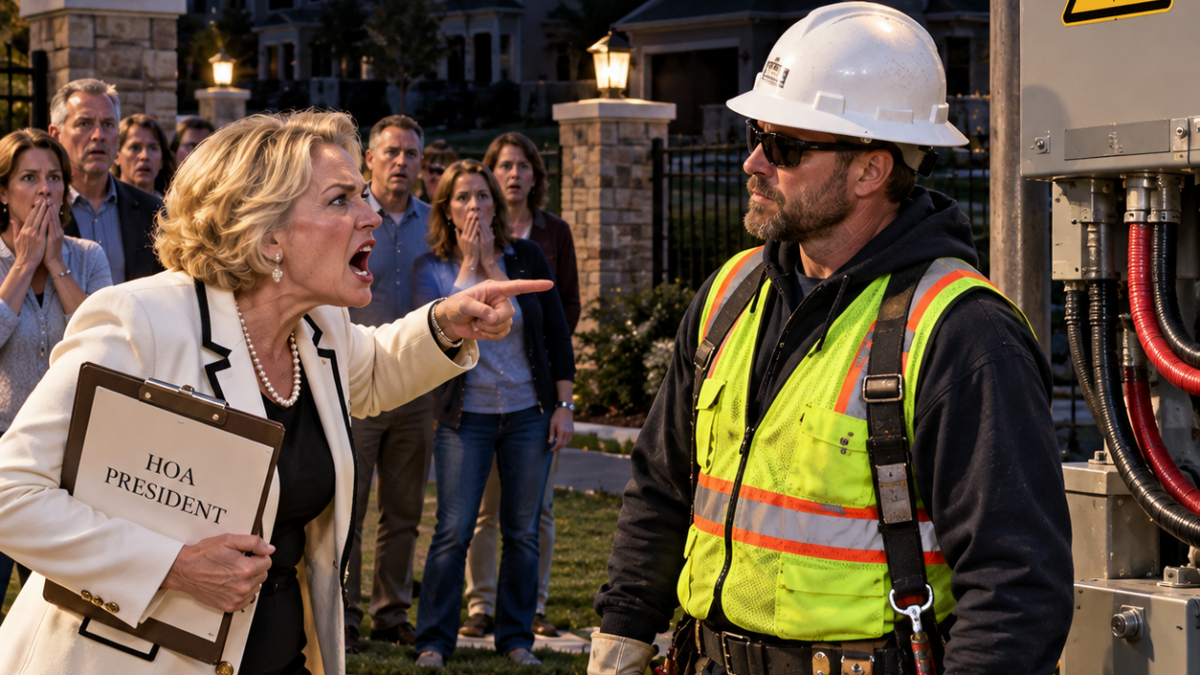
“Walden, why is my house power out?”
He stared at her.
Then at the conductor.
Then back.
“Mrs. Crowfoot…”
He pointed.
“The line we just cut is the line that serves Crooked Creek.”
Vivien looked at the line.
Then toward her subdivision.
Then back.
“That cannot be right.”
Freda slowly turned toward me.
I didn’t say anything.
Dad did.
“Well.”
That one word contained eighty years of Montana judgment.
Deputies arrived first.
12:04.
State police at 12:07.
Alyssa and federal investigators soon after.
The easement filled with vehicles.
Vivien started arguing before anybody finished introducing themselves.
We heard parts through the live feed.
“HOA-authorized improvement.”
“Community beautification.”
“Contractor authority.”
“Private standards.”
Then an investigator held up the recorded easement.
Vivien’s face changed.
At 12:17, warrants were served.
Walden was taken into custody.
Vivien shortly after.
Her four crew members followed.
A separate FBI team arrested Renton at the Crowfoot Line Works office downtown.
By 12:35, the southern easement looked less like family ranchland and more like a federal staging area.
Investigators photographed everything.
Cutter.
Truck.
Pole.
Conductor.
Bucket.
Tire tracks.
Crew paperwork.
Phones.
Meanwhile, Ingrid reached pole 42.
I watched my daughter put on climbing gear.
That affected me more than the arrests.
My grandfather had built that line.
My father had maintained it.
I had run it.
Now Ingrid was climbing the same corridor to repair damage caused by people who thought our infrastructure was an eyesore.
She began the splice shortly after one.
It was not simple work.
Everything had to be tested.
Isolated.
Grounded.
Verified.
Hardware inspected for arc damage.
Conductor tension restored.
Connections checked.
At 3:45, Ingrid landed the new splice.
Kell coordinated restoration.
Sections returned.
Then more.
At 4:03, all 380 customers had power again.
Including Crooked Creek.
Outage:
Less than four and a half hours.
I called Ingrid.
“You good?”
“Tired.”
“Anything damaged besides conductor?”
“Some hardware.”
“You eat?”
She laughed.
“Dad.”
“Answer.”
“No.”
“Then eat.”
“I will.”
“Good work.”
Pause.
Then:
“Grandpa there?”
I looked across the room.
Bjorn sat quietly.
“He’s here.”
“Tell him the splice is clean.”
Dad heard.
He nodded.
Then looked away.
His eyes were wet.
While we repaired the line, Crooked Creek residents were learning why they’d lost power.
The FBI released a public statement.
Federal utility sabotage investigation.
Fraud allegations.
Crowfoot Line Works.
Vivien.
Renton.
The HOA office became crowded.
Roshene Pruitt arrived at 1:30 carrying the recall petition.
Thirty-eight signatures.
By the time power returned, residents had read enough to understand what had happened.
People started showing up to sign.
Forty-two.
Forty-seven.
Fifty-one.
Fifty-nine.
The recall meeting was scheduled for seven that evening.
Eighty-one of the 120 households were represented.
Roshene presided because Vivien obviously couldn’t.
She stood at the front of the clubhouse with the federal indictment in one hand and years of budgets in the other.
I didn’t attend in person.
I had enough happening at the utility.
But I watched later.
Roshene was calm.
That was what made her devastating.
She didn’t rant.
Didn’t call Vivien names.
Didn’t celebrate the arrest.
She read numbers.
Four years of fraudulent vegetation billing.
By then, approximately $192,000.
Money homeowners believed was paying for legitimate utility vegetation work.
Work our company had actually been doing.
Then she summarized the copper-theft investigation.
Approximately $2.3 million worth of conductor removed over six years.
Insurance fraud exposure approaching $740,000.
Dozens of suspicious outages.
Federal allegations.
She reminded them why she had been removed from the budget committee.
Then called the vote.
Eighty-one to zero.
Vivien Crowfoot lost the HOA presidency while sitting in federal custody.
The irony wasn’t subtle.
The woman who had spent years treating Crooked Creek like her personal government was removed unanimously by the homeowners whose money had helped fund her husband’s company.
That night, the Big Timber Tribune called.
Reporter named Alyssa Whitestone.
She asked:
“Mr. Osterman, if you could say one thing to Mrs. Crowfoot tonight, what would it be?”
I almost declined.
Then I looked at the old utility easement.
November 1947.
One dollar consideration.
My grandfather’s name.
I held it up for the photographer.
“My grandfather built the first line across this valley with his own hands.”
She waited.
“He climbed poles in Montana storms before bucket trucks existed.”
I looked toward the southern corridor.
“He accepted one dollar to establish the easement that made the system possible.”
Then:
“Mrs. Crowfoot spent four years trying to remove the line without ever understanding who built it, who owned it, or what it served.”
The reporter wrote.
I added:
“If she’d asked one competent person before ordering the cut, 380 customers wouldn’t have lost power today.”
That quote became the headline story.
Then Billings picked it up.
Bozeman.
Helena.
Montana Public Radio.
By the weekend, the case had moved far beyond our county.
Reporters were fascinated by the one-dollar easement.
I understood why.
It’s a good detail.
A grandfather.
Rural electrification.
Hand tools.
A single dollar.
Then almost eighty years later, an HOA president trying to cut down the lines because she disliked the view.
But the old easement wasn’t the real story.
The real story was what happened when people trusted authority without asking where the money went.
Vivien had approved payments to her husband’s company for years.
Most residents never questioned them.
Four thousand dollars monthly disappeared into a budget large enough that nobody felt the full amount individually.
A little from every household.
Spread across time.
Easy to hide.
Roshene questioned it.
She lost her committee position.
After that, people learned the lesson Vivien wanted them to learn.
Questions create trouble.
So fewer questions came.
That’s how fraud survives.
Not because every victim is foolish.
Because everyday life is busy.
Mortgage.
Children.
Jobs.
Medical appointments.
Cars.
Groceries.
Most people do not spend evenings auditing HOA vendor invoices.
Vivien counted on that.
Renton counted on something similar at Big Timber Electric.
Remote line.
Reported damage.
Missing copper.
Insurance claim.
Repair.
Another outage.
Another location.
Another invoice.
One incident looked like vandalism.
Five looked unlucky.
Dozens became a system only after Freda and Ingrid laid every event side by side.
The FBI investigation expanded after the arrests.
Walden cooperated.
He knew enough to understand the evidence was overwhelming.
Cameras.
Phones.
Work orders.
Cut signatures.
Vehicle records.
Recovered copper channels.
Insurance flows.
HOA payments.
Federal agents began identifying other Crowfoot workers involved in earlier incidents.
Some had only participated once.
Others repeatedly.
A few claimed they thought they were doing authorized salvage work.
Investigators sorted it out.
That wasn’t my job.
Mine was keeping power running.
But the fallout came through our doors anyway.
Customers called.
Some angry about the outage.
Some apologetic.
Some terrified their rates had covered years of theft.
One rancher came into headquarters, removed his hat, and said:
“I’ve been paying for these people to steal from you?”
“From all of us.”
He clenched his jaw.
“How much?”
“We’re still calculating.”
“Get it back.”
“We’re trying.”
That became personal to me.
Big Timber Electric was privately owned, but a utility doesn’t function like an ordinary private business.
Customers cannot simply decide they don’t want electricity that month.
When we spend money replacing stolen infrastructure, those costs go somewhere.
Insurance.
Company reserves.
Rates.
Eventually ordinary people pay.
A widow in a small house.
A grocery store.
A rancher running irrigation pumps.
The very Crooked Creek homeowners Vivien claimed to represent.
That was what made me angrier than the insult to my grandfather’s lines.
She didn’t simply attack my property.
She used other people’s trust as money.
Freda handled restitution documentation.
She was merciless.
Every repair invoice.
Crew hour.
Truck mile.
Emergency callout.
Insurance deductible.
Replacement conductor.
Switching operation.
We reconstructed years.
Ingrid helped verify technical damage.
Kell provided SCADA timestamps.
Dad came into headquarters one Tuesday and sat beside stacks of files.
He looked at me.
“Your mother would’ve hated this.”
“The paperwork?”
“The thieves.”
I laughed.
“She hated paperwork too.”
“That too.”
Then his expression became serious.
“Your grandfather used to say electricity is a promise.”
I had heard the phrase.
Not in years.
“A promise?”
“You turn the switch, it comes on.”
Dad shrugged.
“People don’t care how many poles stand between them and the lightbulb.”
“They shouldn’t have to.”
“Exactly.”
He tapped the table.
“That’s our job.”
That became the way I thought about August 14.
Vivien saw power lines.
Ugly poles.
Blocked views.
Infrastructure she could order somebody to remove.
My grandfather saw a promise.
A ranch house ten miles from town with children reading after dark.
A dairy running refrigeration.
A pump keeping livestock watered.
A community connected.
When Walden closed that cutter, 380 promises broke at once.
Our job was to restore them.
We did.
The prosecutions took months.
Federal cases do not move at the speed television teaches people.
There were hearings.
Motions.
Evidence review.
Plea negotiations.
Accounting.
Victim-impact statements.
By February, Renton pleaded guilty to a large group of federal charges tied to infrastructure sabotage, fraud, conspiracy, and the broader copper-theft scheme.
The sentence was fourteen years in federal prison and approximately $2.7 million in restitution.
Vivien’s case resolved in April.
She pleaded guilty to nine federal counts connected to conspiracy, HOA misappropriation, mail fraud, and witness intimidation.
Four years federal.
$340,000 restitution.
Walden accepted a cooperation agreement.
Five years.
He identified additional Crowfoot employees and explained how the earlier cuts had been organized.
The remaining crew members received shorter sentences based on their individual roles.
Crowfoot Line Works was dissolved.
Its remaining assets went into court-supervised receivership.
That’s where the story could easily turn into celebration.
Bad people punished.
Homeowners cheering.
Utility vindicated.
But I didn’t feel much like celebrating.
A company that had existed for decades was gone.
Employees who had done nothing wrong lost jobs.
Families were embarrassed by relatives.
Crooked Creek residents learned their own HOA had been taking money from them.
Our customers learned part of their utility expenses came from repairing sabotage disguised as weather damage.
Nobody walks out of a scheme that large untouched.
Accountability was necessary.
Satisfying?
Sometimes.
Clean?
Never.
Roshene became chair of the reconstituted Crooked Creek board.
That amused Freda.
“She spent four years getting pushed out for asking questions.”
“Now she runs it.”
“Think she’ll enjoy that?”
“No.”
“Good answer.”
The new bylaws prohibited board members or their spouses from controlling vendors paid by the association.
Seems obvious.
Apparently obvious rules often get written only after somebody proves why they’re needed.
HOA dues were capped at a lower level.
Vendor contracts required disclosure.
Budget review became public.
Residents received refunds averaging around sixteen hundred dollars per household from recovered Crowfoot assets.
Roshene called me after the checks were mailed.
“Some people think we won.”
“What do you think?”
“I think we got some money back.”
“That isn’t the same?”
“No.”
She paused.
“You can’t refund trust.”
I knew exactly what she meant.
Walton Hardesty received restitution too.
Forty-seven thousand dollars tied to the 2023 theft and damage on his ranch.
He drove to Helena to accept the check himself.
Same cattle hat.
Someone sent me a photograph.
Walton standing beside a federal prosecutor holding the check like it weighed nothing.
I called him.
“Worth the two-year wait?”
“No.”
I laughed.
“Fair.”
“But nice to be believed.”
That answer stayed with me.
Sometimes money is secondary.
What a person really wants is for someone to finally say:
You saw what you said you saw.
You were not imagining it.
The damage happened.
We believe you.
Big Timber Electric received approximately $640,000 in federal restitution from recovered Crowfoot assets for our share of repair and ratepayer costs.
It wasn’t enough to erase every expense.
It wasn’t supposed to.
But it mattered.
I could have put that money into general operations.
Instead, I kept thinking about Granddad.
Then Ingrid.
Three generations.
Four if you counted my father.
I established the Spar Osterman Memorial Rural Utility Apprenticeship Fund in November 2025.
Paid two-year apprenticeships.
Journeyman lineman training.
SCADA operations.
Rural utility engineering certifications.
Priority for first-generation Montana students trying to enter the electrical trades.
Casper agreed to serve as pro bono counsel.
Roshene joined the board.
Ingrid became master instructor.
When I told her, she stared.
“You didn’t ask.”
“I’m asking now.”
“You already printed paperwork.”
“Minor detail.”
She smiled.
“I’ll do it.”
Our first apprentice was eighteen.
Halmar Gunderson from Carbon County.
His grandfather had been a lineman.
Halmar climbed his first transmission pole in January 2026.
I watched from the ground.
He was nervous.
Good.
A lineman who isn’t nervous the first time isn’t paying attention.
Ingrid stood beside him.
“Three points of contact.”
“I know.”
“Then show me.”
He climbed.
Slow.
Careful.
Twenty feet.
Thirty.
Stopped.
Looked down.
I shouted:
“Don’t look at me. I’m not up there.”
Ingrid glared.
“Dad.”
“What?”
“Helpful instruction only.”
Halmar laughed.
That helped more than my instruction.
He reached the work position.
Secured himself.
Completed the exercise.
When he came down, Dad was there.
Eighty-five by then.
He shook Halmar’s hand.
“What’d you think?”
“Higher than it looks.”
Dad smiled.
“Everything is.”
Those were some of Dad’s last good months.
He still visited SCADA every Tuesday.
Sometimes staff pretended they needed his advice because everybody knew how much he loved being asked.
He knew they were pretending.
He gave advice anyway.
One Thursday night in April 2026, he went to bed.
Didn’t wake up.
Eighty-five.
No hospital.
No long decline.
Just sleep.
I found out at 5:18 Friday morning.
Freda took the phone.
She knew before I spoke.
At the funeral, we buried Dad wearing his 1973 Big Timber Electric service pin.
The same one he’d worn August 14.
I stood beside the grave looking at the mountains.
All I could think about was the kitchen table the night before the cut.
“Tomorrow, son, make him proud.”
I wondered if I had.
Then Ingrid slipped her hand into mine.
“Grandpa knew.”
I looked at her.
“What?”
“He knew.”
She didn’t explain.
Didn’t need to.
The company kept moving.
Utilities do.
People die.
Storms come.
Equipment fails.
Someone still has to answer at two in the morning when a feeder trips.
Freda remained COO.
Kell stayed at SCADA.
Ingrid kept climbing and training apprentices.
She started taking more executive meetings.
At first, reluctantly.
Then with confidence.
One afternoon she came into my office carrying a capital-improvement report.
“This replacement schedule is wrong.”
“How?”
“We’re replacing poles by age instead of condition.”
“That’s policy.”
“Bad policy.”
“You’ve been in management fifteen minutes.”
“And already improving it.”
I laughed.
Then listened.
She was right.
I told her later:
“Five years.”
“For what?”
“CEO.”
Her face changed.
“Dad.”
“You’ll be ready.”
“I didn’t ask.”
“Neither did I.”
“That doesn’t mean—”
“Five years.”
She shook her head.
But she smiled.
The southern easement remained intact.
Pole 42 got new hardware after the sabotage.
Ingrid’s splice carried load through winter.
Then another.
Then another.
Snow.
Wind.
Heat.
No problem.
Sometimes I drove out there alone.
Not because it needed inspection.
Because I liked standing beneath it.
The sound of energized transmission isn’t dramatic.
A faint hum.
Sometimes corona under certain conditions.
Wind through conductor.
Steel hardware clicking when temperature changes.
Most people barely notice.
I notice.
Always have.
I once brought Halmar out to the original Yellowstone River pole.
Granddad’s old cedar pole.
He looked up.
“That’s really from 1948?”
“Yes.”
“You climb it?”
“Twice a year.”
He stared at me.
“You’re fifty-nine.”
“Thank you for the update.”
“Ingrid lets you?”
“She doesn’t run the company yet.”
“She runs you.”
I looked at him.
“You’re getting too comfortable.”
He grinned.
I showed him the old willow-bark guideline, preserved behind glass now.
Granddad’s mother made it in Norway in 1907.
He carried it west.
Used it when setting poles.
Halmar stared.
“Why keep something like that?”
“Because equipment tells stories.”
“What story?”
“That none of this started with us.”
I pointed toward the modern transmission system.
Fiber.
SCADA.
Automated relays.
Remote cameras.
“All that came later.”
Then at the old guideline.
“Somebody still had to start.”
I thought often about Vivien.
Not with hatred.
People expected hatred.
Reporters asked.
Crooked Creek residents sometimes apologized as though she represented them personally.
She didn’t.
One woman stopped me at the grocery store.
“I voted for Vivien twice.”
I said:
“Okay.”
“I feel terrible.”
“Why?”
“I trusted her.”
“That’s not a crime.”
“I should’ve asked more questions.”
“Maybe.”
She looked embarrassed.
I added:
“So should a lot of us.”
That included me.
I signed Crowfoot Line Works’ contract in 2022.
I knew Renton.
Knew his father.
Trusted continuity.
Routine can make smart people lazy.
Same contractor.
Same work.
Same annual renewal.
Sign.
Move on.
If Ingrid hadn’t looked carefully at one piece of copper, how long would the theft have continued?
Another year?
Five?
Until someone died?
I don’t like that question.
But I ask it.
Because organizations become vulnerable when experience turns into assumption.
Granddad knew every pole because he had set half of them.
Dad knew every feeder because the system was small enough to carry in one man’s head.
By my generation, we had 400 miles of distribution.
Computers.
Crews.
Contractors.
Insurance systems.
Specialists.
Growth creates distance.
Distance creates places where bad people can hide.
The answer isn’t distrust everyone.
It’s verify.
That became one of Ingrid’s favorite words.
Verify.
She made it part of apprentice training.
Don’t assume conductor is dead.
Verify.
Don’t assume grounding is good.
Verify.
Don’t assume paperwork matches field condition.
Verify.
Don’t assume contractor report is accurate.
Verify.
Electricity is unforgiving.
Apparently so is accounting.
Crooked Creek changed after the scandal.
The new HOA removed several ridiculous rules.
Residents voted on larger contracts.
Vendor names became public.
Conflict-of-interest statements mandatory.
Roshene served two terms as chair.
Then stepped down.
I asked why.
“Because unlike some people, I understand power is supposed to be temporary.”
I laughed.
“Subtle.”
“I’ve earned subtlety.”
She deserved that.
The development never buried the transmission lines.
Nobody asked again.
Property values did not collapse.
People continued buying expensive houses with mountain views.
Turns out buyers could survive seeing utility poles.
A few years after the arrests, Crooked Creek planted native trees along a different boundary.
Not beneath the transmission corridor.
They consulted us first.
Roshene called.
“You sitting down?”
“Yes.”
“We would like permission.”
I laughed.
“For what?”
“Landscaping near utility infrastructure.”
“Those words coming from Crooked Creek make me nervous.”
“That’s why I’m calling.”
We reviewed the plan.
Proper clearances.
Approved species.
No conflict.
I signed.
She said:
“That easy?”
“That’s what happens when nobody tries cutting a 70,000-volt line.”
“Good policy.”
I agreed.
People later embellished the story.
They always do.
One version said Vivien personally climbed a pole with bolt cutters.
False.
Another said the entire county went dark.
False.
Three hundred eighty customers.
Another claimed the line explosion threw Walden fifty feet.
Didn’t happen.
Protective gear and positioning saved him from worse.
Somebody online said the FBI had agents hidden inside our hay barn.
No.
Dad liked that one.
“Would’ve been exciting.”
“You would have fed them.”
“Of course.”
“Then blown the operation.”
“They need breakfast.”
The truth was dramatic enough.
An HOA president wanted power lines removed.
Her husband’s company had a long-running pattern involving copper theft and fraudulent outage reports.
Her association had been paying that company for vegetation work it wasn’t performing.
Federal investigators built a case.
She fabricated HOA authority.
Her husband’s foreman cut an energized transmission conductor.
The very subdivision she governed lost power.
The cut was recorded live.
Arrests followed.
That doesn’t need embellishment.
The moment I remember most wasn’t the arrest.
It was 11:47.
Walden’s cutter closing.
White flash.
Conductor falling.
Then Kell’s voice:
“Outage on southern feeder.”
Calm.
My son doing his job.
Then later Ingrid up the pole.
My daughter repairing it.
Dad watching.
Four generations attached to one line.
That meant more to me than Vivien in handcuffs ever could.
The news coverage eventually faded.
Another scandal came.
Then another.
Federal filings moved out of headlines.
Crooked Creek became just another subdivision again.
Big Timber Electric kept sending bills.
Customers kept paying them.
Lights came on.
Life returned to what Dad called the promise.
Then one evening, Freda and I drove into town in Dad’s old 1989 Chevrolet C30 utility truck.
He’d bought it new.
Utility bed still attached.
Paint faded.
Bench seat cracked.
Freda hated how much I loved it.
“We own newer trucks.”
“I know.”
“With air conditioning.”
“I know.”
“With suspension designed after the invention of comfort.”
“I know.”
“Why are we driving this?”
“Character.”
“My spine has character already.”
We went to the Grand Hotel.
Corner booth.
Prime rib.
Creamed corn.
George Strait playing from the jukebox.
Nothing fancy.
After dinner, we drove home with the windows down.
Cool Montana evening.
Sandhill cranes somewhere overhead.
The road followed the Yellowstone.
For a while, neither of us spoke.
Then the transmission lines appeared against the fading sky.
Freda looked toward them.
“You still think about August?”
“Sometimes.”
“Vivien?”
“Not much.”
“Renton?”
“No.”
“What then?”
I looked at the poles.
“Dad.”
She nodded.
“Granddad.”
Another nod.
“Ingrid.”
“She’ll be good.”
“Better than me.”
“Probably.”
I looked at her.
“You could disagree.”
“I could.”
She smiled.
Didn’t.
We turned onto Crazy Mountain Lane.
Crooked Creek’s entrance lights glowed ahead.
Every one powered through the system Vivien once tried to remove.
Nobody standing outside cared where the electrons came from.
Good.
They shouldn’t have to.
A utility works best when ordinary people never think about it.
Switch.
Light.
Thermostat.
Refrigerator.
Pump.
Business.
Life.
Invisible reliability.
Granddad understood that before I was born.
That old 1947 easement cost a dollar.
People loved talking about that dollar after the case.
One dollar built the legal foundation for a line that served generations.
But the dollar wasn’t what made the agreement valuable.
Trust did.
My grandfather trusted that the company he created would maintain the corridor responsibly.
The company trusted that ownership and easement rights would be respected.
Customers trusted the power would flow.
Vivien looked at that system and saw something obstructing her view.
Renton looked at it and saw copper.
That’s the difference.
Some people inherit infrastructure and think about what it can give them.
Others inherit it and think about what they owe the people depending on it.
I know which side my grandfather stood on.
I know which side Dad stood on.
And I know which side I want Ingrid and Kell to remember.
The apprenticeship fund keeps growing.
Every January, a new group comes through.
Some have never climbed.
Some have never been inside a substation.
Some are farm kids.
Some come from town.
One young woman asked me during orientation:
“What’s the most dangerous thing about line work?”
People expected me to say voltage.
I didn’t.
“Assumption.”
She frowned.
“Not electricity?”
“Electricity is dangerous whether you respect it or not.”
I pointed toward the training yard.
“The mistake is assuming something is safe because it was safe yesterday.”
I could have been talking about the Crowfoots.
I could have been talking about myself.
Maybe I was.
We teach apprentices to test.
Measure.
Confirm.
Communicate.
Stop if something doesn’t make sense.
The same habits would have prevented most of the disaster.
If a Crooked Creek board member had asked:
“What exactly are we paying Crowfoot four thousand dollars a month to do?”
If somebody had demanded photographs.
Service locations.
Work orders.
If I had audited remote outage patterns sooner.
If an insurance reviewer had noticed Crowfoot repeatedly reporting the same category of damage.
If Walden had trusted his hesitation at 11:47.
If Vivien had listened to the county official who explicitly told her she had no authority.
So many chances to stop.
That’s what frightened me most afterward.
Large crimes often survive because each individual decision appears small.
Approve invoice.
Sign report.
Trust contractor.
Ignore complaint.
Remove difficult committee member.
Call outage weather damage.
Pay deductible.
Renew contract.
One by one, nothing looks large enough to stop the world.
Then someone finally lays every decision across one table.
And the pattern becomes impossible to ignore. Pasted text
Freda still keeps the first Crooked Creek newsletter where she noticed the vegetation charge.
It is inside a file at headquarters.
I asked once why.
“Evidence?”
“No.”
“Memory?”
“No.”
“Then?”
She looked at me.
“Because fraud can fit in one boring line on page six.”
That’s Freda.
She wasn’t wrong.
Ingrid kept the cut copper sample too.
Clean jaw marks still visible.
It sits in the training room now.
Not behind glass.
Students can hold it.
Feel the weight.
See what a hydraulic cutter does.
The label beneath it says:
VERIFY THE STORY THE METAL TELLS YOU.
Kell thought that was dramatic.
Ingrid told him to mind his computer screens.
They argue like siblings.
Then run the company together when I’m gone.
Exactly as they should.
As for Vivien, I never spoke to her after August 14.
No prison letter.
No apology addressed personally to me.
The court required an apology to her HOA members.
That belonged to them.
She had harmed them differently.
I didn’t need one.
What would she apologize for?
The view?
The fraud?
The outage?
The line?
My family?
There wasn’t a sentence that could make the conductor uncut.
Ingrid had already repaired the important part.
That was enough.
Renton’s apology came through lawyers.
Also unnecessary.
Restitution mattered.
Cooperation mattered.
Stopping mattered.
I don’t require remorse to restore electrical service.
That’s one benefit of infrastructure.
It doesn’t care how sorry anyone feels.
Repair correctly.
Energize.
Move forward.
Dad’s photograph of Granddad beside the old Yellowstone River pole was returned after the national press used it.
Dad kept it on his nightstand.
After he died, I found it there.
Black-and-white.
Granddad younger than I am now.
Work clothes.
Hat.
One hand against the cedar pole.
Willow guideline around his wrist.
He wasn’t smiling.
Men in old photographs rarely did.
I sat on Dad’s bed holding it.
For a while, I was nine again.
Then twenty.
Then forty.
Then fifty-eight watching a line explode on a monitor.
Generations compress inside photographs.
I brought the picture back to headquarters.
It hangs in the lobby now.
Not because I want customers worshiping founders.
I don’t.
Because apprentices should see that systems come from people.
Someone digs the hole.
Someone sets the pole.
Someone lands the conductor.
Someone answers the outage.
Someone checks the invoice.
Someone notices the cut.
Someone says:
“This doesn’t look right.”
That’s how infrastructure survives.
Not because companies are immortal.
Because responsibility gets handed forward.
The plaque under Granddad’s photograph is simple.
SPAR OSTERMAN
FOUNDER
1947
Nothing about Vivien.
Nothing about the federal case.
She doesn’t belong on that wall.
The southern easement does not have a memorial plaque either.
It carries electricity.
That is memorial enough.
Last winter, I drove out after a heavy storm.
Wind had pushed snow across the ranch in long ridges.
The lines were intact.
I stopped near pole 42.
Ingrid’s splice still there.
No trouble.
I got out.
Cold enough to hurt my lungs.
Looked up.
The line disappeared west toward the mountains.
I thought about the day it fell.
Then about the afternoon it rose again.
That’s the part I prefer.
People tell stories about destruction because destruction is loud.
Repair is quieter.
A cutter closes in two seconds.
A splice takes hours.
Fraud can steal for years.
Restitution takes longer.
A president can destroy trust in one decision.
A community may need years to rebuild it.
That’s why I no longer think August 14 was mainly about catching anyone.
It was about what happened after.
Kell kept the grid safe.
Ingrid restored the feeder.
Freda rebuilt the accounting record.
Roshene rebuilt the HOA.
Federal investigators followed the money.
Walton finally got heard.
Customers recovered part of what they’d lost.
Young apprentices entered the trade.
Our family kept the company moving.
That is a better ending than handcuffs.
The next generation does not need our anger.
It needs our records.
Our lessons.
Our tools.
And enough honesty to understand how close we came to missing what was happening.
The last time I climbed the old Yellowstone pole, Ingrid came with me.
She stood on the ground looking up.
“You know I can do this.”
“I know.”
“You’re getting too old.”
“I know.”
“That wasn’t agreement.”
“I heard you.”
I climbed anyway.
Slowly.
Cedar wood.
Old iron.
Newer hardware.
At the top, the valley opened around me.
Yellowstone River.
Ranchland.
Crazy Mountains.
Crooked Creek roofs in the distance.
The subdivision looked small from there.
So did its clubhouse.
So did the southern corridor where everything had happened.
I inspected the termination.
Sound.
Hardware clean.
Exactly as it should be.
Then I looked down.
Ingrid had one hand shading her eyes.
“Hurry up, Dad!”
I laughed.
Granddad had set that pole almost eighty years earlier.
Father had checked it.
I checked it.
Soon she would.
That’s all inheritance really is.
Not owning the past.
Taking your turn caring for what survives it.
I climbed down.
Ingrid looked at the inspection sheet.
“Well?”
“Good.”
“That’s it?”
“That’s what good inspections sound like.”
She signed beneath my name.
Two signatures.
Two generations.
Then she looked toward Crooked Creek.
“Do you think they still hate the lines?”
“Who?”
“The residents.”
“No.”
“How do you know?”
“Because when the lights work, nobody thinks about the lines.”
She smiled.
“That sounds like Grandpa.”
“It was.”
We drove back to headquarters.
Kell was arguing with a vendor.
Freda was reviewing an audit.
Halmar was in the training yard.
Normal day.
Exactly what Granddad built the company to create.
Normal.
The final federal restitution payments were distributed by then.
Crowfoot Line Works was gone.
Vivien was gone from HOA leadership.
Crooked Creek had new bylaws and new people.
Renton’s old trucks had been sold by the receiver.
The white Navigator disappeared too.
I don’t know who bought it.
Don’t care.
What remained were the things that should have remained.
The ranch.
The easement.
The company.
The customers.
The line.
Ingrid’s splice.
And the lesson.
Vivien Crowfoot spent years believing those transmission lines were ugly objects blocking her view.
She never understood that they were older than her subdivision, legally protected, technically essential, and connected to the very homes she claimed to be improving.
On August 14, she finally got what she had been demanding.
For a few hours, the line stopped serving Crooked Creek.
The view was unobstructed by electricity.
The lights went out.
The air conditioners stopped.
The HOA office died.
And suddenly everyone understood exactly what those “eyesore” lines were doing there.
But by then, the cut had exposed far more than an HOA president’s obsession with mountain views.
It exposed years of false invoices.
Years of suspicious outages.
Years of stolen conductor.
Insurance fraud.
Hidden conflicts.
People who had been ignored.
Evidence sitting in files waiting for someone to connect it.
A whole structure built on the assumption that nobody would ever look closely enough.
They were wrong.
Freda looked.
Ingrid looked.
Roshene looked.
Walton had looked years earlier.
The FBI finally had enough to look at all of it together.
And once the truth was visible, it didn’t need exaggeration.
That is the part I tell our apprentices.
Don’t try to make evidence dramatic.
If it’s real, it doesn’t need help.
A cleanly cut conductor.
A repeated invoice.
A timestamp.
A truck on camera.
A false directive.
A recorded easement.
Each thing small.
Together, undeniable.
Granddad charged one dollar for the original easement.
Vivien’s scheme cost millions.
One agreement helped electrify a valley.
The other tried to exploit it.
That contrast followed me for a long time.
Sometimes it still does.
But when Freda and I drive home at night now, I don’t look at the southern line and think about Vivien.
I look at the houses beneath it.
Porch lights.
Kitchen windows.
Barn lamps.
Pumps.
Businesses.
Families.
Electricity doing what it was built to do.
Last night, the sky over the Crazy Mountains turned purple while we drove back from dinner.
George Strait had been playing at the restaurant.
Freda had complained about the C30’s suspension.
I had ignored her.
Sandhill cranes called somewhere above us.
Then we turned onto Crazy Mountain Lane.
Crooked Creek glowed ahead.
Every house lit.
The transmission line crossed the road as quietly as it had before any of us were born.
I slowed.
Freda looked at me.
“What?”
“Nothing.”
“You’re doing the thing.”
“What thing?”
“Thinking about dead relatives and power poles.”
I laughed.
“Maybe.”
She took my hand.
We drove beneath the line.
No outage.
No federal vehicles.
No cameras being watched in real time.
No HOA president shouting about mountain views.
Just current flowing across a corridor my grandfather had protected for one dollar in 1947.
My father’s company.
My wife’s audit.
My son’s control room.
My daughter’s splice.
And someday, if we do our jobs right, somebody else’s responsibility.
That is what survived.
Not Vivien’s rules.
Not Renton’s company.
Not the fraudulent invoices.
Not the copper scheme.
The promise did.
Flip the switch.
The light comes on.
And after everything they tried to do to those lines, that remains the most powerful ending I could have asked for.
THE END








