The HOA President Watched My Barn Burn and Called It an Eyesore—She Never Looked Up at the Camera.k
part2:
The first HOA notice appeared on my gate on a Tuesday morning.
I found it while walking back from feeding two old cows I’d kept mostly because neither of us had the energy for change.
White paper.
Clear plastic sleeve.
Willow Creek logo at the top.
PROPERTY CONDITION CONCERN
I almost laughed.
The complaint referenced the barn’s faded exterior and said its condition negatively affected the appearance of the “adjacent residential community.”
I read the page twice.
Then looked across the highway at Willow Creek.
The nearest home sat nearly four hundred yards from the barn.
I went inside, found the association’s mailing address online, and sent a short certified letter.
My farm is not within Willow Creek Estates and is not subject to its restrictive covenants. Please direct any legitimate legal concern through the appropriate county authority.
That should have ended it.
A week later, another notice appeared.
This time:
Fence maintenance.
Apparently a cedar rail on the eastern line was “visibly uneven.”
The fence belonged entirely to me.
It had been installed by my father before Monica was old enough to vote.
I sent another certified response.
Then another notice arrived.
Native weeds.
Old utility trailer.
Equipment stored near the shed.
One complaint claimed an antique tractor visible from Willow Creek reduced “visual cohesion.”
I started a file.
Then a drawer.
My neighbor Hank Bell thought the entire thing was hilarious.
Hank lived half a mile down the road on thirty acres his family had owned almost as long as mine.
Retired high-school shop teacher.
Baseball cap permanently tilted over one eyebrow.
He showed up one Friday while I was repairing a mower deck.
Another HOA notice was sitting on my workbench.
He picked it up.
“Three hundred dollars?”
“Apparently.”
“For weeds?”
“Wildflowers.”
“Same crime.”
I handed him a wrench.
“They can’t fine me.”
“They can print numbers on paper.”
“That’s different.”
Hank grinned.
“One day you’re gonna wallpaper this barn with Monica’s love letters.”
“I’ve considered it.”
“Would improve the aesthetics.”
That made me laugh.
At the time, the whole thing still felt ridiculous.
Monica wanted attention.
I wasn’t giving it.
I had spent too many years watching people become their worst selves because somebody else provoked them.
So I answered every notice calmly.
Certified mail.
No insults.
No shouting at board meetings.
No threats.
Just:
This property is not subject to your authority.
Please identify any legal basis for your claim.
They never did.
The dollar amounts increased anyway.
Two hundred.
Three hundred.
Five hundred.
I never paid.
Never acknowledged the debt.
Never entered any payment arrangement.
Never signed anything.
I also ordered a fresh county survey even though I already knew the boundary.
That was habit.
Facts first.
The survey confirmed what the deed had always said.
Willow Creek ended across the highway.
My farm was separate.
No HOA easement.
No architectural authority.
No shared common parcel.
No ambiguity.
I sent Monica a certified copy.
For almost two weeks, nothing happened.
I thought maybe she’d finally spoken to an attorney.
Then one afternoon, a white SUV rolled down my gravel driveway.
Monica stepped out.
Black slacks.
Cream blouse.
Clipboard.
Her shoes were completely wrong for a working farm.
I walked out of the barn.
“Can I help you?”
She looked at the tractor beside me.
“I’m conducting a visual inspection.”
“No, you’re not.”
She blinked.
“Excuse me?”
“You’re standing on private property.”
“Our community borders this parcel.”
“Across a public highway.”
“Your property directly affects ours.”
“That does not make you an inspector.”
She looked toward the barn.
“People like you always use history as an excuse.”
“For what?”
“To resist progress.”
I almost smiled.
“What progress am I resisting?”
“Willow Creek is trying to establish a high-quality residential community.”
“Congratulations.”
“And structures like that undermine the investment people have made.”
She pointed at my barn.
Something about that bothered me more than the letters had.
Maybe because the barn had belonged to my father.
Maybe because she’d reduced decades of work to an eyesore from the seat of an SUV.
I said:
“My family paid taxes here before your developer bought the first acre across that road.”
She rolled her eyes.
“That doesn’t mean everyone else has to look backward forever.”
“No.”
“It means you don’t get to walk onto my property and tell me what belongs here.”
She tightened her grip on the clipboard.
“The county could condemn that barn if it becomes unsafe.”
“If the county believes that, they know where to find me.”
“Eventually progress always wins, Mr. Mercer.”
There was something about the way she said it.
Not warning.
Promise.
I looked at her.
“You should leave.”
She did.
Tires kicked gravel against my mailbox on the way out.
That evening, I wrote down the exact conversation.
Date.
Time.
Location.
Her words.
I had done that for decades from the bench.
Memory gets prettier with age.
Contemporaneous notes don’t.
A week later, Monica emailed me directly.
No HOA manager copied.
No other board member.
She described my property as a “public embarrassment” and claimed respectable residential development could not coexist indefinitely beside neglected agricultural structures.
I printed it.
Saved the electronic copy.
Added it to the drawer.
Then the letters stopped.
Completely.
That worried me more.
Hank noticed too.
He came by one morning.
“Quiet.”
“Yeah.”
“Maybe she got bored.”
“Maybe.”
“You don’t believe that.”
“No.”
He scratched his chin.
“What do you think?”
“I don’t know.”
That was the truth.
But I had spent too many years watching disputes to believe unexplained silence always meant peace.
Sometimes it meant someone had finally listened to legal advice.
Sometimes it meant they were planning something they didn’t want documented.
I checked my cameras.
A few years earlier, copper wire had been stolen from the well pump.
After that, I’d installed a small security camera on the well house.
Cheap.
Weatherproof.
Motion activated.
It covered the pump.
Part of the gravel lane.
And because of the angle, most of the south side of the barn.
I checked the battery.
Storage.
Time stamp.
Working.
Then I forgot about it.
The morning the barn burned, my dog woke me before sunrise.
Duke was a ten-year-old shepherd mix with bad hips and the moral conviction of an airport security officer.
He barked once.
Sharp.
Then stopped.
I looked at the clock.
5:11.
The house was dark.
I listened.
Nothing.
No second bark.
No vehicle.
No voices.
I got up anyway.
Pulled on jeans.
Started coffee.
By 5:19, I was standing in the kitchen looking out toward the pasture.
Nothing obvious.
The barn was mostly hidden by darkness.
I poured coffee.
Turned to feed Duke.
Then orange light moved across the kitchen wall.
I looked up.
Flames.
For a second, my brain couldn’t place them.
Then I ran.
By the time I reached the front porch, the south wall of the barn was burning from end to end.
I called 911 while running toward it.
The heat hit before I reached the fence.
Dry old timber catches fast.
Faster than people understand.
The barn roof had cedar underlayment beneath later metal patches.
Inside:
Wooden shelving.
Old lumber.
Oil residue.
Tractor tires.
Cardboard.
Forty years of things that could burn.
I grabbed a hose knowing it was useless.
Then stopped.
The roof began to crack.
Firefighters arrived within minutes.
Volunteer company first.
Then county units.
They kept me back.
One tire exploded inside.
Then another.
A window blew outward.
Someone shouted for more water.
Hoses snaked across the pasture.
Smoke swallowed the early light.
I stood there watching my father’s workbench disappear behind fire.
There are moments when grief arrives before loss is complete.
I knew, while parts of the barn were still standing, that the things inside were already gone.
Dad’s notebooks.
Grandfather’s tools.
Photographs.
A wooden level with Earl Mercer’s initials cut into the side.
No insurance payment could reproduce those.
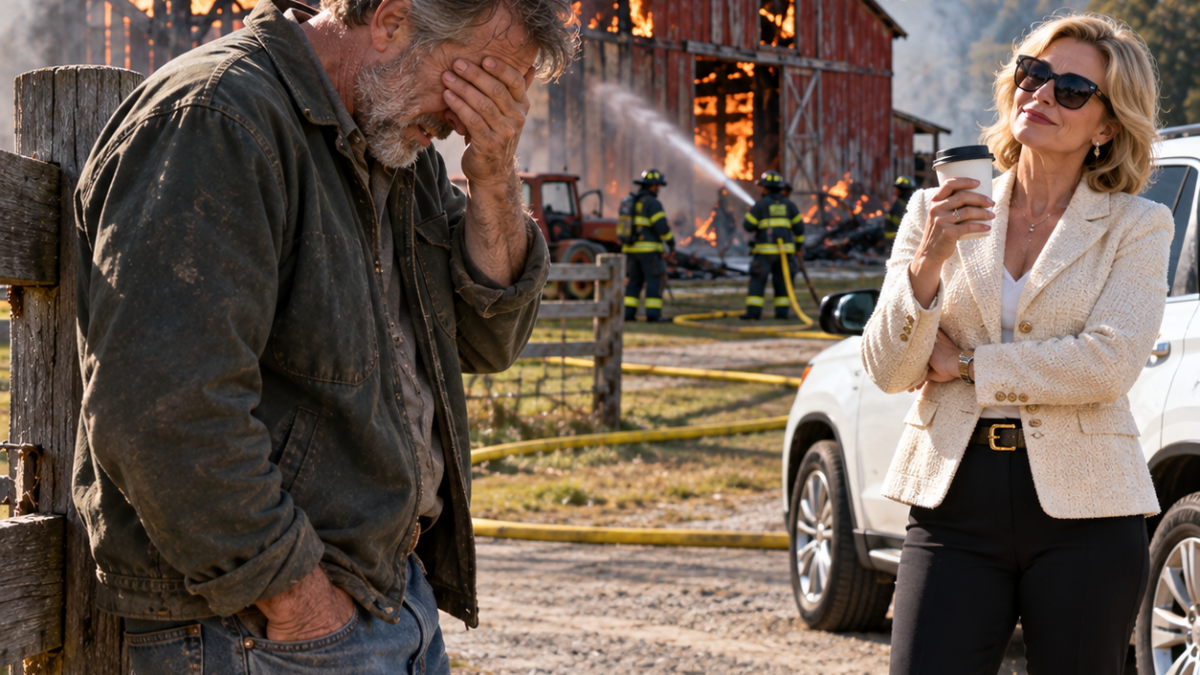
Then I saw the white SUV.
End of my driveway.
Monica.
She stood beside it.
Coffee cup in one hand.
No jacket.
Watching.
I don’t know how long she’d been there.
She looked almost calm.
That bothered me immediately.
I walked toward her.
Not close.
Maybe twenty feet.
She looked at the flames.
Then at me.
Small smile.
Not a grin.
Worse.
Satisfaction.
“Guess the county finally took care of that eyesore.”
I stared.
“What did you say?”
She shrugged.
“Honestly, Daniel, that building was dangerous.”
“Firefighters are still inside the perimeter.”
“I’m just saying maybe something good comes from this.”
I wanted to walk toward her.
Every nerve in my body wanted confrontation.
Twenty-four years on the bench stopped me.
Not dignity.
Training.
The fastest way to destroy your own position is to react before you know what you’re reacting to.
I looked past her.
Then toward the well house.
Camera.
Tiny black square beneath the roof edge.
Monica never looked up.
I said nothing.
She took another sip.
That was when I first thought:
What if this wasn’t an accident?
And immediately told myself not to decide.
Suspicion is not evidence.
People say ugly things during emergencies.
Monica’s smile did not make her an arsonist.
Her months of harassment did not prove she’d lit anything.
I went back toward the firefighters.
Let professionals work.
The barn collapsed around 6:02.
Roof folded inward.
Sparks rose.
A section of the east wall remained.
Then fell.
Hank arrived at seven carrying two coffees.
He stood beside me.
Didn’t say anything.
Good friend.
After nearly a minute:
“Tell me you’ve got something.”
“I don’t know.”
He looked toward Monica’s SUV.
She was gone by then.
“What’d she say?”
I told him.
Hank’s jaw tightened.
“You think—”
“I don’t know.”
“You’ve got that camera.”
“Yes.”
“Check it.”
“Not yet.”
“Why not?”
“Because firefighters are still working.”
He stared at me.
“You’re unbelievable.”
“I’ve been told.”
Fire marshal Robert Gaines arrived around eight-thirty.
He began the ordinary process.
Origin.
Fuel sources.
Electrical.
Accelerants.
Weather.
Recent work.
Access.
I answered everything.
Old electrical circuit.
Disconnected most of the time.
No hay stored recently.
Fuel cans in a locked metal cabinet.
Small tractor inside.
Welding equipment present but unused for two weeks.
No one living inside.
No reason for anybody to be there overnight.
Robert asked:
“Any disputes?”
I paused.
“Yes.”
“Who?”
“Homeowners association across the road.”
His eyebrows lifted.
I explained briefly.
He wrote it down.
No conclusions.
Good.
Around ten-thirty, the last active hot spot was out.
Fire crews reduced.
Robert remained.
I went inside.
Hank followed.
We sat at my kitchen table.
I opened the security system.
Motion events.
4:52.
Nothing useful.
Raccoon.
4:56.
Headlights.
I clicked.
White SUV entered frame.
Hank leaned forward.
The time stamp:
4:57:11 a.m.
The SUV stopped halfway into my gravel drive.
Driver’s door opened.
Monica stepped out.
I knew the walk before I saw her face clearly.
Gray rain jacket.
Rubber boots.
She went to the rear.
Opened hatch.
Removed a red gasoline can.
Nobody spoke.
She walked directly toward the south barn wall.
The camera angle wasn’t perfect.
But good enough.
She tipped the can.
Moved along the siding.
A dark line appeared briefly on the ground.
Then she disappeared near the corner.
Returned.
Crouched.
Her hand moved.
A flare.
Not huge.
Bright.
Then flame climbed.
She stepped backward.
Watched for several seconds.
Returned the can to her SUV.
Drove away.
Hank whispered:
“Lord.”
I said nothing.
My heart was beating so hard I could hear it.
Seven minutes later, the SUV returned.
Monica got out.
This time carrying a coffee cup.
Gas-station logo visible when she turned toward the camera.
She parked near the highway.
Then walked toward the fire as though she’d only just discovered it.
The video ended.
Hank looked at me.
“Danny.”
“Don’t.”
“You saw it.”
“Yes.”
“That woman burned your barn.”
“Looks like it.”
“Looks like it?”
I turned.
“I’m not giving her attorneys the pleasure of saying I accused her before an investigator authenticated the recording.”
Hank stared.
Then slowly smiled.
“There he is.”
“Who?”
“Judge Mercer.”
“I retired.”
“Apparently not enough.”
I copied the footage.
First to a flash drive.
Second to external storage.
Third to encrypted cloud backup.
Then I generated the original file hash and wrote down where the source recording was stored.
Old habits.
Evidence is only useful if people can establish what it is and where it came from.
At noon, Robert called me back toward the barn.
Monica was there again.
Talking.
Of course.
“I warned him for months,” she said as I approached.
“That wiring was ancient.”
Robert looked at me.
“Mr. Mercer, anything you’d like to add?”
Monica smiled.
I held out the flash drive.
“Yes.”
“I’d like you to watch something before anybody settles on an electrical cause.”
She laughed.
“Security camera?”
“Yes.”
“You’re seriously wasting the fire marshal’s time with a farm camera?”
Robert did not react.
He connected the drive to a field laptop.
Video began.
White SUV.
Monica’s smile disappeared.
She recognized herself before anyone said a word.
Then the gas can appeared.
Her face went white.
Robert watched to the end.
No expression.
Then he replayed it.
He asked:
“Ms. Ellis, is that your vehicle?”
She opened her mouth.
Closed it.
“That’s not what it looks like.”
Robert looked at the screen.
“What does it look like?”
“I was…”
She swallowed.
“I was treating weeds.”
Hank made a sound behind me.
Robert raised a hand without looking at him.
“With gasoline?”
“I don’t remember what was in the can.”
“Why were you on Mr. Mercer’s property at 4:57 in the morning?”
“I was driving.”
“And stopped here?”
“Yes.”
“Why?”
“I saw something.”
“What?”
“I don’t remember.”
Robert’s tone didn’t change.
“Then let’s stop.”
She stared.
“What?”
“Don’t answer anything else until law enforcement arrives.”
Monica looked toward me.
For the first time since I’d known her, there was no confidence in her face.
Sheriff’s investigators arrived within twenty minutes.
They treated the property as a potential arson scene.
Photographed.
Collected samples.
Took the drive.
Requested original recordings.
Asked me for camera model.
Asked whether footage could be remotely altered.
Asked who had system access.
Exactly the questions they should ask.
Monica requested counsel.
Also exactly what she should do.
She was not dragged away in handcuffs from the pasture.
Real investigations move slower than people’s anger.
She was told not to interfere with the investigation.
Her vehicle later became subject to lawful search procedures.
I stayed out of it.
That afternoon, I walked through what remained after investigators released the safe perimeter.
Metal twisted.
Ash ankle-deep.
Workbench gone.
Dad’s notebooks gone.
My grandfather’s planes warped beyond use.
One heavy vise survived.
Blackened.
Cracked.
I touched it.
Then had to walk away.
Hank followed.
“You okay?”
“No.”
“Good.”
I looked at him.
“What?”
“I’d be worried if you said yes.”
Fair.
Insurance adjuster came the next morning.
Farm policy.
Separate from HOA.
We documented everything we could.
Structure.
Tools.
Equipment.
Personal property.
Historical items with little market value but enormous personal value.
Insurance can price steel.
Lumber.
A tractor.
It cannot price your father’s handwriting.
Three days after the fire, an overnight courier envelope arrived from a Nashville law firm.
Expensive stationery.
The letter represented Monica personally.
It accused me of making reckless conclusions from incomplete surveillance footage.
Suggested the footage might have been altered, compressed, or taken out of context.
Warned against defamation.
I laughed.
Not because the threat was harmless.
Because of what it didn’t say.
It did not say:
Our client was not on your property.
Did not say:
That isn’t her vehicle.
Did not say:
She never handled a fuel can.
It attacked the evidence.
I had heard that strategy before.
Sometimes appropriate.
Sometimes desperate.
I wrote one reply.
Short.
Counsel:
The original recording and source device have been made available to the appropriate investigative authorities. I will not litigate evidentiary authenticity by correspondence. Please direct any further communication through my attorney, whose information is below.
Then I signed:
Daniel Mercer
Not Judge.
Not Honorable.
Not Former United States District Judge.
My retirement had made me a farmer again.
If their lawyers hadn’t looked me up, that was not my responsibility.
They looked me up by afternoon.
I know because my attorney, Rebecca Sloan, called laughing.
Rebecca had appeared before me years earlier when she was an assistant U.S. attorney.
Later became a respected civil litigator.
Now she was my friend and, reluctantly, my lawyer.
“What?”
I asked.
“You’ve caused a minor event.”
“I burned nothing.”
“Monica’s attorneys discovered who you are.”
“That sounds like basic research.”
“One of them called me.”
“What did he want?”
“To know whether you’re really retired.”
I stared at the phone.
“From judging?”
“Apparently.”
“What answer did you give?”
“I said you still issue written opinions about barbecue.”
“Helpful.”
She became serious.
“Daniel.”
“Yes?”
“Do not speak to Monica.”
“I haven’t.”
“Do not speak publicly about the criminal investigation.”
“I won’t.”
“Do not contact the HOA yourself.”
“Why?”
“Because their insurance situation is about to become complicated.”
That turned out to be an understatement.
Willow Creek’s board called an emergency executive meeting three days later.
They invited me.
Rebecca came too.
The board consisted of five people.
Monica at the far end.
Two attorneys beside her.
Carl Bennett, retired bank executive.
Melissa Grant, nurse.
Evan Lowe, accountant.
Two others I barely knew.
They looked stunned.
Not defensive.
Stunned.
Carl opened.
“Mr. Mercer, thank you for coming.”
“Daniel is fine.”
He nodded.
“We’d like to understand your concerns.”
I almost laughed.
Instead, I opened my binder.
Not one.
Three.
Certified letters.
Surveys.
Every violation notice.
Emails.
Photographs of Monica entering my property before the fire.
Her “progress always wins” message.
County confirmation that my farm was outside Willow Creek.
Then the fire footage.
I placed the tablet on the table.
Pressed play.
Nobody spoke.
White SUV.
Gas can.
Flame.
Departure.
Return with coffee.
At the end, one board member whispered:
“Please tell me there’s another explanation.”
Monica stared at the tabletop.
Carl removed his glasses.
“You told us the county was investigating an unsafe agricultural structure.”
Monica said nothing.
“You told us the farm’s appearance was being handled through compliance channels.”
Still nothing.
Carl’s voice hardened.
“Did you lie to this board?”
Monica looked up.
Something snapped.
“That barn was destroying values.”
Her attorney touched her arm.
She pulled away.
“You all complained about it.”
Carl said:
“We complained about the view.”
“You told me to fix it.”
“No.”
“We told you to talk to counsel.”
“Same thing.”
“No.”
Monica stood.
“None of you had the backbone to deal with him.”
That sentence finished whatever loyalty remained.
Carl slammed his palm against the table.
“We asked you to enforce our covenants inside Willow Creek.”
“Not burn a man’s barn.”
Silence.
Monica sat.
Her attorney whispered something.
She stopped talking.
Rebecca touched my sleeve under the table.
Don’t react.
I hadn’t planned to.
I slid a damage summary toward the board.
Preliminary documented property loss:
$48,612.
That figure did not include a final replacement barn.
Did not include litigation expenses.
Did not include lost use.
Did not attempt to price family memorabilia.
One attorney said:
“Perhaps we can discuss settlement parameters.”
I looked at him.
“Before the criminal investigation finishes?”
“A civil resolution may benefit everyone.”
“Maybe.”
“We can discuss confidentiality.”
That bothered me.
I said:
“The barn burned in full view of the county fire department.”
“The criminal investigation is public business.”
“I am not agreeing today to silence myself about established facts.”
Rebecca added:
“We’ll evaluate any legitimate proposal when appropriate.”
The HOA’s insurance representative joined by phone.
Brian Holloway.
No relation to Monica.
He explained something the board had apparently not understood.
Intentional criminal acts by an individual may not be covered in the same way as negligent association conduct.
Coverage issues could become separate.
Defense obligations could differ.
The association’s liability might depend partly on what the board knew, authorized, failed to supervise, or allowed Monica to do in her official capacity.
Nobody liked that explanation.
Especially Monica.
For months, the board had let her become Willow Creek’s enforcement arm.
Most members worked full time.
Raised families.
Wanted someone energetic to handle complaints.
Monica had energy.
They had given her room.
Too much.
But there was still a question.
Had the HOA authorized the fire?
Almost certainly not.
Had it authorized harassment beyond its legal jurisdiction?
Some records suggested members knew Monica was contacting me.
How much they knew about her methods remained unclear.
That’s why investigations exist.
At the end of the meeting, Carl made an emergency motion under their bylaws to suspend Monica from exercising presidential authority pending review.
The vote passed.
Four to one.
She was told not to act for the association.
Not to contact me.
Not to communicate with vendors on Willow Creek’s behalf.
She stood.
Collected her purse.
Looked at me.
I expected anger.
What I saw was fear.
Then she left.
I thought that was the full story.
One angry HOA president.
A personal obsession.
An escalation into arson.
Terrible enough.
I was wrong.
The first hint came from Brian Holloway at Northridge Mutual.
He called the following Monday.
“Mr. Mercer?”
“Yes.”
“We’ve located communications relevant to our coverage investigation.”
“What kind?”
“I think you’d better have counsel present.”
That gets your attention.
Rebecca and I met him at a claims office outside Nashville.
Conference room.
Laptop.
Stacks of printed emails.
Brian slid one page toward us.
Subject:
PROPERTY COMPLIANCE ACTION — MERCER PARCEL
Sent three days before the fire.
The sender was not Monica.
Richard Talbott.
I knew the name.
Talbott Development.
The company that built Willow Creek.
I had met him once years earlier during planning hearings.
Silver-haired.
Polished.
Good suit.
The kind of developer who remembered every commissioner’s spouse’s name.
He supposedly stepped away from day-to-day Willow Creek management once most lots sold.
But he still owned undeveloped acreage behind the subdivision.
Brian said:
“Mr. Talbott continued communicating with Ms. Ellis regarding the remaining development phases.”
“What does that have to do with my barn?”
He showed us the email.
Talbott complained about my property frustrating “future access objectives.”
He instructed Monica to continue pressure.
Not:
Burn the barn.
The email wasn’t that direct.
But one line read:
We need final corrective action before the county revisits the expansion map. Make the Mercer parcel expensive and inconvenient to hold.
I read it twice.
Rebecca did too.
I looked up.
“What expansion map?”
Brian opened an attachment.
Willow Creek Phase Four.
The unfinished section sat behind existing homes.
Its cheapest potential secondary access ran toward the highway.
Across one narrow strip.
Mine.
My farm frontage.
Specifically, a section near the old barn.
Without access through my parcel, Talbott’s development required a longer road connection plus drainage and bridge work.
Millions.
With my land?
Much cheaper.
I felt physically cold.
Monica’s obsession with my barn had never really been about paint.
The barn was leverage.
The fines were leverage.
Trespassing.
Letters.
Humiliation.
All intended to make ownership exhausting.
If I became tired enough, maybe I’d sell.
Rebecca asked:
“Has law enforcement seen this?”
Brian nodded.
“We produced it under the appropriate request.”
More emails followed.
Talbott to Monica:
He has no reason to keep all that frontage at his age.
Another:
Continue the nuisance record. Documentation helps later.
Another:
If he feels surrounded by problems, he’ll negotiate.
My hands tightened.
Rebecca noticed.
“Daniel.”
“I’m fine.”
No.
I wasn’t.
Being insulted is one thing.
Discovering someone has reduced your family’s land to a financial obstacle and designed a strategy to exhaust you out of it is something else.
My father had died there.
Grandfather too.
My wife, Ellen, had been buried in the family cemetery on the north hill twelve years earlier.
I wasn’t holding acreage because I was too stubborn to understand market value.
It was home.
And men I’d barely spoken to had apparently written emails about making it painful enough to leave.
Investigators widened their inquiry.
Search warrants came later.
Phones.
Computers.
Development records.
HOA correspondence.
County filings.
I stayed out of the details unless asked.
That was hard.
Retired judges are terrible at not wanting the entire record.
Rebecca reminded me:
“You are a witness.”
“I know.”
“Not the prosecutor.”
“I know.”
“Not the judge.”
“I know.”
“Say it.”
“I am not the judge.”
She smiled.
“Growth.”
The evidence against Monica became stronger.
Investigators authenticated the original camera data.
Location records placed her phone near my farm before the fire.
Receipts confirmed she bought gasoline shortly before.
Another gas-station transaction showed coffee afterward.
Surveillance from the station supported the timeline.
She had tried to create innocence after the act.
Drive away.
Coffee.
Return as observer.
A clever idea if no camera had covered the barn.
But cameras change everything.
Talbott’s role was more complicated.
He did not appear in my barn footage.
No video showed him handing Monica gasoline.
No message said:
Set it on fire.
Prosecutors needed to distinguish pressure strategy from criminal agreement.
Then Monica began cooperating.
That changed things.
I did not know every detail immediately.
Later, through public court filings and the criminal process, the broader picture emerged.
Talbott had pushed her for months.
Wanted nuisance documentation.
Wanted me tired.
Wanted the barn issue escalated because the building sat near the corridor his engineers hoped eventually to negotiate through.
Monica told investigators Talbott repeatedly promised that once my property became “unmanageable,” he’d make me an offer.
She also claimed he knew she planned “something decisive.”
Did that mean arson?
His lawyers said no.
Prosecutors had to prove more.
They found texts.
One from Monica:
After Friday there won’t be a barn problem.
Talbott replied:
Don’t put details in writing. Just solve what you can legally solve.
That message cut both ways.
His defense said it showed he expressly wanted lawful action.
Prosecutors argued it showed awareness that Monica was escalating into territory he didn’t want documented.
Then another message surfaced after the fire.
Monica:
It’s gone. He’ll sell now.
Talbott:
Stay quiet. No more messages.
That was harder.
Still not a direct arson order.
But enough to deepen the investigation.
While all of this unfolded, I had to live beside a black hole where my barn had been.
That was worse than court.
Every morning I could see the foundation.
Charred.
Bent hinges.
Metal scraps.
The smell lasted weeks.
Rain didn’t remove it.
Cold didn’t either.
Hank started coming by Fridays.
Always coffee.
Sometimes food.
Usually no useful conversation.
One morning, he stood beside the slab.
“What’ll you do?”
“Rebuild.”
“Same barn?”
“No.”
“Good.”
I looked at him.
“You hated it?”
“It leaned.”
“It had character.”
“It had termites.”
“Character.”
Hank smiled.
Then:
“Bigger?”
“Probably.”
“There he is.”
Insurance covered a significant portion of the physical loss under my farm policy, subject to limits and depreciation issues.
The HOA’s insurer eventually contributed toward certain civil claims after coverage disputes.
Monica’s intentional act complicated individual coverage.
Talbott and his company became separate defendants in civil litigation after the criminal investigation produced enough evidence of coordinated pressure and interference.
Nothing happened overnight.
This is the part stories usually compress.
Real accountability takes months.
Sometimes years.
Depositions.
Motions.
Discovery.
Coverage letters.
Expert reports.
Property valuations.
Fire analysis.
Emails pulled from servers.
People arguing about exactly what one sentence meant.
I knew the process.
That did not make waiting easier.
The first criminal resolution came from Monica.
She entered a plea agreement.
Felony arson.
Criminal mischief.
Restitution.
Other counts were addressed as part of the agreement.
She accepted prison time followed by supervision.
I didn’t attend the plea hearing.
Reporters asked why.
Because I didn’t need to watch her stand before a judge.
I’d already watched the moment that mattered to me.
Her final HOA meeting.
After enough evidence became public, Willow Creek held a membership meeting.
Packed clubhouse.
Monica attended with counsel.
No longer president.
Still technically a director pending removal procedures.
Carl stood at the front.
He looked older than he had the night of the emergency meeting.
He addressed residents.
Then Monica.
“Leadership isn’t the ability to make people afraid of consequences.”
He said it quietly.
“It’s the obligation to protect the people who trusted you with authority.”
He paused.
“Somewhere along the way, you forgot the difference.”
No applause.
I’m glad.
Applause would’ve made it entertainment.
The board voted to remove her.
Recorded.
Properly.
She stood.
Collected her purse.
Walked out.
The room stayed silent.
That was enough.
Talbott’s case took longer.
His attorneys fought every inference.
They argued he wanted legitimate property negotiation.
That “pressure” meant lawful code complaints.
That Monica independently committed arson without his knowledge.
Some of that may even have been partly true.
People don’t need to agree on every criminal act to create destructive systems.
But prosecutors ultimately proved financial and communication misconduct surrounding efforts to manipulate the parcel negotiations and conceal relevant dealings.
The final charges and plea were narrower than neighborhood gossip wanted.
No dramatic life sentence.
No courtroom confession that he had personally ordered the barn burned.
He admitted offenses tied to conspiracy and improper development practices under the evidence prosecutors could prove.
His company paid substantial civil settlements.
Several county approvals connected to the future expansion were revisited.
Phase Four was delayed for years.
My land remained mine.
That mattered more than watching Talbott fall.
The Willow Creek board sent me a formal written apology.
Not one of those:
We regret if you were offended.
A real apology.
They acknowledged:
My farm had never been within HOA jurisdiction.
The violation notices had been improper.
Association leadership had exceeded its authority.
They withdrew every purported fine.
They recorded the withdrawal internally and provided written confirmation that the HOA claimed no covenant authority over my farm.
They also paid documented civil damages through negotiated insurance and association arrangements.
People assumed the money felt good.
It didn’t.
Useful?
Yes.
I rebuilt.
Replaced tools.
Covered uninsured losses.
Paid legal expenses.
But money does not recreate a notebook written in your father’s handwriting.
It doesn’t recreate the small pencil marks on a workbench showing where he measured me as a boy.
It doesn’t restore a photograph once the emulsion has burned away.
There are losses the legal system can recognize without truly repairing.
I had said versions of that from the bench.
Understanding it personally was different.
For months, I considered rebuilding the barn exactly as it had been.
Same dimensions.
Red siding.
Timber framing.
Hank stopped me.
“You really want to build a replica of a seventy-year-old problem?”
“It was forty.”
“Felt seventy.”
“It mattered.”
“The old barn mattered.”
“A copy isn’t the old barn.”
I hated that he was right.
So I built something new.
Steel frame.
Red metal siding.
Wider doors.
Concrete floor.
Fire separation.
Modern wiring.
Sprinkler protection in the work area.
Security system that would have impressed a casino.
Hank stood inside during construction.
“You expecting an invasion?”
“Yes.”
“From retired HOA presidents?”
“Especially.”
He laughed.
Above the main entrance, I hung the one thing connected to the old barn that had survived.
A weathered wooden sign my father carved decades earlier.
MERCER FARM
He had taken it down for repainting before his death.
I’d kept it in the farmhouse because I never got around to rehanging it.
Procrastination saved it.
There’s probably a lesson there I don’t want anyone to repeat.
The first morning the new barn was finished, I opened the doors before sunrise.
Fresh steel.
New lumber.
Oil.
Cold concrete.
Nothing smelled like my father’s barn.
That hurt.
Then sunlight came across the pasture.
I put Dad’s surviving cracked vise on the new bench.
Unusable.
Blackened.
I kept it anyway.
Not every object needs to remain useful.
Hank arrived with coffee.
Looked around.
“Not bad.”
“High praise.”
“Needs character.”
“Give it forty years.”
“I’ll be dead.”
“Then stop criticizing.”
He laughed.
Willow Creek changed after Monica.
Not overnight.
The new board hired independent management.
Required legal review before enforcement against anything near external property boundaries.
Created conflict-of-interest disclosures.
Limited unilateral authority of the president.
Reviewed every pending violation.
Adopted records-retention policies.
Actually trained directors.
In other words:
They became boring.
Excellent.
I attended one board meeting by invitation to discuss the boundary issue.
A homeowner asked:
“Why can’t we require neighboring properties to maintain standards if they affect our values?”
I answered:
“Because buying a home in an HOA gives you contractual rights over property subject to that HOA.”
“It does not give you ownership of the horizon.”
Some people didn’t like that.
They didn’t have to.
Another resident said:
“But what if the farm becomes dangerous?”
“Then call the county.”
“Fire marshal.”
“Health department.”
“Whoever has lawful jurisdiction.”
“Not the HOA president with a clipboard.”
Carl smiled.
Point made.
The unfinished expansion across my frontage eventually took a different route.
Expensive.
As Talbott had feared.
Another access road.
Drainage improvements.
Bridge work.
The developers who took over after his company unraveled approached me once about purchasing a strip.
Properly.
Attorney.
Survey.
Written offer.
No pressure.
I declined.
They said:
“Understood.”
Amazing what civilized negotiation looks like.
No barns had to burn.
Years passed.
The scar where the old barn stood became ordinary.
Grass returned around the new concrete.
Trees grew.
Willow Creek matured.
Children who had moved in as toddlers became teenagers.
People stopped talking about Monica.
Mostly.
Hank never did.
Every Friday:
“Cameras working?”
“Yes.”
“Gas cans secured?”
“Yes.”
“HOA invasion?”
“Nothing.”
“You’re getting boring.”
“That’s retirement.”
One year, he gave me a coffee mug for Christmas.
PROGRESS ALWAYS WINS
He had crossed out PROGRESS and written PAPERWORK above it.
I still have it.
A reporter contacted me on the fifth anniversary of the fire.
Wanted a “where are they now” story.
I declined.
“Why?”
she asked.
“Because I know where I am.”
She laughed.
I wasn’t joking.
I had spent enough of my life watching one terrible morning become the lens through which people viewed everything.
The farm existed before Monica.
My life existed before her.
I wanted it to continue afterward.
That’s why I didn’t put up a giant sign insulting Willow Creek.
Didn’t turn the burned foundation into a monument.
Didn’t spend retirement attending HOA meetings.
Revenge can become another form of occupation.
You think you’re punishing the person who hurt you.
Then discover they’ve been living in your thoughts rent-free for ten years.
I wasn’t giving Monica that.
I rebuilt.
Worked.
Drank coffee.
Fixed tractors.
Let the anger become smaller.
That was the only revenge worth having.
Hank’s health began declining a few years later.
Heart first.
Then lungs.
He still came Friday mornings.
Slower.
One day he sat at the new barn bench.
Looked at the blackened vise.
“You ever think about her?”
“Who?”
“Don’t be annoying.”
“Sometimes.”
“Hate her?”
I thought.
“No.”
“You’re lying.”
“Maybe five percent.”
“That’s healthier.”
He took a drink.
“What about Talbott?”
“Less.”
“Why?”
“Monica stood there smiling.”
“Talbott hid behind emails.”
“That bother you more?”
“Different.”
Hank nodded.
Then:
“I’d hate both.”
“You’re a simpler man.”
“Retired shop teacher.”
“Same thing.”
He died the following winter.
His daughter gave me his old baseball cap.
I hung it on a nail inside the barn.
Next to Dad’s cracked vise.
My new building slowly filled with old people.
Not literally.
Objects.
Memories.
That was when I finally understood something I’d resisted.
You cannot rebuild the past.
But you can give what survives a new place to live.
My father’s sign didn’t make the steel barn old.
Hank’s cap didn’t make him alive.
The cracked vise didn’t become useful.
They simply occupied the future with me.
That was enough.
The fire investigation file eventually became something I rarely opened.
Rebecca retained legal copies.
I kept my own.
Camera footage.
Emails.
Photographs.
Restitution records.
Settlement agreements.
The original HOA notices.
One drawer.
I never wallpapered the barn with them.
Hank would be disappointed.
But I did frame one page.
Not Monica’s email.
Not the court judgment.
Not the plea.
A certified survey showing my property line.
At the bottom, beneath the legal description, I’d handwritten one sentence:
Confidence does not move boundaries.
That sentence captured more than the case.
Monica believed the strength of her conviction could expand HOA jurisdiction.
Talbott believed money could turn my ownership into a temporary inconvenience.
The board believed silence was harmless.
I believed ignoring Monica would make her stop.
We were all wrong in different ways.
The law did not save me by magic.
Evidence did not appear because I had been a judge.
I got lucky.
That camera could’ve been pointed ten degrees farther east.
Battery could’ve failed.
Motion detection could’ve missed her.
Rain could’ve obscured the image.
If the footage didn’t exist, investigators might still have found accelerants.
Gas-station records.
Phone location.
Other evidence.
Maybe.
But the case would have been harder.
That thought stayed with me.
So I became annoyingly serious about cameras.
Not paranoia.
Documentation.
Our farm entrances.
Fuel shed.
Barn.
Equipment.
Signs telling visitors recording occurred.
Everything lawful.
Everything maintained.
When a young farmer asked why, I said:
“Because memory argues.”
“Video doesn’t have to.”
That’s oversimplified.
Video can mislead.
Angles matter.
Context matters.
Authenticity matters.
But it records things people later swear never happened.
The federal bench taught me that.
The barn taught me emotionally.
A decade after the fire, I received a letter from Monica.
Prison mailing address.
I almost didn’t open it.
Then did.
Three pages.
Handwritten.
No excuses at first.
She said she had spent years telling herself Talbott manipulated her.
That Willow Creek residents encouraged her.
That I provoked her by refusing to cooperate.
That the board abandoned her.
Then she wrote:
Eventually I had to admit none of those people carried the gas can.
I stopped.
Read that line again.
She continued:
I did.
She apologized.
Not only for the barn.
For standing at my driveway afterward and smiling.
She said that part haunted her more than lighting the fire.
Because by then she knew what she’d done and still wanted me to hurt.
I put the letter down.
Walked outside.
Sat on the porch.
I did not feel forgiveness arrive like warm light.
Life isn’t a movie.
I felt tired.
Then sad.
Then unexpectedly relieved that she had finally said the one thing people in authority avoid longest.
I did it.
No passive voice.
No:
Mistakes were made.
No:
The situation escalated.
I did it.
I wrote back one page.
Monica,
I received your letter.
What you destroyed cannot be restored exactly. I also do not intend to spend the rest of my life carrying anger for you. I hope you use whatever years remain to become someone who never again confuses being certain with being entitled to act.
Daniel Mercer
I did not write:
I forgive you.
I wasn’t sure what that meant.
But I mailed the letter.
That was enough for me.
She never wrote again.
Years later, after my knees began telling me farm work was a young man’s conspiracy, I leased most of the pasture to a neighbor.
Kept the house.
Barn.
Family cemetery.
Woodlot.
I still walked out every morning.
Slower.
Duke was long gone.
Another dog, Scout, followed me.
Willow Creek’s entrance across the road had mature trees by then.
Fountain.
Families.
Nothing sinister.
One day a little girl from the subdivision came to the fence with her father.
She pointed at the barn.
“Was that the one that burned?”
Her father looked embarrassed.
“Sorry.”
I smiled.
“No.”
“That one came after.”
She asked:
“Why did the old one burn?”
Her father said:
“Let’s go.”
I stopped him.
“Someone made a very bad decision.”
The girl thought.
“Did they say sorry?”
Interesting question.
“Yes.”
“Did that fix it?”
“No.”
She nodded, as though this made perfect sense.
“Then what did?”
I looked at the new barn.
“Building another one helped.”
She smiled.
Children sometimes understand justice better than adults.
Accountability doesn’t reverse time.
It prevents denial.
Repair does not erase loss.
It creates something after it.
Both matter.
The HOA eventually invited me to speak at a board orientation.
I almost refused.
Then Carl called.
He was old by then.
Older than me.
“Daniel, come scare them.”
“That’s your recruitment pitch?”
“Pretty much.”
I went.
Ten new and returning directors from Willow Creek and neighboring associations.
I expected to talk about jurisdiction.
Instead, I talked about something broader.
I told them:
“If someone disagrees with you, do not assume they disrespect your office.”
“Ask what they’re actually disputing.”
“If someone refuses to comply, make sure the rule you’re enforcing exists.”
“If property is outside your covenants, stop.”
“If you’re angry enough to want to teach someone a lesson, resign from the decision for the day.”
They laughed.
I didn’t.
“I’m serious.”
Then:
“And if a developer tells you one homeowner is standing in the way of progress, ask whose profit is hiding inside the word progress.”
The room went quiet.
Afterward, a woman approached.
New HOA president from another development.
She said:
“You really believe boards can be good?”
“Yes.”
She seemed surprised.
“After what happened?”
“Especially after.”
“Why?”
“Because authority isn’t going away.”
“Better people learn how to use it.”
That had been my entire judicial career in one sentence.
Rules don’t become unnecessary because someone abuses them.
We make institutions safer by defining authority.
Checking it.
Documenting it.
Challenging it.
Replacing people who misuse it.
The answer to Monica wasn’t no HOA ever.
It was an HOA that understood where it ended.
The answer to Talbott wasn’t no development ever.
It was development without coercion.
The answer to the fire wasn’t pretending buildings can’t burn.
It was evidence, accountability, and rebuilding.
Simple in principle.
Hard in practice.
One spring morning, I pulled the old fire footage up for the first time in years.
I don’t know why.
Maybe because the date was close.
4:57.
White SUV.
Monica.
Gas can.
Flame.
I watched only the first thirty seconds.
Then closed it.
What struck me wasn’t anger.
It was how ordinary she looked.
That’s what we miss when telling stories about people who do terrible things.
We expect them to look monstrous in the decisive moment.
Monica looked like a suburban woman in rubber boots and a rain jacket.
No dramatic music.
No crazed expression.
Just a person who had spent enough time justifying an outcome that the next step probably felt smaller than it should have.
Pressure him.
Fine him.
Trespass.
Threaten.
Make ownership inconvenient.
Burn the problem.
Moral boundaries rarely disappear all at once.
People move them.
An inch.
Then another.
That’s why small abuses matter.
Not because every annoying HOA president becomes an arsonist.
Of course not.
Because each time someone exercises authority they do not actually possess and gets rewarded for it, the next step becomes easier to rationalize.
Monica had spent months putting fake fines on my gate.
Nothing happened.
She entered my property.
Nothing happened.
She told the board I was a problem.
People nodded.
Talbott encouraged pressure.
Nobody asked what pressure meant.
By the time she carried gasoline toward the barn, she had built herself an entire story in which I was no longer a neighbor.
I was an obstacle.
Objects are easy to remove.
People are not.
Unless you stop seeing them as people.
That’s what frightened me most afterward.
Not the fire.
The language.
Nuisance.
Parcel.
Obstacle.
Eyesore.
Problem.
Words that make harm easier.
I had heard versions of them in court for years.
Then lived inside one.
That experience changed how I thought about my old cases too.
I remembered defendants I’d sentenced.
Plaintiffs who came before me after losing homes.
Business owners.
Families.
People whose lives became exhibits.
Judges try to maintain necessary distance.
We have to.
But after the barn burned, I understood more viscerally that every exhibit number represents something that was ordinary and beloved before it became evidence.
Exhibit 14: Three burned notebooks.
To a court:
Property.
To me:
My father’s handwriting.
Both descriptions can be legally accurate.
Only one explains the loss.
Maybe retirement had made me sentimental.
Fine.
A man earns that eventually.
I never regretted not charging toward Monica that morning.
That part matters.
If I had screamed?
Threatened?
Touched her?
The camera still would’ve shown what she did.
But her attorneys would’ve gained another narrative.
Former judge attacks HOA president while barn burns.
Maybe irrelevant legally.
Still noise.
My restraint didn’t make me stronger morally.
It simply protected the facts.
That’s something I tell people whenever they ask:
“How did you stay calm?”
I wasn’t calm.
I wanted to put my fist through her windshield.
Calm is not absence of anger.
It’s deciding anger doesn’t get to select your next move.
Sometimes the smartest revenge is giving the other person’s conduct enough room to stand alone.
Monica didn’t need my help looking guilty.
The camera did that.
Talbott didn’t need me shouting accusations.
His emails did that.
The HOA didn’t need threats.
Its own records showed where oversight failed.
Truth is often strongest when you stop decorating it.
Dad would’ve liked that.
He was not an educated man in the formal sense.
High school.
Army.
Farm.
Mechanic.
But whenever I told him about law school, he’d say:
“Daniel, if you need twelve pages to explain why you’re right, check whether you’re right.”
Terrible legal advice.
Excellent life advice.
His notebooks were gone.
That sentence wasn’t.
So I wrote it on a small card and mounted it above the new workbench.
Underneath the blackened vise.
Visitors ask what it means.
I say:
“My father distrusted lawyers.”
Accurate.
The new barn has been standing longer now than Monica ever spent living across the highway.
That’s strange to realize.
One terrible morning can feel permanent when you’re inside it.
Then years accumulate.
New scratches appear on new workbenches.
Tools get rearranged.
Dust gathers.
You fix a tractor.
A neighbor dies.
A dog comes and goes.
Trees grow.
People move.
The event stops being the center.
That’s healing.
Not forgetting.
Proportion returning.
The fire used to be the first thing I thought about when I saw the barn.
Now sometimes I go an entire week without thinking about it.
Maybe longer.
Then I see Hank’s cap.
Dad’s vise.
The framed survey.
Memory returns.
But it doesn’t own the room.
That is enough.
A few years ago, Willow Creek replaced its entrance sign.
The board asked whether I objected to construction trucks temporarily using a shoulder near my frontage.
They sent a map.
Proof of insurance.
Dates.
Contact person.
Asked permission.
I signed a temporary access agreement through Rebecca.
No drama.
Carl called afterward.
“You realize ten years ago we would’ve just assumed?”
“Yes.”
“Progress.”
I laughed.
“Careful with that word.”
He laughed too.
That was perhaps the clearest evidence anything had changed.
They asked.
I answered.
Authority respected boundary.
No one burned anything.
Boring.
Perfect.
I am seventy-two now.
The farm will eventually go to my niece, Sarah.
She grew up visiting.
Understands the land.
I have shown her every survey.
Every easement.
Every title record.
Every Willow Creek acknowledgement.
She says:
“Uncle Daniel, I know.”
I say:
“Show me.”
She rolls her eyes.
Then shows me.
Good.
I also showed her the fire file once.
Not every page.
Enough.
She asked:
“Why keep it?”
“Because memory becomes generous.”
“To Monica?”
“To everyone.”
“People simplify.”
“They’ll eventually say it was a neighbor dispute.”
“Or an HOA argument.”
“It wasn’t.”
She nodded.
“Then what was it?”
I thought.
“Someone decided my right to keep something became less important than their desire to acquire it.”
“Everything else followed.”
She was quiet.
Then:
“Could it happen again?”
“Not the same way.”
“How do you know?”
“I don’t.”
Honest answer.
“But the records are better.”
“The boundaries are recorded.”
“The people involved know the history.”
“And you’ll have cameras.”
She smiled.
“So many cameras.”
“Yes.”
“Your inheritance includes paranoia.”
“Documentation.”
“Same thing.”
“No.”
Maybe a little.
The original fire camera still exists.
Not in service.
I kept it.
Cheap plastic housing.
Sun-faded.
Lens scratched.
That tiny thing survived weather for years and happened to capture the most important fourteen minutes of my post-retirement life.
Sometimes people ask whether I consider that luck.
Absolutely.
I also consider it preparation.
Luck gave me the angle.
Preparation made sure the recording existed.
The distinction matters.
You can’t prepare for every betrayal.
You can keep records.
Know your property.
Back up evidence.
Ask questions.
Maintain boundaries.
Then if someone crosses one, you’re not beginning from nothing.
That’s what I learned.
Not:
Never trust neighbors.
Not:
All HOAs are corrupt.
Not:
Developers are evil.
Those are lazy conclusions.
The useful conclusion is smaller.
Power needs limits.
Ownership needs records.
Anger needs patience.
And when someone tells you they’re acting for the greater good, it is reasonable to ask who benefits financially if you surrender.
Talbott wrapped profit in the language of progress.
Monica wrapped control in the language of standards.
The board wrapped inattention in the language of delegation.
I wrapped avoidance in the language of patience.
Every one of those had consequences.
Mine was waiting too long to challenge the harassment formally.
Would that have prevented the fire?
Maybe not.
I don’t rewrite history that way anymore.
That’s another habit from judging.
Counterfactuals can become emotional prisons.
If only I had sued after the first notice.
If only I’d installed more cameras.
If only I’d confronted Talbott.
If only.
You can live forever inside those two words.
Better question:
What do I do now?
After the fire?
Preserve evidence.
After the loss?
Rebuild.
After the scheme?
Protect title.
After the anger?
Decide whether it still serves you.
After the apology?
Choose what you’re willing to carry forward.
Those answers belong to the present.
The past already voted.
One cold morning last winter, I sat in the barn drinking coffee.
Hank’s cap on the wall.
Dad’s sign above the doors.
Scout asleep near the heater.
A Willow Creek landscaping truck passed across the highway.
Then another.
Nobody looked toward me.
Nobody needed to.
I thought about Monica standing at the driveway with coffee all those years ago.
Same posture.
Same smoke.
Same terrible sentence.
“Maybe now you’ll finally clean this place up.”
For a long time, I had imagined a better answer.
Something sharp.
Judicial.
Devastating.
Words that would’ve made her face fall.
Now I know the best answer was the one I actually gave her.
Nothing.
I looked at the camera.
Let the evidence speak.
Because people like Monica often expect confrontation.
They know how to fight accusations.
What they don’t know how to fight is their own conduct replayed without commentary.
At 4:57 a.m., she carried gasoline toward my barn.
At 5:04, she drove away.
At 5:11, she returned with coffee.
Those facts were enough.
Everything that followed came from them.
The investigation.
The board’s collapse.
The developer emails.
The plea.
The settlements.
The new barn.
The new boundaries.
And eventually, peace.
Not the peace I had imagined when I retired.
I thought peace meant nobody bothering me.
I was wrong.
Peace is knowing somebody can bother you, threaten you, even destroy something you love—and they still don’t get to decide what you become afterward.
Monica burned a building.
She did not get my farm.
Talbott spent money and influence trying to make ownership unbearable.
He did not get the frontage.
The HOA spent months telling me my family property embarrassed them.
Today their residents wave when they drive past.
And the barn?
The new one stands on the same place.
Stronger.
Wider.
Steel frame.
Red siding.
My father’s sign above the entrance.
Inside, the cracked vise sits on the workbench.
Hank’s cap hangs nearby.
A drawer holds fresh notebooks in my handwriting now.
Measurements.
Repairs.
Weather.
Things Sarah should know someday.
Maybe one will survive me.
Maybe none will.
That’s all right.
The point isn’t making objects immortal.
The point is refusing to let another person’s destruction become the final chapter.
Every morning, I unlock those doors.
The smell is no longer smoke.
Lumber.
Oil.
Coffee.
Cold steel in winter.
Fresh-cut grass in summer.
Ordinary things.
That’s what I wanted when I retired.
Ordinary.
It took a fire, an arson investigation, an HOA collapse, and a developer’s hidden scheme to teach me how valuable ordinary really is.
So if you ask me whether Monica lost because I had been a federal judge for twenty-four years, I’d say no.
My old job helped me stay quiet.
Helped me preserve evidence.
Helped me understand patience.
But law didn’t make the camera record her.
Her choices did.
She lost because she believed intimidation could eventually become authority if nobody resisted long enough.
Talbott lost because he believed money could turn someone else’s ownership into an obstacle he was entitled to remove.
Both were wrong.
Truth took longer.
That’s the frustrating thing about truth.
It is often slower than intimidation.
Slower than fire.
Slower than rumors.
Slower than money.
But once evidence catches up, confidence stops mattering.
That is what I saw from the bench for twenty-four years.
And what I learned again on my own farm.
The barn burned before breakfast.
The truth took months.
The rebuilding took longer.
Peace took years.
But in the end, the person who tried to erase my history became a footnote in it.
The barn she hated is gone.
The barn I chose stands in its place.
And every time the sun rises over that red steel roof, I remember the part Monica never understood:
You can burn a building.
You can destroy tools.
You can reduce photographs and notebooks to ash.
You can even make someone stand helplessly in a pasture while forty years of memory disappears in front of them.
But you do not get to decide what they build on the foundation afterward.








