The HOA Threw a Party on My Private Lakefront—Then One Question Silenced the Whole Crowd.k
PART2:
I stopped my truck halfway down the drive.
For a few seconds, I just sat there.
Two white SUVs were parked partly on my grass.
A catering van blocked the turnaround near the cabin.
Someone had placed a wooden sign beside the oak tree that read:
CEDAR POINT SUMMER SOCIAL.
Music drifted from portable speakers.
There were cocktail tables under white umbrellas.
A bartender beside my firepit.
Children running near the water.
And on my dock, three men I had never seen before were opening a cooler.
I looked at my house.
Front door closed.
Windows intact.
Good.
Then I looked toward the lawn.
Melissa stood near the shoreline wearing a pale blue sundress and holding a stemless wineglass.
She saw my truck.
She didn’t look worried.
She smiled.
Then she lifted one hand and waved.
Like I’d finally arrived at an event she had invited me to.
I got out.
The closest group of guests turned.
One man smiled politely.
“Great place you’ve got here.”
“Thank you.”
He lifted his glass.
“Melissa really found a winner.”
I looked at him.
“Did she tell you who owns it?”
His smile weakened.
Before he could answer, Melissa walked toward me.
“Michael.”
“You’re back early.”
That sentence caught my attention.
“Early from where?”
She laughed lightly.
“I thought you were in Savannah for the weekend.”
I had been in Savannah.
A three-day construction-management conference for work.
I’d left Thursday.
The closing session was canceled Saturday morning, so I drove home several hours ahead of schedule.
I had told no one in Cedar Point where I was going.
Interesting.
I looked around.
“What is this?”
Melissa glanced at the party as though I might be struggling to identify basic social activity.
“Our summer lake social.”
“On my lawn.”
Her smile remained.
“The board approved use of the waterfront.”
“No.”
“The board approved use of Cedar Point’s lakefront recreation area.”
“This isn’t Cedar Point’s lakefront recreation area.”
She tilted her head.
“Michael, we’ve discussed this.”
“No.”
“You have talked.”
“I have corrected you.”
“The HOA boundary ends north of the drainage swale.”
“This entire lawn is mine.”
“So is the dock.”
A few nearby guests had begun listening.
Melissa noticed.
That mattered to her.
Her voice became sweeter.
“Let’s not create an uncomfortable situation.”
I looked at the catering tables.
“You already created one.”
“I’m sure we can discuss your concerns Monday.”
“Everybody needs to leave.”
The sweetness vanished.
“Excuse me?”
“You brought dozens of people onto private property without permission.”
“I’m asking you to pack up and leave.”
She laughed.
Not loudly.
Just enough for the nearest people to hear.
“Michael.”
“This event was approved.”
“By whom?”
“The Cedar Point board.”
“Does the Cedar Point board own my land?”
She sighed as if I were a difficult child.
“The shoreline has historically been treated as part of the community lake-access area.”
“No, it hasn’t.”
“It absolutely has.”
“My uncle owned it before Cedar Point existed.”
“Well, according to our maps—”
“Which maps?”
She hesitated.
“Our community plan.”
There it was.
A developer map.
Probably one of the conceptual marketing drawings that showed all open green space as though it belonged to whoever printed the brochure.
I said:
“Your planning map doesn’t override my deed.”
Melissa’s expression hardened.
Behind us, somebody turned the music down.
I pulled out my phone.
Not to call anyone yet.
I opened the cloud folder where I kept copies of:
My deed.
Title policy.
Recorded plat.
Boundary survey.
Tax parcel information.
I had learned to keep them accessible after Melissa’s third violation letter.
I brought up the survey.
“Here.”
She barely glanced at it.
“I’ve seen surveys.”
“Not this one.”
“You don’t need to explain property law to me.”
“I’m not.”
“I’m showing you the line.”
I zoomed in.
Cedar Point’s southern boundary was clear.
My parcel began beyond it.
The lawn where we stood was well inside my property.
The dock was even farther.
Melissa folded her arms.
“The HOA’s attorney has already reviewed our rights.”
“Then give me the easement.”
“What?”
“The recorded easement that gives seventy-three households permission to hold parties here.”
She looked away.
“Don’t be ridiculous.”
“Then show me the deed.”
“Michael.”
“Show me anything recorded against my property.”
She raised her voice.
“This is an HOA event.”
Several guests turned fully toward us.
Melissa continued:
“You are interfering with an organized community function.”
That was when the mood changed.
Until then, many people probably thought I was an irritated neighbor.
Now Melissa had given them a story.
She was president.
I was the man interrupting.
A woman beside the buffet said:
“Can’t you just let people finish?”
Another man:
“We were told the lakefront belonged to Cedar Point.”
A third:
“Isn’t this shared access?”
Melissa looked almost relieved.
Crowds are useful when people assume the person with the microphone—or in this case the title—must know what she’s talking about.
I looked around.
“How many of you were told this property belonged to your HOA?”
Hands didn’t go up.
But faces answered.
Nearly everyone.
I said:
“It doesn’t.”
Melissa rolled her eyes.
“Please don’t turn this into a spectacle.”
I almost laughed.
My driveway was full of strangers.
There was a bartender beside my firepit.
Somebody had tied balloons to my dock ladder.
And she was worried about spectacle.
I could have called the sheriff.
Maybe I should have.
But I knew the property dispute had already been framed as competing claims.
I wanted somebody who understood both civil enforcement and local property records well enough not to treat Melissa’s board title like evidence.
So I called Daniel Reese.
Daniel was a deputy chief marshal for the county.
His office handled a mix of civil process, ordinance enforcement, court security, and property-related service work.
He was also my neighbor from six miles away.
Not a friend in the sense that he would do me favors.
More useful than that.
He was the kind of man who didn’t do favors when procedure existed.
He answered.
“Reese.”
“Daniel.”
“Michael Barrett.”
“Everything okay?”
“I have an unauthorized event on my property.”
“How unauthorized?”
“Fifty people.”
Pause.
“That’s ambitious.”
“HOA president says the board approved it.”
“Your parcel in Cedar Point now?”
“No.”
“Still separate?”
“Yes.”
“You have deed and survey?”
“On my phone.”
“Recorded survey?”
“Yes.”
“I’m nearby.”
“Do you need the sheriff?”
“No threats.”
“No violence.”
“Nobody refusing physically yet.”
“Then I’ll come look and call patrol if needed.”
“Thank you.”
Melissa had been listening.
“Who did you call?”
“County marshal.”
That got her attention.
“Why?”
“To help keep this calm.”
She laughed.
“You think the county is going to remove an entire HOA event because you’re upset?”
“No.”
“I think somebody neutral should look at the records.”
Her mouth tightened.
Then she turned toward the guests.
“Everybody, please continue.”
“This is a private dispute.”
That phrase irritated me.
Private dispute.
Taking over somebody’s yard can become a “private dispute” very quickly when the person doing it wants everyone else to ignore the owner’s objection.
I didn’t touch anything.
Didn’t unplug speakers.
Didn’t move tables.
Didn’t block cars.
I walked to my porch and waited.
A few guests followed Melissa’s instruction and resumed talking.
Most didn’t.
The party had already lost its rhythm.
People started checking their phones.
One couple quietly gathered their children’s shoes.
A caterer approached me.
“Sir?”
“Yes?”
“We were contracted by Cedar Point HOA.”
“I understand.”
“Were we not supposed to be here?”
“You weren’t given permission by me.”
His face changed.
“We were told this was association lake property.”
“I know.”
“Do you want us to stop service?”
“Yes.”
“Please don’t pack until the official arrives.”
“I don’t want anyone later saying I damaged or interfered with equipment.”
He nodded immediately.
“Understood.”
Professional.
Good.
Then I asked:
“Do you have your contract?”
“Email.”
“Keep it.”
His eyes narrowed slightly.
“I planned to.”
Smart man.
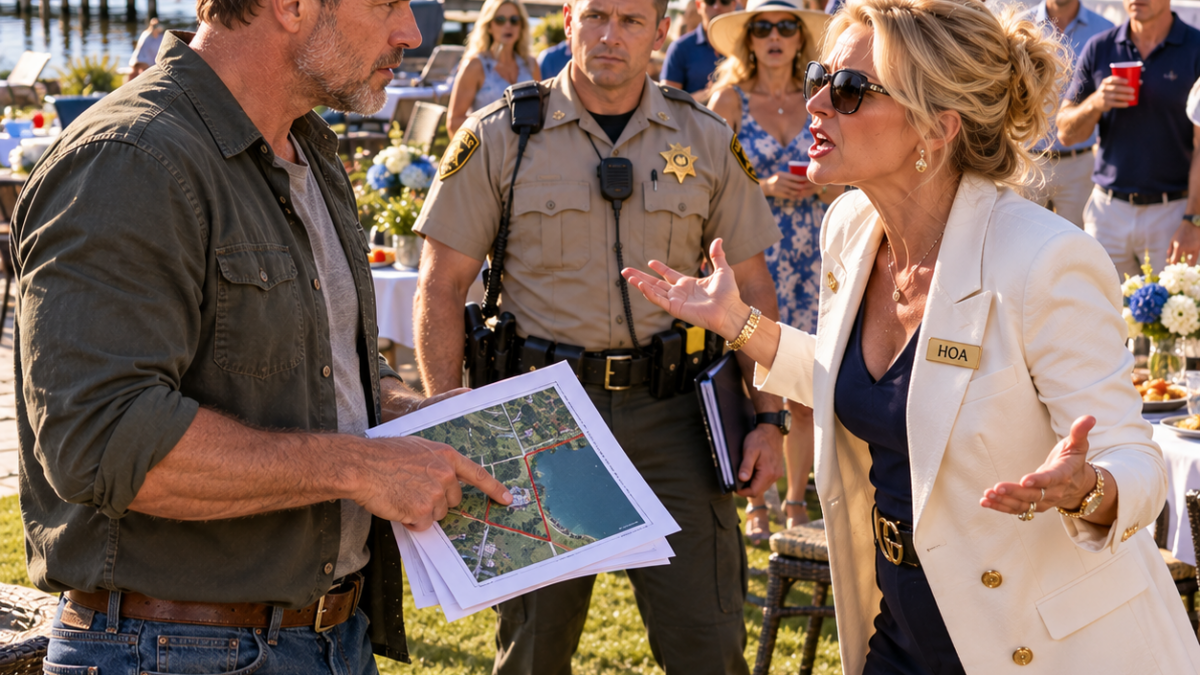
About eighteen minutes later, a white county vehicle came down my driveway.
No siren.
No dramatic lights.
Daniel parked near my truck.
Uniform.
Badge.
Body camera.
Clipboard.
The crowd went quiet in waves.
People nearest the driveway stopped first.
Then others noticed.
By the time Daniel reached the lawn, only the music was still playing.
The caterer shut that off.
Melissa walked forward.
“Officer.”
Daniel said:
“Marshal Reese.”
She smiled.
“Melissa Hawthorne.”
“President of Cedar Point HOA.”
“I understand there is a property-access disagreement.”
“That is one way to describe it.”
Melissa gestured toward me.
“Mr. Barrett is disrupting an authorized community event.”
Daniel looked at me.
“Michael?”
“My property.”
“No permission given.”
“I have deed and survey copies.”
Daniel nodded.
Then he asked the question that changed the whole afternoon.
“Who specifically authorized the HOA to use this parcel?”
Melissa opened her mouth.
Nothing came out.
He waited.
She said:
“The board.”
Daniel shook his head once.
“I understand the board approved the event.”
“I’m asking who gave the board legal permission to use this land.”
“The HOA has always considered this shoreline—”
“I’m asking about legal authorization.”
She glanced at the guests.
Then at me.
Then:
“Our development maps show the waterfront as community recreation.”
Daniel said:
“Do you have a recorded deed, easement, license, lease, or written permission from the owner?”
Melissa’s face changed.
Just slightly.
But everybody saw it.
“No.”
Then quickly:
“Because we’ve never needed one.”
Daniel nodded.
“Okay.”
He turned to me.
“Show me what you’ve got.”
I opened the deed first.
He did not simply take my word for it.
Good.
He read the legal description.
Looked at the plat reference.
Then the survey.
He used his tablet to pull county parcel information.
He asked:
“Surveyor?”
I gave the company name.
“Licensed?”
“Yes.”
He looked at the dates.
Then walked toward the drainage swale north of the lawn.
Back to the survey.
Then toward my dock.
He was not conducting a boundary adjudication.
He said that clearly.
“This office does not decide disputed title in the field.”
“If there is a genuine competing ownership claim, that belongs in the appropriate civil process.”
Then he looked at Melissa.
“But based on the recorded parcel information available to me right now, I see no document showing Cedar Point owns this lawn or has an event easement over it.”
She crossed her arms.
“Our attorney disagrees.”
“Then your attorney can provide the recorded instrument.”
“He will.”
“Until then, the person with the apparent recorded title is asking your event to leave.”
Her face flushed.
Daniel continued calmly.
“No one is being arrested.”
“No one needs to argue.”
“Pack the event.”
“Remove the vehicles.”
“Do not damage the property.”
“If Cedar Point believes it has a legal right to use the land, have counsel address that through the civil process.”
A man near the drinks table asked:
“So this isn’t HOA land?”
Daniel looked at him.
“I’m not giving you a final title opinion.”
“What I am saying is that the documents I’ve reviewed do not show this event location as association property.”
That was enough.
The crowd changed immediately.
Not dramatically.
Nobody booed Melissa.
People simply began creating distance from her certainty.
One family gathered bags.
Then another.
A woman whispered to her husband:
“I told you this looked like someone’s house.”
The bartender started packing bottles.
The caterer folded serving trays.
Someone removed the balloons from the dock.
Melissa stood beside the water.
She looked furious.
Not because people were leaving.
Because she no longer controlled the explanation.
She walked toward Daniel.
“This is going to cost the HOA thousands.”
He said:
“Then I recommend preserving your contracts and discussing the issue with counsel.”
“This man is deliberately humiliating me.”
I actually laughed.
Could not help it.
She spun toward me.
“You think this is funny?”
“No.”
“I think standing on my private lawn and accusing me of embarrassing you is unusual.”
She pointed toward the party.
“These people were invited.”
“By you.”
“Because this shoreline has always been understood as community access.”
I said:
“By whom?”
“Everyone.”
“My uncle?”
No answer.
“He owned this before your subdivision existed.”
“Did he sign anything?”
She looked away.
I continued.
“Did I?”
“No answer.
Daniel stepped between us conversationally, not physically.
“That’s enough.”
“Everybody understands the immediate instruction.”
“Let’s keep this orderly.”
Within twenty minutes, half the guests were gone.
Within forty, the tables were disappearing.
The caterer photographed the lawn before removing equipment.
Again:
Smart.
I did the same.
The HOA had placed metal stakes for temporary decorations.
One had damaged an irrigation line.
A delivery van left tire ruts beside the driveway.
Two planters near my dock had been moved.
Nothing catastrophic.
But I documented it.
The final guest vehicle left at 6:42 p.m.
Melissa remained.
So did Daniel.
She stood beside her Escalade.
“I want it noted that I object to this.”
Daniel said:
“Noted.”
“I believe Cedar Point has rights here.”
“Then have counsel document them.”
“You’ll hear from him Monday.”
“That’s fine.”
She looked at me.
“You could have handled this privately.”
I stared at her.
“You held a party at my house.”
She got in the Escalade.
Left.
Daniel stayed another ten minutes.
“You okay?”
“Yes.”
“You want a formal incident number?”
“Yes.”
“Probably smart.”
He took basic information.
Then:
“Get an updated survey.”
“I plan to.”
“And don’t assume today settled title forever.”
“I know.”
“If their attorney sends anything, send it to yours.”
“I will.”
Then he smiled.
“Nice view.”
I looked across the lake.
“Usually quieter.”
He laughed.
After he left, I walked down to the dock.
The sun was low.
Water darkening.
A few paper napkins had blown into the shrubs.
I picked them up.
Then sat at the edge.
For the first time all afternoon, I could hear water hitting wood.
Small sound.
Regular.
That was why I’d bought the place.
Not to make a point.
Not to fight an HOA.
Quiet.
My wife, Ellen, had loved that dock.
She died six years earlier after a stroke.
Fast.
No warning.
One morning she was drinking coffee beside me.
The next afternoon I was sitting alone in a hospital family room listening to a neurologist explain words I did not want to understand.
For months afterward, the lake became the only place where silence didn’t feel empty.
At home in Atlanta, silence was absence.
At the cabin, silence had wind.
Birds.
Water.
Insects.
Rain.
Things still happening.
Eventually I sold the city house and moved to the lake permanently.
That is why the party bothered me beyond trespass.
Melissa saw lawn.
View.
Dock.
Event space.
I saw the place where I’d learned how to be alone without feeling abandoned.
She didn’t know that.
She didn’t need to.
Property rights don’t depend on a sufficiently tragic backstory.
Even if my lawn meant nothing more to me than grass, she still needed permission.
That night, I reviewed every document.
Not because I doubted the deed.
Because confidence is not proof.
Melissa had made herself certain.
I didn’t want to make the same mistake in reverse.
I pulled:
Recorded warranty deed.
Title insurance policy.
Original closing survey.
County tax map.
Uncle Robert’s prior deed.
Subdivision plat for Cedar Point.
Development declaration.
Recorded amendments I could locate.
Everything.
The record said exactly what I’d always believed.
My southern and eastern boundaries met the water independently of Cedar Point.
The association’s common area ended well north.
No shared-waterfront easement.
No party license.
No recreational-use grant.
Nothing.
Then I noticed something I’d forgotten.
A twenty-foot utility easement crossed one corner of my parcel.
That was legitimate.
Power company access.
Nothing to do with the HOA.
Important distinction.
Property ownership is rarely “nobody can ever enter.”
Rights can overlap.
Utility easements.
Access easements.
Drainage rights.
Government rights-of-way.
The question isn’t:
Is this mine?
The better question is:
Who has which rights here?
Cedar Point had none that allowed Saturday parties.
Monday morning, I called a licensed surveyor.
Not the man who had done my original closing survey.
A different firm.
Independent confirmation.
Carson Land & Survey sent two men Tuesday.
GPS equipment.
Total station.
Recorded monuments.
Subdivision plat.
My deed.
They spent most of the day.
Wednesday afternoon, their preliminary result came.
No ambiguity.
The nearest HOA common-area boundary was more than sixty feet from where Melissa had placed the buffet.
My dock and lawn were entirely inside my parcel.
The surveyor asked:
“Why are we confirming this?”
“HOA held a party here.”
He looked at me.
“Without asking?”
“Yes.”
He stared toward Cedar Point.
Then:
“Well.”
“That’s new.”
The final signed survey arrived Friday.
I sent it to my attorney, Rachel Morgan.
Rachel had handled commercial property matters for my company for years.
She called.
“I’ve reviewed everything.”
“And?”
“Based on what you’ve provided, I don’t see Cedar Point’s right to use the lawn.”
“Good.”
“Don’t sound too happy.”
“Why?”
“Because they’ve sent me a letter.”
Of course.
The HOA attorney argued that the waterfront had been “historically represented” as an amenity benefiting Cedar Point residents.
Rachel said:
“Represented by whom?”
The letter cited:
Marketing materials.
Community maps.
Informal past usage.
No recorded easement.
No signed license.
No deed interest.
No adverse-possession claim asserted with supporting facts.
Nothing that converted marketing into ownership.
Rachel responded professionally.
Not angrily.
She included:
Deed.
Survey.
Subdivision plat.
Demand that Cedar Point cease unauthorized entry.
Demand that all future communications concerning claimed property rights go through counsel.
Request for reimbursement of:
Irrigation repair.
Lawn restoration.
Survey costs.
Attorney fees where legally supportable or as part of negotiated resolution.
She also asked for copies of every document the HOA relied on.
Melissa arrived at my house Saturday morning.
Alone.
No board members.
No wineglass.
Jeans.
Sweater.
She stayed outside the gate.
That was new too.
I walked down.
“Morning.”
“Michael.”
She looked uncomfortable.
“I’d like to talk.”
“I have counsel now.”
“I know.”
“This isn’t legal.”
“That is usually what people say before discussing something legal.”
She almost smiled.
Then didn’t.
She held a folder.
“Our attorney reviewed your survey.”
“Okay.”
“It appears the board may have been relying on an outdated conceptual development map.”
There are apologies.
Then there are sentences designed to approach apologies without touching them.
I waited.
She continued.
“The shoreline was shown as shared recreation.”
“On a sales brochure.”
“On several planning documents.”
“Were they recorded against my property?”
“No.”
“Did my uncle sign them?”
“Not that we’ve found.”
“Did I?”
“No.”
“So the board had no authorization.”
She looked toward the lake.
“We misunderstood.”
That was the first useful sentence.
I said:
“Mistakes happen.”
Her face relaxed slightly.
Then I continued:
“Hosting fifty people on somebody’s land after that person has repeatedly told you the land is private is more than one mistaken map.”
Her face tightened again.
“I believed the HOA had rights.”
“You never verified them.”
“Our management company—”
“Melissa.”
She stopped.
“You’re president.”
“You signed the event contract.”
“You sent violation letters about my property for months.”
“You knew I disputed your authority.”
“Yet you scheduled a party here while you believed I was out of town.”
That last part landed.
Her eyes shifted.
I asked:
“How did you know I was supposed to be in Savannah?”
She hesitated.
Then:
“You mentioned a conference.”
“To whom?”
She didn’t answer.
Later I learned I’d mentioned it casually to Gerald Owens, a Cedar Point resident who occasionally fished with me.
Gerald told his wife.
His wife served on the social committee.
No conspiracy.
Neighborhood information travels faster than weather.
Still, Melissa had clearly planned the event expecting me to be gone.
That made the “misunderstanding” harder to accept.
She said:
“I wasn’t trying to invade your privacy.”
“You put a bartender beside my porch.”
“I thought the property issue had been resolved.”
“Without telling me?”
Silence.
I looked at the folder.
“What do you want?”
“The board wants to settle this.”
“Then have Rachel send terms.”
“Can we do this like neighbors?”
I thought about that.
Then:
“Neighbors ask before using each other’s yards.”
She nodded.
For once.
Actually nodded.
“We did this wrong.”
There it was.
Not quite an apology.
Close enough to start.
I said:
“I don’t want a war.”
“Neither do we.”
“I am not joining Cedar Point.”
“We understand.”
“No HOA signs on my property.”
“Understood.”
“No events.”
“Yes.”
“No landscaping.”
“Yes.”
“No one using the dock unless I invite them.”
“Yes.”
“And I want the boundary marked clearly enough that the next board doesn’t start this again.”
She looked at me.
“What are you proposing?”
“Recorded boundary acknowledgment.”
“Survey markers.”
“Maybe discreet fencing near the northern transition.”
“Not a prison wall.”
“A boundary.”
She nodded.
“I think the board will agree.”
“Good.”
Then she said:
“Some residents are angry at you.”
I almost laughed.
“For what?”
“For ending the party.”
“That wasn’t my party.”
“I know.”
“But people lost catering money.”
“The association chose the location.”
“I know.”
“Then they’re angry at the wrong person.”
She looked tired.
“I’m beginning to understand that.”
Melissa left.
The formal settlement took longer.
Three months.
That surprised residents who expected the marshal visit to settle everything permanently.
It hadn’t.
Daniel had preserved peace and responded to the immediate complaint.
He did not issue a judicial declaration of title.
The legal resolution came through records, survey work, counsel, and agreement.
Cedar Point ultimately signed a recorded boundary acknowledgment.
The association disclaimed any ownership or recreational easement over my shoreline, lawn, dock, cabin area, or private driveway except for any separately recorded utility rights held by actual utility providers.
They reimbursed documented property damage.
Paid the survey cost.
Covered part of my legal expense as negotiated.
The amount wasn’t dramatic.
A few thousand dollars.
Enough.
I did not sue for emotional distress.
Did not demand six figures because people drank wine on my lawn.
I wanted clarity.
I got it.
The HOA also changed its event-approval process.
Before booking any location not clearly titled as association common property, management had to confirm ownership and written permission.
Again:
A rule that should not need writing.
Apparently it did.
Gerald came over after everything settled.
He carried a six-pack.
“Peace offering.”
“For what?”
“My wife told Melissa you’d be gone.”
I laughed.
“So you’re the intelligence leak.”
“Apparently.”
“Did you know they were planning the party here?”
“No.”
“She said lake social.”
“I assumed clubhouse lawn.”
He looked embarrassed.
“I was at the party.”
“I saw you.”
“Why didn’t you say hello?”
“You were hiding behind the caterer.”
He laughed.
Then:
“I thought you were being an asshole when you arrived.”
“I know.”
“Melissa told us the land belonged to the HOA.”
“I know.”
“I should’ve asked.”
“Probably.”
He handed me a beer.
“Can I use your dock?”
I stared at him.
He grinned.
“Worth a try.”
I let him fish.
Because he asked.
That became the running joke.
People from Cedar Point started asking.
Not all.
A few.
Gerald.
A retired couple named Sam and Ruth who lived near the south trail.
One family whose daughter loved fishing.
If I wanted company, I said yes.
If I didn’t, I said no.
Nobody died from hearing no.
Amazing.
Melissa remained president for another year.
I expected homeowners to remove her.
They didn’t.
Not immediately.
The party embarrassed her, but most residents considered it a major mistake rather than evidence she should be exiled from civilization.
Fair.
She became more cautious.
Less theatrical.
The violation letters stopped.
A few months after settlement, she called.
“Michael.”
“Yes?”
“We’re planning a Fourth of July event.”
I waited.
“At the clubhouse.”
“Congratulations.”
She sighed.
“I’m calling because the fireworks vendor says the best viewing angle is your shoreline.”
“No.”
“I hadn’t asked yet.”
“Sorry.”
She laughed.
“May residents stand on the HOA trail north of your line?”
“Yes.”
“Can we temporarily place one safety marker near the drainage swale?”
“Where?”
She emailed a map.
The marker stayed on HOA land.
“Fine.”
“Thank you.”
“No problem.”
The Fourth of July came.
I watched fireworks from my dock.
Cedar Point residents watched from their side.
Music across the water.
Kids cheering.
No conflict.
That’s what boundaries are supposed to do.
Not separate enemies.
Clarify permission.
The strange thing was that my relationship with Cedar Point improved after I stopped fighting about whether I belonged to it.
For months Melissa had treated my property as unfinished HOA business.
Once the recorded acknowledgment made the separation undeniable, people relaxed.
They stopped seeing me as the holdout.
I stopped seeing them as a collective nuisance.
Most homeowners had never read the declaration.
Why would they?
They paid dues.
Mowed lawns.
Raised children.
Went to work.
They assumed the board knew what it controlled.
That assumption turned out to be wrong once.
It didn’t make seventy-three families villains.
That distinction mattered to me.
It would’ve been easy to build the story differently.
HOA INVADES MY LAND.
ENTIRE NEIGHBORHOOD GETS WHAT IT DESERVES.
No.
Melissa made the decision.
The social committee followed her.
Residents relied on what they were told.
Some were rude after I objected.
A few apologized later.
That’s human.
If I made every Cedar Point household responsible for Melissa’s mistake, I’d be doing my own version of what she had done to me.
Treating a boundary as meaningless because it inconvenienced my preferred story.
I didn’t want that.
A year later, Cedar Point elected a new president.
Melissa chose not to run again.
The new president was Sam Whitaker.
Retired high-school principal.
Seventy-one.
He came down my driveway the first week after taking office.
Stopped at the marker.
Called my phone.
“Michael?”
“Yes.”
“I’m at your boundary.”
“I can see you.”
“May I come down?”
That made me smile.
“Yes.”
He walked to the porch carrying a binder.
“I want to make sure I understand the agreement.”
We reviewed it.
Not because I distrusted him.
Because clarity is easiest before conflict.
Sam pointed at the survey.
“So this drainage swale is ours.”
“Mostly.”
“The line angles west here.”
“Right.”
“And the trail stops there.”
“Yes.”
“No shoreline use.”
“Correct.”
“Dock obviously yours.”
“Yes.”
He closed the binder.
“Seems simple.”
“It always was.”
He laughed.
Then:
“Melissa said you were difficult.”
“I am.”
“Good.”
“Easy people get volunteered for things.”
I liked Sam.
Under him, the relationship became boring.
Best possible outcome.
Then another issue came.
A storm damaged several trees near the shared northern boundary.
One tree leaned from my side toward the HOA walking trail.
Sam called.
“Arborist says it could fall.”
I had my own arborist inspect.
Agreed.
We removed it.
Split the cost because the tree was mine but the trail closure and cleanup benefited both sides.
Written agreement.
Licensed contractor.
No drama.
That is how neighbors solve things.
I started wondering whether the party dispute had been necessary to teach everyone that.
Probably not.
But it happened.
So we learned from it.
One afternoon, I found Melissa walking the public road near the entrance.
She had sold her Cedar Point house months earlier but was visiting friends.
We stopped.
Awkward.
Then she said:
“I owe you a real apology.”
I hadn’t expected that.
“For the party?”
“For more than the party.”
She looked toward the lake through the trees.
“I thought your property should’ve been part of Cedar Point.”
“Because it made the map cleaner.”
“At first.”
“Then because you kept saying no.”
That was surprisingly honest.
She continued.
“Every time you refused something, I started treating the refusal as a challenge.”
“I told myself I was protecting community interests.”
“But really…”
She paused.
“I didn’t like having something inside the neighborhood view that I couldn’t control.”
There it was.
Not greed.
Not criminal conspiracy.
Control.
Often much more ordinary.
I said:
“I appreciate you saying that.”
“I shouldn’t have used your lawn.”
“No.”
“I shouldn’t have threatened HOA enforcement against you.”
“No.”
“I shouldn’t have assumed that because everyone believed something, it was legally true.”
“That one caused most of the trouble.”
She smiled weakly.
Then:
“The party was beautiful, though.”
I stared.
She laughed.
“I’m kidding.”
“Mostly.”
“There she is.”
She smiled.
We parted.
Not friends.
Not enemies.
Finished.
That felt healthier than lifelong war.
Years went by.
I retired.
The consulting company I’d worked for merged with a larger firm, and I decided sixty-four was enough.
The cabin became home full time in every sense.
Mornings on the dock.
Coffee.
Fishing badly.
Repairing things that didn’t need repairing because retirement makes men invent maintenance.
Gerald and I became actual friends.
He died five years later from a heart attack.
Ruth’s husband Sam died after him.
The neighborhood changed.
Children grew.
New owners moved in who knew nothing about Melissa’s party.
Good.
I did not become the old man who greeted every newcomer with:
“Let me tell you what your HOA once did.”
Nobody wants that neighbor.
The recorded boundary did its job without me narrating it.
One new family bought the nearest Cedar Point house.
The husband, Aaron, walked toward my dock during their first week.
I was sitting there.
He stopped when he saw the boundary marker.
“Is this private?”
“Yes.”
“Sorry.”
He stepped back immediately.
“No problem.”
Then:
“Fish biting?”
“No.”
“Ever?”
“Also no.”
He laughed.
I invited him down.
Permission.
The easiest legal instrument in the world when everyone respects it.
A few weeks later, his daughter, Lily, asked whether she could kayak from my shoreline because the HOA launch was muddy after heavy rain.
“Ask your dad.”
“He said ask you.”
“Then yes.”
She launched.
Returned.
Put the kayak exactly where she’d found it.
No board meeting required.
No deed dispute.
No county marshal.
This is the part people sometimes misunderstand when they hear property-rights stories.
The goal isn’t exclusion.
My lawn being mine does not mean nobody can ever stand on it.
It means I decide.
That is ownership.
Not permanent isolation.
Choice.
I can host fifty people tomorrow if I want.
I can invite Cedar Point.
I can invite no one.
I can let Gerald fish.
Tell somebody else no.
Lease the land.
Sell the land.
Donate an easement.
Keep it private.
Ownership is not a moral claim that my wishes are always wise.
It’s the legal starting point that my consent matters where the law gives me that right.
Melissa tried to skip that.
The marshal didn’t give me my property back.
The deed already did that.
He simply refused to pretend her title as HOA president meant more than the records.
That distinction matters.
Daniel retired a few years after the incident.
At his retirement dinner, I reminded him about the party.
He laughed.
“I remember.”
“You were very dramatic.”
“I asked one question.”
“Exactly.”
“What question?”
He stared.
“You’ve told this story too many times.”
Probably.
Then he said:
“People think uniforms resolve disputes.”
“They don’t.”
“Documents do half the work.”
“Calm does the rest.”
“That sounds like something you practiced.”
“I had twenty-nine years.”
Fair.
He asked:
“Did the HOA ever bother you again?”
“No.”
“Then it worked.”
“Yes.”
But what worked?
Not fear.
Not humiliation.
Not even enforcement.
Verification.
That was the turning point.
Melissa had an assumption.
I had an assumption.
The marshal checked available records.
Then the surveyor checked professionally.
Then lawyers documented it.
Facts survived each layer.
That’s what gave them weight.
If my survey had shown Cedar Point actually held an easement?
I would have had to accept that too.
Property rights cut both ways.
You don’t get to love records only when they support you.
That lesson became more important later.
Eight years after the party, the county proposed a drainage-improvement project along the north side of my property.
The preliminary plan required a temporary construction easement.
Ten feet.
Six months.
My first reaction was:
No.
Then I read the engineering.
Flooding had worsened.
Cedar Point’s lower trail washed out twice.
Part of my driveway also flooded.
The project made sense.
County offered compensation.
Restoration.
Insurance.
Defined dates.
Surveyed limits.
I signed.
Why?
Because someone asked through the proper process.
Because the right was specific.
Temporary.
Documented.
Compensated.
Not:
We think this would be convenient, therefore it’s ours.
That’s the difference.
During construction, one excavator crossed outside the permitted strip.
I called the project manager.
He came out.
Compared stakes.
Apologized.
Repaired the rut.
Done.
No war.
I thought of Melissa.
A tiny mistake corrected immediately feels very different from a person refusing to admit a line exists.
The cabin aged.
So did I.
I replaced the roof.
Then the dock decking.
Kept the original pilings where possible.
Ellen’s favorite chair stayed on the porch until the fabric finally disintegrated.
I replaced it with another chair.
For weeks, I felt guilty.
Then realized grief can make furniture carry responsibilities nobody asked it to carry.
Ellen would have told me to throw the old thing away three years earlier.
I kept one piece of the fabric.
Enough.
The lake remained the lake.
Storms.
Sunrise.
Fog.
Jet skis on summer weekends.
Geese making a mess.
Peace isn’t silence every second.
It’s knowing what belongs in your life and what doesn’t.
The unauthorized party didn’t belong.
Neighbors I chose to invite did.
That’s why I never built the giant privacy fence everybody expected after the dispute.
Rachel, my attorney, suggested I consider more visible markers.
We installed discreet stone posts at key corners.
Small PRIVATE PROPERTY signs near the driveway and shoreline transition.
Enough.
Not a fortress.
I wanted the boundary obvious.
Not hostile.
The signs stayed.
One disappeared during a storm.
Aaron’s daughter found it floating near the reeds and brought it back.
“I think this is yours.”
“It is.”
She grinned.
“See?”
“Boundaries respected.”
She rolled her eyes.
Teenager by then.
Good.
Cedar Point eventually added its own lakeside pavilion.
On property it actually owned.
Very nice.
Covered deck.
Restrooms.
Grills.
Kayak rack.
I attended the opening.
Sam insisted.
I stood beside the new HOA president, a woman named Denise Carter.
She said:
“Look.”
“We built our own party location.”
I laughed.
“Revolutionary.”
She handed me a beer.
“Melissa would hate this joke.”
“Probably.”
The pavilion became popular.
Residents stopped caring about my lawn.
Exactly as they should.
Sometimes conflict persists only because everyone acts as if one specific outcome is indispensable.
Cedar Point thought it needed my view.
Turns out it needed a place to gather.
Different problem.
Different solution.
The association already owned another shoreline parcel.
They simply hadn’t developed it.
Because my lawn was prettier.
Convenience had masqueraded as necessity.
That happens constantly.
“We need access.”
No.
You prefer this access.
“We need your land.”
Maybe you prefer the cheapest alignment.
“We need to use your dock.”
No.
You want the best view.
Once people separate need from preference, negotiation becomes easier.
The pavilion taught Cedar Point that.
It also taught me something.
I had been so focused on keeping them off my property that I never asked whether there was a way to help them solve the real problem.
At the time, probably too angry.
Fair.
Later, I donated an old picnic table to the pavilion.
Gerald would’ve laughed.
He used to tell me:
“One day you’ll join the HOA.”
Never did.
But being outside an organization doesn’t require opposing everything it does.
I paid my taxes.
They paid dues.
I maintained my driveway.
They maintained theirs.
We shared weather.
Lake.
Road.
Occasional beer.
Enough community for me.
There was one detail from the party afternoon I didn’t learn until years later.
The catering company had almost refused the job.
Their manager, Luis Ortega, found the address strange because it didn’t match the HOA clubhouse.
He emailed Melissa:
“Please confirm property owner has authorized event.”
She replied:
“Board approval confirmed.”
Not:
Owner approval confirmed.
Board approval.
Luis noticed the distinction but assumed she knew what she was doing.
He showed me the email later when we met accidentally at another event.
“I should’ve asked again.”
I said:
“You asked the right question.”
“I accepted the wrong answer.”
He nodded.
Then:
“I changed our contract after that.”
Now every off-site private event required the customer to certify they had legal authority to use the venue.
One sentence.
One checkbox.
Small change.
That’s often how institutions learn.
Not giant transformation.
One better question on a form.
Cedar Point added one too.
EVENT LOCATION OWNERSHIP VERIFIED?
A future board member once showed it to me.
“I think you’re responsible for this.”
“Sorry.”
“It’s actually useful.”
“Then I’m less sorry.”
The party became folklore.
New residents sometimes heard exaggerated versions.
One claimed Melissa tried to have me arrested.
She didn’t.
She threatened HOA enforcement before the party and argued with me that day, but Daniel didn’t arrest anyone.
Another version said twenty deputies surrounded the lake.
No.
One marshal.
White county SUV.
No siren.
Another said I secretly owned half the subdivision.
Definitely not.
Stories hate moderation.
Reality usually has more paperwork and fewer helicopters.
The truth was enough.
A board president assumed control over land the association didn’t own.
She hosted an event there.
I objected.
A county official helped keep the situation peaceful and reviewed available records without pretending to be a judge.
A licensed survey confirmed the boundary.
Lawyers documented a permanent resolution.
Then everybody moved on.
Less cinematic.
Much healthier.
If I’m honest, I didn’t handle every moment perfectly.
When Melissa arrived alone after the survey, part of me wanted to make her beg.
I imagined telling her:
Not interested.
Talk to my lawyer.
Never come back.
Some of that would have been justified.
But my actual goal was not humiliation.
It was:
No more unauthorized use.
Clear boundary.
Restoration.
Peace.
If you confuse the emotional goal with the practical goal, disputes become permanent.
I had to ask myself:
What would success look like six months from now?
Not:
Melissa embarrassed.
Success was:
Quiet dock.
No HOA letters.
No strangers.
Recorded clarity.
I got that.
Everything beyond it would’ve been revenge.
Revenge is expensive maintenance.
I didn’t want another job.
Retirement already gave me too many chores.
The most satisfying moment wasn’t watching the party leave.
Not even close.
It came three years later.
Saturday morning.
I was drinking coffee.
Heard voices near the north boundary.
Looked up.
A Cedar Point family had stopped beside one of the stone markers.
The father checked his phone.
Then told the children:
“This side is private.”
They turned around.
Didn’t know I was watching.
No confrontation.
No marshal.
No president.
No argument.
The system worked without me.
That’s success.
A good boundary shouldn’t require constant defense.
It should become boring.
My lakefront became boring again.
Thank God.
Ellen’s anniversary came every October.
For years I spent it alone on the dock.
Then, one year, Aaron saw me sitting there.
He stood at the top of the lawn.
Didn’t come down.
Called:
“You want company?”
I thought.
Then:
“Yeah.”
He brought two beers.
We sat.
He didn’t ask why I was quiet.
Good neighbor.
Permission goes both ways.
You ask before entering someone’s space.
You also give them room to say yes.
I told him about Ellen eventually.
He listened.
Then:
“She’d like this place.”
“She did.”
“That why you fought so hard?”
I looked at the water.
“Partly.”
Then corrected myself.
“But I shouldn’t need that reason.”
He nodded.
“Fair.”
That was always the larger point.
Property law cannot depend on who has the saddest story.
My grief made the invasion feel worse.
It did not create the boundary.
The deed did.
The survey did.
The law did.
Even if I had bought the cabin purely as an investment and never loved it at all, the HOA still needed permission.
Rights matter most when they don’t require sympathy.
I wish more people understood that.
Decades of neighborhood disputes get turned into morality plays.
Good owner.
Evil HOA.
Sometimes.
Other times:
Bad document.
Wrong assumption.
Overconfident volunteer board.
Management-company mistake.
Old easement.
Unclear survey.
Conflicting plats.
That’s why checking matters.
My case happened to be clear.
Not all are.
If the records had genuinely conflicted, the correct response would not have been:
Marshal picks a winner.
It would’ve been:
Stop escalation.
Preserve status quo where possible.
Survey.
Title research.
Lawyers.
Court if necessary.
Slow.
Annoying.
Civilized.
Daniel’s greatest contribution that day was refusing to become what Melissa wanted him to be.
She wanted authority to validate her.
I wanted authority to validate me.
He did neither.
He asked for documents.
That’s why I trusted him.
“Who authorized this event?”
Simple question.
Board?
Fine.
Who authorized the board?
Nothing.
That was the crack.
Authority must come from somewhere.
A deed.
An easement.
A contract.
A statute.
Consent.
You can’t simply point upward forever.
“The board said.”
Who gave the board the right?
“Our map says.”
What legal instrument supports the map?
“Everyone knows.”
Where is it recorded?
Eventually confidence has to touch evidence.
Melissa’s never did.
Mine did.
That ended it.
The cabin is still mine today.
I’m seventy now.
Slower getting down the dock steps.
Fishing still terrible.
Aaron’s daughter Lily is in college.
Gerald’s widow moved closer to her children.
Sam’s Cedar Point house sold to a young couple with twins.
Melissa lives in North Carolina now, according to someone who still keeps in touch.
Good for her.
I hope she’s happy.
That surprises people when I tell them.
Why would I want her miserable?
Her misery doesn’t protect my boundary.
The recorded agreement does.
I don’t need permanent punishment to prove I was right.
I needed the behavior to stop.
It did.
The lake doesn’t remember any of it.
That’s my favorite part.
Water keeps moving.
Storms erase footprints.
Grass grows through tire ruts.
The oak where the event sign stood got struck by lightning two summers ago.
Half came down.
I kept the trunk as a bench.
Now I sit there sometimes.
Same spot where Melissa announced the party was board-approved.
No marker.
No plaque.
No:
SITE OF THE GREAT HOA DEFEAT.
That would be ridiculous.
Places shouldn’t belong forever to their worst afternoon.
My lawn belongs to ordinary life again.
Coffee.
Grandchildren visiting.
Neighbors I invite.
A dog named Henry who belongs to Aaron but considers my property part of his personal jurisdiction.
I let that violation slide.
Selective enforcement.
One evening last spring, Cedar Point held another summer social.
At their pavilion.
Music carried across the lake.
I could hear laughter from my dock.
For a second, I remembered that afternoon years ago.
White tables.
Wine.
Melissa.
Daniel’s question.
Then fireworks went up.
Nothing extravagant.
Gold light reflected on the water.
I sat alone.
Not lonely.
That’s different.
Ellen taught me that after she died, though it took years to understand.
The quiet I had fought for was not the absence of other people.
It was the presence of choice.
People could be nearby.
Music across the lake.
Kids laughing.
Neighbors fishing.
None of that threatened me.
The thing I had resisted was someone deciding for me when my private space became public.
That’s what Melissa took that afternoon.
Choice.
Only for a few hours.
Still.
When the final SUV left my driveway at sunset, I felt something return that had nothing to do with grass or property records.
Control over my own home.
That was why I followed through.
Not to prove I knew more than the HOA.
Not to embarrass Melissa.
Not to become the neighborhood man everybody feared.
I wanted one rule understood.
If you don’t own it, ask.
If the answer is no, respect it.
If you believe you already have a legal right, prove the right before acting like consent is optional.
That’s it.
A rule simple enough for children.
Apparently difficult enough for adults to hire lawyers over.
Today the survey markers are still there.
Small.
Gray.
Almost invisible unless you know where to look.
That’s appropriate.
Boundaries don’t need to scream when everybody agrees where they are.
Sometimes I walk past one and remember Melissa standing on my lawn saying:
“The board approved it.”
Back then, the sentence infuriated me.
Now it almost makes me smile.
The board could approve fifty parties.
A hundred.
They could approve matching napkins and a brass band and a champagne fountain.
None of it mattered until someone with authority over the land said yes.
That person was me.
I had never said yes.
And after one marshal asked the question Melissa had somehow skipped through months of planning—
“Who authorized you to use this property?”
—the entire event collapsed under the simplest fact in the world.
Nobody had.
The next morning, the lawn was empty.
No tables.
No music.
No HOA signs.
Just dew on the grass and fog over the lake.
I made coffee.
Walked down the dock.
Sat where Ellen used to sit.
And listened to the water tap softly against the pilings.
The party was gone.
The argument was gone.
The lake was exactly where it had always been.
And finally, so was the boundary.








