The HOA Tore Out Our Only Bridge—Then the County Pulled Up My Property Survey.k
part2:
The announcement arrived by email.
Subject:
MAJOR INFRASTRUCTURE IMPROVEMENT — BRIDGE REPLACEMENT
I read it while standing at my kitchen counter.
According to Linda, the HOA board had approved a full removal and reconstruction project.
The old bridge was supposedly nearing the end of its useful service life.
New concrete.
New guardrails.
Improved drainage.
Wider pedestrian shoulder.
Updated load capacity.
On the surface, none of that sounded unreasonable.
I had crossed that bridge for years.
I knew the deck had cracks.
I knew winter salt had damaged sections near the joints.
I knew several residents had complained about standing water after storms.
A properly engineered replacement could be a good thing.
Then I reached one sentence.
The HOA retains full ownership and control over the bridge structure, approaches, abutments, and underlying property.
I read it twice.
Then a third time.
Underlying property.
That wasn’t right.
I walked into my home office and opened the old file cabinet where I kept real-estate documents.
Deed.
Recorded survey.
Title report.
Access agreement.
Aerial map.
Original purchase documents.
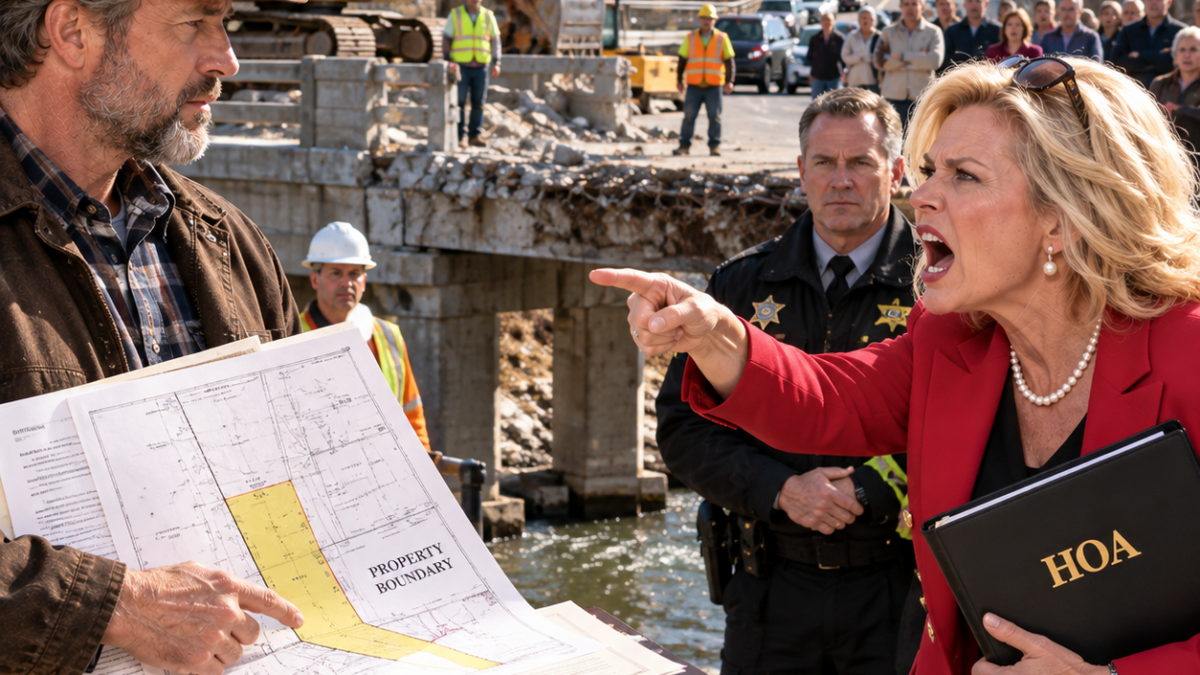
I spread everything across the dining-room table.
The paper survey was large enough that I had to move the fruit bowl.
I found my parcel line.
Followed it down the hillside.
Across the creek corridor.
Then directly beneath part of the bridge.
There it was.
Exactly where I remembered.
The community had a recorded right of access.
The HOA had maintenance responsibilities related to the shared road and crossing.
But my property had never been conveyed to the association.
No deed transfer.
No sale.
No dedication giving them fee ownership.
No document magically transforming the ground into HOA property because residents had driven over it for years.
I opened Linda’s bridge map on my laptop and placed it beside the survey.
The construction boundary extended across my parcel.
Staging area.
Excavation zone.
Abutment work.
Drainage modifications.
They weren’t merely resurfacing a road within an existing access right.
They planned to tear into land I owned.
I called the HOA management number.
Voicemail.
Then emailed Linda.
Before construction begins, please provide the recorded document establishing HOA ownership of the land beneath the western portion of the bridge. My deed and survey show that portion within my parcel. I support necessary bridge repairs, but ownership and construction authorization need to be clarified first.
I copied the property manager.
The board secretary.
And my attorney, Daniel Reeves.
Linda answered eleven minutes later.
Not the board.
Not management.
Linda.
Ethan, the board has already approved this project. Please do not interfere with contractors performing authorized HOA work.
I replied:
Board approval does not answer my question about property ownership.
Her response:
This bridge has served the neighborhood for decades. It is HOA infrastructure.
I stared at the screen.
Then wrote:
Infrastructure use and land ownership are separate issues. Please send the recorded ownership document.
No response.
I called Daniel.
He specialized in real estate and land-use work.
He was the kind of attorney who became excited by old surveys, which made him ideal for situations normal people would rather avoid.
I emailed everything.
Twenty minutes later, he called.
“Ethan.”
“Yeah?”
“Your survey is pretty clear.”
“I thought so.”
“Do you have the original access instrument?”
“In front of me.”
“Read the granting language.”
I did.
It granted a nonexclusive perpetual easement for ingress and egress across a defined strip, including roadway and bridge access.
Daniel asked:
“Anything about transferring title?”
“No.”
“Anything giving the association unilateral authority to expand beyond the easement for reconstruction?”
“Not that I see.”
“Maintenance language?”
“Yes.”
We went through it.
The association could maintain the shared access improvements.
But any substantial expansion or work outside the recorded corridor required coordination with the fee owner.
Me.
Daniel said:
“Do not block emergency maintenance.”
“I won’t.”
“But substantial demolition and reconstruction is another question.”
“Exactly.”
“You need to notify them formally tonight.”
We drafted a short notice.
Not hostile.
Not dramatic.
The title and survey showed that part of the planned work area lay on my property.
I did not oppose a safe bridge replacement.
I did object to demolition or excavation proceeding before ownership, easement scope, permits, and construction rights were confirmed.
Daniel sent it to the HOA’s registered office and management company.
I went to bed believing that would slow things down.
At 6:43 the next morning, I woke to diesel engines.
I looked out the window.
Two excavators.
Dump trucks.
A crane truck.
Traffic-control trailer.
Construction crew.
Already moving toward the bridge.
I threw on jeans, boots, and a jacket.
By the time I reached the crossing, workers were setting barricades.
Linda stood beside a black SUV wearing a white winter coat and holding a rolled set of plans.
She looked almost cheerful.
“Morning, Ethan.”
“What are they doing?”
“Starting.”
“I sent notice last night.”
“I saw it.”
“And?”
“The board has authorization.”
“From whom?”
“The HOA.”
“That still isn’t ownership.”
Her smile tightened.
“Ethan, this bridge serves the entire community.”
“I know.”
“Then stop creating problems.”
“I am trying to prevent one.”
A superintendent wearing a fluorescent vest approached.
“Sir, are you the adjacent owner?”
“I own part of the property under the bridge.”
He looked at Linda.
She said:
“He disputes the HOA’s records.”
“No.”
I looked at him.
“I have a recorded survey.”
The superintendent’s expression changed.
“Do you have a copy?”
“Yes.”
Linda cut in.
“You have a signed construction authorization from the association.”
He nodded slowly.
“Yes.”
“Then continue.”
I said:
“Your authorization is from a party that may not own part of the work area.”
The superintendent rubbed his jaw.
That was not a sentence contractors enjoy hearing after bringing heavy equipment to a site.
“Do you have an attorney?”
“Yes.”
“Has he contacted the association?”
“Yes.”
Linda said:
“This is delay tactics.”
I ignored her.
The superintendent asked:
“Are you telling me not to perform any work on your parcel?”
“I’m telling you ownership and the easement need to be verified before you excavate beyond whatever rights are already documented.”
He looked at the bridge.
Then at his plans.
Then at Linda.
“I need to call our office.”
Good.
That’s what a responsible contractor does.
Linda did not appreciate responsibility.
“This project was approved weeks ago.”
The superintendent said:
“Approval by the client doesn’t resolve a title dispute.”
“There is no title dispute.”
I held up the survey.
“There is now.”
Linda’s face reddened.
I didn’t enjoy saying it.
The neighborhood needed the bridge.
Every hour of delay could become a problem.
But tearing apart infrastructure on disputed property and figuring out authority afterward would be worse.
The superintendent stepped away to make calls.
I went home, scanned the survey at full resolution, and emailed it to his company.
I also sent it to the county public works department.
Then Daniel called.
“I just spoke to HOA counsel.”
“And?”
“They didn’t know about your ownership claim.”
I stopped.
“Linda didn’t tell them?”
“Apparently not before yesterday.”
“What did she tell them?”
“That the association owned and maintained the bridge.”
“Those aren’t the same thing.”
“I explained that.”
He sighed.
“They’re reviewing.”
Then I heard a low metallic crash outside.
I walked toward the window.
A section of guardrail was being lifted away.
“Daniel.”
“What?”
“They’re still working.”
“Call the superintendent.”
I did.
He answered.
“We’ve been directed to proceed with work clearly inside the existing maintenance footprint while ownership gets reviewed.”
“What does that mean?”
“Guardrail removal.”
“Deck saw cuts.”
“No excavation into disputed ground.”
That sounded narrower.
Still risky.
I went back to the site.
By noon, portions of the old deck had been cut.
One lane was gone.
Traffic had been stopped completely because the structural work made crossing unsafe.
Residents were being routed toward the secondary roads.
Linda kept saying the closure would be temporary.
Then the contractor uncovered more deterioration near one support.
The engineer on site stopped demolition.
That should have been the moment everyone paused.
Instead, Linda pushed.
“We’re already committed.”
The project manager said:
“We need revised sequencing.”
“How long?”
“Could be tomorrow.”
“We can’t leave the bridge like this.”
“We can’t reopen a partially demolished deck.”
That sentence changed everything.
By four that afternoon, the bridge was unusable.
Concrete had been removed.
Guardrails were down.
Equipment blocked the approaches.
The only practical route serving 993 households was gone.
Not permanently.
But gone enough.
At 5:20, I stood on the hillside above the crossing.
Cars were already turning around.
A school activity bus had to reverse nearly two hundred feet before finding space to turn.
Delivery vans sat confused at the barricades.
A woman rolled down her window.
“How long?”
The flagger shrugged.
“Don’t know.”
That was when the neighborhood understood this wasn’t an ordinary overnight repair.
The emergency text from the HOA came thirty minutes later.
BRIDGE CLOSED UNTIL FURTHER NOTICE. USE DESIGNATED ALTERNATE ROUTES.
By six, every neighborhood group was exploding.
Parents asking about school transportation.
Hospital workers asking about commute times.
One resident said the alternate route added thirty-seven minutes.
Another had a mother receiving home-health care.
Someone asked whether fire apparatus could reach the eastern section efficiently.
The fire department had already been notified and was adjusting response planning, but people didn’t know that yet.
Fear fills information gaps quickly.
I stayed off social media.
Daniel called.
“What happened?”
“They removed enough that it can’t reopen.”
He went silent.
Then:
“Emergency meeting?”
“Tomorrow.”
“You attending?”
“Yes.”
“Bring copies.”
“I planned to.”
“Don’t make it about stopping the bridge.”
“I don’t want to stop the bridge.”
“Good.”
“Make that clear immediately.”
I understood why.
By morning, I could easily become the man everyone blamed.
PROPERTY OWNER BLOCKS BRIDGE PROJECT
That’s a simpler story than:
HOA BEGAN DEMOLITION BEFORE CLARIFYING OWNERSHIP AND EASEMENT RIGHTS
Simple stories spread faster.
The next day, the entrance roads looked like evacuation routes.
Cars backed up at the secondary exit.
Residents who had never used the old county road were trying to follow GPS directions at the same time.
A delivery truck got stuck attempting a tight turn.
Parents left early.
School transportation adjusted pickup points.
The HOA clubhouse parking lot filled before the emergency meeting was scheduled to start.
I arrived carrying a document tube.
Linda was already at the front.
She had a microphone.
Of course she did.
Every chair was filled.
People stood along walls.
The board had set up a livestream for residents who couldn’t fit.
Linda began:
“First, I want everyone to understand that this temporary inconvenience is part of a necessary modernization project.”
Someone shouted:
“Temporary means how long?”
Another:
“My wife was forty minutes late to the hospital!”
“Why did you tear it out before having the new bridge ready?”
“Who approved this?”
Linda raised her hand.
“We are working closely with our contractor.”
That wasn’t answering anything.
A man in the front row stood.
“You said this would be phased.”
“It was intended to be.”
“What changed?”
“Unexpected site conditions.”
Partly true.
Then another resident shouted:
“I heard somebody claims the HOA doesn’t own the bridge.”
Every head turned.
Linda’s eyes found me.
There it was.
The story she didn’t want to discuss.
She said:
“There is a minor boundary question being reviewed.”
Minor.
I stood.
Didn’t take the microphone yet.
“Linda.”
She looked at me.
“Is that minor boundary question the land under the bridge?”
Murmuring.
She said:
“The association has long-standing access and maintenance rights.”
I nodded.
“I agree.”
That surprised her.
“And nobody here has heard me challenge the community’s access rights.”
More murmuring.
I continued:
“The question is ownership.”
She tightened her grip on the microphone.
“The HOA controls the bridge.”
“Then who owns the land beneath the western portion of it?”
Silence.
Not complete.
Somebody’s phone rang.
A chair scraped.
But the room changed.
Linda said:
“We have documentation.”
“Good.”
“So do I.”
I walked toward the projector.
“Let’s compare it.”
The board secretary looked at Linda.
Linda hesitated.
That hesitation did more damage to her position than anything I could have said.
Finally she nodded.
I connected my laptop.
The recorded survey filled the screen.
Parcel boundaries.
Creek.
Road corridor.
Bridge.
I zoomed.
A red digital line followed my property boundary directly through the western section of the crossing.
I said:
“This is the survey tied to my recorded deed.”
A resident asked:
“So you own the bridge?”
“No.”
Important distinction.
“I own land beneath part of the crossing.”
“The bridge structure and the access rights involve additional documents.”
“That’s why this needed to be reviewed before demolition.”
Another resident:
“Can you close the road?”
“I have not tried to close the road.”
“Will you?”
“No.”
The room quieted again.
“I live here too.”
“I use that bridge.”
“I have no interest in trapping 993 households.”
“What I want is a safe bridge rebuilt under proper authorization with everyone’s rights documented correctly.”
A woman near the back asked Linda:
“Did you know he owned that land?”
Linda said:
“We had conflicting information.”
I asked:
“What document shows HOA ownership?”
She opened a folder.
Pulled out the project map.
I said:
“That’s a construction map.”
“It shows the bridge within the community transportation system.”
“Yes.”
“That still doesn’t transfer title.”
A retired engineer in the audience spoke up.
“He’s right.”
Linda stared at him.
He continued:
“Operational control and fee ownership can be different.”
Another resident asked:
“Did the contractor see Ethan’s deed?”
Linda said:
“They received the board authorization.”
The room became louder.
A man shouted:
“That wasn’t the question.”
For the first time since I’d known Linda, she looked overwhelmed.
I didn’t enjoy it.
We still had no bridge.
Humiliating her would not move one pound of steel into place.
I raised my hand.
“Everybody.”
Eventually the room quieted.
“This can be verified.”
I pointed toward the survey.
“County records.”
“Let’s get the county involved tomorrow.”
“Get the engineer.”
“Get title records.”
“Get HOA counsel.”
“Get my attorney.”
“Then answer two separate questions.”
I held up one finger.
“Who owns what?”
Second finger.
“What access and maintenance rights already exist?”
That became the plan.
The next morning, we met at the county records office.
Not all 993 families.
Thank God.
Me.
Daniel.
Linda.
Two HOA board members.
The HOA attorney.
The project engineer.
And a county engineer named Robert Kessler.
Robert looked like a man who had spent twenty-five years waiting for other people to discover why records matter.
He spread everything across a conference table.
My deed.
Survey.
Subdivision plats.
Recorded easement.
HOA declaration.
Road-maintenance documents.
Bridge plans.
Construction authorization.
He asked almost no questions for the first fifteen minutes.
Just read.
Then he pulled tracing paper across one map.
Marked coordinates.
Checked recording numbers.
Compared dates.
Linda sat with both hands folded.
For once, she wasn’t talking.
Robert finally said:
“Here’s what I’m seeing.”
Everyone leaned forward.
“The association has documented access rights over this corridor.”
Linda started to smile.
Robert lifted one hand.
“I’m not finished.”
Her smile disappeared.
“The association also has maintenance obligations associated with the common access system.”
He pointed.
“However, those rights are not the same thing as fee ownership.”
He moved his finger toward my parcel.
“The underlying land through this section remains within Mr. Walker’s recorded property.”
Silence.
Linda stared at the map.
Then:
“That cannot be right.”
Robert turned the survey.
“Why?”
“Our bridge has been there for decades.”
“Yes.”
“Residents use it.”
“Yes.”
“The HOA maintains it.”
“Yes.”
“Then how could he own the property?”
Robert looked at her.
“Because an easement permits use of land someone else owns.”
That was the entire issue in one sentence.
Linda sat back.
Daniel opened the original agreement.
“Exactly.”
Robert continued.
“The access right survives.”
“So residents aren’t losing lawful access simply because Mr. Walker owns the ground.”
I nodded.
“Correct.”
“However, substantial reconstruction may require permissions beyond routine maintenance, depending on the final design and the extent of disturbance outside the existing easement footprint.”
The project engineer nodded.
“We’re widening the western abutment.”
Robert pointed.
“That appears to move farther into Walker’s parcel.”
The engineer checked.
Then quietly:
“Yes.”
Linda said:
“But the board approved that.”
Nobody answered immediately.
Finally the HOA attorney said:
“Board approval cannot grant property rights the association does not possess.”
That was the first time Linda fully understood.
I could see it.
Not defeat.
Recognition.
She looked again at my original survey.
Then at her construction map.
The maps resembled each other enough to encourage careless assumptions.
One showed project limits.
The other showed property ownership.
Linda had treated one as if it proved the other.
It didn’t.
Robert said:
“You need a reconstruction agreement.”
“Possibly temporary construction easements.”
“Clear restoration obligations.”
“Defined maintenance rights.”
“Updated engineering.”
“And because the bridge is already partially demolished, you’re going to need to move quickly.”
I said:
“I’ll cooperate.”
Linda looked at me.
“You will?”
“Yes.”
She seemed genuinely surprised.
“I’ve been telling you that.”
Daniel almost smiled.
The HOA attorney said:
“Then we should stop arguing over whether there’s a problem and start drafting the solution.”
That was the first productive sentence anyone had spoken all week.
We spent the afternoon building a framework.
My conditions were straightforward.
First:
My ownership would be acknowledged in writing.
No language pretending the HOA owned my parcel.
Second:
The community’s existing access would remain protected.
I didn’t want future owners of my land trying to extort 993 households.
Third:
Temporary construction areas would be precisely mapped.
Fourth:
Any grading or excavation outside the established access corridor would require my approval.
Fifth:
The HOA would restore disturbed portions of my property.
Sixth:
Future major bridge modifications would require notice and coordination.
Seventh:
Emergency access would never depend on one person’s mood.
The HOA wanted permanent clarity.
So did I.
Daniel suggested recording an updated agreement.
That made sense.
The goal wasn’t a handshake that would become somebody else’s argument twenty years later.
Write it.
Record it.
Make the next generation’s dispute boring.
The engineers handled the technical side.
The old structure was more deteriorated than expected.
That was real.
Linda had not invented the need for replacement.
This distinction mattered.
Her mistake wasn’t wanting a safer bridge.
Her mistake was treating authority as broader than the records allowed and moving too fast.
The replacement design was revised.
The new span would have a stronger deck.
Modern guardrail.
Improved drainage.
A slightly wider pedestrian area.
The western abutment would extend onto my parcel under a recorded easement I expressly granted for that purpose.
I retained ownership.
The community retained access.
The HOA retained defined maintenance responsibilities.
Clear.
Construction restarted six days later.
Those six days felt much longer.
The alternate roads remained crowded.
Temporary traffic-control officers helped during peak hours.
School buses adjusted.
Emergency services staged around the closure.
A grocery store began making deliveries through the secondary entrance at different hours to avoid congestion.
People complained.
Understandably.
A bridge doesn’t become less important because the paperwork gets complicated.
Every day it remained closed was another reminder of how casually everyone had depended on it.
Including me.
On the first day of reconstruction, I stood near the work zone with the superintendent.
Same man from the original demolition.
He looked at the new authorization package.
Then at me.
“Everyone signed this time?”
I smiled.
“Every page.”
“Recorded?”
“In process.”
“Good.”
Then he pointed at Linda, who was standing farther up the road.
“You two done fighting?”
“I wasn’t fighting.”
He laughed.
“That’s what both sides always say.”
Fair.
The work was impressive once it moved.
Old concrete removed.
Damaged steel inspected.
Temporary supports installed.
New foundation elements formed.
Rebar tied.
Concrete poured.
Steel beams arrived on flatbeds.
A crane lifted them one by one.
People from the neighborhood came to watch from behind safety barriers.
Children especially.
A boy asked me:
“Is that your bridge?”
I said:
“No.”
His father laughed.
I continued:
“It’s everybody’s bridge.”
Then corrected myself.
“The bridge serves everybody.”
The land underneath part of it is mine.”
The boy frowned.
“So who’s allowed to drive?”
“Everybody who has the access right.”
He looked even more confused.
His father said:
“Welcome to property law.”
I laughed.
That became the strangest side effect of the whole situation.
Residents started learning how their neighborhood actually worked.
Road ownership.
Common areas.
Easements.
Drainage corridors.
Utility rights.
Things most homeowners never think about until something breaks.
One woman told me:
“I assumed the HOA owned everything outside our lots.”
“No.”
“Apparently.”
Another resident asked:
“Could you have refused to rebuild?”
Daniel gave the lawyer answer:
“It depends.”
I gave the neighbor answer:
“I wasn’t interested in finding out.”
Because technically, legal rights can be fought over.
But law isn’t the only thing that matters.
Nine hundred ninety-three households depended on that crossing.
Children.
Older residents.
Workers.
People with disabilities.
People who had nothing to do with Linda’s mistake.
I wasn’t going to weaponize ownership against them.
That’s not what property rights are for.
At least not to me.
Ownership gave me the right to insist on proper authorization.
It did not give me a moral excuse to create unnecessary hardship after the problem could be fixed.
That distinction became important as the story spread.
Some residents initially treated me like I’d discovered a lever over the HOA.
One man actually said:
“You should charge them a million dollars.”
“No.”
“Why not?”
“Because that’s not what this is about.”
“You own their only way out.”
“I own land beneath part of an access route they already have rights to use.”
He stared.
“Less exciting.”
“Yes.”
“More accurate.”
Accuracy matters.
The neighborhood already had access rights.
I couldn’t simply wake up and block 993 families because I felt powerful.
The same way the HOA couldn’t wake up and claim ownership of my land because it maintained the bridge.
Both sides had rights.
The solution needed to respect both.
By week three, the new bridge started looking like a bridge.
Beams.
Deck forms.
Concrete.
Drainage.
Guardrail posts.
Each afternoon, residents walked down to look.
The HOA posted construction photographs and progress updates.
This time, the updates included actual engineering information.
Not just:
YOUR BOARD IS IMPROVING THE COMMUNITY
They explained why cure time mattered.
Why traffic couldn’t open immediately.
What testing remained.
What alternate routes were available.
Transparency made people more patient.
Not infinitely patient.
This was still an HOA neighborhood.
Someone complained that one traffic cone was ugly.
But better.
Linda stopped making public statements for several weeks.
The vice president handled updates.
I didn’t ask why.
Then one afternoon, she came down to the work site alone.
No board folder.
No audience.
She stood beside me behind the barrier.
A crane was setting the final guardrail section.
She said:
“I owe you an apology.”
I looked at her.
“For which part?”
She smiled slightly.
“Fair.”
Then:
“I assumed because the HOA maintained the bridge, we controlled the property.”
“Yes.”
“I should have checked.”
“Yes.”
“You warned me.”
“Yes.”
She looked irritated.
“Could you stop agreeing so quickly?”
“No.”
That actually made her laugh.
Then she became serious.
“I was under pressure.”
“From residents?”
“From everybody.”
“The old bridge inspection wasn’t good.”
“Insurance wanted a plan.”
“The board wanted it done before winter.”
“The contractor’s schedule opened unexpectedly.”
“I thought if we delayed, we’d lose months.”
I nodded.
That explained the hurry.
Not the assumption.
She continued.
“When you emailed me, I thought you were trying to stop the project.”
“I wasn’t.”
“I know that now.”
I looked at the work.
“You could have called.”
“I should have.”
That was the apology I wanted.
Not:
Sorry you were offended.
Not:
Sorry things got complicated.
Specific.
I assumed.
You warned me.
I moved anyway.
I should have checked.
I said:
“I accept.”
She looked surprised.
“That’s it?”
“What do you want me to do?”
“I don’t know.”
“Punish you?”
“No.”
“Then yes.”
“That’s it.”
She nodded.
Then:
“I’ve been getting emails suggesting I resign.”
“That’s between you and the board.”
“You don’t have an opinion?”
“Of course I do.”
“But it’s still between you and the board.”
She stared at me for a moment.
“You really don’t want to win, do you?”
I looked toward the unfinished bridge.
“I want that open.”
That was true.
I’ve never understood why every dispute needs a winner.
Sometimes you need a corrected map.
A signed agreement.
A repaired road.
And people going home.
Five weeks after the closure, the bridge passed final inspection.
The opening was scheduled for 7:00 on a Friday morning.
No giant ceremony.
Residents had had enough drama.
Still, about a hundred people came.
Coffee cups.
Kids before school.
A few retirees.
County engineer Robert Kessler.
Contractor crew.
Board members.
Daniel.
Linda.
The new bridge looked cleaner and stronger than the old one.
Dark railings.
Fresh concrete.
Reflective markers.
The creek moved quietly beneath it.
Robert finished his inspection.
Signed.
Then said:
“You’re open.”
For a second, nobody moved.
Then a school bus rolled forward.
That felt appropriate.
Not Linda’s SUV.
Not my truck.
A school bus.
Yellow.
Kids pressed faces against windows.
One waved.
I waved back.
Then cars followed.
Dozens.
Normal traffic returning.
Within twenty minutes, the bridge was already becoming invisible again.
That’s what good infrastructure does.
It works quietly.
People stop thinking about it.
I stood on the hillside and watched the neighborhood reconnect to the highway.
Nine hundred ninety-three families.
Work.
School.
Life.
Normal again.
Near the entrance, the HOA installed a small sign.
Not flashy.
No victory language.
It explained:
PRIVATE PROPERTY / COMMUNITY ACCESS CORRIDOR
Bridge access and maintenance governed by recorded easement agreement.
Then the recording reference.
My idea.
Linda supported it.
Daniel insisted on the exact wording.
No more confusion.
The sign didn’t say:
ETHAN WALKER OWNS THIS LAND.
It didn’t need to.
Anyone who mattered could find the record.
That’s better than a boast.
The HOA also adopted a new procedure.
Before major construction involving roads, drainage, utility corridors, retaining walls, bridges, or property boundaries, management had to verify ownership and easement rights using current recorded documents.
Not maps copied from old presentations.
Not assumptions.
Not:
We’ve always maintained it.
Actual records.
The board called it the Infrastructure Property Verification Policy.
I called it:
Check Before You Dig.
Mine was shorter.
Linda remained president until the end of her term.
She didn’t run again.
Not because I demanded it.
She told residents she thought the bridge project had exposed weaknesses in how the board handled infrastructure decisions and that new leadership would be healthy.
I respected that.
People make mistakes.
Some are expensive.
Some inconvenience almost a thousand families.
Accountability should be real.
But if someone admits what happened and helps correct it, I don’t see the value in demanding permanent humiliation.
The board election brought in a retired civil engineer named Marcus Hale.
His first meeting lasted three hours because he wanted every map labeled correctly.
People complained.
I liked him immediately.
Six months later, he called.
“Ethan.”
“Yeah?”
“We’re replacing a drainage culvert near your north line.”
I laughed.
“Okay.”
“I have three surveys.”
“Good.”
“Two easements.”
“Better.”
“A title report.”
“Excellent.”
“And I still want you to walk it with me before bidding.”
I smiled.
“Now you’re showing off.”
We walked it.
Found no issue.
Project finished without drama.
That’s what success looks like after a mistake.
Not everyone remaining afraid to act.
People learning how to act correctly.
I became friendlier with several residents after the bridge episode.
Before, I was mostly “the guy who owns the wooded parcel.”
Afterward, people knew my name.
That wasn’t entirely good.
For months, strangers stopped me in the grocery store.
“You’re the bridge guy.”
Apparently.
One resident tried persuading me to run for the HOA board.
I reminded him I wasn’t a member.
He said:
“That’s probably why you’d be good at it.”
I declined.
Another wanted me to start a property-rights group.
No.
I had a life.
I hadn’t uncovered some grand conspiracy.
No secret development scheme.
No embezzlement.
No forged deed.
The HOA made a serious mistake because its president and board moved too quickly and treated maintenance control as ownership.
That’s enough of a story.
Reality doesn’t need a bigger villain every time.
The consequences were already real.
Nine hundred ninety-three households lost their normal route for weeks.
The HOA paid additional engineering and legal costs.
The contractor had to remobilize parts of the project.
Residents lost time.
Trust took a hit.
Those are consequences.
Not cinematic.
Real.
Linda’s apology mattered because she didn’t pretend otherwise.
A year after the opening, we stood together at another HOA meeting.
I had been invited because the board was reviewing its long-term infrastructure plan.
Linda attended as a homeowner.
A resident asked:
“What was the biggest lesson from the bridge?”
Marcus looked at me.
I looked at Linda.
She answered before either of us.
“Maintenance rights aren’t ownership.”
People laughed.
She continued:
“And if a property owner sends you a survey the night before demolition, maybe don’t send the excavator at dawn.”
More laughter.
I laughed too.
That was when I knew the conflict was actually over.
Not when the bridge opened.
When everyone could remember the mistake without needing to defend their side.
The county records stayed exactly where they had always been.
That’s one of the strangest parts.
Nothing about the ownership was newly created.
The deed wasn’t filed after the fight.
The survey wasn’t drawn to stop the HOA.
The easement wasn’t invented at the emergency meeting.
Every important document already existed.
The entire crisis came from people acting before putting those documents side by side.
That’s why the moment in the records office stayed with me.
Robert wasn’t shocked.
He didn’t deliver some dramatic speech.
He just compared maps.
Read legal descriptions.
Then said:
“The access right and the underlying ownership are different.”
Simple.
It took five minutes to explain.
Weeks to repair the consequences of not checking sooner.
People underestimate records because paperwork feels passive.
Steel feels real.
Excavators feel real.
Concrete feels real.
A survey line on paper feels abstract.
Until the excavator is sitting on the wrong side of it.
Then the line becomes very real.
I started keeping better records afterward too.
Not because mine had been bad.
Because I saw how easily future confusion could happen.
I had the deed and easement scanned.
Stored digitally.
Placed certified copies with Daniel’s firm.
Added a map showing the recorded bridge corridor.
Not a substitute for the legal description.
Just a visual index.
I also wrote a short note for whoever eventually owns my parcel after me.
The neighborhood has recorded access across the bridge corridor. Do not interfere with it. Major construction may require owner consent depending on scope. Review the recorded instruments before doing anything.
I don’t have children.
My sister’s daughter, Emily, will probably inherit the property.
She read the note.
Then asked:
“So I can’t charge 993 people a toll?”
“No.”
“Could I?”
“No.”
“You hesitated.”
“I was disappointed in you.”
She laughed.
Then:
“What if the HOA tries taking the bridge again?”
“They never took it.”
“They tore it down.”
“Different.”
She rolled her eyes.
“You’re annoyingly precise.”
“That’s why we still own the land.”
She couldn’t argue with that.
Precision matters most when stories become emotional.
During the closure, some residents said:
Ethan owns the bridge.
Not exactly.
Others:
The HOA stole Ethan’s bridge.
Not exactly.
Then:
Ethan blocked 993 families.
Definitely not.
The truth required more words.
I owned the underlying land beneath part of the crossing.
The community had access rights.
The association had maintenance responsibilities.
The reconstruction expanded beyond what could safely be assumed without clarification.
Work began before those rights were properly reconciled.
Then everyone fixed it.
Longer.
Less dramatic.
Correct.
I learned not to resent people for simplifying.
That’s what humans do.
But whenever the details matter, use the longer version.
Especially with property.
Especially with law.
Especially when hundreds of families depend on the outcome.
The new bridge has now been in service for years.
Snowplows cross it.
Ambulances cross it.
Kids walk across the pedestrian side.
Delivery drivers probably curse the speed bump near the western approach.
Nobody thinks about me.
Good.
I didn’t want 993 households waking every morning grateful to a landowner.
They already had recorded access.
Their ability to reach the highway shouldn’t depend on personal gratitude.
That’s why recording the updated agreement mattered.
A handshake with me would protect them only while I was alive and reasonable.
A recorded agreement protects everyone later.
Ownership changes.
Board members change.
Memories change.
Records carry the arrangement forward.
That was the biggest improvement to come out of the whole mess.
Before, everyone relied on old documents scattered across separate files.
Afterward, the rights were restated clearly.
My land.
Their access.
HOA maintenance.
Construction coordination.
No ambiguity.
A good settlement doesn’t merely stop today’s fight.
It makes tomorrow’s fight less likely.
Daniel taught me that.
He retired two years later.
At his retirement lunch, I asked:
“What was your favorite part of the bridge mess?”
He didn’t hesitate.
“Robert’s face when Linda said the HOA maintained it, so it must own it.”
I laughed.
Then he said:
“Actually, no.”
“What?”
“The fact you didn’t try leveraging the access.”
“That would’ve been wrong.”
“Yes.”
“But people do wrong things when they discover leverage.”
He leaned back.
“You had nearly a thousand households depending on a route that crossed your property.”
“You could’ve turned it into a power contest.”
“You didn’t.”
I shrugged.
“They had access rights.”
“Exactly.”
“You read your own documents too.”
That was fair.
Property rights work both directions.
I couldn’t demand everyone respect my ownership while ignoring their easement.
An easement is a property right too.
Not mine.
Theirs.
That lesson became important when people started congratulating me for “winning.”
I didn’t beat 993 families.
I protected one set of rights while preserving another.
That’s a better outcome.
A retired man named Frank, who lived near the bridge, put it best.
He stopped me one morning.
“You know what I realized?”
“What?”
“I lived here nineteen years and never knew what an easement was.”
“Lucky.”
He laughed.
“No.”
“I thought the HOA owned every road.”
“Then I thought you owned our road.”
“Turns out nobody’s version was right.”
“That’s usually the case.”
He looked at the bridge.
“Complicated.”
“Not really.”
“Whose is it?”
I laughed.
“Never mind.”
Some questions are only simple until you demand a one-word answer.
Infrastructure often sits on layers of rights.
Public roads.
Private roads.
Utility easements.
Drainage easements.
Maintenance agreements.
Fee ownership.
Rights-of-way.
Most people don’t need to know.
Until somebody tries changing something physical.
Then every layer matters.
That is why “we’ve always used it” isn’t enough.
Neither is “my survey shows I own the dirt.”
Both statements can be true at the same time.
The community can have a permanent right to cross land I own.
I can own the land without the right to block their recorded access.
Once everyone accepted that, the solution became obvious.
Rebuild.
Document.
Respect both.
The bridge opening became one of the quietest satisfying mornings of my life.
Not because I had won.
Because the traffic returned.
A nurse in blue scrubs drove across.
Then a plumbing van.
Then an SUV with two kids fighting in the back seat.
Then a delivery truck.
Nobody stopped to thank me.
Perfect.
Normal life had returned.
The best infrastructure is something people trust enough to stop noticing.
A year later, I walked across early one morning.
Fog sat over the creek.
The rail was cold beneath my hand.
I stopped near the point where my property line passed underneath.
There was no painted line.
No marker in the pavement.
Nothing showing:
PRIVATE HERE.
COMMUNITY THERE.
Because real boundaries often aren’t visible.
That doesn’t make them less real.
I looked toward the 993 homes beyond the trees.
Then toward my hillside.
For a few weeks, a legal distinction had threatened to turn us into opposing camps.
Homeowners versus landowner.
HOA versus property rights.
It didn’t need to stay that way.
We had different interests.
Not incompatible ones.
Everyone wanted a safe bridge.
Everyone wanted reliable access.
I wanted my land rights recognized.
The HOA wanted maintenance certainty.
Engineers wanted a structure they could certify.
The county wanted recorded documents matching what existed on the ground.
Once we stopped pretending only one interest mattered, the problem became solvable.
That’s the lesson I kept.
Not:
Never trust an HOA.
Too simple.
Not:
Landowners always win.
False.
Not:
Paper beats people.
Also wrong.
The lesson is:
Before you physically alter something that touches property boundaries, find out what rights exist.
All of them.
Ownership.
Access.
Maintenance.
Construction.
Utilities.
Permits.
Then put the right people in the room before the excavator arrives.
That’s much cheaper.
Linda learned that.
So did I.
I had known the bridge crossed my land for years.
But I hadn’t thought much about whether the old easement language was clear enough for a modern reconstruction.
Maybe I should have.
No conflict forced me to update it.
So I didn’t.
That’s human.
We maintain what squeaks.
The bridge arrangement had worked quietly for decades.
No reason to touch it.
Then a major project exposed every ambiguity at once.
Afterward, the records were better than before.
That doesn’t justify the disruption.
It means we learned from it.
There’s a difference.
I ran into Linda at a grocery store last winter.
She was selecting apples.
I was looking for coffee.
She saw me.
“Ethan.”
“Linda.”
She smiled.
“How’s your bridge?”
I raised an eyebrow.
She laughed.
“Sorry.”
“Our bridge?”
“Also wrong.”
She shook her head.
“The bridge.”
“Still standing.”
“Good.”
Then:
“Marcus makes us review title reports for everything now.”
“Sounds exhausting.”
“It is.”
“Good.”
She laughed again.
Then became serious.
“I still think about those first two days.”
“So do I.”
“I should’ve stopped the contractor.”
“Yes.”
“I know.”
Then she said:
“I was afraid if I delayed, everyone would say I couldn’t get anything done.”
That was the most honest explanation she’d ever given me.
I understood it.
Leadership creates a dangerous temptation.
Movement looks like competence.
Delay looks weak.
But sometimes the strongest leadership decision is:
Stop.
We don’t know enough.
That’s hard when hundreds of people expect progress.
Harder when you’ve already announced a schedule.
Linda chose action over uncertainty.
The result looked decisive for about six hours.
Then 993 households lost their normal access.
I told her:
“Next time, being slow might be faster.”
She nodded.
“I learned that.”
We went separate ways.
No enemies.
No best friends.
Fine.
The property sign remains near the crossing.
Most people probably never read it.
That’s also fine.
It isn’t there for daily life.
It’s there for the next Linda.
The next contractor.
The next engineer.
The next owner.
The next board.
Someone, someday, will propose another bridge project.
Maybe fifty years from now.
Concrete wears out.
Steel corrodes.
Standards change.
When that happens, I hope somebody walks over to the sign.
Finds the recording number.
Pulls the documents.
Then calls whoever owns my land before bringing an excavator.
If that happens, the inconvenience we went through will have purchased something useful.
Institutional memory.
That is worth more than winning an argument.
Nine hundred ninety-three families still use the bridge every day.
They leave for work.
Come home.
Drive kids to school.
Bring groceries.
Rush to appointments.
Most probably don’t remember the week it was gone.
I do.
I remember the barricades.
The traffic.
The angry emergency meeting.
Linda insisting the HOA controlled everything.
My survey glowing on the projector.
Robert Kessler laying tracing paper across county maps.
And the moment he said:
“The access right and ownership are separate.”
That sentence fixed more than the property question.
It changed how everyone saw the problem.
Nobody had to lose their access for me to keep ownership.
I didn’t have to surrender ownership for them to keep access.
Both could exist.
They already did.
The records had been saying so for years.
We simply had to stop arguing long enough to read them.
That’s why when people ask who owned the neighborhood’s “only way out,” I correct them.
I owned land beneath part of it.
The community owned something just as important:
A recorded right to cross.
And the HOA had a responsibility to maintain the shared infrastructure serving that right.
Nobody owned everything.
That’s what Linda got wrong.
That’s what nearly a thousand families learned.
And that’s why the replacement bridge is stronger now in two ways.
The steel and concrete are stronger.
But so is the paperwork beneath them.
I never expected an old survey to become one of the most important documents in a neighborhood of 993 homes.
But the morning those machines arrived, that line on the page was the difference between assumption and authority.
The HOA had permission to maintain access.
It did not have permission to pretend ownership didn’t matter.
Once that was understood, we stopped fighting over who could control the bridge and started doing what should have happened from the beginning.
We rebuilt it.
Properly.
Safely.
With every right acknowledged.
And when the first cars finally crossed again, nobody needed to win.
We just needed the road home.
Tighten the repetitive resolutionClarify the bridge ownership timeline








