They Destroyed My Mailbox Again and Again—Then One Night Their Truck Finally Stopped.k
PART2:
I stood there so long my coffee got cold.
Same broken post.
Same twisted metal.
Almost the same spot.
Once is an accident.
Twice makes your brain work harder.
I walked down and studied the shoulder.
The road surface was damp from overnight mist.
There were tire impressions where the gravel shoulder softened, but nothing clear enough for me to identify a vehicle.
No broken headlight pieces.
No mirror.
No plate.
Nothing.
My neighbor across the road, Earl Patterson, came outside while I was dragging the post up the ditch.
Earl was sixty-eight, retired from the county highway department, and possessed an almost supernatural ability to appear whenever somebody else had outdoor work.
He leaned on his mailbox.
“That again?”
“Apparently.”
“Same spot?”
“Unless mailboxes migrate after impact.”
He came across when traffic cleared.
Looked at the broken wood.
Then at the shoulder.
“You piss somebody off?”
“Not recently.”
“You sure?”
“I work industrial maintenance.”
“I piss people off professionally, not recreationally.”
Earl laughed.
Then looked toward the road.
“You call the sheriff?”
“For a mailbox?”
“For two mailboxes.”
I shrugged.
“What are they going to do?”
“Take a report.”
“Exactly.”
“Reports matter when three becomes four.”
I looked at him.
“You expecting three?”
“No.”
“But you’re already standing beside number two.”
That was Earl.
Annoyingly difficult to argue with.
I called the sheriff’s nonemergency line.
A deputy took the report over the phone because there was no injury, no immediate danger, and no suspect description.
He gave me an incident number.
Told me to preserve any evidence.
Suggested a camera if the problem continued.
I almost said:
If?
Instead I bought another mailbox.
Third one.
Same simple design.
This time I added a small security camera on my property where it could see the driveway entrance and roadside area without pointing into my neighbors’ homes.
I had cameras near the house already.
This one was purely for the mailbox.
That felt ridiculous.
I’m a grown man.
I pay taxes.
I have a mortgage.
I had now reached the point where I was installing surveillance to defend a twenty-dollar steel box containing grocery-store advertisements.
That night I kept listening.
Every time headlights moved across the bedroom wall, I wondered whether somebody was approaching the shoulder.
Nothing happened before I fell asleep.
Sometime after midnight, the camera sent an alert.
I didn’t hear it.
I found the notification the next morning.
The third mailbox was down.
I didn’t even swear.
I stood on the porch staring toward the road, opened the camera app, and found the recording.
12:46 a.m.
A dark pickup approached from the west.
Older full-size truck.
Dark paint.
Hard to tell whether black or deep blue under infrared.
It was moving below the speed limit.
At first, nothing strange.
Then, roughly fifty yards before my driveway, the truck shifted toward the shoulder.
Not drifting.
Not wandering.
It changed direction.
Deliberately.
The right-side tires left the travel lane.
The truck lined up with the mailbox.
Impact.
The post disappeared.
Truck corrected back onto the asphalt.
No brake lights.
No stopping.
Gone.
I replayed it.
Then again.
Then a third time.
Earl had been right.
Three had become evidence.
I saved the file in multiple places.
Copied it to my computer.
Wrote down the timestamp.
Then called the sheriff again.
This time Deputy Rachel Foster came out.
She was maybe thirty-five, calm, practical, the type of person who managed to make every question sound important without pretending the answer would solve the case.
She watched the clip on my phone.
“That’s intentional.”
“That’s what I thought.”
“Can you read the plate?”
“No.”
She zoomed.
Pixelated blur.
“Truck familiar?”
“No.”
“Neighbor?”
“Not that I recognize.”
“Anybody you’ve had disputes with?”
“No.”
“Kids?”
“None.”
“Ex?”
“No.”
“Work dispute?”
“Nothing that ends with mailbox homicide.”
She almost smiled.
Then looked at the ditch.
“Don’t confront them if they come back.”
“I wasn’t planning to.”
“I mean it.”
“People do stupid things when they think they’re funny.”
“Then do stupider things when somebody catches them.”
I nodded.
She gave me a card.
“Call if you get more footage.”
I looked at the wrecked box.
“I’m hoping I won’t.”
“Me too.”
That afternoon I replaced it again.
Fourth mailbox.
At the hardware store, the cashier recognized me.
“Didn’t you buy one of these yesterday?”
“Don’t judge me.”
She laughed.
“Wind?”
“Something like that.”
I considered buying the cheapest possible setup.
Why spend money on something that apparently had a life expectancy measured in hours?
But standing in the aisle, I started feeling something different.
Not rage.
Not yet.
Exhaustion.
The money wasn’t really the problem.
Even after three replacements, I wasn’t financially devastated.
It was the routine.
Buy.
Dig.
Set.
Clean debris.
Come inside.
Wait.
Somebody out there had apparently decided I would keep resetting the game indefinitely.
Hit the mailbox.
Drive away.
Come back after Mason conveniently rebuilt it.
The more I thought about that, the less funny it became.
Still, I wasn’t about to build a trap.
That mattered to me.
I work around machinery for a living.
I’ve seen what happens when someone intentionally creates a dangerous condition because they’re angry.
You can be morally furious and legally stupid at the same time.
I wanted the vandalism to stop.
I didn’t want somebody dead.
So before changing anything substantially, I started making calls.
Township road department.
Local post office.
County engineer.
I explained that my mailbox had been intentionally struck repeatedly and asked what I could legally change at that location.
The answers were less satisfying than internet revenge stories would’ve liked.
Roadside mailbox rules exist for a reason.
Clear zones matter.
Right-of-way matters.
Support design matters.
Postal accessibility matters.
A property owner can’t simply put whatever he wants beside a public road because he’s mad at drivers.
That was useful information.
It also slowed me down.
Good.
Anger benefits from friction.
The township official pulled the location map.
Confirmed where my property line sat relative to the road.
The postal supervisor explained placement requirements.
I asked about commercially available vandal-resistant installations that complied with the location’s standards.
He gave me guidance but emphasized local roadway approval.
The county engineer’s office reviewed my situation after I sent photographs.
Eventually, I had a path forward:
A durable replacement positioned lawfully.
Nothing concealed.
Nothing extended into the travel lane.
Nothing designed to injure a normal driver accidentally leaving pavement.
And because the location involved a drainage ditch and road shoulder, I had a local contractor install the approved setup rather than improvising something myself.
That part gets lost when people retell the story.
They imagine I spent Saturday night building some medieval anti-truck device.
I didn’t.
I documented vandalism.
Asked what was permissible.
Hired somebody who knew local requirements.
The replacement was stronger than the lightweight posts I’d been buying.
It was also ordinary-looking.
That wasn’t camouflage.
Mailboxes tend to look like mailboxes.
When the contractor finished, I stood at the edge of my driveway looking at it.
“That’s it?”
He shrugged.
“What were you expecting?”
“I don’t know.”
“Castle wall?”
“You said somebody keeps hitting it?”
“Same truck.”
He looked down the road.
“Hope they’re done.”
“So do I.”
I meant it.
I would have been completely satisfied if the driver never came back.
No damaged truck.
No dramatic lesson.
No confrontation.
Just silence.
For two nights, that’s what I got.
Nothing.
Cars passed normally.
The camera sent alerts for a raccoon.
One cat.
Earl walking across the road at seven in the morning because he wanted to inspect the new mailbox.
I opened the front door.
“You know I have a phone.”
He looked at the post.
“Phones don’t tell me anything.”
“What are you doing?”
“Evaluating.”
“You’re retired.”
“Doesn’t mean standards disappear.”
He tapped the box.
“Looks good.”
“Thank you, Department of Mailbox Affairs.”
He nodded solemnly.
“Very serious division.”
Then he looked at me.
“You tell the deputy?”
“Yes.”
“About this?”
“Yes.”
“Good.”
“Why?”
“Because if Captain Idiot comes back, you want a record showing you didn’t suddenly invent something after seeing him.”
Again.
Annoyingly right.
The third night passed.
Then the fourth.
By the fifth, I started believing maybe the whole thing really was over.
Habits fade quickly when nothing happens.
I stopped checking the live camera every time headlights passed.
That night, around 11:30, I was sitting in the living room watching a hockey game.
The TV was low.
A pair of headlights moved across the front wall.
Normal.
Then slowed.
Something in me noticed before I consciously understood why.
I muted the television.
The camera notification appeared.
I opened it.
Same pickup.
Coming from the west.
Slow.
My stomach tightened.
“Keep going.”
I actually said it aloud.
Nobody heard.
The truck continued toward the house.
For maybe two seconds, it stayed completely inside the lane.
I remember hoping.
Just drive.
You’re done.
Let this be over.
Then the truck shifted right.
Same movement.
Same angle.
Same deliberate approach.
No hesitation anymore.
That was the part that struck me later.
Confidence.
Whoever was driving had done this enough times that destroying my mailbox had become routine.
I watched the right tires leave the pavement.
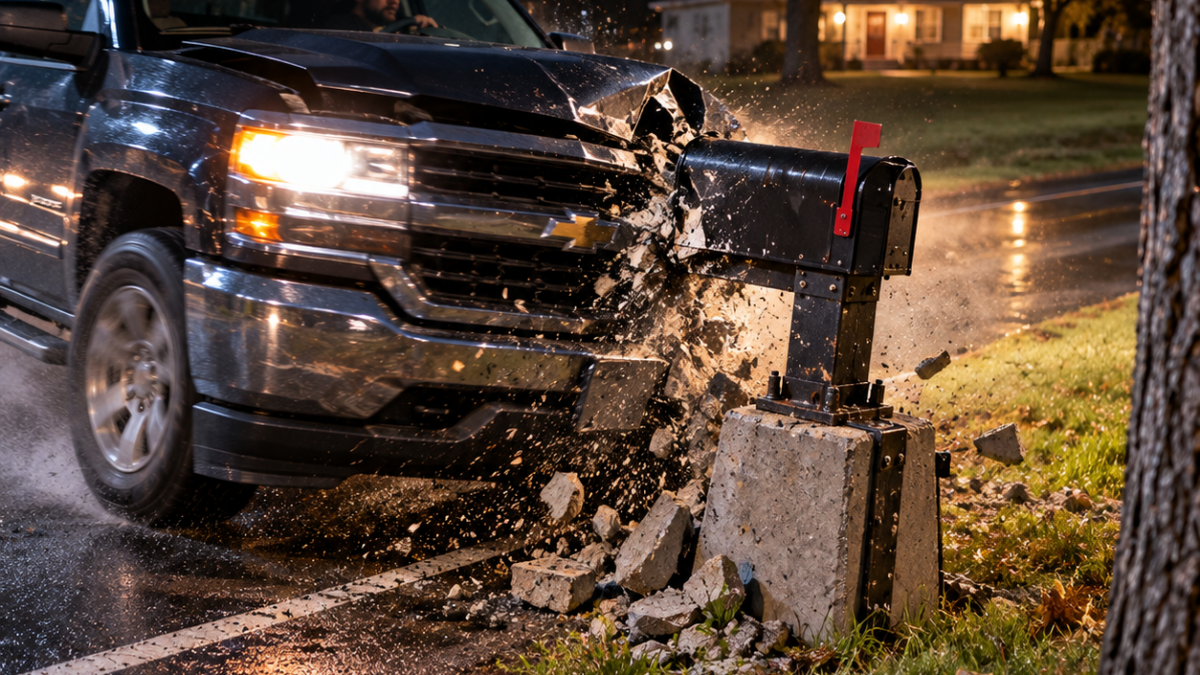
The pickup entered the roadside area.
Then impact.
The sound reached my house a fraction of a second after the image.
A hard metallic crash.
Far heavier than the earlier wooden impacts.
Then scraping.
A flash of sparks.
The pickup stopped.
Completely.
I froze.
The hockey announcer continued talking silently on my television.
For perhaps two seconds, I did nothing.
Then grabbed my phone.
Called 911.
Not because I wanted anyone arrested immediately.
Because a vehicle had crashed beside my property and I didn’t know whether somebody was hurt.
The dispatcher answered.
I gave the address.
“Vehicle left roadway and struck my mailbox.”
“Anyone injured?”
“I don’t know.”
“Fire?”
“No.”
“Fluid leak?”
“Looks like something is leaking.”
“Stay away if you can.”
“Deputies and fire are being sent.”
I put on boots and a coat.
Stepped outside.
Kept my distance.
The truck sat angled partly in the ditch, partly near the shoulder.
Headlights still on.
Front-right corner visibly damaged.
Steam or vapor rose faintly in the cold air.
Three people were around it.
Driver.
Passenger.
Another person from the rear seat.
All young adults.
Maybe early twenties.
No one appeared seriously injured.
That was the first thing I noticed.
Good.
Whatever anger I felt, I didn’t want ambulances carrying anyone away because of a mailbox.
The driver saw me.
“What the hell did you put in that thing?”
I stopped maybe twenty feet away.
“My mailbox?”
“Yeah.”
“It’s my mailbox.”
“That’s dangerous!”
I looked at the truck.
Then the road.
Then him.
“You drove into it.”
He threw both arms out.
“Nobody expects that!”
“Most people aren’t aiming for mailboxes.”
That did not improve his mood.
The passenger stepped forward.
“You knew somebody was hitting it.”
“Yes.”
“So you did this on purpose.”
“I replaced damaged property.”
“With what?”
I wasn’t going to stand in a ditch explaining construction.
“I used an approved installation after talking to the township and post office.”
The driver’s face changed slightly.
“You’re lying.”
“No.”
“You set us up.”
I stared.
“Us?”
He froze.
Tiny mistake.
But important.
I said nothing.
The passenger looked at him.
Then at me.
The driver tried to recover.
“I mean whoever.”
Too late.
My phone was recording.
Not secretly.
I held it visibly.
He noticed.
“Are you filming?”
“Yes.”
“Turn that off.”
“No.”
“This is private.”
“You’re standing beside my property after driving off a public road into my mailbox.”
“I’m keeping it on.”
The third person, a young woman, had stayed near the truck.
She said:
“Can we not do this?”
The driver snapped:
“Stay out of it.”
She folded her arms.
“I told you not to hit it again.”
Silence.
I looked at her.
She looked at me.
Then realized what she’d said.
The driver’s face tightened.
“Emily.”
“What?”
“You told me it was stupid.”
“Because it is.”
“Shut up.”
“No.”
“I’ve been saying this for a week.”
That was almost comical.
Almost.
Sirens became audible.
The driver’s confidence changed immediately.
“Why’d you call cops?”
“Because you crashed.”
“We’re fine.”
“There’s fluid on the road.”
“We can tow it.”
“Then explain that when they arrive.”
He took two steps toward me.
I stayed where I was.
“Turn off the phone.”
“No.”
“Man, I’m serious.”
“So am I.”
He stopped.
Good.
I didn’t want a confrontation.
Didn’t want some stupid mailbox war turning into assault.
The first vehicle to arrive was a sheriff’s cruiser.
Deputy Rachel Foster.
The same deputy.
When she saw me, she looked from my face to the truck.
Then to the mailbox.
Still standing.
Her eyebrows rose.
She got out.
“Mr. Mason.”
“Evening.”
She looked toward the truck.
“Same one?”
“Looks like it.”
The driver immediately said:
“This guy built a trap.”
Rachel held up one hand.
“Everybody slow down.”
Then to me:
“Anyone injured?”
“Not that I can see.”
She looked toward them.
“Anybody hurt?”
Emily shook her head.
Passenger said his shoulder was sore from the belt.
Driver said:
“My truck’s destroyed.”
Rachel nodded.
“Fire department will check you.”
Then she walked toward the mailbox.
Looked.
Looked at the roadway.
Looked at the camera mounted farther back.
Then at me.
“You still have the old recordings?”
“Yes.”
“All of them?”
“Yes.”
“Good.”
The driver interrupted.
“He knew we’d hit it.”
Rachel turned.
“We?”
He stared.
“I mean somebody.”
Rachel’s face stayed neutral.
“Okay.”
Fire and EMS arrived.
Nobody required hospital transport.
The truck had damaged cooling components and suspension parts badly enough that it wasn’t going anywhere under its own power.
A deputy photographed the scene.
Measured where the truck left the road.
Marked debris.
Took statements separately.
That’s important.
The story people tell later becomes much cleaner than what actually happens during an investigation.
Nobody arrived and immediately declared:
Mailbox man wins.
Nobody applauded.
Rachel didn’t high-five me.
She asked uncomfortable questions.
“When was the new installation completed?”
I gave the date.
“Who installed it?”
I gave the contractor.
“Do you have invoices?”
“Yes.”
“Any township communication?”
“Yes.”
“Postal communication?”
“Yes.”
“Did you modify it after installation?”
“No.”
“Were you hoping somebody would hit it?”
I thought before answering.
“No.”
“I hoped they’d stop.”
“Did you expect they might return?”
“Yes.”
“Why?”
“Because they had returned repeatedly.”
“Did that influence your decision to install something stronger?”
“Yes.”
She nodded.
Honest answer.
No reason to pretend otherwise.
Then:
“Did you install anything for the purpose of injuring the occupants?”
“No.”
“Anything hidden beyond the approved installation?”
“No.”
“Any objects placed in the road?”
“No.”
“Did you alter the shoulder?”
“No.”
“Okay.”
She walked away.
I appreciated that.
She wasn’t there to validate me.
She was there to figure out what happened.
Meanwhile, another deputy spoke to Emily.
I couldn’t hear most of it.
Then her voice rose.
“I already told him to stop.”
The driver shouted from near the ambulance:
“Emily!”
Deputy:
“Don’t talk to her.”
The driver:
“She doesn’t know anything.”
Emily:
“I was there the other nights.”
Everything went quiet.
Even Earl, who had appeared on his porch because sirens are more powerful than alarm clocks in rural Ohio, seemed to stop moving.
Rachel walked back toward Emily.
“You were present before?”
Emily nodded.
Tears were forming now.
Not from injury.
Stress.
“Twice.”
“Who was driving?”
She looked at the young man.
“Him.”
The passenger said:
“Come on.”
Rachel held up a hand.
“Do not coordinate statements.”
Then to Emily:
“Tell me only what you personally saw.”
She did.
What began as a mystery finally became embarrassingly simple.
The driver was twenty-two-year-old Cody Mercer.
No relation to me.
He lived about seven miles away.
The passenger was his friend Tyler Grant.
Emily was Cody’s girlfriend.
Weeks earlier, they’d been driving home late after visiting friends.
Cody had clipped the edge of my first mailbox accidentally.
Not enough to destroy it completely.
But enough that Tyler laughed.
Cody backed up.
Then deliberately hit it again.
That was mailbox number one.
I had assumed accident.
They thought the destruction was funny.
The next day, Cody drove past and saw I’d replaced it.
Tyler apparently said:
“He rebuilt it.”
Like I’d issued a challenge.
So they came back.
Mailbox two.
Then three.
Then four.
Each time I replaced it, the game became funnier to them.
At least to Cody and Tyler.
Emily said she’d participated in the laughter initially.
Then became uncomfortable.
By the fourth time, she told them to stop.
Cody didn’t.
That night, when they saw the stronger-looking replacement from a distance, Tyler apparently joked:
“Bet this one lasts two seconds.”
Cody turned around.
Came back.
And hit it.
Their mistake wasn’t that I had tricked them.
Their mistake was believing their own pattern entitled them to the same outcome forever.
Rachel asked:
“Alcohol tonight?”
Cody said no.
Breath tests later supported that.
No drugs evident.
This wasn’t intoxicated stupidity.
Just ordinary stupidity.
Somehow that made it worse.
Or maybe more honest.
A tow truck arrived.
The driver’s father arrived too.
His name was Dennis.
Mid-fifties.
Work jacket over pajamas.
He looked at Cody’s truck.
Then the mailbox.
Then me.
Then his son.
“What happened?”
Cody immediately said:
“He built that thing to wreck my truck.”
Dennis stared.
Rachel stepped in.
“Sir, before this turns into an argument, we’re still investigating.”
Dennis nodded.
“Fine.”
Then looked at Cody.
“Were you on the road?”
Silence.
“Cody?”
“I was driving.”
“That isn’t what I asked.”
Cody looked toward the ditch.
Dennis followed his eyes.
Then saw the obvious tire path.
“You drove off the road?”
“It’s complicated.”
“No.”
Dennis said.
“Cars stay on roads.”
“That’s the easy part.”
I liked him immediately.
Cody snapped:
“You don’t understand.”
Dennis looked at him.
“Then explain why your truck is in a ditch wrapped around somebody’s mailbox.”
No answer.
Rachel later showed Dennis one of my earlier videos with my permission.
He watched silently.
Cody’s truck drifting deliberately from the lane.
Impact.
Leaving.
Then another night.
Same thing.
When Rachel stopped playback, Dennis handed my phone back.
He looked at his son.
“You did this more than once?”
Cody didn’t answer.
Dennis’s face changed.
Not rage.
Disappointment.
Some emotions are quieter and hit harder.
“How many?”
Emily said:
“Four.”
Tyler muttered:
“Three.”
Rachel corrected:
“We’ll establish the number.”
Dennis rubbed both hands over his face.
Then came toward me.
I wasn’t sure what to expect.
He stopped several feet away.
“I’m sorry.”
I said:
“You didn’t do it.”
“No.”
“But apparently I raised somebody who thought destroying your property was entertainment.”
Cody shouted:
“Dad.”
Dennis turned.
“Not now.”
Then to me:
“He’ll pay for it.”
Rachel said:
“That may be part of the legal process.”
Dennis nodded.
“Whatever it takes.”
Cody looked furious.
At everyone.
Mostly me.
That bothered me.
Not because I needed an apology.
Because he still believed the primary injustice was his damaged truck.
That became even clearer after the vehicles left.
The tow truck hauled it away around 1:30.
Deputies cleared.
Fire department left.
Earl came across in slippers.
He stared at the mailbox.
Then down the road.
Then at me.
“Well.”
I laughed.
“That’s your analysis?”
“Trying to remain professional.”
“You’ve never been professional.”
“Mailbox won.”
“Earl.”
“What?”
“Don’t call it that.”
He grinned.
Then became serious.
“Everybody okay?”
“Yes.”
“Good.”
He looked toward the tire marks.
“You happy?”
I thought.
“No.”
He nodded.
“Good.”
That surprised me.
“Why good?”
“Because if you were happy somebody wrecked a truck, I’d worry about you.”
I looked at him.
“I’m happy the mailbox is still standing.”
“Different thing.”
“Exactly.”
We stood there in the cold.
Then Earl said:
“You should go inside.”
“Why?”
“Coffee’s probably cold again.”
It was.
The next morning, I woke after barely four hours.
The mailbox remained.
That felt strange.
For weeks, the first thing I’d done each morning was check whether another box had been destroyed.
Now it was still there.
The road was quiet.
No debris.
No crushed metal.
No splintered post.
Nothing.
I walked down.
Touched the side.
A scrape from the collision.
Minor.
I took photographs.
Not because I was sentimental.
Evidence.
Then I noticed an envelope on the ground.
One piece of mail had arrived the previous afternoon and been knocked out during the impact.
Electric bill.
Of course.
The most expensive mailbox drama in county history, and the surviving document was a utility bill.
I laughed alone beside the road.
By noon, social media had discovered the story.
Not from me.
Tyler posted first.
That was another mistake.
His version:
CRAZY GUY BUILDS STEEL TRAP AFTER KIDS ACCIDENTALLY HIT MAILBOX
Attached:
Photograph of Cody’s truck.
Someone shared it.
Then someone else recognized the road.
Comments started.
One person wrote:
Why were you off the road?
Tyler answered:
That’s not the point.
It was exactly the point.
Then another user claimed I had filled the mailbox post with concrete specifically to kill drivers.
False.
Someone else said I had installed railroad track.
Also false.
A third claimed Cody was hospitalized with broken ribs.
He wasn’t.
Internet stories improve themselves through exaggeration.
By evening, my phone had messages from people I hadn’t spoken to in years.
DID YOU REALLY DESTROY A TRUCK WITH A MAILBOX?
No.
ARE YOU GETTING SUED?
I don’t know.
SEND PICTURE.
No.
Then my sister called.
She lived in Columbus.
“What did you do?”
“Nothing.”
“Mason.”
“I replaced my mailbox.”
“Mom says somebody’s truck exploded.”
“The truck did not explode.”
“She said the internet says—”
“Mom is seventy-four.”
“Why is she reading internet comments?”
“Because retirement is dangerous.”
Fair.
I explained the whole story.
She went quiet.
Then said:
“You could’ve gotten somebody killed.”
That landed harder than the online criticism.
“I know.”
“Did you know they’d come back?”
“I thought they might.”
“Then why not just let police handle it?”
I sat at my kitchen table.
Because that question had already been moving around inside me.
“I did call police.”
“And?”
“They had footage.”
“No plate.”
“No identity.”
“So you built the mailbox.”
“I replaced property they kept destroying.”
“Stronger.”
“Yes.”
“Knowing they’d probably hit it.”
“Maybe.”
Silence.
Then:
“I don’t know how I feel about that.”
“Neither do I.”
That surprised her.
“You don’t?”
“No.”
“Then why’d you do it?”
“Because I was tired of replacing mailboxes.”
“Because I didn’t want to keep rewarding vandalism.”
“Because I checked what I was allowed to install.”
“Because I didn’t think they had the right to keep turning my property into a game.”
“All of those things can be true.”
She sighed.
“I just don’t want to visit you in prison over a mailbox.”
“Neither do I.”
“Good.”
Then:
“Mom wants pictures.”
“No.”
“She’ll get them from Facebook.”
“Probably.”
My sister’s question mattered because the legal issue wasn’t imaginary.
Cody’s family contacted an attorney.
So did I.
Mine was Laura Bennett, a civil attorney in town who had helped me with a contractor dispute years earlier.
She listened.
Asked for everything.
Reports.
Videos.
Installation documents.
Road correspondence.
Postal guidance.
Invoices.
Photographs.
I sent the whole file.
Two days later we met.
Laura put her glasses on the table.
“First.”
“Yes?”
“Never call this a trap.”
“I don’t.”
“Good.”
“Second.”
“What?”
“Stop arguing online.”
“I’m not.”
“Excellent.”
“Third.”
“Nothing about this is automatically simple.”
I nodded.
She continued:
“Someone deliberately leaving the roadway and striking the same mailbox repeatedly is strong evidence for you.”
“The fact you documented the vandalism before the replacement helps.”
“Consulting local authorities and using a professional installer helps.”
“Placement matters.”
“Compliance matters.”
“Whether the structure itself met applicable standards matters.”
“Your intent may matter.”
“Foreseeability may matter.”
“Everything matters.”
“That sounds expensive.”
“Lawyers are poets.”
I stared.
She smiled.
Then:
“Did you want the truck damaged?”
“No.”
“Did you want them to hit the mailbox?”
“No.”
“Did you expect they might?”
“Yes.”
“Did you build something beyond what was approved because you wanted to punish them?”
“No.”
“Can we document that?”
“Yes.”
“Good.”
She leaned back.
“Then stop trying the case inside your head before anyone files one.”
Good advice.
Hard to follow.
Cody did file an insurance claim.
His insurer contacted mine.
My insurance company investigated.
Again:
No instant triumph.
No adjuster laughing and saying Cody deserved it.
They reviewed.
The truck’s insurer argued there could be comparative liability depending on the roadside installation.
My insurer provided the documentation.
The township confirmed the approved placement.
The contractor confirmed what he installed.
Deputy Foster provided the report showing prior intentional collisions by the same vehicle.
Eventually, Cody’s vehicle damage remained his responsibility and his insurer’s problem under his coverage.
No payment came from me.
But that wasn’t the end.
The county prosecutor considered charges for the prior vandalism and final incident.
Again, not because a mailbox was sacred.
Repeated intentional property damage is still property damage.
Leaving the travel lane deliberately adds other issues.
The video made denial difficult.
Cody and Tyler both hired attorneys.
Emily cooperated.
She wasn’t charged.
She admitted she’d been present but evidence didn’t show she’d driven, damaged anything herself, or encouraged the final incident.
That distinction upset some people online.
They wanted everyone in the truck punished.
Law doesn’t work by seating arrangement.
Cody eventually admitted responsibility for multiple acts of criminal damaging.
Tyler admitted complicity in two incidents where messages showed he had actively encouraged Cody and helped plan the return.
No felony spectacle.
No ten-year prison sentence.
The losses weren’t enormous enough for the fantasy punishments social media demanded.
Cody received probation, community service, restitution for the destroyed boxes and associated documented costs, and driving-related consequences.
Tyler received a lesser resolution.
Both were ordered to stay away from my property.
That was enough for me.
More than enough.
The prosecutor asked whether I wanted to submit a victim statement.
I almost declined.
Then I wrote one page.
I didn’t mention the truck.
Didn’t ask for jail.
I wrote:
“The frustrating part was never the cost of the mailbox.”
“It was waking up each morning knowing someone had decided my time and property were available for entertainment.”
“I replaced the box after the first incident because I assumed an accident.”
“I replaced it after the second because I hoped it would stop.”
“By the time I had video, what bothered me most was the confidence behind the repetition.”
Then:
“I don’t want anyone’s life ruined over a mailbox.”
“I want them to understand that another person’s restraint is not permission.”
Laura read it.
“Good.”
“Too dramatic?”
“No.”
“Needs more legal words?”
“Absolutely not.”
At sentencing, Cody looked different.
Not physically.
Attitude.
He didn’t look at me initially.
His lawyer spoke.
Young.
Immature judgment.
No prior record.
Steady employment.
Truck repair costs already severe.
All true.
Then Cody stood.
He said:
“I thought it was funny.”
Silence.
“That’s basically it.”
“I hit it once by accident.”
“Tyler laughed.”
“I backed up and finished it.”
“Then the next day we saw a new one.”
“And it became a joke.”
He looked toward me.
“I didn’t think about him buying them.”
“Or fixing them.”
“I just thought it was funny that they kept coming back.”
That was honest.
Then:
“When the truck got wrecked, I thought he had done something to me.”
The judge interrupted.
“Had he entered the roadway?”
“No.”
“Had he touched your truck?”
“No.”
“Had he asked you to return?”
“No.”
Cody looked down.
“No.”
The judge nodded.
“Continue.”
Cody swallowed.
“I got mad because the consequences happened to me for once.”
There it was.
Exactly what I had felt beside the ditch that night.
He apologized.
Not perfectly.
Real apologies rarely arrive polished.
He said:
“I shouldn’t have done it.”
Then sat.
The judge imposed the agreed sentence.
No applause.
I left.
Outside, Dennis was waiting near the courthouse steps.
Cody’s father.
He came toward me.
“Can I talk?”
“Sure.”
He looked exhausted.
“I’m paying you the restitution today.”
“You don’t have to.”
“My son owes it.”
“Then let him pay.”
Dennis nodded.
“I know.”
“He’s paying me back.”
“Okay.”
Then:
“The truck was mine originally.”
“I gave it to him when he turned twenty-one.”
I didn’t know what to say.
He laughed bitterly.
“Maybe should’ve given him a bicycle.”
I smiled.
“Could’ve been worse.”
He looked toward the courthouse.
“Could it?”
“Yes.”
“Someone could have been walking beside that mailbox.”
His face changed.
He nodded slowly.
“I keep thinking about that.”
So did I.
That was one of the things that bothered me most after the whole story became local legend.
People focused on truck versus mailbox.
They missed the obvious danger that had existed long before I changed anything.
Cody had deliberately driven a full-size pickup off the road repeatedly.
What if Earl had been crossing?
What if a child were retrieving mail?
What if another car approached and he overcorrected?
What if ice sent him farther than intended?
The vandalism wasn’t harmless just because earlier mailboxes broke before his truck did.
Bad behavior often looks harmless when only property loses.
That doesn’t make the behavior safe.
Dennis held out his hand.
I shook it.
“I’m sorry.”
he said again.
“You don’t owe me that.”
“Parents always owe somebody something.”
“That’s not how it works.”
“Maybe.”
He walked back inside.
I went home.
For weeks afterward, nothing happened.
The road became quiet.
The camera alerts became boring.
Cars.
Deer.
Coyotes.
Snowplow.
Earl checking my driveway after a storm without telling me.
I called him one morning.
“You know the camera sees you.”
“Then wave.”
“You could text.”
“I’m retired.”
“Why does that prevent texting?”
“Busy.”
“Doing what?”
“Checking your driveway.”
I hung up.
Winter deepened.
Snow piled along the ditch.
The mailbox kept standing.
Spring came.
I realized one morning I hadn’t checked the camera in almost a week.
That felt important.
Repetition trains anxiety just like it trains arrogance.
Four nights of vandalism had taught my brain:
Headlights mean something might happen.
For months afterward, headlights made me look up.
Even after Cody was under a no-contact order.
Even after restitution.
Even after the criminal case.
My nervous system hadn’t attended the hearing.
It didn’t know the problem was officially resolved.
Eventually, it learned.
Slowly.
Ordinary headlights.
Ordinary road.
Ordinary mail.
That’s what I had wanted from the beginning.
Then a local reporter called.
Not television.
Small county newspaper.
She wanted an interview.
I almost said no.
Then asked:
“What’s the story?”
She said:
“People are arguing about whether homeowners can reinforce mailboxes after vandalism.”
That concerned me.
“That’s not the story.”
“What do you mean?”
“Don’t publish my setup like instructions.”
“I wasn’t planning to.”
“Good.”
“Because road rules vary.”
“Mailbox standards vary.”
“Property lines vary.”
“Somebody reading a revenge post and building a dangerous roadside obstacle is exactly what I don’t want coming from this.”
She paused.
“That’s actually why I’m calling.”
Her name was Samantha Reed.
We met at a diner.
She recorded.
Asked:
“If you could go back, would you build the same mailbox?”
I thought.
“Probably.”
“Why probably?”
“Because I still think I had a right to replace repeatedly vandalized property with something durable.”
“But?”
“But knowing the final collision happened makes the decision feel heavier than it did before.”
“Do you feel responsible for his truck?”
“No.”
She raised an eyebrow.
“That sounded certain.”
“It is.”
“He deliberately left the road and hit the same target he’d already destroyed several times.”
“That’s his decision.”
“But I can still recognize the outcome could have been worse.”
“Those aren’t contradictions.”
She nodded.
“Do you regret not simply giving the footage to law enforcement and waiting?”
“I did give it to law enforcement.”
“But continuing to replace the mailbox?”
“What was the alternative?”
“Leave no mailbox indefinitely?”
“Rent a post-office box?”
“Keep buying breakable posts until Cody got bored?”
“I don’t think property owners should have to make themselves easier to victimize.”
Then I added:
“That doesn’t mean they should create hazards either.”
“So where’s the line?”
“I think the line is law, design standards, intent, location, and common sense.”
She smiled.
“That’s less satisfying than revenge.”
“Good.”
Her article was fair.
Headline:
MAILBOX VANDALISM CASE RAISES QUESTIONS ABOUT ROAD SAFETY AND PROPERTY RIGHTS
Boring.
Responsible.
Earl hated it.
“Should’ve been ‘Mailbox Fights Back.’”
“That’s why you weren’t interviewed.”
“They called.”
“You talked to them?”
“No.”
“Why?”
“Didn’t want to embarrass you.”
I stared.
“You have told everyone at the diner.”
“Different audience.”
Of course.
Months passed.
One afternoon, a truck pulled into my driveway.
Not Cody’s.
Dennis.
His father.
He got out carrying something long wrapped in a moving blanket.
I stepped outside.
“What is that?”
“Before you get mad, hear me out.”
“That always starts well.”
He unwrapped it.
A new wooden mailbox post.
Plain.
Nothing special.
I stared.
“What am I supposed to do with that?”
He smiled.
“My wife said I couldn’t come here empty-handed.”
“Your son destroyed three wooden posts.”
“Four, apparently.”
I laughed despite myself.
Dennis continued:
“Cody made this.”
“What?”
“He’s been working at my brother’s cabinet shop on weekends.”
“He made the post.”
“Didn’t buy it.”
“Made it.”
I looked.
Clean work.
Better than anything I’d installed initially.
“He wanted you to have it.”
“Why?”
Dennis shrugged.
“Maybe because saying sorry in court wasn’t enough for him.”
“I don’t need another post.”
“I know.”
“Especially wood.”
“I know.”
We both laughed.
Then Dennis said:
“Put it in the garage.”
“Burn it.”
“Give it away.”
“I don’t care.”
“He spent eight hours on it.”
That changed things.
I took it.
“Tell him thank you.”
Dennis nodded.
“He also wants to know if he can write you.”
I thought.
“Why?”
“He says there’s something he wants to explain without a lawyer standing beside him.”
I didn’t love the idea.
Still:
“Okay.”
The letter arrived a week later.
Handwritten.
Two pages.
Cody started:
Mr. Mason,
I don’t know if you care why I kept coming back.
Then explained something neither police reports nor hearings had fully captured.
After the second mailbox, people in their friend group began expecting stories.
Someone posted a private video.
Another friend laughed and asked:
“Did mailbox guy rebuild?”
The joke became social currency.
Cody wasn’t only entertaining himself anymore.
He was performing.
Every replacement created another episode.
He wrote:
By the fourth one, I didn’t even want to do it that much. I wanted to be the guy who would do it because everybody expected me to.
That sentence interested me.
Then:
When Emily told me to stop, I called her scared. When Tyler hesitated, I called him soft. I turned every reason not to do something stupid into proof I had to do it.
I sat at my workbench reading.
Then:
When the truck hit the new mailbox, my first thought was that you cheated. I know how stupid that sounds now. I had destroyed your stuff over and over, but when mine broke, I thought the rules suddenly mattered.
He ended:
I don’t expect you to forgive me. I wanted you to know I understand why you stopped replacing the same weak thing for us to destroy.
I folded the letter.
Kept it.
That night, I looked at the handmade wooden post in my garage.
I eventually turned it into something else.
Not a mailbox.
A support for a small birdhouse near the workshop.
Earl saw it.
“That’s symbolic.”
“No.”
“Redemption.”
“Birds.”
“Same thing.”
“Go home.”
He pointed.
“Should paint ‘Cody Memorial Mailbox.’”
“Absolutely not.”
He laughed.
The birdhouse stayed.
So did the roadside mailbox.
People sometimes asked why I didn’t replace the durable setup after Cody’s case ended.
Simple.
It was legal.
Functional.
Already paid for.
And replacing it solely because I was afraid somebody might intentionally crash into it would’ve felt backward.
But I did add brighter reflective markers after consulting the road department.
Not because Cody deserved help seeing it.
Because ordinary drivers do.
That’s another thing I learned.
Safety improvements don’t need to become moral statements.
If visibility can improve, improve it.
The road belongs to more people than the idiot who targeted your property.
Earl approved.
“Looks official.”
“Don’t start.”
“I’ve seen worse.”
“You worked for the highway department.”
“Exactly.”
Years passed.
The story became something other people remembered more often than I did.
New employees at the plant occasionally figured out I was “mailbox Mason.”
I hated that nickname.
One young maintenance apprentice asked:
“Is it true you buried six feet of railroad steel?”
“No.”
“Concrete?”
“I’m not telling you how it was installed.”
“Why?”
“Because you’re exactly the kind of person who would hear the wrong lesson.”
He laughed.
“I just think it’s awesome.”
“No.”
“What?”
“The awesome part is nobody got seriously hurt.”
“That isn’t what TikTok says.”
“TikTok wasn’t standing there.”
He looked disappointed.
Good.
Then I explained the part I wanted him to understand.
“Somebody damaging your property doesn’t give you unlimited permission to create danger.”
“You document.”
“You call authorities.”
“You verify what you can legally repair or replace.”
“You don’t build booby traps.”
“Then how did the truck get wrecked?”
“Because it left the road and collided with an approved object.”
“That’s less cool.”
“Exactly.”
Maybe I’m getting old.
But “less cool” is often another word for “more accurate.”
My mother eventually heard the full story from me instead of Facebook.
She came to visit the following summer.
First thing she did was walk to the road.
Stared at the mailbox.
Then came back.
“That?”
“Yes.”
“That’s what everybody is talking about?”
“Yes.”
“It looks normal.”
“Thank you.”
She shook her head.
“Your father would’ve loved this.”
Dad had died years earlier.
“He would’ve made it worse.”
“Oh, absolutely.”
We both laughed.
Then she became serious.
“You could’ve been outside when they hit it.”
“I know.”
“That bothers me.”
“Me too.”
“More than the truck?”
“Yes.”
She nodded.
“Good.”
Apparently everybody in my family needed confirmation I hadn’t become a roadside psychopath.
Fair.
One afternoon, maybe three years after the incident, I ran into Cody at the hardware store.
Of course.
Where else?
I was looking at furnace filters.
He came around the aisle.
We recognized each other immediately.
He stopped.
So did I.
For a second, neither spoke.
Then:
“Mr. Mason.”
“Cody.”
He looked older.
Not much.
Mid-twenties now.
Work shirt.
Company logo.
No swagger.
“Didn’t expect to see you.”
“It’s a hardware store.”
“Small town.”
“Fair.”
Silence.
Then he asked:
“Birdhouse still there?”
That surprised me.
“How do you know?”
“My dad told me.”
“Yes.”
“Good.”
He nodded.
Then:
“I sold the truck.”
“After repairs?”
“Yeah.”
“Couldn’t look at it anymore.”
I wasn’t sure whether to laugh.
Didn’t.
He continued:
“I drive a Civic now.”
“That sounds safer.”
He smiled.
“Way less fun.”
“Good.”
Another silence.
Then:
“I’m sorry.”
“I know.”
“No.”
He looked at me.
“I mean when I said it in court, I was mostly trying not to get a worse sentence.”
Honest.
“Now I’m actually sorry.”
“Why now?”
He considered.
“My younger brother got his first car.”
“He’s seventeen.”
“He drove home one night and told me his friends wanted him to hit a trash can.”
“I lost my mind.”
I laughed.
“You?”
“Yeah.”
“I gave him this twenty-minute lecture about respecting other people’s property.”
“Halfway through, I heard myself.”
He shook his head.
“My mom laughed for like five minutes.”
“That seems deserved.”
“Definitely.”
Then:
“I realized the thing that scared me wasn’t the trash can.”
“It was how quickly stupid becomes normal when everybody around you laughs.”
That was good.
I nodded.
“You tell your brother?”
“All of it.”
“He already knew.”
“Of course he did.”
“Whole family calls me Mailbox now.”
I laughed.
Finally.
“Better you than me.”
He grinned.
Then:
“Take care, Mr. Mason.”
“You too.”
We went opposite directions.
No handshake.
No dramatic forgiveness.
Didn’t need it.
Sometimes closure is just discovering the person who hurt you eventually developed enough perspective to feel embarrassed.
That was enough.
Tyler took longer.
I never spoke to him directly again.
Years later Earl heard that Tyler had moved to Indiana.
Earl reported this as though intelligence analysts had confirmed it.
“How do you know?”
“His aunt goes to my church.”
“You don’t go to church.”
“My sister does.”
“Why do you care?”
“I maintain files.”
“You need hobbies.”
“This is my hobby.”
Terrifying.
Emily sent me a Christmas card one year.
That surprised me.
Nothing romantic or strange.
Just:
Thank you for not blaming me for being there. I should have spoken up sooner.
I wrote back:
You did speak when it mattered. Take care.
That was it.
The mailbox outlasted Earl.
He died at seventy-six.
Stroke.
Sudden.
His daughter asked me to help clean out the garage.
I found a coffee can filled with screws, bolts, washers, and random hardware sorted by absolutely no system.
Typical Earl.
Then I found a folder.
Written on it:
MASON MAILBOX INCIDENT — OFFICIAL RECORDS
I laughed alone in his workshop.
Inside were newspaper clipping.
A printed photograph.
A copy of the article Samantha wrote.
And a note in Earl’s handwriting:
I told him to call the sheriff after #2. For once, I was right.
I sat down.
Cried.
Then laughed again.
I kept the folder.
His daughter insisted.
“He talked about that mailbox like it was Normandy.”
“That sounds like Earl.”
“He was proud of you.”
That surprised me.
“For what?”
“I don’t know.”
“Not killing anybody?”
She smiled.
“Probably.”
After Earl died, the road felt different.
His porch stayed empty.
No retired highway inspector wandering across to critique my gravel.
No one appearing when I used a ladder.
No sarcastic commentary.
The mailbox story suddenly mattered less than the man who had been standing beside me through most of it.
That’s what time does.
It changes which parts of old stories carry weight.
At first, the important part was:
They hit it and their truck broke.
Then:
The evidence proved what they’d been doing.
Then:
Nobody was seriously hurt.
Then:
Cody eventually understood.
Now, when I remember those weeks, I mostly remember Earl saying:
“Reports matter when three becomes four.”
He had been right.
Documentation ended up being more important than anything physical.
Without the recordings, the final collision could have looked very different.
A damaged truck.
A sturdy roadside installation.
A driver claiming accident.
Me admitting I knew someone had hit previous mailboxes.
Messy.
Instead, investigators had sequence.
First impact.
Replacement.
Second.
Replacement.
Camera installed.
Third.
Fourth.
Final incident.
Same truck.
Same deliberate drift.
Repeated behavior.
Context.
That’s what evidence does.
It protects truth from becoming whoever talks loudest first.
I’ve carried that lesson into everything.
At work, if a machine fails repeatedly, write down the conditions.
Don’t rely on memory.
At home, if a contractor promises something, get it in writing.
If somebody damages property, photograph before repairing.
Not because life should become an evidence locker.
Because memory changes.
People change stories.
Stress edits details.
Paper and video help anchor reality.
There is another lesson I became less comfortable with over time.
Consequences aren’t the same thing as punishment.
I didn’t need Cody’s truck destroyed.
The truck damage wasn’t my goal.
I needed the vandalism to stop.
It stopped.
Those two outcomes became connected because Cody chose to continue.
But I try not to confuse them.
That’s important because revenge stories encourage the idea that the best ending is symmetrical damage.
You hurt me.
Now you hurt.
Satisfying.
Simple.
Dangerous.
If Cody had driven past that night, I would’ve won just as completely.
Probably more.
No damaged vehicle.
No insurance dispute.
No court date.
No possibility of somebody being injured.
Just a mailbox still standing.
Sometimes the best consequence is the bad behavior failing to happen.
That isn’t cinematic.
It’s still better.
A few years ago, a teenager knocked over one of my trash cans.
Actually an accident.
He stopped immediately.
Got out.
Picked everything up.
Knocked on my door.
“Sir, I’m really sorry.”
I looked at the can.
Small crack.
“It’s fine.”
“I’ll pay.”
“No.”
“My dad says I have to.”
“Your dad sounds wise.”
“He’s going to kill me.”
“He won’t.”
“How do you know?”
“Because you’re still standing here wasting time.”
The boy laughed nervously.
I let it go.
Why?
Because context.
Same property.
Damage.
Completely different behavior.
Accident plus responsibility is not the same thing as deliberate destruction plus escape.
Rules without context become stupidity.
Cody’s first contact with my mailbox may have started accidentally.
If he’d stopped that first night?
Knocked the next morning?
Left a note?
I’d probably have said:
Forget it.
Instead, he turned accident into entertainment.
That choice created everything afterward.
People sometimes ask:
“What if he had been seriously hurt?”
I don’t like the question because I don’t have a comfortable answer.
I would have felt terrible.
Even if I remained legally blameless.
Even if every inspection said my mailbox was properly located.
Even if the video showed him deliberately driving off the road.
Human emotion doesn’t follow liability charts.
Someone can cause his own injury and you can still wish it hadn’t happened.
That’s why I won’t romanticize the final impact.
It was loud.
Violent.
Scary.
When the truck stopped, I didn’t pump my fist.
I called 911.
That’s the version worth remembering.
Not:
I got him.
But:
Is everyone okay?
Because once somebody is hurt, the game changes.
Property becomes secondary.
Cody later told Samantha, the reporter, something she included in a follow-up article.
He said:
“I thought Mason was trying to teach me a lesson.”
Then:
“Now I think he was just done buying mailboxes.”
Exactly.
That’s almost disappointingly ordinary.
People want elaborate revenge.
I wanted mail delivered.
Years later, the post office changed our rural delivery setup slightly.
New carrier.
New route timing.
The carrier, a man named Ben, stopped one day.
“You Mason?”
“Yes.”
He pointed.
“Is that the mailbox?”
I sighed.
“What mailbox?”
He grinned.
“Oh, come on.”
“Who told you?”
“Everybody.”
“Fantastic.”
He examined it from the road.
“Looks normal.”
“That’s because it is.”
He nodded.
“People told me it was a bunker.”
“People lie.”
“Welcome to mail delivery.”
Fair.
Ben became a friend.
Not close.
The rural kind.
Wave.
Weather conversation.
Occasional complaints about dogs.
One winter, snowplow spray buried the mailbox almost halfway.
I spent an hour clearing around it.
Ben arrived while I was still shoveling.
“You know what’s funny?”
“No.”
“If a snowplow destroys it after all this.”
I stared.
“Leave.”
He laughed from the truck.
That mailbox survived twelve more years.
Then rust finally got it.
Not vandals.
Not pickup.
Not revenge.
Ohio.
Salt.
Snow.
Water.
The bottom seam corroded.
Door stopped closing.
I stood beside it one spring morning and realized it was finished.
I felt weirdly sentimental.
Ridiculous.
It was a mailbox.
But it had become an object carrying years of story.
I called the township.
Yes.
Again.
Asked about updated requirements.
Standards had changed somewhat.
I replaced the old installation with a modern approved unit appropriate for the road.
Nothing dramatic.
When the contractor removed the old box, he asked:
“You want to keep it?”
I almost said no.
Then:
“The box.”
“Not the post.”
“What are you going to do with it?”
“No idea.”
It sits in my workshop now.
Dented slightly.
Scratched.
Rust along the bottom.
No mystical significance.
Still, I can’t throw it away.
My nephew saw it last Thanksgiving.
He’s fourteen.
“Is that the famous mailbox?”
“Yes.”
He picked it up.
“This?”
“Yes.”
“Looks stupid.”
“Thank you.”
“Dad said it wrecked a truck.”
“The truck wrecked itself.”
He rolled his eyes.
“Same thing.”
“No.”
“Important difference.”
Then came the question every teenager asks.
“How was it built?”
I looked at him.
“No.”
“What?”
“I’m not teaching you that.”
“Why?”
“Because someday you’ll be seventeen with friends and too much confidence.”
He laughed.
“I’m not stupid.”
“Every stupid seventeen-year-old has said that.”
“Dad did?”
“Your father especially.”
He put it down.
Then:
“So what am I supposed to learn from the story?”
Good question.
“Don’t hit mailboxes.”
He groaned.
“Seriously?”
“Yes.”
“That’s it?”
“That’s enough.”
He stared.
“You’re terrible at stories.”
Maybe.
But simple lessons survive longer.
Don’t deliberately drive into things.
Don’t mistake someone else’s patience for weakness.
Don’t create hazards just because you’re angry.
Document recurring problems.
Use lawful channels.
Stop escalation when the original problem stops.
Those aren’t viral.
They’re useful.
One night, long after Earl died and Cody had moved away, I sat on my porch listening to traffic.
The road was busier than when I bought the house.
New subdivision farther east.
More commuters.
Delivery vans.
People moving faster than they should.
Still no sidewalks.
Still dark.
A truck approached.
For just a second, my body reacted.
Old instinct.
Headlights.
Pickup silhouette.
Shoulders tightened.
Then the truck passed normally.
Taillights disappeared.
I laughed at myself.
Trauma is too dramatic a word for what happened to me.
But conditioning?
Absolutely.
The brain learns patterns.
Mine learned:
Late-night pickup could mean trouble.
Cody’s brain learned something too:
Destroy mailbox, get laugh, face no consequence.
Both patterns took repetition to break.
That’s what interests me most now.
People talk about boundaries as if they’re lines you announce once.
Sometimes they are.
Often, boundaries are patterns.
If somebody crosses one and nothing changes, they learn something.
Maybe the wrong thing.
The first mailbox?
I gave him grace.
That was reasonable.
Second?
Suspicion.
Third?
Evidence.
After that, continuing exactly the same response would no longer have been patience.
It would’ve been participation in the routine.
That doesn’t mean escalation has to equal retaliation.
My useful escalation was:
Camera.
Report.
Documentation.
Professional advice.
Lawful replacement.
Not:
Weapon.
Ambush.
Threat.
Confrontation.
That’s the line I care about.
Could I have gone farther toward authorities sooner?
Maybe.
Could deputies have identified Cody from the truck before the final collision?
Possibly.
Could I have left the mailbox absent temporarily?
Yes.
Could I have rented a post-office box?
Sure.
There were alternatives.
That’s why I don’t present my choice as universal advice.
Different road.
Different law.
Different installation rules.
Different risks.
Different answer.
Anybody copying some internet story without checking local regulations could create a dangerous mess.
I don’t want that on my conscience.
But I also reject the idea that repeated deliberate vandalism gives the vandal a right to demand that his target remain fragile enough to damage safely.
That makes no sense.
Cody never had a right to leave the roadway.
Never had a right to hit my property.
Never had a right to expect the next replacement to fail in exactly the same way as the previous one.
His expectation came from repetition.
Not entitlement.
Those are different.
A few years after our hardware-store encounter, I received another letter from Cody.
Short.
He had become a father.
Baby girl.
Photograph included.
I stared at that tiny face and felt old.
His note said:
Mr. Mason, I was installing a mailbox at our new house today and thought of you.
Then:
Don’t worry. It’s boring and legal.
I laughed.
He continued:
I understand your side even more now that I own a house and keep finding out how much everything costs.
Of course.
Nothing matures a man faster than discovering the price of lumber.
Then:
My daughter won’t hear the mailbox story from me until she’s old enough to understand why being funny isn’t an excuse for making somebody else pay.
I kept that letter too.
Not because Cody became my friend.
He didn’t.
Because people changing matters.
Consequences should leave room for that.
If the only satisfying ending is somebody permanently destroyed, what exactly are consequences supposed to accomplish?
Cody paid.
Worked.
Apologized.
Grew older.
Tried to become different.
Good.
That’s better than eternal shame.
I hope Tyler did too.
Never found out.
Not my responsibility.
Dennis died several years ago.
Cancer.
Cody called to tell me.
I went to the funeral.
That surprised him.
Dennis had apologized for something he hadn’t done because he felt responsible as a father.
He had treated me decently from the first night.
That mattered.
At the funeral, Cody hugged me.
Unexpected.
We stood outside the church.
He said:
“Dad kept a picture of that truck.”
“Why?”
“To remind himself never to give me another vehicle.”
I laughed.
Then Cody said:
“He always felt guilty.”
“He shouldn’t.”
“I told him.”
“Didn’t matter.”
“Parents.”
“Yeah.”
We stood quietly.
Then:
“He liked you.”
“I liked him.”
“That would’ve annoyed him.”
“Good.”
Life is strange.
One stupid mailbox connected families that otherwise would’ve never known each other.
Not in some magical everything-happens-for-a-reason way.
I hate that phrase.
Bad things don’t need to become necessary to produce good outcomes.
I would’ve preferred no vandalism.
Dennis probably would’ve preferred an undamaged truck.
Cody would’ve preferred avoiding court.
But after something happens, people decide what to do with what remains.
That’s different.
I got better at documenting.
Cody got better at accountability.
Dennis taught me a parent can support a child without defending every stupid choice.
Earl taught me reporting early matters.
My sister taught me moral certainty deserves questioning even when you’re angry.
Deputy Foster taught me evidence beats speeches.
Laura taught me never say “trap” to a lawyer.
Useful lessons.
Expensive route.
A few months ago, I drove past my old house.
Yes, old.
I eventually sold it.
Nothing dramatic.
Job moved.
I got tired of the commute.
The new owner is a young couple.
When we were closing, I told them the mailbox story because the existing camera and roadside setup were part of the property.
The husband laughed.
His wife didn’t.
She said:
“Wait.”
“People deliberately hit this?”
“Years ago.”
“Are they still around?”
“No.”
“Should we be worried?”
“No.”
“The problem ended.”
Then I showed them the file.
Old reports.
Approvals.
Maintenance records.
Camera details.
The husband said:
“You saved all this?”
“Yes.”
“Why?”
“Because once you’ve had to explain a mailbox to a lawyer, you never underestimate paperwork again.”
They kept everything.
When I drove past last month, the mailbox was still there.
Different box now.
Same general spot.
A small flower bed near the driveway.
Kids’ bicycles beside the garage.
No camera that I could see from the road.
Maybe they moved it.
Maybe didn’t need it.
I slowed slightly.
Then laughed because slowing near that mailbox felt like exactly the wrong thing to do.
So I kept driving.
That’s what everybody should’ve done from the beginning.
Just keep driving.
The road asks almost nothing of you.
Stay between the lines.
Leave other people’s property alone.
Get where you’re going.
Cody turned that simple task into weeks of damage because the first mistake became a joke, the joke became a habit, and the habit became a performance.
By the time the consequences changed, he genuinely felt cheated.
That’s the strangest part.
He wasn’t pretending outrage.
He believed it.
He had become so accustomed to my mailbox losing that the first time his truck lost instead, it felt unfair.
People do that everywhere.
Not only with property.
At work.
In families.
Relationships.
One person absorbs inconvenience repeatedly.
Others start treating that patience as part of the system.
Then the patient person changes the system.
Suddenly everyone asks:
Why are you making things difficult?
You weren’t difficult before.
Exactly.
Sometimes “easygoing” is just another name other people give your willingness to pay the cost.
That doesn’t mean every boundary needs steel.
Usually words are better.
Written rules.
Distance.
Consequences.
Sometimes leaving.
What matters is recognizing when grace has stopped teaching grace and started teaching access.
The first mailbox taught Cody nothing because I assumed accident.
Fair.
The second probably taught him I’d replace it.
The third taught him I still hadn’t identified him.
The fourth taught him confidence.
The final one taught something different.
Not because the mailbox attacked him.
Because reality finally stopped cooperating with the joke.
That’s how I see it now.
Not revenge.
Friction.
The behavior reached a point where it no longer produced the expected reward.
Then it ended.
If there is anything I would change, it isn’t the documentation.
I’d document sooner.
It isn’t contacting authorities.
I’d call after the first suspicious repeat.
It isn’t checking the installation rules.
Definitely keep that.
Maybe I’d involve the sheriff more actively before replacing the final box.
Ask whether they could increase patrols.
See if someone recognized the truck.
Maybe that would have prevented the crash entirely.
Hindsight makes alternatives easy to see.
At the time, I was a tired man standing in a hardware store buying his fourth mailbox.
People make decisions from where they are.
The goal is to make them carefully enough that you can live with them later.
I can live with mine.
Not proudly.
Comfortably.
There’s a difference.
I didn’t lure Cody to the property.
Didn’t challenge him.
Didn’t publish his name.
Didn’t damage his truck myself.
Didn’t alter the road.
Didn’t hide something where an ordinary driver should be expected to hit it.
I rebuilt what belonged to me after checking the rules.
Then he made the same deliberate choice again.
I wish he’d made a different one.
He does too.
That’s probably the healthiest ending available.
My current house has a mailbox too.
Different county.
Suburban edge.
Wooden post.
Basic black metal box.
Yes.
Wood.
People laugh when they learn that.
“You didn’t reinforce it?”
No.
“Why not?”
Because nobody is hitting it.
Protection should respond to an actual problem.
Not become a permanent worldview.
I don’t need every mailbox in my life built for war because one idiot targeted one years ago.
That’s another lesson.
Boundaries shouldn’t become fortresses after the threat is gone.
If they do, the person who hurt you keeps shaping your choices long after they leave.
I don’t want Cody driving my life forever.
So my current mailbox is boring.
Sometimes crooked after winter.
I straighten it.
Once a snowplow buried it.
I dug it out.
A delivery driver backed into it two years ago.
Stopped.
Knocked.
Apologized.
Insurance paid for the replacement.
No drama.
The driver looked terrified when he told me.
I almost laughed.
He said:
“Sir, I hit your mailbox.”
I stared at him.
“You stopped.”
“Yes.”
“You told me.”
“Yes.”
“Then we’re good.”
He seemed confused.
“You’re not mad?”
“No.”
I thought about telling him why.
Didn’t.
Some stories don’t need to follow you into every new interaction.
I signed the insurance form.
He left.
A week later, new mailbox.
End.
That’s what accountability looks like when nobody turns an accident into entertainment.
Simple.
Years ago, standing beside Cody’s wrecked pickup, I thought the satisfying part was seeing my mailbox still upright.
I was wrong.
The satisfying part came later.
No more nighttime alerts.
No more debris in the ditch.
No more wondering who was coming.
No more hardware-store cashier recognizing me.
No more replacement posts.
Just mail.
Bills.
Advertisements.
Birthday cards.
Ordinary things.
Boring things.
Earl was right about that too.
Boring is underrated.
The older I get, the less interested I am in dramatic victories.
Give me a problem that stops.
A neighbor who understands a boundary.
A person who apologizes without needing to be destroyed.
A road where headlights are only headlights.
That’s enough.
The old mailbox in my workshop has one dent near the side where part of Cody’s bumper struck it.
Sometimes visitors notice.
“What happened?”
“Long story.”
If they know me well, I tell it.
If they don’t:
“Truck hit it.”
Both answers are true.
The longer version matters only because the truck didn’t simply hit it.
The driver chose the same target again and again because nothing had forced him to reconsider.
That’s what changed the meaning.
Patterns matter.
Intent matters.
Response matters.
Evidence matters.
And limits matter.
Especially your own.
I could have let anger turn the whole situation into something worse.
I didn’t.
Cody could have stopped after the first mailbox.
He didn’t.
Deputy Foster could have arrived assuming the angry homeowner or damaged driver was automatically right.
She didn’t.
Dennis could have defended his son against everybody else.
He didn’t.
Those choices are why a stupid vandalism story ended with bills and probation instead of funerals.
That is worth more to me than the satisfaction of a crushed bumper.
So when people ask whether reinforcing the mailbox was justified, I don’t give them a heroic answer.
I tell them what happened.
Repeated deliberate damage.
Camera footage.
Police reports.
Professional advice.
A lawful replacement.
A driver who chose to leave the roadway again.
A collision.
An investigation.
Consequences.
Then I tell them something that disappoints anybody hoping for instructions.
Check your own laws.
Check your roadway rules.
Don’t create hidden hazards.
Don’t chase vandals.
Don’t confront strangers at midnight.
Preserve evidence.
Call the people whose job it is to handle crimes.
Because the goal should be ending the behavior, not winning a contest over who can escalate farther.
I didn’t need Cody hurt.
I didn’t need his truck ruined.
I didn’t need strangers online cheering.
I needed one thing.
For somebody else to stop deciding that because I had been patient yesterday, my property was available again tonight.
Eventually he did.
The road became quiet.
The camera became unnecessary.
And the mailbox went back to being what it had been before any of this started.
A box on a post.
That’s all I ever wanted it to be.








