Three Months After I Divorced Her, the Hospital Called—Then the Doctor Asked Me One Question.k
part2:
For several seconds, I forgot there were people around me.
Dominic stood in the grainy security image wearing a charcoal overcoat.
Silver hair.
Black gloves.
Same controlled posture he’d carried into my father’s office when I was sixteen and into mine after Dad died.
I had known him for twenty-seven years.
He had taught me how to play chess.
He had attended my mother’s funeral.
He’d stood beside me at my wedding.
When I married Elena, Dominic kissed both her cheeks and said:
“Finally, someone civilized enough to improve this family.”
Three months earlier, he’d been the one who entered my office at two in the morning carrying photographs.
Elena leaving her law office.
Elena at a grocery store.
Elena entering our home.
Red circles around her face.
Times.
Dates.
A typed message on the final page.
YOU KEEP THE WIFE, YOU BURY THE WIFE.
Dominic told me the threat came through channels he trusted.
He said someone had been asking about her routines.
Her car.
Her office.
Whether she traveled with security.
I’d wanted names.
He said he didn’t have them yet.
I doubled her protection without telling her.
Changed her driver.
Moved meetings.
Had men watch our house.
Elena noticed immediately.
She always noticed.
“What happened?”
“Nothing.”
“Nico.”
“Business.”
“Whose business requires a man outside our bedroom window at two in the morning?”
I didn’t answer.
That was the beginning of the end.
Or what I’d thought was the end.
Dominic told me escalating security would only confirm she mattered.
“If they know she is the lever,” he’d said, “they’ll keep pulling it.”
“What do you suggest?”
He looked me directly in the eyes.
“Remove the lever.”
I knew what he meant.
I hated him for saying it.
I hated myself for understanding.
At first I refused.
Then another photograph arrived.
Elena’s car parked outside her office.
Someone had drawn a black X across the windshield in marker.
Dominic showed me a message:
NEXT TIME IT ISN’T INK.
That night I watched Elena sleep against my chest.
Her hand rested over my heart.
I stayed awake until sunrise.
She thought I was being affectionate.
She didn’t know I was memorizing her.
The next morning I told my attorney to prepare divorce papers.
I transferred the condo she’d always liked into her name.
Moved money into an account she could access.
Arranged everything so she would never need to ask me for anything.
Then I destroyed her.
Because when Elena refused to believe I suddenly wanted a divorce, she kept asking one question.
“Why?”
I gave her excuses.
We were different.
I was tired.
Marriage had become inconvenient.
She saw through every one.
Finally, in a courthouse conference room, tears streaming down her face, she asked:
“Was any of it real?”
That was the moment I could have stopped.
Could have told her the truth.
Could have trusted the woman I loved enough to let her decide whether fear was worth facing with me.
Instead I remembered the photographs.
The threat.
The black X.
And I said:
“No.”
One word.
Her entire face changed.
I watched six years disappear from her eyes.
She signed.
Two days later, she moved out.
I kept men watching her from a distance.
She caught one after a week and threatened to call the police.
I pulled them back.
Dominic assured me she was safer now.
“She looks abandoned,” he said.
“That is what they need to believe.”
I had believed him.
Now he was standing beside her in a stairwell three months later.
I called Gabriel.
He answered immediately.
“Tell me.”
“Footage begins at 9:11.”
“Dominic enters the building through the side entrance.”
“Does he live there?”
“No.”
“Was he invited?”
“Unknown.”
“At 9:18, Elena comes into frame on the fourth-floor hallway.”
“She’s carrying a folder.”
“Dominic approaches.”
“What happens?”
“They argue.”
“Audio?”
“None.”
“He follows her toward the stairwell.”
My hand tightened around the phone.
“Then?”
“Camera inside the stairwell doesn’t cover the landing.”
“Next exterior angle catches Dominic leaving at 9:26.”
“Elena is found at 9:31 by a resident.”
Five minutes.
I looked through the hospital doors.
“Where is Dominic now?”
“We don’t know.”
“Find him.”
Gabriel hesitated.
That alone told me how my voice sounded.
“Nico.”
He only used my first name when he believed I was about to make a decision I’d regret.
“What?”
“The police already requested the footage.”
Good.
That wasn’t what I wanted to hear.
It was what I needed.
I said:
“Give them everything.”
“All of it?”
“All relevant footage.”
“Don’t touch the originals.”
“Don’t contact Dominic.”
Gabriel went quiet.
Then:
“Understood.”
I hung up.
Ava stood a few feet away.
She had followed me to the hospital in the second SUV.
My sister was thirty-two, a corporate attorney, and the only person in my family who spoke to me as if my last name were a mildly inconvenient fact rather than an institution.
She had been watching my face.
“Dominic?”
I nodded.
Her mouth opened.
“He was with Elena?”
“Yes.”
“Why?”
“I don’t know.”
Ava stared at me.
Then:
“He’s the one who told you about the threats.”
“I know.”
Her expression sharpened.
“Nico.”
I already knew what she was thinking.
I didn’t want her to say it.
She did anyway.
“What if the threat was Dominic?”
I turned away.
“No.”
“Why no?”
“Because he’s been with us since Dad.”
“That is not an answer.”
“He loved Dad.”
“So did half the men who cheated him.”
I looked at her.
“Dominic carried Dad’s coffin.”
“And?”
Her voice broke.
“People who carry coffins can still lie.”
That sentence stayed with me.
Dr. Whitmore returned at 11:06.
No surgery immediately.
That was good.
Elena had a skull fracture and a significant concussion with a small intracranial bleed they believed could be monitored closely rather than operated on at that moment.
She had stitches near her hairline.
Bruising.
A fractured wrist.
The pregnancy remained viable.
My child.
Our child.
I still hadn’t seen her.
“Can I?”
Dr. Whitmore looked uncomfortable.
“You are no longer her legal spouse.”
The sentence cut cleanly.
“We need to follow her current medical authorization.”
“She named me in the ambulance.”
“As an emergency contact.”
“That’s not necessarily the same as giving you unrestricted access.”
I nodded.
I hated it.
But she was right.
“Is there family?”
“Her sister is on the way.”
Rachel Brooks.
Elena’s older sister.
Rachel hated me before the divorce.
Afterward, she considered my death a reasonable community-improvement project.
She reached the hospital just after midnight.
She saw me.
Stopped.
Then walked directly toward me.
The first slap landed before Gabriel could react.
I let it.
The second almost came.
Ava caught Rachel’s wrist.
“Enough.”
Rachel yanked away.
“You.”
She pointed at me.
“What did you do?”
“Nothing.”
“She’s at the bottom of a stairwell three months after you threw her away and you expect me to believe that’s coincidence?”
“I didn’t touch her.”
“Your people?”
“No.”
“How would you know?”
Because until ten minutes earlier, I believed I knew every important thing happening around me.
Now I wasn’t sure I knew anything.
I said:
“Police have footage.”
Rachel’s eyes narrowed.
“What footage?”
“A man went into the stairwell with her.”
“Who?”
I hesitated.
She saw it.
“Who, Nico?”
“Dominic Bellandi.”
Rachel knew the name.
Everyone around Elena had.
Her face went pale.
“Your father’s friend?”
“Yes.”
She stared.
Then:
“Why was he with her?”
“I don’t know.”
Rachel laughed bitterly.
“You never know when it matters.”
That one I deserved too.
Dr. Whitmore eventually allowed Rachel into Elena’s room as next of kin.
Not me.
I sat outside.
At 1:34 in the morning, Rachel returned.
“She woke up.”
I stood.
“Is she okay?”
“She knows where she is.”
“She knows my name.”
“She asked about the baby.”
My knees nearly failed.
“And?”
“Still stable.”
Then Rachel looked at me.
“She knows you’re here.”
I waited.
“She said you can come in.”
I had walked into rooms knowing men inside wanted me dead.
None frightened me as much as that hospital room.
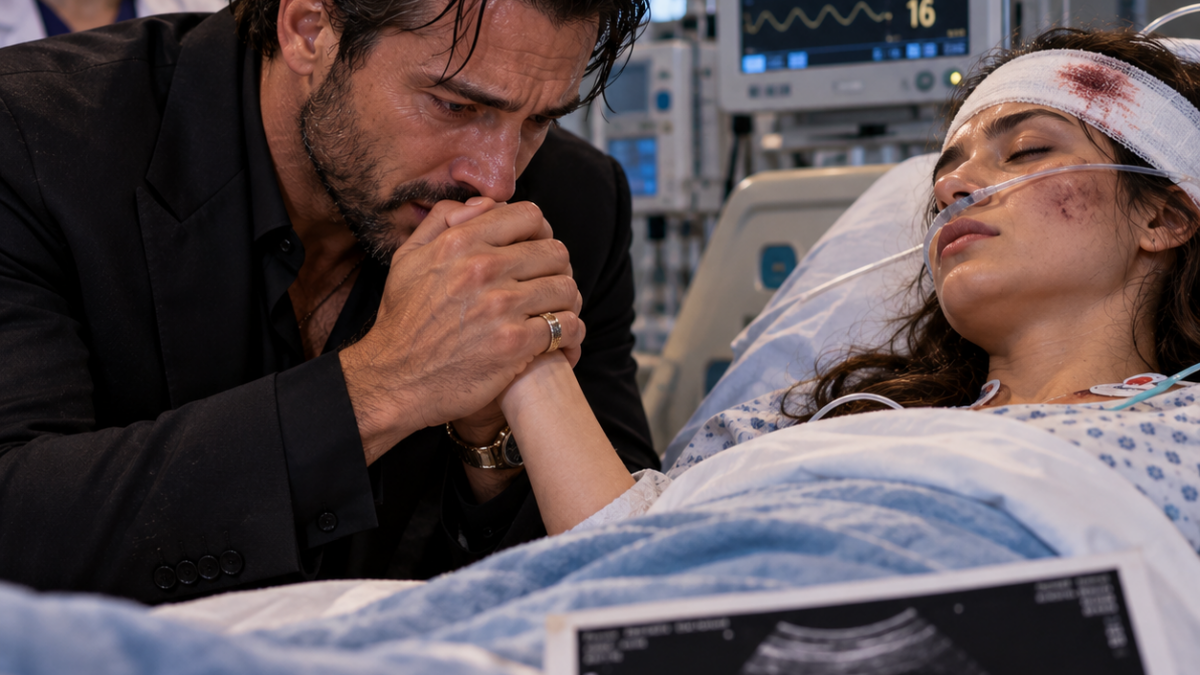
Elena looked small against the white sheets.
She was thirty-five.
Dark hair partly shaved near the stitches.
Bruising along the left side of her face.
Right wrist immobilized.
Monitor leads across her chest.
Her eyes opened when I entered.
Green.
Tired.
Furious.
Elena had always been beautiful.
But beauty wasn’t the first thing people noticed after knowing her.
It was attention.
When Elena looked at you, she made you feel as though everything else in the room had temporarily lost importance.
That night, her eyes held mine.
“Nico.”
I stopped beside the bed.
“Elena.”
Her gaze moved to the wedding ring I still wore.
I’d forgotten to remove my glove at the office.
The ring was visible.
Her expression changed.
“What is that?”
I looked down.
There was no lie available that wouldn’t insult both of us.
“I never took it off.”
She stared at me.
Then laughed once.
The sound hurt her.
She winced.
“Don’t.”
I moved closer automatically.
She lifted her good hand.
“Don’t touch me.”
I stopped.
She closed her eyes.
“You knew?”
“About the baby?”
“Yes.”
“Not until tonight.”
Her face tightened.
“Who told you?”
“The hospital.”
“I told the paramedic not to.”
“I know.”
Silence.
Then:
“Why are you here?”
Because I loved her.
Because the idea of her dying had turned every bone in my body cold.
Because a part of me had been dead since she walked away.
Because she was carrying our child.
Because I was a coward.
I said the only part I thought she’d believe.
“You gave them my number.”
Her eyes filled.
“I was scared.”
Not:
I wanted you.
Not:
I missed you.
I was scared.
I nodded.
“You can tell me to leave.”
“I will.”
“But first I need to ask you something.”
She looked away.
“Dominic was with you.”
Her eyes snapped back.
That was answer enough.
“You knew?”
“I saw footage.”
She breathed carefully.
“He came to my apartment.”
“Why?”
“I called him.”
Every instinct in me stopped.
“You called Dominic?”
“Yes.”
“Why?”
Elena looked toward the door.
Rachel had stepped out, giving us privacy but staying close.
Then Elena said:
“Because I found out you lied.”
My chest tightened.
“About what?”
“Our marriage.”
I didn’t move.
She continued.
“You’re many things, Nico.”
“But you’re a terrible actor with people who know you.”
“You cried after I signed the papers.”
I had turned away.
I thought she hadn’t seen.
She had.
Elena continued.
“You left me the condo.”
“Half your legitimate investment portfolio.”
“The pension account your accountant told me you guarded like scripture.”
“You kept paying the security company for my building for a month and then suddenly stopped.”
“You told me none of our marriage was real, but every legal arrangement you made before the divorce was designed to make sure I’d never need you.”
I said nothing.
“So I started asking why.”
“Elena—”
“Don’t.”
She shifted and winced.
I hated watching pain cross her face.
She waited until it passed.
“Two weeks after the divorce, I found an envelope in a box of my things.”
“What envelope?”
“Photographs.”
My blood chilled.
“The same kind Dominic showed you?”
“I didn’t know he’d shown you anything.”
She looked at me.
“Pictures of me.”
“Outside work.”
“At the grocery store.”
“Our old house.”
“And one threat.”
I sat slowly.
“What did it say?”
Her voice lowered.
“Ask your husband why he chose you to bury.”
Different wording.
Same idea.
She continued.
“I assumed it came from one of your enemies.”
“Then I noticed something.”
“What?”
“The photographs were printed on paper from Marchetti Holdings.”
My stomach dropped.
“How would you know?”
“I was your wife for six years.”
“You had that photo printer in the downstairs office.”
“It leaves a narrow gray line along one edge.”
“I complained about it when I printed the Christmas cards.”
She had.
I remembered.
“So you thought the threat came from inside.”
“Yes.”
“Why didn’t you call me?”
Her eyes hardened.
“Because you’d told me I meant nothing to you.”
Fair.
“So you called Dominic.”
“Eventually.”
“Why him?”
“Because he was the one person besides Ava who always seemed able to tell you no.”
I almost laughed at the irony.
“What did he say?”
“At first?”
“He acted shocked.”
“He said he’d look into it.”
“Then tonight he called.”
“Said he had answers.”
“Told me he’d come over.”
I felt sick.
“What happened in the stairwell?”
Elena looked away.
“He admitted the photographs were his.”
My vision narrowed.
“He what?”
“He said you needed to be separated from me.”
“Why?”
She looked back.
“Because you were going to change the organization.”
I said nothing.
A year before our divorce, I had begun moving parts of my world toward legitimacy.
Slowly.
Quietly.
Shipping.
Construction.
Waste management.
Hospitality.
Businesses that had once existed partly to serve darker purposes were being stripped clean.
No more off-book enforcement.
No street crews operating under our protection.
No cash operations I couldn’t explain to auditors.
I hadn’t done it because I suddenly became good.
I did it because I was tired.
Because Elena wanted children.
Because one night she’d asked me:
“If we ever have a son, what exactly are you planning to leave him?”
I had no answer I could say aloud.
So I began changing things.
Dominic opposed me from the start.
He never said:
Stay criminal.
He said:
Tradition.
Loyalty.
Stability.
Respect.
Words older men use when they don’t want to name what they’re protecting.
Elena continued.
“Dominic said you were dismantling everything your father built.”
“He said I was the reason.”
“He believed if I disappeared from your life, you’d stop.”
My hands went cold.
“He created the threats.”
“Yes.”
“He told you there were enemies watching me.”
I nodded.
She closed her eyes.
“Oh God.”
I looked at the floor.
Six years of marriage.
Three months of devastation.
Our child growing inside her while she believed I had never loved her.
All because I’d trusted another man more than my wife.
“What happened next?”
Elena swallowed.
“I told him I was going to you.”
“He said I wouldn’t.”
“I told him he didn’t know me.”
“He tried to take the folder.”
“I wouldn’t give it to him.”
“In the stairwell he grabbed my arm.”
My jaw tightened.
“Nico.”
I looked at her.
“It was not some execution.”
“I know what you’re thinking.”
“You don’t.”
“Yes.”
“I do.”
Her voice sharpened.
“You’re thinking about what you’re going to do to him.”
I didn’t answer.
“Don’t.”
“He put his hands on you.”
“I pulled away.”
“My heel missed the stair.”
“He didn’t throw me.”
That mattered.
“He left you there.”
“Yes.”
That mattered too.
“He looked down at me.”
Her voice became quieter.
“I was conscious for a few seconds.”
“I remember him looking at me.”
“Then he left.”
My hands closed.
Elena saw.
“If you love me at all, you will not turn this into another decision you make for me.”
That stopped me.
I looked at her.
She was crying now.
Not loudly.
Tears simply moved into her hair.
“You don’t get to divorce me to protect me.”
“You don’t get to lie to me to protect me.”
“And you do not get to kill somebody and call that protecting me either.”
I had not used the word kill.
She knew me.
Maybe better than I knew myself.
I sat there for a long time.
Then said:
“The footage goes to police.”
“Good.”
“Everything Dominic gave me three months ago too.”
“Good.”
“The threats.”
“Photographs.”
“All of it.”
“Good.”
“And I won’t touch him.”
Elena looked at me.
“Promise?”
I almost told her men like me don’t promise things they aren’t certain they can do.
Then I realized that was exactly the kind of man I was trying not to be anymore.
“I promise.”
She closed her eyes.
For several minutes, only the monitors made noise.
Then I asked:
“Why didn’t you tell me about the baby?”
Her eyes opened again.
The pain there was worse than anger.
“I found out ten days after the divorce.”
I tried to breathe.
“I bought six tests.”
“Because I thought the first five had to be wrong.”
Her mouth trembled.
“I sat on the bathroom floor for an hour.”
“I almost called you.”
“Why didn’t you?”
She laughed bitterly.
“Because I remembered you saying none of it was real.”
I looked away.
“I thought you’d ask whether it was yours.”
“I never would.”
“I didn’t know that.”
“You made sure I didn’t know anything.”
There was nothing to defend.
She continued.
“I decided I could raise the baby alone.”
“I didn’t need your money.”
“I didn’t need your family.”
“I didn’t need eight hundred men following us around.”
She placed her hand over her abdomen.
“I just needed one thing.”
“What?”
“To know whether I was bringing a child into the world whose father had ever loved me.”
I couldn’t speak.
She did.
“And according to you, he hadn’t.”
“Elena.”
“No.”
“Listen to me.”
“I loved you before I knew your last name mattered.”
“I loved you when you burned pasta on our third date.”
“You did that.”
“You distracted me.”
For one second, something almost like our old life crossed her face.
Then disappeared.
I continued.
“I loved you when my father told me marrying you would make me weak.”
“I loved you at your mother’s funeral when you held everyone else together until you got into the car and broke apart.”
“I loved you every morning.”
“Every argument.”
“Every night.”
“I loved you the day I lied to you.”
Her lips parted.
“And that doesn’t make what I did noble.”
“It makes it worse.”
She looked at me.
I forced myself to keep going.
“I was afraid.”
“I know that sounds ridiculous from me.”
“It isn’t.”
“You should have told me.”
“Yes.”
“You should have trusted me.”
“Yes.”
“You should have let me decide if I wanted to stay.”
“Yes.”
Her tears returned.
“So why didn’t you?”
Because I had been raised to believe love meant eliminating danger before anyone else could see it.
Because my father taught me that asking permission created hesitation and hesitation got people hurt.
Because every man around me treated control like competence.
Because I was terrified.
I said:
“I thought losing you was better than burying you.”
Elena looked at me for a long time.
Then whispered:
“You almost got both.”
That sentence never left me.
Detectives arrived before dawn.
I gave them the footage through Gabriel.
I gave them copies of the threatening material Dominic had shown me.
My attorneys complained.
I ignored them.
The investigators were understandably skeptical of me.
A crime boss suddenly eager to cooperate because his former wife was hurt?
They had questions.
Good.
I answered the ones I legally could with counsel present.
I did not ask for special treatment.
I did not send men to pressure witnesses.
I did not have Dominic brought to me.
That last one was harder than all the others combined.
Gabriel found him at a townhouse in Evanston before police did.
He called me.
“We have eyes on him.”
“Do not approach.”
“Nico.”
“You heard me.”
“He could run.”
“Then give the location to detectives.”
Silence.
Gabriel had worked for me fourteen years.
He knew what an order sounded like.
“Yes, boss.”
Dominic was arrested that morning.
Not for attempted murder.
Evidence did not support that.
Elena herself had said he had grabbed for the folder and she fell while pulling away.
But he had left an injured pregnant woman at the bottom of a stairwell without calling for help.
There were questions about assault, reckless conduct, obstruction, the earlier threats, harassment, and other acts investigators needed time to sort through.
He had also created a very different problem for himself by fabricating threats connected to a criminal organization.
That investigation reached beyond Elena.
I learned quickly that once official investigators began looking carefully at Dominic’s activities, they found financial misconduct inside our legitimate businesses too.
Money diverted.
Contracts steered.
False invoices.
Nothing as cinematic as a secret underground vault.
Ordinary corruption.
Paperwork.
Greed.
Dominic had been resisting my attempt to clean up the organization partly because disorder made him money.
Elena had been an obstacle.
Remove her, keep me angry, keep me tied to the old system.
Simple.
Cruel.
Effective.
For three months.
The hardest part wasn’t learning Dominic betrayed me.
It was recognizing how easy I’d made it.
He had shown me fear.
I supplied the rest.
I never asked Elena.
Never independently verified enough.
Never let the woman at risk participate in decisions about her own life.
I told myself secrecy was protection.
It was control.
Elena remained hospitalized five days.
The bleed stabilized.
No surgery.
The baby continued developing normally.
Her wrist would heal.
The head injury would take longer.
Headaches.
Light sensitivity.
Fatigue.
Memory gaps around the fall.
Doctors warned recovery from concussion could be unpredictable.
I stayed at the hospital.
Not in her room every night.
She didn’t want that.
So I sat in the family waiting area.
Rachel tolerated me by day three.
Barely.
Ava brought clean clothes.
Gabriel brought work I refused to read.
On the fourth evening, Elena’s nurse came out.
“She wants you.”
I went in.
Elena was sitting up.
Her hair was tied badly on one side because of the stitches.
She held a cup of ice chips.
“You look terrible,” she said.
I almost laughed.
“So do you.”
“I’m injured.”
“What’s my excuse?”
“Personality.”
There she was.
For three seconds, I had my wife back.
Then reality returned.
She pointed toward the chair.
“Sit.”
I did.
“I spoke to the detective.”
“I know.”
“They asked about you.”
“I assumed.”
“I told them the truth.”
“Good.”
“That you didn’t hurt me.”
I nodded.
“And that you lied to me for months.”
“Also true.”
She looked down.
“I don’t know what happens to us.”
The words hurt.
But I had no right to ask for certainty.
“I know.”
“I don’t know if I can trust you.”
“I know.”
“I still love you.”
That hurt worse.
She started crying.
“So do I.”
“I hate that.”
“I know.”
“Stop saying you know.”
“Okay.”
That made her laugh despite herself.
Then she pressed a hand to her abdomen.
I watched.
“Everything okay?”
“Yes.”
Then she hesitated.
“Do you want to see?”
I didn’t understand.
She reached toward the bedside table.
Ultrasound photographs.
I had never seen them.
My child looked like a curved pale shape against black.
Head.
Spine.
Little hand.
I took the image carefully.
My vision blurred.
Elena watched me.
“You really didn’t know.”
“No.”
“You would’ve come?”
I looked at her.
“To every appointment you’d let me attend.”
Her mouth trembled.
“That would’ve been annoying.”
“I can be extremely annoying.”
“I remember.”
I traced nothing.
Just held the edge of the photograph.
“Do you know the sex?”
“No.”
“Do you want to?”
“Eventually.”
I nodded.
Then:
“Can I keep one?”
She looked at the photographs.
There were four.
She slid one toward me.
“Yes.”
That was the first thing Elena gave me after our divorce.
A picture of a child I didn’t know existed.
I carried it in my wallet for years.
When Elena was discharged, she refused to return to her apartment.
Reasonable.
Dominic had been there.
Reporters had already discovered the building.
I offered one of my houses.
She refused immediately.
“I am not moving into some fortress you own.”
Rachel offered her guest room.
Elena accepted.
I arranged no security without asking.
That nearly killed me.
Instead, I asked:
“Would you be willing to have protection outside the house?”
She stared at me.
“Who?”
“Off-duty professionals through a licensed company Ava uses for corporate clients.”
“Not your men?”
“No.”
“Do I get their names?”
“Yes.”
“Can I fire them?”
“Yes.”
She studied me.
“You’re learning.”
“Painfully.”
She agreed.
That became our new language.
Ask.
Not decide.
It sounds embarrassingly simple.
For me it was revolutionary.
I asked whether I could attend her obstetric appointment.
She said yes.
I asked whether I could drive.
She said no.
I sat in Rachel’s SUV like a passenger.
Humbling.
At the appointment, the doctor placed gel over Elena’s stomach.
The screen changed.
Then I heard it.
Our baby’s heartbeat.
Fast.
Steady.
I had heard gunfire without flinching.
That sound broke me.
I covered my mouth.
Elena looked over.
Her eyes softened.
The technician said:
“Everything looks appropriate for gestational age.”
I started crying.
Quietly.
Elena reached over.
For the first time since the divorce, she touched me voluntarily.
Her fingers closed around mine.
Just for a few seconds.
Then she let go.
It was enough.
We learned we were having a daughter at twenty weeks.
Elena wanted to know.
I pretended I didn’t care either way.
The technician said:
“Girl.”
I smiled so hard my face hurt.
Elena laughed.
“You wanted a daughter.”
“No.”
“You absolutely did.”
I looked at the screen.
“Maybe.”
A daughter terrified me.
A son I understood how not to raise.
A daughter?
I imagined a tiny version of Elena looking at me and seeing every lie I’d ever told.
Probably healthy.
Elena named her eventually.
Not officially.
One evening after an appointment, she said:
“What about Sofia?”
My grandmother’s name.
I looked at her.
“You remember?”
“I was married to you six years.”
Right.
“Sofia Elena?”
“No.”
“That sounds like I named myself.”
“Sofia Rose?”
“My mother liked roses.”
Elena looked down.
“Sofia Rose Marchetti.”
Then she stopped.
Her face changed.
“I don’t know about Marchetti.”
I felt the old instinct.
Defend.
Claim.
Decide.
I swallowed it.
“What do you want?”
“I don’t know.”
“Then we don’t decide today.”
She looked at me.
“That was almost emotionally healthy.”
“Don’t tell anyone.”
Our relationship remained uncertain.
I moved out of the penthouse.
Not because she asked.
Because I hated it.
Every room reminded me of the night the hospital called.
I bought a smaller townhouse near the lake under my own name.
No secret ownership layers.
No guards inside.
One security detail outside because my life remained what it was.
But my life was changing.
Dominic’s betrayal forced things I’d postponed.
I had started moving toward legitimacy because of Elena.
After the hospital, I accelerated it.
Not recklessly.
You don’t dismantle a violent organization with a resignation email.
And I will not pretend decades of criminal relationships evaporated because I discovered fatherhood.
They didn’t.
Lawyers.
Accountants.
Federal scrutiny.
Internal resistance.
People who had profited from the old system.
There were consequences.
Some businesses were sold.
Some closed.
Some employees left.
Some men who had once answered to me discovered they no longer had protection for things I would not tolerate.
I cooperated through attorneys where I could do so without creating new danger.
I moved legitimate assets under professional management.
Ava took over the holding company’s lawful operations.
She hated me for six weeks.
Then admitted she had wanted me out of the office for years.
“Your management style is medieval.”
“Effective.”
“Medieval things often were.”
Gabriel retired from security work after helping transition the team.
He opened a small consulting company.
Licensed.
Legal.
Boring.
He loved it.
The darker parts took longer.
Some men left peacefully.
Others didn’t.
I won’t turn that into glamorous mythology.
There were threats.
Investigations.
One attempted attack on a warehouse that ended with arrests because I called police instead of sending retaliation.
Half the old world called me weak.
Good.
I had spent twenty years proving I wasn’t.
I was tired.
Dominic’s case moved slowly.
He denied deliberately causing Elena’s fall.
That part was never proven.
The footage showed confrontation, not the landing itself.
Elena consistently told investigators:
He grabbed for the folder.
I pulled away.
I fell.
He left.
That was enough for serious consequences without inventing attempted murder.
The fabricated threats were supported by records recovered from his devices and accounts.
So were the financial crimes.
Eighteen months later, Dominic entered guilty pleas resolving multiple charges.
He went to prison.
Not for life.
Not in some dramatic courtroom collapse.
Years.
Enough that an old man would feel them.
I attended one hearing.
Elena did not.
Dominic looked at me across the courtroom.
For the first time since childhood, I saw him without loyalty covering the shape of him.
He looked tired.
He mouthed:
I protected your father.
Maybe he did once.
That didn’t erase what he did later.
I did not speak to him.
I didn’t need the perfect confrontation.
Evidence had already spoken.
My relationship with Elena was harder.
There was no plea agreement for marriage.
No judge who could declare trust restored.
Some weeks she wanted me near.
Some weeks she didn’t.
She started therapy.
So did I.
That shocked everyone more than the business changes.
My first therapist was a fifty-year-old man named Dr. Samuel Greene who did not appear impressed by me.
I disliked him immediately.
Good sign.
On our second appointment he asked:
“Why did you lie to Elena?”
“To protect her.”
“No.”
I stared.
He continued.
“That was the intended outcome.”
“I asked why you chose lying as the method.”
I didn’t answer.
He waited.
I hated silence.
He knew.
Finally I said:
“Because if I told her, she might refuse to leave.”
“And then?”
“She’d still be in danger.”
“So you believed her choice could not be trusted.”
“She didn’t understand the threat.”
“Did you?”
I stopped.
Apparently not.
Dr. Greene leaned back.
“You didn’t trust your wife.”
“I trusted her completely.”
“No.”
“You trusted her fidelity.”
“Her love.”
“Her character.”
“You did not trust her capacity to make a decision you disagreed with.”
I wanted to leave.
I went back the next week.
Elena and I eventually started counseling together.
Not reconciliation counseling at first.
Co-parenting.
Boundaries.
Communication.
The counselor, Dr. Aisha Monroe, had one rule:
“No criminal-business euphemisms.”
That was more difficult than expected.
I would say:
“There were operational concerns.”
She would say:
“Threats.”
“Yes.”
“Elena?”
“He lied to me.”
Good.
“I made a protective decision.”
“You divorced her without informed consent.”
Aisha was exhausting.
Useful.
At twenty-seven weeks, Elena had a panic attack during a routine appointment.
The ultrasound room was dark.
Machines beeped.
Something about the hospital smell took her back to waking after the fall.
She started breathing too fast.
I stood.
Old Nico wanted to take over.
Call nurses.
Demand space.
Control the room.
Instead I asked:
“Do you want me to hold your hand?”
She nodded.
I did.
Nothing more.
Afterward, in the parking garage, she leaned against the car.
“You didn’t take over.”
“I wanted to.”
“I know.”
“That counts?”
She looked at me.
“Yes.”
Trust came back like that.
Not through flowers.
Not jewelry.
Not money.
I tried flowers once.
She said:
“You cannot horticulture your way out of trauma.”
Fair.
So I showed up.
On time.
Asked.
Listened.
Accepted no.
When I slipped, she told me.
When she slipped into assuming the worst, I told her.
It was messy.
At thirty-two weeks, she came to my townhouse for dinner.
First time.
I cooked.
Badly.
“Is this chicken?”
“Yes.”
“Are you certain?”
“No.”
We ordered Thai.
Afterward, she walked through the living room.
No guards.
No huge portraits.
No marble.
Just books.
A sofa.
Baby-name notebook on the table.
She picked it up.
“You have forty-three names crossed out.”
“I have standards.”
“Apparently not. You wrote Allegra.”
“It means joyful.”
“It sounds like allergy medication.”
Crossed out.
She sat.
Then noticed something on the shelf.
Our wedding photograph.
Not hidden.
Not framed dramatically.
Just there.
She touched it.
“You kept this?”
“Yes.”
“Why?”
“Because I lied about the marriage.”
“Not about the six years.”
Elena stared at the photo.
Then at me.
“Nico.”
“Yeah?”
“I want to try.”
My chest stopped.
“What?”
“Us.”
I didn’t move.
She almost smiled.
“You’re supposed to say something.”
“I don’t trust my mouth.”
“Good development.”
Then she became serious.
“I am not remarrying you because of the baby.”
“I don’t want that.”
“I am not pretending the divorce didn’t happen.”
“I don’t want that either.”
“You hurt me.”
“I know.”
She gave me a look.
“Sorry.”
“You hurt me.”
“Yes.”
“I may be angry about it again tomorrow.”
“Okay.”
“I might be angry ten years from now.”
“Then I’ll listen ten years from now.”
Her eyes filled.
“And I need you out.”
“Out?”
“Of that life.”
I knew what she meant.
Not instantly.
Not magically.
But genuinely.
“I’m working on it.”
“That answer used to mean nothing.”
“I know.”
She glared.
I corrected myself.
“Then judge what I do.”
“Not what I promise.”
She nodded.
“Good.”
I sat beside her.
Not touching.
She closed the distance.
Her head against my shoulder.
Just like the last night before I destroyed us.
This time I didn’t lie to myself about what the moment meant.
We were not fixed.
We were beginning.
Sofia Rose was born at 3:18 in the morning during a thunderstorm in late April.
Elena’s labor lasted fourteen hours.
I was there for all of it.
She broke two of my fingers.
That’s an exaggeration.
She tried.
At one point she looked at me and said:
“This is your fault.”
The nurse laughed.
I said:
“Technically half.”
Bad answer.
Elena nearly killed me.
When our daughter finally cried, the entire world rearranged itself.
They placed Sofia on Elena’s chest.
Tiny.
Red-faced.
Angry.
Perfect.
I stood beside them.
Couldn’t speak.
Elena looked exhausted.
“Do you want to hold her?”
I nodded.
The nurse helped.
Sofia weighed seven pounds, two ounces.
Less than some weapons I’d carried in my life.
I had never been more afraid to hold anything.
She opened dark eyes.
Looked vaguely in my direction.
I cried.
No dignity.
None.
Elena smiled.
“Chicago’s most feared man.”
“Quiet.”
“What would the eight hundred armed men say?”
“Most of them are accountants now.”
She laughed and immediately regretted it.
I kissed Sofia’s forehead.
Then looked at Elena.
“Thank you.”
Her expression softened.
“For what?”
“Letting me be here.”
She reached up.
Touched my cheek.
“You’re her father.”
Then, after a pause:
“And you’re still the idiot I love.”
Best title I’d ever held.
We did not remarry immediately.
That surprised everyone.
Especially my mother, who had opinions despite being dead.
I could hear them.
Ava certainly had enough for both of them.
“You have a child.”
“Yes.”
“You love each other.”
“Yes.”
“Then what are you waiting for?”
Elena answered:
“For Nico to learn that marriage is not protective custody.”
Ava laughed for five minutes.
Fair.
We lived separately for Sofia’s first six months.
Co-parenting.
Nights.
Feedings.
Doctor visits.
I changed diapers.
Badly at first.
One night at three in the morning, Sofia would not stop crying.
Elena was asleep on my sofa after a long day.
I walked the baby through the kitchen.
“Your mother is stubborn.”
Sofia screamed.
“You get that from her.”
More screaming.
“Your father is extremely reasonable.”
Elena’s voice came from the doorway.
“Don’t lie to the baby.”
She took Sofia.
The crying stopped instantly.
Traitor.
I moved in with Elena when Sofia was eight months old.
Not my old penthouse.
Not her old apartment.
We chose a house together.
That mattered.
Three bedrooms.
Small backyard.
Tree-lined street outside the city center.
Good security that Elena approved.
No fortress.
No men in the kitchen.
One camera system.
Two discreet professionals during periods of elevated risk.
Later none.
Normal enough.
The first night, Elena stood in our bedroom surrounded by boxes.
“This feels strange.”
“Good strange?”
“Terrifying strange.”
“Same.”
She looked at me.
“You?”
“Yes.”
“You’ve been shot.”
“Twice.”
“And moving in with your ex-wife scares you.”
“Ex-wife with precedent.”
She threw a pillow at me.
Good.
My exit from the old life took nearly three years.
Some ties ended legally through business sales.
Some through retirement.
Some through investigations that had nothing to do with Elena.
I had to accept that choosing legitimacy did not erase what came before.
A few investigations remained open.
I spent a great deal on attorneys.
I answered subpoenas.
I paid tax assessments and civil penalties related to business practices that had been dressed up for years.
I was never given some magical clean slate because I became a father.
Nor should I have been.
Men around me faced their own cases.
Some deserved them.
Some accusations failed.
Evidence mattered.
That was a lesson Elena insisted on.
One evening I complained that federal investigators were treating every old company as suspicious.
She looked up from feeding Sofia.
“Nico.”
“What?”
“You ran a criminal organization.”
I paused.
“Fair.”
“Continue.”
Nothing to add.
By Sofia’s second birthday, the violent side of the organization I had inherited no longer existed under my control.
That does not mean crime disappeared from Chicago.
It means I stopped pretending I had a right to manage it.
The legitimate Marchetti companies continued.
Ava became CEO.
I retained a minority ownership interest through transparent structures.
She banned me from operational meetings unless invited.
Humiliating.
Healthy.
Gabriel sent me photographs from his suburban security consultancy.
He wore polo shirts now.
He hated polo shirts.
I enjoyed that.
Dominic remained in prison.
He wrote me once.
Six pages.
I never opened it.
Elena asked:
“Why not?”
“I don’t need his version.”
She nodded.
Then:
“Keep it somewhere in case Sofia asks one day.”
That annoyed me.
She was right.
I put it in a sealed file.
Not every unanswered question needs immediate closure.
Rachel eventually stopped hating me.
Mostly.
The turning point came when Sofia was eighteen months old.
Rachel came over.
Found me on the floor assembling a wooden toy kitchen.
I had instructions in one hand and three unidentified screws in the other.
She watched for a minute.
“You built an empire.”
“Allegedly.”
“And this is beating you.”
“The Swedish are cruel.”
She laughed.
Then sat down and helped.
Halfway through she said:
“Elena was destroyed after the divorce.”
I stopped.
“I know.”
“She barely ate.”
“I know.”
“She cried every night for weeks.”
I looked at the floor.
Rachel continued.
“I wanted you dead.”
“I know.”
“I still think what you did was unforgivable.”
I nodded.
Then she said:
“But she forgave you.”
“She’s working on it.”
“Same.”
Rachel tightened a screw.
“Don’t make her regret it.”
“I won’t.”
She looked at me.
“That’s another promise.”
Right.
So I corrected myself.
“I’ll spend the rest of my life trying not to.”
Better.
At three, Sofia developed a fascination with dinosaurs.
At four, ballet.
At five, dinosaurs again because ballet apparently lacked sufficient violence.
Elena became a partner at her law firm.
Not because of me.
She had worked for that long before I met her.
I stayed home more than anyone expected.
For the first time in my adult life, my calendar contained:
Pediatrician.
Preschool pickup.
Grocery list.
Family dinner.
I discovered that normal life is exhausting.
I loved it.
When Sofia was almost four, Elena found my old wedding ring in the bathroom.
I still wore it sometimes.
Not publicly for business.
At home.
She held it.
“You know we’re divorced.”
“I’ve heard.”
“You’re strange.”
“Yes.”
She turned the ring over.
Then held out her hand.
“What?”
“Give me yours.”
“My what?”
“Your hand, Nico.”
I obeyed.
She slid the old ring back onto my finger.
Then said:
“I think I’m ready.”
I stared.
“For?”
“If you make me say it, I’m changing my mind.”
I laughed.
Then realized she was serious.
My heart started pounding.
“Elena.”
“No giant proposal.”
“I already had one.”
“You rented the Art Institute after closing.”
“It was tasteful.”
“There was a string quartet.”
“Still tasteful.”
“And six thousand roses.”
“Five thousand.”
She stared.
“Not helping.”
I nodded.
“No spectacle.”
“No mob guys.”
“They’re accountants.”
“No helicopters.”
“I wasn’t planning—”
“You were thinking it.”
Maybe.
She continued.
“Ask me here.”
“In our bathroom?”
“Yes.”
“You have toothpaste on your shirt.”
“You chose me.”
Fair.
I took her hand.
No kneeling.
No audience.
No expensive ring.
“Elena Brooks.”
She smiled.
“Will you marry me again?”
She pretended to think.
I nearly died.
Then:
“Yes.”
Our second wedding had twenty-six people.
Backyard.
Sofia carried flowers and dropped most of them before reaching us.
Ava stood with me.
Rachel stood with Elena.
Gabriel wore a suit but complained.
No press.
No business associates we didn’t love.
No one there because they feared offending me.
That mattered.
We wrote our own vows.
Elena went first.
“The first time I married Nico, I thought love meant knowing another person completely.”
She looked at me.
“I was wrong.”
“People can love each other deeply and still hide behind fear.”
“The second time, I am not promising perfect trust.”
“I am promising honest questions.”
“I am promising that when I am afraid, I will tell you.”
“And when you try to decide my life for me…”
Everyone laughed.
“…I will remind you that I have survived worse than your personality.”
My eyes burned.
Then my turn.
I had written six pages.
Elena made me cut it to one.
Good legal editing.
I said:
“The first time I married Elena, I promised to protect her.”
“I thought protection meant standing between her and every danger.”
“I learned too late that sometimes the person standing in front of you becomes the thing blocking her from seeing the truth.”
I looked at her.
“I cannot promise you a life without fear.”
“I cannot promise I will always know the right thing.”
“I can promise you will never again have to wonder whether my love is real.”
“And I can promise that when your life is at stake, your voice belongs in the decision.”
Elena cried.
I did too.
Sofia yelled:
“Daddy’s crying!”
Everyone laughed.
Perfect.
Years later, people occasionally asked why Elena took me back.
Usually not to my face.
Rachel once told me:
“People think forgiveness means she forgot.”
No.
Elena never forgot.
Neither did I.
Every October, around the anniversary of her fall, she sometimes became quieter.
The stairwell remained difficult.
For years, she avoided enclosed concrete stairs.
Therapy helped.
Time helped.
But recovery is not deletion.
The same was true for me.
At 10:03 some nights, I still remembered the hospital call.
If my phone rang late, my body reacted before my mind.
Fear has muscle memory.
We learned to live with it.
Sofia grew.
At seven, she asked why Mommy had a scar near her hairline.
Elena said:
“I fell down some stairs before you were born.”
Sofia’s eyes widened.
“I was in your belly?”
“Yes.”
“Did Daddy catch you?”
Elena and I looked at each other.
“No,” she said.
“Daddy got there afterward.”
Sofia considered this.
Then:
“He should’ve been faster.”
I nodded.
“Agreed.”
At ten, she asked more.
We told her an age-appropriate version.
A man we trusted lied.
Dad made bad decisions because he was afraid.
Mom was hurt.
The police handled the man.
We worked through it.
No glorifying the criminal world.
No:
Your father was a feared boss.
Children do not need family mythology before they have enough context to survive it.
When Sofia was sixteen, she knew almost everything.
She was furious with me for a week.
Fair.
“You told Mom the whole marriage was fake?”
“Yes.”
“That’s psychotic.”
“Elena.”
My wife looked at me.
“She has a point.”
Sofia continued:
“And you thought that protected her?”
“I was not operating at peak emotional intelligence.”
“Clearly.”
Then she went upstairs.
I looked at Elena.
“She hates me.”
“No.”
“She inherited my dramatic exit style.”
“From you.”
“Definitely.”
Sofia came back down twenty minutes later.
“Was the marriage actually fake?”
“No.”
“Any of it?”
“No.”
She looked at her mother.
“You believed him?”
Elena nodded.
“For a while.”
Sofia looked at me.
“That’s horrible.”
“Yes.”
Then:
“Did you love me before I was born?”
I couldn’t answer immediately.
The ultrasound picture still sat in my desk.
The one Elena gave me at St. Matthew.
I retrieved it.
Edges worn.
Fold in one corner from years in my wallet.
I handed it to her.
“This was the first picture I ever had of you.”
She looked at it.
“You carried this?”
“Everywhere.”
“For how long?”
“Until you were born.”
“Then I framed it.”
I pointed toward my office.
She had seen it her whole life without knowing.
Sofia looked at me.
Then hugged me.
Teenagers do not warn you before emotional attacks.
I held her.
She whispered:
“Still horrible.”
“I know.”
She pulled away.
“Stop saying that.”
Elena burst out laughing.
Some patterns survive generations.
I was sixty-one when I finally stopped working entirely.
The legitimate companies had long since moved beyond me.
Ava’s daughter ran part of the group.
Sofia became a physician.
Not a lawyer.
Not business.
Definitely not anything involving my old world.
She chose emergency medicine.
The irony was almost offensive.
The first time she wore her white coat, I cried.
Again.
I had become a very disappointing mafia stereotype.
Elena took photographs.
Sofia said:
“Dad, it’s a coat.”
“It is an important coat.”
“You didn’t cry at my graduation this much.”
“I did privately.”
“Elena?”
“He absolutely did.”
Betrayal everywhere.
We had another child too.
A son.
Three years after Sofia.
Luca Anthony Marchetti.
Before Elena agreed to the name Luca, she made me swear there was no old family associate with a terrible history attached to it.
I provided documentation.
She laughed.
Luca became a high-school history teacher.
My father would have considered this evidence that civilization was collapsing.
I considered it victory.
Neither child inherited my empire.
Because I finally understood that an empire you have to protect your children from is not an inheritance.
It’s a debt.
Dominic died years later in prison after an illness.
His lawyer contacted me about the unopened letter.
I finally read it.
He wrote that he’d loved my father.
That he believed I was destroying everything Dad had sacrificed to build.
That Elena changed me.
That family men become cautious.
That caution destroys power.
He claimed he never intended for her to fall.
I believed that part was possible.
He wrote:
I thought once she was gone, you would become yourself again.
I stopped reading for a while.
Because that sentence contained the entire tragedy.
Dominic thought the man I’d been before Elena was my real self.
He was wrong.
That man was simply unfinished.
Elena didn’t weaken me.
She made it impossible to keep pretending fear was strength.
The letter ended with no real apology.
Only explanation.
I put it away.
Elena asked:
“Feel better?”
“No.”
“Worse?”
“No.”
“Then?”
“Finished.”
She nodded.
Sometimes that’s all closure is.
The last thing I ever said to Dominic in person had been nothing.
I’m glad.
No perfect threat.
No final victory line.
Silence.
His life became the consequence of his own choices.
Mine became the consequence of mine.
Very different paths.
On our twentieth wedding anniversary—the second wedding, Elena insisted we count from the second—we went back to the Art Institute.
Not rented out.
Normal tickets.
Crowds.
School groups.
Tourists.
I complained.
Elena said:
“This is how civilians experience museums.”
“I dislike civilians.”
“You are one now.”
Cruel woman.
We stood in front of the painting where I’d proposed the first time.
Elena slipped her hand into mine.
“Do you remember what you said?”
“Yes.”
“You memorized it?”
“I memorize everything about you.”
She rolled her eyes.
Then:
“What was the first thing you thought when the hospital called?”
I had never told her.
Not exactly.
I looked at her.
“That I would give them everything.”
“Who?”
“God.”
“The doctors.”
“The city.”
“Anyone.”
“Everything I owned.”
“Everything I was.”
“If they just kept you alive.”
Her expression softened.
“And when they said I was pregnant?”
I smiled.
“The world got bigger and smaller at the same time.”
“That sounds suspiciously poetic.”
“I had help.”
“From whom?”
“Therapy.”
She laughed.
Then she leaned against me.
We were old enough that silence no longer needed filling.
After a while, she said:
“You know what still makes me angry?”
“What?”
“That you thought telling me our marriage was fake would make me safer.”
“I know.”
“Don’t.”
“Sorry.”
She smiled.
“I understand why you did it now.”
“That isn’t the same as thinking it was right.”
“No.”
“Good.”
We stood there.
Then she said:
“But if you hadn’t…”
I knew where she was going.
“No.”
She looked at me.
“No what?”
“We don’t do that.”
“Do what?”
“Turn the bad thing into something necessary because good things came after.”
She stared.
I continued.
“Sofia isn’t proof the divorce was worth it.”
“Our second marriage doesn’t make the first betrayal good.”
“Dominic being exposed doesn’t justify you falling.”
“What happened was wrong.”
“We built something afterward.”
“Those are different things.”
Elena’s eyes filled.
“You really did go to therapy.”
“Against my will.”
She kissed me.
I was seventy-two when Elena found the old bourbon glass base in a box.
Not the whole glass.
Just a thick piece from the bottom.
Apparently Ava had picked it up from my office floor the night of the hospital call and kept it.
Why?
Because my sister is strange.
She gave it to Elena years later.
Elena held the piece up.
“This is ridiculous.”
“Yes.”
“You kept your wedding ring.”
“Ava kept broken barware.”
“Your family needs hobbies.”
“We have several.”
“None legal when you were younger.”
“Fair.”
She put the glass fragment beside the ultrasound photograph.
Two objects.
One from fear.
One from hope.
I hated symbolism.
Elena loved it.
She framed them together.
Underneath, she wrote:
10:03 P.M.
Nothing else.
Visitors asked.
We didn’t always explain.
Some stories belong to the people who survived them.
Elena lived to eighty-one.
Longer than me?
No.
I am telling you this after her death, so obviously not.
She died at home after a short illness.
No violence.
No stairwell.
No betrayal.
Cancer.
Three months from diagnosis to goodbye.
I hated the helplessness just as much at seventy-eight as I had at thirty-nine.
Maybe more.
By then I knew power’s limits.
I didn’t bargain with the universe.
Not much.
Sofia handled medical conversations.
Luca handled food.
I handled Elena.
That was the arrangement.
On her last good night, she lay beside me.
Her hand over my heart.
Exactly like the night before our divorce.
I thought of it immediately.
So did she.
“You’re doing that face,” she whispered.
“What face?”
“The one where you think you’re hiding something.”
I smiled.
“I’m not.”
“Good.”
She was quiet.
Then:
“Was any of it real, Nico?”
My heart broke.
Same question.
Forty years later.
But this time she was smiling.
I took her hand.
“All of it.”
“The first marriage?”
“Yes.”
“The divorce?”
“The pain was real.”
“The second wedding?”
“Yes.”
“The children?”
“Definitely.”
“The terrible chicken?”
“Unfortunately.”
She smiled.
Then:
“Good answer.”
I leaned down.
Kissed her forehead.
She died two days later with Sofia, Luca, Rachel, Ava, and me nearby.
Not alone.
Never alone.
After the funeral, I found the ultrasound picture in her bedside drawer.
My original.
The one she’d given me in the hospital.
On the back, Elena had written something years earlier.
I had never noticed.
You loved her before you knew her. I knew that before you did.
I sat on the floor and cried like the thirty-nine-year-old man who had dropped a bourbon glass at 10:03 at night.
For decades, people had told stories about Nico Marchetti.
The feared boss.
The men.
The money.
The organization.
The violence.
Most of those stories made power look bigger than it was.
The truth?
The most consequential decision I ever made happened because I was afraid.
Not angry.
Not ambitious.
Afraid.
I loved Elena so much that I convinced myself love gave me the right to decide her life without her.
That was my failure.
Dominic exploited it.
But it was mine.
For years, I thought protecting people meant controlling every variable around them.
Eliminate threats.
Close exits.
Choose routes.
Make decisions quickly.
Keep secrets.
Then Elena taught me something no man in my father’s world ever had.
Protection without trust can become another kind of cage.
If you love someone, you do not get to erase their choices and call it sacrifice.
You tell them the truth.
Then you stand beside them while they choose.
That lesson cost us three months of our marriage.
It cost Elena a fall.
It nearly cost me my daughter.
I would give anything to have learned it sooner.
But I couldn’t change the past.
So I spent the rest of my life practicing the lesson.
Ask.
Listen.
Tell the truth before fear edits it.
When Sofia asked whether I was proud of her:
Yes.
When Luca said he didn’t want the family companies:
Okay.
When Elena said she needed space:
I left.
When she said come back:
I came back.
Simple things.
Hard things.
A different kind of power.
People still occasionally ask when I knew Elena had forgiven me.
They expect some dramatic moment.
The second wedding.
Sofia’s birth.
The first time she said I love you again.
No.
It was years later.
We were making breakfast.
Nothing special.
I burned toast.
Elena walked past me.
Kissed my shoulder without thinking.
Then kept going.
That’s when I knew.
Forgiveness had stopped being an event.
We had become ordinary again.
That was all I ever wanted after the hospital.
Not my empire.
Not revenge.
Not for the city to fear me.
I wanted ordinary.
A wife annoyed about toast.
A daughter complaining about homework.
A son leaving shoes in the hallway.
Bills.
Doctor appointments.
Birthdays.
Arguments about paint colors.
A refrigerator covered in photographs.
Everything I once thought was small.
It turned out to be the largest life I had ever known.
And every part of it began the night a nurse called me at 10:03 P.M. and asked whether I knew my ex-wife was pregnant.
I hadn’t.
I hadn’t known she still loved me.
I hadn’t known Dominic had built the lie that destroyed us.
I hadn’t known Elena had discovered the truth.
I hadn’t known the child I would spend the rest of my life protecting was already growing inside the woman I had pushed away in the name of protection.
For once, I knew nothing.
Maybe that was what finally saved me.
Because when I stopped believing power meant having every answer, I became capable of asking the one question I should have asked Elena from the beginning.
“What do you want?”
And the miracle wasn’t that she always chose me.
Sometimes she didn’t.
Sometimes she chose distance.
Time.
Anger.
Silence.
Her career.
Her sister.
Herself.
But eventually, freely, with the truth in front of her, Elena chose me again.
That was the only version of love worth having.
Not the woman I could protect.
Not the wife I could possess.
Not the weakness my enemies could use.
Elena.
The woman who had every reason to leave.
The woman I finally learned not to stop.
And when she came back, I never confused her choice with my power again.








