Three Stray Cats Kept Appearing Beneath My Balcony—Then One of Them Finally Stopped Running.k
Three Stray Cats Kept Appearing Beneath My Balcony—Then One of Them Finally Stopped Running
The first cat began sitting beneath my balcony every afternoon as if she were waiting for someone who never came. A few days later she returned with two more strays, and when the first snowstorm hit, I found all three packed inside an empty flower planter trying to survive the cold. I thought I was simply giving them food and a shelter for winter—until the oldest cat limped across the patio one evening, sat beside my shoe, and quietly decided he was done running from me.
My name is Daniel Foster.
I never planned to own three cats.
Actually, if you’d asked me that fall whether I wanted even one cat, I probably would have said no.
Not because I disliked animals.
I liked them perfectly well.
I just liked them in other people’s houses.
My apartment was small.
My job kept me busy.
I traveled enough that owning a pet felt irresponsible.
And after spending most of my twenties and thirties moving between cities, changing jobs, and convincing myself that temporary living arrangements counted as freedom, I had gotten used to coming home to silence.
Silence didn’t need feeding.
Silence didn’t scratch furniture.
Silence didn’t wake me at three in the morning because it had suddenly decided the hallway contained ghosts.
So when I first noticed the little white cat beneath my balcony, I didn’t think much of it.
It was sometime in November.
Late afternoon.
Cold but not yet winter.
She sat beside the bicycle rack outside my building, white fur except for two black ears and a dark patch near the base of her tail.
She wasn’t doing anything dramatic.
Didn’t cry.
Didn’t approach people.
Didn’t dig through trash.
She just sat.
Every afternoon around five.
Always in almost the same spot.
Facing the building.
The first day, I assumed she belonged to somebody.
The second day, I thought maybe she was waiting for a resident who fed her.
By the third day, I started looking for a collar.
There wasn’t one.
Then she disappeared behind the garages.
I figured that was the end of it.
The following afternoon, she came back.
This time she wasn’t alone.
A young orange tomcat followed several feet behind her, moving with the confidence of a cat who had never questioned whether the world belonged to him.
He was thin.
Long-legged.
His tail looked too large for the rest of him.
The white cat sat beside the bicycle rack.
The orange one sat beside her.
They watched the doors.
I watched them from my kitchen window.
Then, two days later, a third cat appeared.
Older.
Dark tabby.
Scarred ears.
Rough coat.
One cloudy patch in the fur along his shoulder.
He kept farther back than the other two.
And when he walked, he favored his left rear leg.
That was when I began paying attention.
I still told myself they were neighborhood cats.
Maybe outdoor pets.
Maybe three animals from different houses who had discovered a reliable place to meet.
Then the snow came.
And everything changed.
PART2 AND FULL STORY IN THE FIRST COMMENT
The storm began overnight.
Not a blizzard.
Just the first real snowfall of the season.
Enough to cover the parked cars.
Enough to turn the courtyard white.
Enough that when I stepped outside before work, the cold immediately found the gap between my gloves and coat sleeves.
I had almost reached my car when I heard movement near the planters.
The building had several large rectangular flower boxes along the walkway.
By November, they were empty except for dead stems and soil.
One had tipped slightly toward the wall, creating a shallow pocket beneath the overhang.
Something white moved inside it.
I stopped.
The white cat looked out.
Then the orange head appeared behind her.
Then the old tabby.
All three were squeezed together.
Not comfortably.
Surviving.
Their bodies pressed so tightly that I couldn’t immediately tell where one ended and another began.
The orange cat’s tail was wrapped over the white one’s back.
The tabby sat against the planter wall, eyes half closed.
Snow had blown across the edge and melted into his fur.
I crouched several feet away.
The white cat tensed.
Orange disappeared farther inside.
The tabby didn’t move.
“Hey.”
I felt ridiculous talking to them.
“You guys live here?”
No answer.
Shocking.
I went back upstairs.
Opened my refrigerator.
I didn’t own cat food.
I had chicken.
Not seasoned.
I boiled a small piece.
Let it cool.
Then carried it outside on a plate.
The white cat watched me place it six or seven feet from the planter.
I backed away.
Nothing.
Went inside.
From the window, I saw her emerge about four minutes later.
She approached carefully.
Sniffed the chicken.
Ate.
The orange cat followed.
The tabby didn’t.
That bothered me.
I waited another ten minutes.
Still nothing.
I went back out.
This time I crouched closer.
The old cat raised his head.
He wasn’t only limping.
He looked exhausted.
His sides moved slowly.
His fur was clumped around one hind leg.
He stared at me with yellow-green eyes.
No hiss.
No growl.
Just wariness.
I slid a piece of chicken toward him.
He didn’t touch it until I walked away.
That morning I was late for work because I spent twenty minutes searching online for:
how to help outdoor cats in freezing weather
By lunch, I had learned more about insulated feral-cat shelters than I had ever expected to know.
That evening, I bought a large plastic storage tote.
A smaller tote.
Straw.
Foam insulation board.
A utility knife.
Duct tape.
Two stainless bowls.
Actual cat food.
I turned my laundry room into a construction zone.
Cut an entrance into the outer box.
Insulated the sides.
Set the smaller box inside.
Packed straw around it.
Made another opening.
Kept the doorway small enough to hold heat.
I carried it outside and placed it near the planter.
The cats vanished immediately.
All three.
I stood there feeling betrayed by animals who had never agreed to know me.
“Fine.”
I said.
“Enjoy the weather.”
I went upstairs.
Two hours later, I checked from the balcony.
The white cat’s face was visible in the shelter entrance.
Progress.
That became our routine.
Morning:
Fresh water.
Food.
Quick check.
Evening:
Food again.
Replace frozen water.
Check shelter.
The cats reacted as if I were delivering supplies to a hostile country.
Door opened?
Gone.
Footsteps?
Gone.
Bag rustled?
Gone.
Sometimes the white cat stayed within sight.
The orange one usually disappeared behind the garages.
The tabby moved slowly but somehow managed to become invisible whenever I approached.
For nearly a month, our relationship consisted of me providing room service to animals who refused to acknowledge the hotel staff.
I named them anyway.
I don’t know why.
The white cat became Mabel.
She had an old-fashioned seriousness about her.
The orange one became Rusty.
Original?
No.
Accurate?
Yes.
The tabby became Otis.
He looked like an Otis.
Tired.
Skeptical.
As though he had spent years dealing with disappointing people.
At first, I used the names only inside my head.
Then one evening, I found myself putting the food down and saying:
“Mabel.”
She froze.
“Rusty.”
Orange ears appeared behind the garage.
“Otis.”
Nothing.
“Of course.”
I went inside.
The weather got colder.
I worried constantly about Otis.
His limp improved some days.
Worsened others.
I tried contacting local rescue groups.
Most were overwhelmed.
One volunteer named Stephanie called me back.
“Can you trap him?”
“I don’t know.”
“Does he let you approach?”
“No.”
“Can you get within ten feet?”
“Sometimes.”
“Five?”
“Absolutely not.”
She explained humane traps.
Veterinary checks.
Feral versus stray behavior.
Ear tipping.
Microchip scanning.
I realized how little I knew.
“Are they feral?”
I asked.
“Maybe.”
“Could be abandoned pets.”
“Could be colony cats.”
“Could be a mix.”
“How do I know?”
“Time.”
That became the answer to almost everything.
Time.
Don’t force.
Don’t corner.
Don’t grab.
Feed consistently.
Sit nearby.
Let them decide whether you’re safe.
So I started sitting outside.
At first, twenty feet away.
Then fifteen.
I brought coffee.
A book.
Sometimes my laptop.
I didn’t look directly at them much.
Apparently staring is rude in cat language.
Mabel usually ate first.
Rusty watched her.
Otis stayed closest to the shelter.
December arrived.
Christmas lights went up around the building.
The three cats kept coming.
Nobody claimed them.
I posted photographs in neighborhood groups.
Checked lost-pet listings.
Asked building management.
Nothing.
One woman said she’d seen the white cat around for months.
Another had seen the tabby behind a grocery store several blocks away the previous spring.
No one knew where they’d come from.
One evening, I sat about eight feet from the shelter.
Cold enough that my coffee cooled almost immediately.
Mabel was eating.
Rusty sat behind her.
Otis emerged.
Slowly.
One step.
Then another.
He looked at me.
I kept my eyes on the book.
He came closer.
Six feet.
Five.
Three.
Then stopped beside my shoe.
I stopped breathing.
He sat down.
That was it.
Didn’t touch me.
Didn’t purr.
Didn’t rub against my leg.
Just sat.
His body remained slightly tense.
His ears moved toward every sound.
But he didn’t run.
I stayed there until my feet went numb.
Eventually, Otis stood.
Walked back toward the shelter.
I went upstairs feeling absurdly happy.
The next night, he did it again.
Closer.
He sat near my ankle.
I didn’t reach.
A few nights later, his tail brushed my boot.
Accidental.
Still counted.
I told Stephanie.
She laughed.
“He’s deciding.”
“Deciding what?”
“Whether you’re trustworthy.”
“How long does that take?”
“For cats?”
She said.
“Anywhere between thirty seconds and six years.”
Helpful.
A week later, I put my hand flat on the ground beside my chair.
Otis approached.
Sniffed.
Backed away.
Returned.
Sniffed again.
Then touched his nose to one finger.
I did absolutely nothing.
My entire body wanted to pet him.
I didn’t.
He walked away.
The next evening, he touched my hand again.
This time, his cheek brushed my knuckles.
Barely.
Then he was gone.
After that, the wall came down faster.
Not completely.
But enough.
Otis began waiting when I opened the door instead of disappearing.
Mabel noticed.
Cats watch each other.
If the old tabby wasn’t afraid of me, apparently my threat level required reevaluation.
Rusty was the last holdout.
He’d come for food but stayed ready to bolt.
Then one morning I opened the door and found all three sitting several feet away.
Waiting.
Mabel in front.
Otis beside her.
Rusty behind.
No one ran.
“Good morning.”
Three faces looked at me.
I put down breakfast.
That was the first morning they ate while I remained outside.
It felt like passing an exam nobody had told me I was taking.
January brought real cold.
Not charming holiday snow.
Dangerous cold.
Night temperatures dropping far below freezing.
Wind.
Ice.
I upgraded the outdoor shelter.
Added another insulated box.
Heated water bowl.
Extra straw.
But I still worried.
Especially about Otis.
His limp had improved but never disappeared.
I had finally managed to touch his back.
Then his shoulders.
Eventually, he let me gently inspect the leg.
No open wound.
But one joint felt thicker than the other.
Old injury, maybe.
I sent Stephanie a video.
She said:
“If you can get him inside, we should have him examined.”
That became the new problem.
Inside.
I had a small apartment.
One bedroom.
Laundry room near the garden entrance.
No pets.
No supplies.
No idea whether three outdoor cats would panic if I shut a door behind them.
But the forecast showed three consecutive nights dangerously below freezing.
I stopped pretending outside shelter was the only answer.
Building management allowed pets.
I checked.
Then I went shopping.
Three cat beds.
Three bowls.
Large litter box.
Litter.
Food.
Blankets.
Scratching pad.
Toys.
Carrier.
Then two more carriers because apparently I had skipped basic arithmetic.
I cleared the laundry room.
Moved detergent to a high shelf.
Covered gaps behind appliances.
Placed a baby gate near the hallway in case I needed separation.
Then I stared at the setup.
It looked ridiculous.
Three beds lined against the wall.
Three bowls.
One litter box.
A cardboard scratcher shaped like a fish.
I had spent approximately two hundred dollars preparing a room for animals that still sometimes ran when I sneezed.
That evening I fed them just inside the open garden door.
They approached.
Stopped.
Mabel entered first.
Of course.
One paw.
Then another.
Rusty followed because Rusty followed food.
Otis stood outside.
He looked at the threshold for a long time.
Then crossed.
I did not close the door immediately.
They ate.
Explored.
Mabel sniffed everything.
Rusty inspected the food bag as if hoping I’d left it unsecured.
Otis stood in the center of the room listening.
I waited.
Then slowly closed the garden door.
Mabel whipped around.
Rusty froze.
Otis looked toward the sound.
I expected chaos.
Claws.
Panic.
Cats launching themselves at windows.
Instead, Mabel walked to the door.
Sniffed the bottom.
Rusty circled the washing machine.
And Otis walked directly to the smallest bed.
Climbed inside.
Turned around twice.
Curled up.
Just like that.
I stared.
Mabel noticed him.
Walked over.
Sniffed the bed.
Then climbed in beside him.
The bed was designed for one small cat.
Now it held two.
Rusty watched.
I swear he looked offended that a meeting had happened without him.
Then he climbed on top.
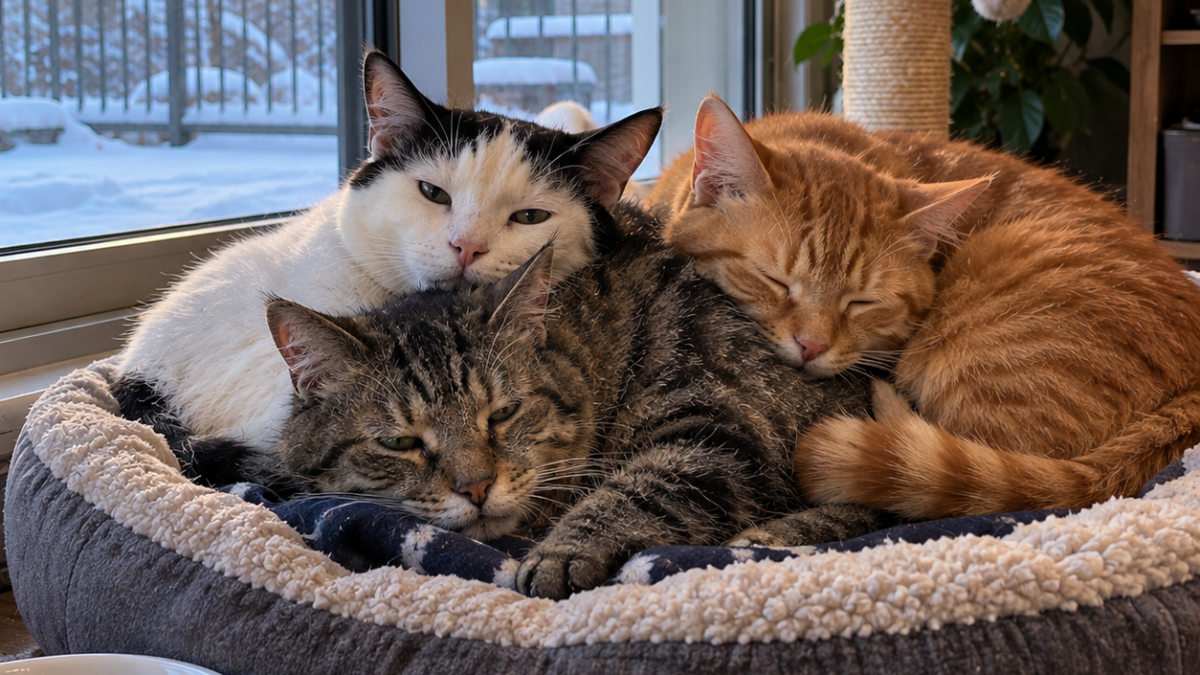
Three cats.
One bed.
White.
Orange.
Tabby.
A ridiculous pile of fur.
Otis on the bottom.
Mabel pressed against him.
Rusty draped across both like he’d invented the arrangement.
Within minutes, they were asleep.
I sat on the laundry-room floor and watched them.
That’s one of the moments I remember most clearly.
Not because anything dramatic happened.
Because nothing did.
Three animals who had spent months surviving outdoors entered a warm room.
And instead of panicking, they slept.
Together.
Like they had been waiting for permission to stop being cold.
I left the door to the rest of the apartment closed that night.
Mostly.
I checked them every hour.
At midnight, still asleep.
At two, Mabel awake.
Rusty eating.
Otis sleeping.
At four, all three piled together again.
Around six, I woke on the couch.
Apparently, I’d fallen asleep without meaning to.
I opened the garden door.
Just in case.
I wanted them to have a choice.
Cold air rushed into the laundry room.
Mabel approached first.
She stood at the threshold.
Looked outside.
Snow covered the courtyard.
She sniffed.
Then turned away.
Rusty came next.
Poked his head out.
His whiskers moved.
He backed up.
Otis?
Didn’t get out of bed.
I laughed.
“Okay.”
I closed the door.
That was the beginning of indoor life.
Not the end of the problems.
Just the beginning.
The first issue was the litter box.
Mabel understood immediately.
Rusty understood after watching Mabel.
Otis looked at the litter as though I had installed a sandbox for no reason.
Then used the bathmat.
Twice.
I bought a second litter box.
Then a third.
Problem solved.
Apparently, cats prefer options.
The next issue was nighttime.
Rusty believed two in the morning was recreational.
He discovered the hallway.
Then the couch.
Then a lightweight decorative bowl on my coffee table.
The bowl did not survive.
Mabel found the windowsill.
Within twenty-four hours, she had claimed it.
Otis explored more slowly.
He mapped the apartment room by room.
Always stopped at transitions.
Carpet to tile.
Doorway.
Corner.
He preferred walls.
Maybe years outside had taught him never to cross open space casually.
I kept the environment quiet.
No visitors for the first week.
No chasing.
No forced touching.
Stephanie came over on day four.
She sat on the floor.
Mabel watched from the windowsill.
Rusty hid behind my couch.
Otis walked toward Stephanie.
Sniffed her shoe.
Then sat beside it.
She smiled.
“So he’s the ambassador.”
“He started everything.”
She watched him.
“He may have lived with people before.”
“Why?”
“Feral cats don’t usually make this kind of transition so quickly at his age.”
“How old?”
“Hard to tell without an exam.”
We scheduled veterinary appointments.
That required carriers.
Carriers required betrayal.
At least, according to the cats.
Mabel went in after food bribery.
Rusty required twenty minutes of negotiation and a towel.
Otis walked into his because I placed a blanket inside.
I told him:
“You’re making the others look bad.”
He sat down.
The veterinarian scanned them.
No microchips.
Mabel:
Female.
Approximately three.
Healthy overall.
Underweight.
Evidence she’d likely had kittens at some point.
Rusty:
Male.
Maybe two.
No major issues.
Some dental tartar.
Very healthy considering his life outside.
Otis:
Male.
Estimated eight to ten.
Old fracture in his left rear leg that had healed badly.
Arthritis.
A few missing teeth.
Ear scars.
No active injury.
That was the good news.
The bad news came from bloodwork.
Otis had early kidney disease.
Not severe.
Manageable.
But it explained some of his thinness and fatigue.
The vet said:
“He’s probably been compensating for a long time.”
I looked at him sitting on the exam table.
He pressed his forehead into my hand.
“Can we treat it?”
“Yes.”
Diet.”
“Hydration.”
“Monitoring.”
“Maybe medication later.”
I nodded.
“Do it.”
The veterinarian asked:
“Are these your cats now?”
I looked at the three carriers.
Then at Stephanie.
“I don’t know.”
Stephanie laughed.
The vet smiled.
“You bought three carriers.”
Fair point.
We still checked lost-animal databases.
Posted again.
Waited.
No owner came forward.
Then came the spay and neuter appointments.
Vaccinations.
Parasite treatment.
Microchips registered to me.
That last part felt strangely official.
I typed my name.
Address.
Phone number.
Emergency contact.
Then stared at the screen.
Three cats.
Mine.
Somewhere along the way, temporary had changed meaning.
I hadn’t decided it.
It had happened quietly.
Mabel became the ruler of the windowsill.
Every morning, she sat behind the curtain watching birds.
If I opened the blinds late, she stared at me until I corrected the error.
Rusty became obsessed with food.
Not ordinary interest.
Spiritual commitment.
Breakfast at seven?
At five-fifteen he began preparing.
First:
Sit beside bed.
Then:
Stare.
Then:
One paw on mattress.
Then:
Tiny sound.
If ignored:
Walk across my chest.
If still ignored:
Knock something off nightstand.
I started sleeping with fewer objects beside the bed.
Otis changed the most.
Outside, he’d looked rough.
Older than he probably was.
Always braced.
Indoors, his coat improved.
The dull fur became soft.
His face relaxed.
He gained weight.
The limp remained but became less pronounced with arthritis management.
And he discovered my bed.
The first time it happened, I woke at three in the morning with weight against my legs.
I assumed Rusty.
Opened my eyes.
Otis.
Curled beside my knee.
I didn’t move.
He slept there until morning.
The next night, same thing.
Then he moved closer.
Within a month, he slept beside me almost every night.
Usually against my ribs.
Sometimes on my pillow.
He snored.
Tiny.
Barely audible.
I loved it.
That surprised me.
Remember, I liked silence.
I had built a life around not being needed.
Cats changed that without asking permission.
Mabel needed her window opened.
Rusty needed food approximately every twenty minutes.
Otis needed kidney-support food, water fountains, medication eventually, and a warm place for his joints.
Routine appeared around them.
Morning feeding.
Litter.
Water.
Evening meal.
Medication.
Play.
Bed.
My apartment stopped feeling quiet.
It started feeling occupied.
There’s a difference.
Months passed.
Spring came.
The first warm day, I opened the garden door.
Mabel walked to it.
Sat.
Rusty approached.
Otis remained on the couch.
I wondered whether they’d want outside.
Mabel stepped onto the patio.
I followed.
She sniffed the grass.
Walked maybe ten feet.
Then returned.
Rusty went farther.
Chased a leaf.
Looked under the old planter.
Then came back inside.
Otis eventually wandered to the threshold.
Looked out.
Turned around.
Went to bed.
Apparently, he’d made his position clear.
After that, I stopped worrying that I was imprisoning them.
The door could open.
They preferred home.
I built a screened patio enclosure later so they could sit outside safely.
Mabel loved it.
Rusty hunted insects with the seriousness of a military operation.
Otis slept in the sun.
I sometimes sat there with them in the evening.
The same courtyard.
Same bicycle rack.
Same garages.
Different life.
Neighbors began recognizing them.
One woman said:
“Oh, you took in those three strays?”
“I guess.”
She laughed.
“You guess?”
“I didn’t exactly hold interviews.”
People asked:
“Which one did you rescue first?”
That question always confused me.
Mabel appeared first.
Otis trusted first.
Rusty adapted fastest.
Who was first?
I didn’t know.
The truth was, I didn’t choose any of them.
I didn’t go to a shelter.
Didn’t look through photographs.
Didn’t decide I wanted a white cat, an orange cat, and an old tabby.
They simply appeared.
Then stayed long enough for me to notice.
Maybe that’s what rescue often looks like.
Not heroic.
Not dramatic.
A bowl placed outside.
An insulated box.
A door left open.
An old animal sitting beside your shoe.
Small decisions repeated until suddenly there is no longer a question of whether somebody belongs.
One summer evening, Stephanie visited.
She hadn’t seen them in several months.
Mabel was on the windowsill.
Rusty was lying beside the refrigerator for reasons known only to him.
Otis was asleep on my couch.
Stephanie stared.
“What?”
I asked.
“That cat.”
“Which?”
“Otis.”
“What about him?”
“Do you remember what he looked like outside?”
I did.
Thin.
Matted.
Eyes tired.
Always ready to disappear.
She walked over.
Otis woke.
Looked at her.
Then rolled partly onto his side.
Stephanie scratched his cheek.
“He looks five years younger.”
I smiled.
“He acts seventy.”
“He is seventy in cat years.”
“That explains the judgment.”
She looked around.
“You know, when you called me, I assumed you’d foster them.”
“I assumed that too.”
“And?”
“No one told them.”
She laughed.
That night, I thought about the word foster.
Temporary care.
Bridge.
Safe place until permanent home.
Maybe I had been the foster home.
Then the cats simply refused the next stage.
Or maybe I did.
I had opportunities to adopt Mabel and Rusty out.
Young.
Healthy.
Friendly after settling.
They would have found homes.
Otis would’ve been harder.
Older.
Chronic kidney disease.
Arthritis.
People love kittens.
Senior cats wait.
I told myself I couldn’t separate them.
That was partly true.
They slept together.
Groomed each other.
Rusty followed Mabel everywhere.
Otis seemed calmer when the other two were nearby.
But the bigger truth was:
I didn’t want them to leave.
Admitting that took me embarrassingly long.
One night, I looked at them piled together in that same ridiculously small bed.
Yes.
They still used it.
I had purchased three larger beds.
Expensive ones.
Memory foam.
Washable covers.
They preferred the smallest original bed.
All three.
I watched Rusty’s leg hanging over the edge.
Mabel’s face pressed against Otis’s shoulder.
Then said aloud:
“You’re not going anywhere, are you?”
Rusty opened one eye.
That was apparently consent.
The first anniversary of their arrival brought snow.
I remembered the planter.
So I went outside.
The old insulated shelter still sat in storage.
I’d kept it.
No reason.
Sentimental, maybe.
I brought it out.
Cleaned it.
Set it near the patio for one afternoon.
Mabel sniffed it.
Rusty climbed on top.
Otis ignored it completely.
I sat beside the shelter.
Thought about that first winter.
How close I’d come to assuming somebody else would help.
That’s uncomfortable to admit.
The first several times I saw them, I did nothing.
I thought:
Someone feeds them.
They probably belong somewhere.
Outdoor cats manage.
Not my problem.
All understandable.
But wrong.
The snow forced the truth into view.
They were cold.
Otis was injured.
Nobody was coming.
Sometimes compassion begins when distance stops being comfortable.
The old planter had hidden how vulnerable they were.
Snow exposed it.
I still didn’t become some animal rescue expert.
I didn’t start taking home every stray cat.
You can’t solve everything.
But I did start paying attention.
I began donating to Stephanie’s rescue group.
Helped build winter shelters.
Transported cats to appointments occasionally.
Not because I owed the universe repayment.
Because now I understood how much difference small infrastructure can make.
A plastic tote.
Straw.
Food.
Water.
A spay appointment.
A microchip scan.
Nothing glamorous.
But survival is built from ordinary things.
Otis’s kidney disease progressed slowly.
At first, special food and hydration were enough.
Then medication.
More bloodwork.
Subcutaneous fluids later.
I learned how to do them at home.
The first time, I hated it.
Needle.
Fluid bag.
Otis looked at me like I’d betrayed every treaty between us.
Then accepted a treat afterward.
Our relationship recovered.
He aged.
His face became lighter around the muzzle.
Jumping onto the bed grew difficult.
I bought pet stairs.
He ignored them.
I bought a ramp.
Ignored that too.
Eventually, I put a small ottoman beside the bed.
Apparently, that met his architectural standards.
He used it every night.
Mabel remained healthy.
Rusty became enormous.
Not obese, according to the vet.
“Sturdy.”
I called him orange furniture.
He became deeply offended if meals were delayed by more than forty-five seconds.
Mabel remained suspicious of strangers.
But not me.
She eventually slept on my lap.
Only when she chose.
Any attempt to move her resulted in a look suggesting eviction proceedings.
Years passed.
More than two.
Then three.
Then five.
The cats became the timeline of my life.
New job.
Rusty slept on the laptop during remote interviews.
Flu.
Mabel sat at my feet.
Breakup.
Otis stayed beside me all night.
My father visited and claimed he didn’t like cats.
By the end of the weekend, he was letting Rusty lick yogurt from a spoon.
I took photographs.
For leverage.
The apartment changed too.
Cat tree.
Scratching posts.
Water fountain.
Blankets.
Toys beneath every piece of furniture.
Hair on everything I owned.
Silence?
Gone.
I stopped missing it.
Then came the day the veterinarian told me Otis’s kidneys were getting worse.
I knew it would happen.
Knowing does not make hearing easier.
He had lost weight.
More tired.
Drinking constantly.
Blood values worsening.
We adjusted treatment.
He rallied.
Months.
Then another decline.
I sat on the exam-room floor with him.
The vet, Dr. Patel, said:
“We’re not at the end today.”
I nodded.
“But we’re closer.”
“Yes.”
“What should I watch?”
She gave me the list.
Eating.
Hydration.
Mobility.
Hiding.
Pain.
Interest in people.
Good days versus bad.
I knew the concept.
Quality of life.
Still hated it.
At home, Otis slept beside me.
Mabel groomed his ears.
Rusty pressed against him.
The three-cat pile had become less common as they aged.
That night, it returned.
All three in one bed.
Same old bed.
I sat on the floor.
Otis opened his eyes.
Reached one paw toward me.
I put my hand beside him.
He rested the paw on my fingers.
Maybe accidental.
Still counted.
We had almost another year.
Good year.
Slower.
Quieter.
Otis spent more time sleeping in sunlight.
He still ate.
Still came to bed.
Still followed me into the kitchen.
Then one February morning, he didn’t.
I put food down.
Mabel came.
Rusty came.
Otis stayed in bed.
He looked at me.
I brought the bowl to him.
He sniffed.
Turned his head.
My stomach dropped.
I called the vet.
That afternoon, we sat in a quiet room.
I had brought his blanket.
Mabel and Rusty stayed home.
Dr. Patel examined him.
More tests.
The kidneys were failing.
There were treatments we could attempt.
Hospitalization.
IV fluids.
Possibly a few more weeks.
Maybe months.
Maybe not.
I looked at Otis.
He was exhausted.
Not terrified.
Just tired.
I asked:
“If he were yours?”
Veterinarians hate that question.
But she answered.
“I’d think about whether you’re extending his life or extending the process of dying.”
That was enough.
I held him.
The cat who had once refused to move from a freezing flower planter.
The cat who had sat beside my shoe without letting me touch him.
The cat who had walked into my laundry room and immediately chosen the smallest bed.
He put his face against my chest.
I whispered:
“You did good.”
Ridiculous thing to say.
Still true.
He had survived long enough to become old somewhere safe.
That was good.
The medication made him sleepy.
Then still.
I stayed for a long time.
When I came home, Mabel and Rusty searched for him.
That was worse than I expected.
Mabel walked through every room.
Rusty sat by the carrier.
I put Otis’s blanket in the little bed.
Both cats slept there that night.
I slept badly.
For weeks, the apartment felt wrong.
Still occupied.
But missing one specific weight.
At night, I would wake expecting Otis beside my ribs.
Nothing.
The silence I once loved had returned in one small place.
I hated it.
Mabel changed after he died.
She became more affectionate.
Rusty too.
Maybe they were grieving.
Maybe I was projecting.
Didn’t matter.
We stayed close.
I had Otis cremated.
His ashes came in a simple wooden box.
I put it on a shelf above the laundry room.
Not hidden.
Not shrine-like.
Just present.
Beside it, I placed a photograph.
The three of them in the tiny bed.
Mabel almost invisible beneath Rusty.
Otis in the center.
That photograph still makes me laugh.
Two years later, Mabel and Rusty are still with me.
Mabel owns the windowsill.
Some things never change.
Rusty still believes every meal is three hours late.
Also unchanged.
I still open the garden door sometimes when weather is good.
Mabel sits at the threshold.
Rusty wanders into the screened patio.
Neither tries to leave.
The old outdoor shelter is gone now.
I donated it to another colony caretaker.
The flower planter was replaced by the building years ago.
The bicycle rack is still there.
Sometimes I stand on the balcony around five.
The same time Mabel used to appear.
I look down and try to remember exactly how small she was.
How nervous.
How impossible it seemed that the three cats would ever let me near them.
People still ask:
“Which one did you rescue first?”
I still don’t have an answer.
Mabel appeared first.
Otis trusted first.
Rusty followed.
Maybe I rescued Otis when I brought him inside.
Maybe Mabel rescued Rusty by leading him toward food.
Maybe Otis rescued all three when his decision to trust taught the others I wasn’t dangerous.
Or maybe rescue is the wrong direction entirely.
Because those cats changed me in ways I didn’t understand until much later.
Before them, I had spent years protecting my independence.
No responsibilities I couldn’t leave.
No pet.
No permanent attachments.
No one relying on me.
I called it freedom.
Sometimes it was.
Sometimes it was loneliness with better marketing.
Then three animals began waiting beneath my balcony.
They needed food.
I gave food.
They needed shelter.
I built shelter.
They needed warmth.
I opened the door.
And in return, they made my apartment into somewhere I wanted to come home to.
Otis did that most of all.
He never made a dramatic choice.
He simply stopped running.
One evening.
Beside my shoe.
That tiny decision changed everything.
I sometimes wonder what happened to them before they found my building.
Was Mabel abandoned?
Did Rusty grow up outside?
Had Otis once belonged to somebody?
His comfort with people suggested maybe he had.
Was he lost?
Left?
Did someone love him once?
I’ll never know.
For a while, that bothered me.
Then I realized the beginning of his life didn’t need solving for the end to matter.
Whatever happened before, his last years were warm.
He had food.
Medication.
Sunlight.
Two cats piled on top of him.
A bed he refused to share appropriately.
And somebody who knew where he was every night.
That’s enough.
There is a strange arrogance in believing every rescue story needs the rescuer to be heroic.
I wasn’t.
I was slow.
I watched them for days before acting.
I made mistakes.
Fed the wrong food at first.
Bought useless beds.
Had no idea how litter boxes worked.
Nearly lost my mind trying to put Rusty in a carrier.
I didn’t save them through expertise.
I stayed consistent.
That was the useful part.
Food at the same time.
Water.
Same voice.
Same door.
No grabbing.
No forcing.
No punishment when they were scared.
Over time, predictability became trust.
People underestimate predictability.
For animals who’ve spent their lives not knowing what happens next, boring can be beautiful.
Breakfast comes.
Water is clean.
Nobody hits you.
Door doesn’t slam.
Bed remains.
Person returns.
Again.
Again.
Again.
Eventually the nervous system notices.
Maybe humans aren’t so different.
Otis taught me that without trying.
His trust wasn’t instant.
That made it valuable.
The first time he sat beside my shoe, he wasn’t saying:
I love you.
He was saying:
For the next thirty seconds, I don’t think you’re going to hurt me.
That was enough.
Then a minute.
Then a touch.
Then a bed.
Then years.
Trust built in tiny increments until one day he slept with his back against my chest, completely unconscious, because somewhere along the way he had stopped calculating escape routes.
That may be the greatest gift an animal can give a person.
Not affection.
Safety.
The willingness to become vulnerable beside you.
I think about that whenever someone tells me:
“They’re just cats.”
Yes.
They are cats.
Not human children.
Not replacements for people.
Not magical therapists.
Cats.
Animals with their own needs and limitations.
And that is enough too.
Something doesn’t have to be human to matter.
A relationship doesn’t have to speak your language to change you.
Mabel taught me patience.
Rusty taught me to secure all food cabinets.
Otis taught me that old, injured things are not finished.
The last one matters most.
When I first saw him, he looked like the least adoptable.
Older.
Limping.
Rough coat.
Chronic health problems.
If I’d walked into a shelter choosing among cats, I might have chosen Rusty.
Young.
Healthy.
Funny.
Or Mabel.
Small.
Beautiful.
Otis?
Maybe I’d have looked at the medical notes and thought:
I travel.
I work.
That’s a lot.
But I wasn’t given a menu.
He was simply there.
And because I got to know him before I had to decide what he was “worth,” the calculation never happened.
He wasn’t an elderly cat with kidney disease.
He was Otis.
Once somebody has a name, numbers become harder.
Eight years old.
Ten.
Medication cost.
Vet bills.
Those things still matter.
But they stop being the whole description.
That’s one reason I tell people to consider older animals.
Not because adopting them is always easy.
It isn’t.
You may get fewer years.
More veterinary care.
Harder endings.
But fewer years doesn’t mean less relationship.
Otis gave me almost seven years indoors.
I would’ve taken seven months.
The value wasn’t duration.
It was that he got to stop surviving.
I got to watch that happen.
Even now, I sometimes see a dark shape at the edge of my bed and think it’s him.
Usually a blanket.
Mabel occasionally sleeps where he did.
Rusty almost never does.
Maybe they remember too.
Maybe cats don’t think about absence in the same narrative way people do.
Again, I don’t know.
Not knowing is okay.
I used to need explanations.
Now I need fewer.
The first cat appeared beneath my balcony in November.
Three days later, there were two.
Then three.
No plan.
No decision.
No moment where I said:
I will adopt these animals.
There were only small choices.
Chicken.
Shelter.
Water.
Sitting outside.
A door.
Then another day.
And another.
Eventually, the answer had been made by repetition.
They belonged.
Today, Mabel is asleep on the windowsill while I write this.
She is older now.
White fur still clean.
Black ears slightly gray around the edges.
Rusty is in the kitchen.
I know because I can hear something I should probably investigate.
He remains committed to crime.
Above the laundry-room door is Otis’s box.
Underneath it sits a newer cat bed.
Mabel sometimes uses it.
Rusty doesn’t fit.
I kept the original little bed until the fabric finally tore beyond repair.
Throwing it away felt ridiculously difficult.
Three cats had spent years refusing every sensible bed in favor of that stupid tiny thing.
Eventually, I cut a small square from the fabric.
It’s tucked behind Otis’s photograph.
Sentimental?
Definitely.
I no longer pretend otherwise.
Sometimes people ask whether I’ll adopt another cat after Mabel and Rusty are gone.
I don’t know.
Maybe.
Maybe not.
I won’t try to replace them.
You can’t.
Every relationship changes the shape of the space it leaves.
But I know this much.
If another animal appears beneath my balcony in winter, I won’t spend three days pretending it probably belongs to someone else.
I’ll check.
I’ll ask.
I’ll put food out.
I’ll make the call.
Because the first time, I almost missed what was happening.
I thought I was looking at three neighborhood cats.
I was actually watching a family try to survive.
And when I finally opened my door, I thought I was giving them somewhere warm to stay.
I didn’t understand that they were giving me something too.
A reason to return home.
A routine.
Noise.
Responsibility.
Companionship.
And one old tabby who taught me that trust doesn’t always arrive with purring or affection.
Sometimes it just walks slowly across frozen concrete, stops beside your shoe, and decides not to run.
That was Otis’s first gift to me.
The last one came years later when I held him at the end and realized something I had never understood when I first saw him beneath the balcony.
Rescue isn’t always about keeping someone alive forever.
Sometimes it’s about making sure that when life finally becomes too heavy, they don’t face the cold alone.
Mabel, Rusty, and Otis found my building together.
They survived winter together.
They entered my apartment together.
And for years, every time I bought them separate beds, they ignored me and piled themselves into one.
Maybe that was the answer all along.
Whenever someone asks which cat I rescued first, I still don’t know what to say.
Because I didn’t choose Mabel.
I didn’t choose Rusty.
I didn’t choose Otis.
They arrived as three frightened animals beneath a balcony.
Then the oldest one stopped running.
The others followed.
And somehow, without any of us deciding exactly when it happened, the place I had always called my apartment became our home.








