We Found the Missing Boy Alive—Then He Told Us Why the Stray Dog’s Face Was Swollen.K
PART2:
Amy had volunteered with our K9 unit for years.
She knew animal trauma.
She knew snakebites.
And the look on her face told me immediately this was bad.
“How long?” I asked.
She remained six feet away from the dog.
“Judging by that swelling? Hours.”
“How many?”
“I don’t know.”
She looked at his breathing.
“Maybe most of the night.”
The dog tried lifting himself again.
His front legs trembled.
Amy raised one hand.
“Don’t rush him.”
“He’s guarding the boy.”
“I know.”
Behind us, searchers were coming down the wash.
Someone whispered:
“Is that a coyote?”
“No,” another deputy said. “That’s the stray from the campground.”
I remembered Leo’s father talking about him.
A sandy-colored dog had been hanging around their campsite the previous afternoon.
Thin.
Dirty.
No collar.
Leo had tried feeding him crackers.
His father, Daniel, had shooed the animal away twice because they didn’t know whether he was friendly.
At the time, none of us had thought much about it.
Campgrounds attract strays.
Lost dogs.
Dumped dogs.
Dogs that follow food.
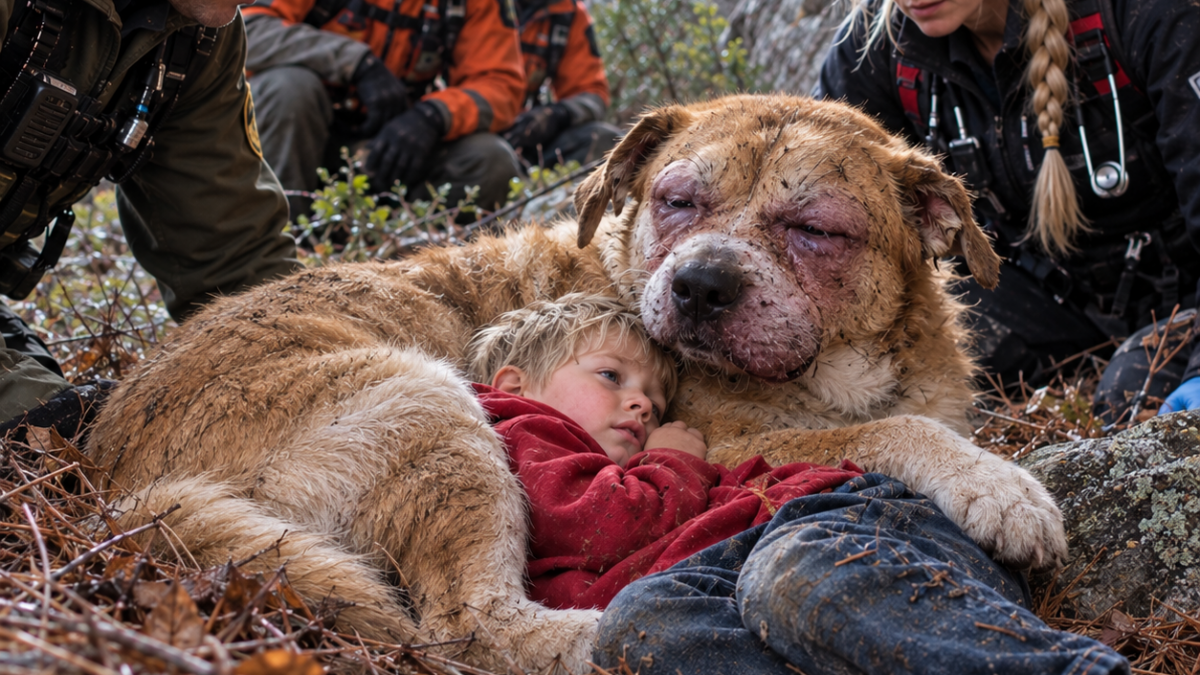
Now that same animal was curled around Daniel’s missing son.
I keyed my radio.
“I’ve got the child.”
My voice sounded strange even to me.
“Alive.”
Static.
Then dispatch came back immediately.
“Confirm child alive?”
“Affirmative.”
Behind me, somebody started crying.
I didn’t turn.
“Need medical team moving toward my location.”
Then:
“Also veterinary emergency.”
That wasn’t something I had ever said over a search radio before.
Amy lowered herself onto one knee.
The dog gave another weak growl.
She spoke softly.
“Easy, buddy.”
His ears twitched.
“I’m not taking him.”
The dog stared at her through swollen slits.
Then Leo moved.
At first, just his fingers.
Then his shoulder.
He yawned.
A tiny, completely ordinary yawn.
The kind my own kids used to make when I carried them from the car.
I felt something unclench inside my chest.
Leo rubbed one eye with a dirty fist.
Three animal crackers fell from the pocket of his hoodie.
He looked around at all of us.
Orange search vests.
Uniforms.
Medical packs.
Flashlights.
Strangers.
Then he turned toward the dog.
His small hand touched the swollen side of the animal’s neck.
“Buddy?”
The dog stopped growling.
Leo looked at me.
“Don’t hurt him.”
“No one’s hurting him.”
“He saved me.”
Every adult in that wash went silent.
Amy leaned forward slightly.
“What happened, sweetheart?”
Leo looked at the dog.
Then at the pine needles.
“There was a snake.”
My stomach dropped.
Amy and I exchanged a look.
“What kind of snake?” I asked gently.
Leo shrugged.
“Loud one.”
“Did it make a shaking sound?”
He nodded.
“Like this.”
He moved his hand back and forth.
Rattle.
Amy closed her eyes for half a second.
Leo continued.
“I wanted to see it.”
Of course he did.
He was four.
“Buddy pushed me.”
“How?”
“He jumped.”
Leo pointed toward his own chest.
“He went in front.”
Then he touched the dog’s swollen face.
“The snake got him.”
I looked at Amy.
She whispered:
“Facial strike.”
Leo didn’t understand.
He kept talking.
“He cried.”
That sentence hit me.
“He cried?”
Leo nodded.
“Then he didn’t let me go.”
“What do you mean?”
“When I walked, he walked.”
He paused.
“When I sat, he sat.”
Then:
“When I got cold, he laid on me.”
One volunteer turned away.
Another covered her mouth.
We had spent the entire night searching for a missing child.
The stray dog had apparently spent the same night doing something else.
Keeping him alive.
Amy moved closer.
Very slowly.
The dog growled again.
Leo stroked his neck.
“No.”
The dog stopped.
Leo looked at Amy.
“He’s nice.”
“I believe you.”
“He doesn’t like strangers.”
“I noticed.”
That got a few weak laughs.
Amy reached into her pack.
“I need to help his face.”
Leo immediately said:
“No needles.”
“Maybe one.”
“No.”
“Leo.”
He frowned.
“Buddy doesn’t like needles.”
I asked:
“Do you?”
“No.”
“Then you have something in common.”
That almost made him smile.
Amy took out a soft slip lead.
Not a pole.
Not anything intimidating.
She set it on the ground in front of her.
Then she put several pieces of soft food beside it.
The dog didn’t move.
His breathing was shallow.
Fast.
The swelling around his muzzle made every breath look more difficult than the last.
Amy whispered:
“We don’t have much time.”
I knew.
The helicopter could not safely land in the wash.
The nearest road access was uphill.
We had to move both of them.
But the dog was still guarding Leo.
And Leo had clearly decided that if we tried separating them, we were going to have a problem.
So we didn’t.
First, our paramedic checked Leo where he sat.
Core temperature low but not dangerously so.
Mild dehydration.
Scratches.
No broken bones.
No snakebite.
No serious injury.
Miraculously.
He had spent a freezing night in the forest with one shoe.
His right sock was torn.
His foot was scraped.
But he was alive.
The dog had taken the cold with him.
Maybe more than the cold.
I asked Leo:
“Can I carry you?”
He looked at Buddy.
“Can he come?”
“Yes.”
That answer was easy.
We wrapped Leo in a thermal blanket.
The dog watched every movement.
Then Amy tried getting the slip lead around him.
He snapped once.
Weakly.
Not close enough to contact.
Then collapsed.
Leo whispered:
“Buddy.”
The dog lifted his head.
That was the moment Amy stopped treating him like a defensive stray and started treating him like a patient running out of time.
She moved.
Fast.
Towel over shoulders.
Slip lead.
Another rescuer supported his body.
The dog struggled once.
Then stopped.
He had nothing left.
His entire body sagged.
Amy placed two fingers against his chest.
“Pulse is fast.”
“How fast?”
“Too fast.”
She looked at gums.
Pale.
“Possible shock.”
Leo started crying.
Not loud.
Just tears.
“Is Buddy dying?”
Nobody wants to answer that question from a four-year-old.
Especially when the honest answer is:
Maybe.
Amy looked straight at him.
“We’re going to work very hard to help him.”
Good answer.
Not a promise.
Not a lie.
We loaded Buddy onto a soft rescue litter.
Leo refused to be carried separately.
So I carried Leo while another team carried Buddy directly beside us.
Every few steps, Leo leaned over to look.
“Buddy.”
The dog’s ear twitched.
“Buddy.”
Another twitch.
That became our climb out.
Leo saying his name.
Buddy answering with one ear.
We reached the upper trail around 7:05.
Daniel and Rachel Hartman were waiting near the command area because someone had radioed ahead.
I will never forget Rachel’s scream when she saw Leo.
Not fear.
Not exactly.
Something deeper.
The sound a person makes when nineteen hours of terror break apart all at once.
She ran.
Daniel followed.
I put Leo down.
Rachel dropped to her knees and pulled him against her.
“Baby.”
“Mommy.”
“Oh, God.”
She buried her face in his hair.
Daniel wrapped both of them in his arms.
He was crying so hard he couldn’t speak.
Then Leo twisted around.
“Buddy!”
Rachel looked up.
The rescue team was carrying the dog toward Amy’s vehicle.
Leo fought out of her arms.
“Buddy!”
Rachel grabbed him.
“Leo, wait.”
“He saved me!”
Daniel froze.
“What?”
“The snake got him.”
Daniel looked at the dog.
Then at me.
His face changed.
“You said…”
“I know what you said yesterday.”
He had told us about the stray.
Told us he’d chased him away.
Twice.
Now his eyes followed Buddy.
“Oh, God.”
Leo started struggling.
“I have to go.”
Rachel held him.
“Sweetheart, you’re going to the hospital.”
“No!”
“You need to be checked.”
“Buddy needs me.”
Amy came over.
She had blood on one sleeve from starting an IV line in the dog.
Not much.
Enough for Leo to notice.
“Is that Buddy?”
“He’s getting medicine.”
“He’s coming?”
“To the animal hospital.”
“I want to go.”
Rachel looked at Amy.
Amy looked at me.
Then Daniel said:
“We’ll go wherever he goes.”
Rachel nodded immediately.
Medical staff weren’t thrilled.
Leo needed evaluation at Yavapai Regional.
Buddy needed an emergency veterinary clinic capable of managing envenomation.
Two different facilities.
So we split.
Leo went with his parents in the ambulance.
Buddy went with Amy.
Daniel took my arm before leaving.
“Sergeant.”
“Yes?”
“That dog—”
His voice broke.
“He was there yesterday.”
“I know.”
“I chased him.”
“You didn’t know.”
“He came back.”
“Yes.”
Daniel looked toward Amy’s vehicle disappearing down the road.
“Why would he come back?”
I didn’t have an answer.
Maybe crackers.
Maybe Leo.
Maybe because abandoned dogs learn to follow kindness wherever they find it.
Maybe no reason we could understand.
I said:
“He came back.”
That was all.
Leo reached the hospital around eight.
His physical condition was surprisingly good.
Mild hypothermia.
Dehydration.
Small abrasions.
One blistered foot.
No head injury.
No broken bones.
No evidence of abuse or animal attack.
He was kept for observation.
The dog was another story.
Amy later told me she nearly lost him twice on the drive.
His blood pressure dropped.
Breathing became harder as swelling progressed.
The snake had struck high on the left side of his muzzle.
Two punctures.
Because rattlesnake venom causes tissue damage, swelling, pain, and potentially dangerous effects on blood and circulation, the clinic treated aggressively.
Antivenom.
IV fluids.
Pain control.
Monitoring.
Oxygen.
Blood testing.
The staff shaved a section near the bite.
Cleaned him.
Searched for identification.
No microchip.
No collar mark.
No tattoo.
Nothing.
Just scars.
Old ones.
Thin body.
Toenails worn unevenly.
Evidence he had been living outside for a while.
A technician took photographs for intake records.
When Amy showed me later, I barely recognized the dog from the forest.
The swelling was worse.
His eyes completely closed.
His tongue protruded slightly because his muzzle had ballooned around it.
But his chest was still moving.
That mattered.
Leo asked about him every five minutes.
Rachel eventually called the veterinary clinic from the pediatric floor.
Amy answered.
“How is he?”
“Alive.”
Rachel closed her eyes.
Leo heard.
“Alive?”
“Yes.”
“Can I talk to him?”
Rachel looked helplessly at the phone.
Amy put the call on speaker.
“Leo?”
“Buddy?”
“He can hear you.”
Maybe.
Maybe not.
It didn’t matter.
Leo leaned toward the phone.
“You’re okay.”
Pause.
“You’re a good boy.”
Then:
“I didn’t go near the snake.”
Rachel looked at him.
“After?”
“No.”
“Because Buddy told me.”
“How?”
“He barked.”
Leo frowned.
“He pushed me back.”
Then he said the line that explained most of the night.
“He wouldn’t let me walk that way.”
We reconstructed the rest slowly.
Not through interrogation.
A four-year-old’s memory doesn’t arrive in clean chronology.
It comes in fragments.
A blue butterfly.
A stick shaped like a sword.
A squirrel.
A hill.
A creek.
Buddy.
The snake.
Cold.
Crackers.
Trees.
Dark.
Based on search tracks and where we found them, Leo had apparently followed something away from camp shortly before noon.
Maybe the stray.
Maybe a bird.
Maybe nothing.
He drifted downhill.
Lost sight of camp.
Kept moving.
At some point, the dog found him.
Or had followed him.
By late afternoon, they were near the wash.
That’s where Leo saw the rattlesnake.
Most likely a western diamondback or prairie rattlesnake, though nobody ever found it.
Leo approached.
Buddy intercepted.
The snake struck the dog in the face.
Afterward, Buddy apparently prevented Leo from moving toward that area.
Then, as evening cooled, the dog stayed with him.
Leo remembered crying for his mother.
He remembered Buddy licking his cheek.
He remembered sharing animal crackers.
He remembered trying to walk uphill but becoming tired.
Then Buddy led him beneath the granite overhang.
That last part was uncertain.
Leo said:
“He showed me the cave.”
It wasn’t a cave.
Just a shallow recess beneath granite.
But it blocked wind.
Dry pine needles insulated the ground.
And the dog curled around him.
A medium-sized dog doesn’t produce enough heat to replace real shelter.
But wrapped around a four-year-old?
It helped.
A lot.
I have no doubt.
Searchers had passed within maybe three hundred yards during the night.
One team heard coyotes.
Another heard something barking far off.
Could have been Buddy.
Could have been another dog.
We’ll never know.
Around noon, Leo was discharged.
Rachel wanted to take him home.
Leo wanted only one thing.
“Buddy.”
The veterinary clinic initially said no visitors.
Infectious risk.
Stress.
Dog unstable.
Then Amy called.
“Bring him.”
The family arrived around one.
I went too.
Not because I needed to.
Because I wanted to know.
The clinic had Buddy in a quiet treatment room.
IV line.
Oxygen support nearby.
His face still enormous.
He looked terrible.
But when Leo’s voice came through the doorway—
“Buddy?”
One eye cracked open.
Barely.
His head moved.
That’s all.
Leo started crying.
He approached slowly.
Amy had him sit on a stool.
“Don’t touch his face.”
“I know.”
“Gentle on the chest.”
Leo placed both hands against the dog’s shoulder.
Buddy’s tail moved.
Once.
A tiny thump.
Then again.
Daniel turned away.
Rachel covered her mouth.
I stared at the floor.
You see a lot in law enforcement.
People think that makes you harder.
It doesn’t always.
Sometimes it just means you recognize exactly how rare a good moment is when it happens.
Leo leaned against Buddy’s shoulder.
“You found me.”
The dog closed his eye.
Then Leo whispered:
“You can sleep now.”
That one got everybody.
Amy had to leave the room for a minute.
Buddy slept.
Really slept.
Head down.
No guarding.
No growling.
No trying to stand.
For the first time since we found him, he apparently believed somebody else was watching Leo.
The next twenty-four hours were uncertain.
Snakebite swelling can worsen.
Blood clotting can change.
Tissue can die.
Kidneys can be affected.
And nobody knew how much venom he’d received.
Amy warned the Hartmans.
“He is not safe yet.”
Daniel said:
“Whatever he needs.”
Amy hesitated.
“There will be costs.”
“How much?”
“We don’t know.”
“Do it.”
“Daniel—”
He looked at her.
“That dog kept my son alive.”
“Do whatever he needs.”
The clinic had already contacted a rescue fund because Buddy was technically an unowned stray.
Once word spread among search volunteers, money appeared from everywhere.
Deputies.
Firefighters.
Campground staff.
People who had walked trails all night.
A retired couple donated the first thousand dollars anonymously.
Then the sheriff’s association offered to cover part.
Then a local rescue organization stepped in.
By the time anyone created a public fundraiser, most of the immediate treatment had already been secured.
The story reached local news that evening.
We tried protecting Leo.
No interviews.
No dramatic reenactments.
His parents released one photograph.
Leo sitting beside Buddy’s treatment bed.
That’s all.
The caption:
He found our son before we did.
Within hours, people wanted to adopt the dog.
Hundreds.
Everyone loves a hero once the television calls him one.
I found that strange.
Twenty-four hours earlier, Buddy had been the ragged stray somebody chased from a campground.
Now he was getting adoption applications from three states.
Amy said exactly what I was thinking.
“Where were all these people when he was sleeping under picnic tables?”
Not fair, maybe.
People hadn’t known him.
Still.
Daniel and Rachel didn’t fill out an application.
They didn’t need to say anything.
We all knew.
If Buddy survived, he was going home with Leo.
The question was whether Buddy would survive.
On day two, the swelling stopped increasing.
That was the first victory.
Day three, bloodwork improved.
His kidneys were functioning.
Clotting values stabilized.
He started drinking small amounts.
Then soft food.
He hated the cone the clinic put on him.
That was another good sign.
Sick dogs don’t waste energy hating plastic.
Buddy hated it passionately.
Leo visited every afternoon.
Always carrying one animal cracker.
He wasn’t allowed to feed them to Buddy.
So he kept them in his pocket.
By day four, the swelling had decreased enough that we could see the shape of his face again.
He was maybe thirty-five pounds.
Mixed breed.
Some terrier.
Maybe cattle dog.
Maybe shepherd.
Nobody knew.
Sandy coat.
White chest.
Notched ear.
Short tail.
Amy estimated three or four years old.
He had no heartworm.
No major chronic disease.
Old scar on one rear leg.
Calluses.
Evidence of living rough.
But otherwise?
Strong.
He had survived a rattlesnake bite.
A cold night.
And whatever life had happened before Leo.
On day five, he stood without collapsing.
Leo clapped so hard a technician started laughing.
“Look!”
Buddy wobbled.
Took three steps.
Then sat.
Leo pointed.
“He can walk!”
Amy smiled.
“Yes.”
“He’s better.”
“Better.”
“Home?”
“Not yet.”
Leo sighed.
“Doctors always say that.”
Rachel laughed.
“Unfortunately.”
The story of the snake became clearer over time.
Leo told his mother one night:
“I wanted to touch its buttons.”
“What buttons?”
“The tail.”
Rachel went pale.
“You wanted to touch the rattle?”
“It was shiny.”
Then:
“Buddy yelled.”
Buddy had apparently barked and lunged between them.
The strike hit his muzzle.
The dog’s head was closer to the ground than Leo’s body.
If Buddy hadn’t moved?
I don’t like finishing that thought.
Neither did Daniel.
He struggled badly after the rescue.
Not publicly.
But I saw it.
Guilt.
He had chased Buddy away.
Then Buddy saved his son.
Daniel started visiting the clinic alone in the mornings.
He’d sit beside the kennel.
Sometimes not touch the dog.
Just sit.
One morning I stopped by and found him there.
Buddy was asleep.
Daniel said:
“I threw a stick at him.”
I sat in the chair beside him.
“What?”
“The day Leo disappeared.”
“He kept coming near the cooler.”
“I threw a stick toward him.”
“Did you hit him?”
“No.”
“But I yelled.”
He looked at Buddy.
“He still came back.”
I didn’t know what he wanted from me.
Permission to forgive himself, probably.
I wasn’t a priest.
So I said:
“You were protecting your family from an unknown dog.”
“He was protecting them better.”
“That’s hindsight.”
Daniel rubbed his face.
“I should have known.”
“No.”
“How?”
“He looked scared.”
“Daniel.”
He looked at me.
“You didn’t know.”
Silence.
“What matters is what you do now.”
That was all I had.
He nodded.
Then Buddy woke up.
Looked at him.
Daniel slowly put his hand against the kennel door.
Buddy leaned his nose toward it.
No growl.
By day seven, Buddy left the hospital.
Not permanently.
He transferred to the Hartmans’ home as a foster-to-adopt placement under the rescue organization overseeing his care.
The family had to agree to restrictions.
Quiet.
Medications.
Follow-up bloodwork.
Limited activity.
No rough play.
Monitor swelling.
Monitor appetite.
Monitor wound site.
And, because Leo was four, constant adult supervision around the dog.
Hero story or not, responsible placement still mattered.
Buddy was an adult stray with an unknown history.
The fact that he’d protected Leo didn’t mean everyone should ignore ordinary safety.
Daniel and Rachel understood.
They set up a bed in the living room.
Leo immediately dragged his own blanket next to it.
Rachel said:
“No.”
“But Buddy slept by me.”
“In the forest.”
“So?”
“You are sleeping in your bedroom.”
Leo folded his arms.
“Buddy can sleep there.”
“Eventually.”
He frowned.
“Doctors always say eventually.”
I heard that story from Rachel later.
For the first few nights, Buddy slept hard.
The kind of sleep an animal gets when it finally believes food will still exist in the morning.
He woke at small noises.
Door.
Car.
Leo coughing.
Every time Leo moved through the room, Buddy’s head came up.
If Leo disappeared down a hallway, Buddy watched until he returned.
But he wasn’t clingy.
He didn’t panic.
He simply checked.
Like a guard making sure his post was secure.
The Hartmans kept the name Buddy because Leo refused every alternative.
Daniel suggested Ranger.
Leo said no.
Rachel suggested Scout.
No.
Amy suggested Copper.
No.
Leo became offended.
“He is Buddy.”
So Buddy he remained.
Two weeks after the rescue, Buddy returned to the clinic.
The swelling was almost gone.
There was a patch of damaged tissue near the bite site, but it was healing.
His eyes were fully open.
I finally saw them properly.
Brown.
Soft.
Not fierce at all.
The dog who had growled at sixty searchers looked like the kind of animal who’d apologize for taking up too much carpet.
Leo sat beside him.
One sneaker on each foot now.
He had become intensely serious about shoes.
Rachel said he checked both feet before leaving the house.
The forest had changed him in little ways.
He hated being alone in rooms.
Asked where everyone was.
Didn’t like the dark for a while.
At bedtime, he wanted the hallway light on.
The family arranged a child therapist familiar with traumatic events.
Good.
People love stories where a rescued child runs home, hugs the dog, and everything is over.
That isn’t how fear works.
Leo was physically okay.
That didn’t mean the nineteen hours disappeared from his mind.
Some nights he woke crying.
Sometimes he talked about the snake.
Sometimes he couldn’t explain.
Buddy helped.
Not as therapy by magic.
Just presence.
When Leo had nightmares, Rachel would sometimes find him sitting on the hallway floor with Buddy beside him.
The dog wouldn’t be in the bed.
They kept that boundary.
But Buddy would lean against the child.
Leo would put one hand on the white patch of his chest.
Then breathe.
Rachel told me:
“He doesn’t ask questions.”
That’s what dogs are good at.
They don’t demand explanations for things you don’t understand yourself.
A month after the rescue, the Hartmans came back to Lynx Lake.
Not to camp.
Just for an hour.
Their therapist had suggested returning in a controlled way if Leo seemed ready, so the forest didn’t become a monster in his mind.
I met them.
So did Amy.
Buddy came on leash.
His coat had filled out.
He wore a bright blue harness.
Leo held Daniel’s hand.
At first, he was quiet.
Then he saw a picnic table.
Same kind.
He stopped.
Rachel knelt.
“You okay?”
Leo nodded.
Then:
“I had crackers.”
“You did.”
He looked at Buddy.
“Buddy had crackers.”
We walked maybe a quarter mile.
Not toward the place we’d found them.
Too much.
Just a flat trail near lake.
Leo collected pinecones.
Buddy sniffed every tree.
Then something rattled in brush.
Not a snake.
A dry seedpod.
But Buddy froze.
So did Leo.
The dog’s body shifted instantly between the sound and the child.
Every hair along his back lifted.
Daniel saw it.
So did I.
Leo put his hand on Buddy’s back.
“It’s okay.”
Buddy didn’t move.
Amy went ahead.
Checked.
Nothing.
Then Buddy relaxed.
We continued.
That was the first time I realized the forest night had probably affected him too.
He had taken the bite.
Protected Leo.
Stayed awake.
Cold.
In pain.
Animals can carry fear.
We made sure the family understood that.
No forcing him around snakes.
No testing his bravery.
No putting him into dangerous situations because people wanted to see a hero dog.
He had already proved enough.
The adoption became official six weeks after the rescue.
Small ceremony at the local shelter.
Mostly paperwork.
Leo wore his red hoodie even though Rachel tried convincing him to wear something nicer.
“I found Buddy in this.”
Technically Buddy had found him.
Nobody corrected.
Daniel signed.
Rachel signed.
Leo drew a dog in the margin.
The shelter manager stamped the adoption.
Leo asked:
“Is he ours now?”
Rachel smiled.
“Yes.”
He hugged Buddy’s neck.
Buddy licked his ear.
Everyone applauded.
Buddy looked deeply confused.
Local reporters asked whether we wanted a public presentation.
The sheriff’s office declined.
The rescue declined.
The Hartmans declined.
Good.
The dog didn’t need a medal.
But a few months later, something happened that I liked better.
Prescott’s fire department hosted a community safety day.
Search-and-rescue teams were there.
K9 demonstrations.
First-aid booths.
Wildlife safety.
The Hartmans came.
Buddy wore his blue harness.
Leo stood beside a ranger teaching children about rattlesnakes.
The ranger held up a photograph.
“Never approach.”
“Never touch.”
“Back away slowly.”
“Tell an adult.”
Leo raised his hand.
“I know.”
The ranger smiled.
“Why?”
Leo looked at Buddy.
“Because snakes bite your dog.”
The ranger paused.
Then said:
“Yes.”
“They can.”
Leo added:
“Buddy says no.”
People laughed.
The ranger crouched.
“And Buddy is right.”
That became the theme of the day.
Not:
Hero dog saves child.
But:
Wildlife deserves distance.
Children stay close.
Dogs stay leashed.
Campsites need constant supervision.
Search teams need good descriptions.
Simple safety.
The Hartmans didn’t hide their own mistake either.
Daniel spoke openly when asked.
“I looked away.”
“Maybe thirty seconds.”
“That’s all.”
He never tried blaming Leo.
Never blamed forest.
Never blamed dog.
He said:
“Thirty seconds can be enough.”
That honesty probably helped more families than any dramatic headline.
He also volunteered with search-and-rescue afterward.
Not because he thought he owed us.
At least that’s what he said.
But guilt has a way of turning into service when people handle it well.
He trained.
Learned navigation.
Radio protocol.
Basic tracking.
First aid.
Eventually joined volunteer team.
The first child-search call he responded to happened almost a year later.
The child was found quickly.
Safe.
Daniel told me afterward:
“I understood the parents before anyone spoke.”
I believed him.
Rachel did something quieter.
She started collecting comfort items for families waiting at search command posts.
Blankets.
Water.
Phone chargers.
Snacks.
Small stuffed animals.
Because she remembered sitting in a folding chair at two in the morning, unable to eat, staring at a dark tree line while strangers searched for her son.
Everybody transformed the experience differently.
Even me.
I’d led searches before.
Found people alive.
Found people dead.
But Buddy stayed with me.
Not because his story was dramatic.
Because he reminded me how narrow our definitions can be.
When I first saw him, I saw an unknown animal beside a missing child.
Possibly dangerous.
Then I saw a dog with a grotesquely swollen face.
Then a snakebite victim.
Then the child said:
“He saved me.”
Same dog.
Different information.
That’s why you don’t rush conclusions when you first enter a scene.
I had spent my career teaching young deputies that.
Observe.
Assess.
Don’t let appearance become explanation.
Buddy made the lesson impossible to forget.
The ragged stray we might have treated as a threat had been the reason the boy was warm enough to wake up.
Years passed.
Leo grew.
Buddy’s muzzle healed completely except for a small scar beneath the left side.
His face returned to normal.
The notch in his ear remained.
Short tail.
Sandy coat.
He gained weight.
Enough that Amy eventually told Daniel:
“He isn’t starving anymore.”
Daniel looked offended.
“He looks healthy.”
“He looks like he has access to a four-year-old’s snacks.”
Leo was five by then.
“Five-year-old.”
“That’s worse.”
Buddy developed an unhealthy interest in peanut butter sandwiches.
And socks.
He never chewed shoes.
Only socks.
Rachel joked that was because Leo’s missing sneaker had traumatized him.
Probably not.
Funny anyway.
Every October, around the anniversary, the Hartmans went back to Lynx Lake.
Not always camping.
Sometimes just walking.
Eventually Leo wanted to spend a night.
Rachel resisted.
Daniel resisted.
Leo insisted.
He was seven by then.
Old enough to remember more.
They chose the same campground but a different site.
Buddy slept inside the tent.
Leashed.
The family carried proper lights.
Whistles.
GPS tracker.
Emergency kit.
Daniel checked Leo every thirty seconds until Rachel told him to stop.
At four in the morning, Buddy woke and growled softly.
Daniel sat straight up.
“What?”
Buddy stared at tent wall.
Something rustled.
Daniel grabbed flashlight.
Outside:
A raccoon.
Buddy continued growling.
Daniel whispered:
“That’s enough heroics.”
The raccoon left.
Everyone slept.
In the morning, Leo ate animal crackers.
He gave Buddy one.
Rachel said:
“No.”
Too late.
Tradition won.
I joined them one year for breakfast.
Leo was eight.
He had heard the story enough times that some details had become family legend.
According to him, the rattlesnake was six feet long.
It wasn’t.
He claimed Buddy fought it for ten minutes.
No evidence.
He also claimed I rappelled from a helicopter.
Definitely false.
I corrected him.
“I walked.”
“That’s boring.”
“Most rescues are walking.”
“You should say helicopter.”
“No.”
He sighed.
Children prefer better stories.
I preferred true ones.
The truth was already enough.
A stray dog followed a four-year-old into the forest.
A rattlesnake struck him when he moved between the child and danger.
The dog stayed.
Through pain.
Cold.
Darkness.
He wrapped his body around the boy.
He tried to guard him even after searchers arrived.
That doesn’t need improvement.
Leo eventually stopped having nightmares.
Not suddenly.
Gradually.
The hallway light turned off.
Then his bedroom door started closing.
Then he could talk about the forest without going quiet.
Buddy aged faster.
Dogs do.
At ten or eleven, depending on how accurate Amy’s original estimate had been, his hips became stiff.
He still followed Leo.
Just slower.
Leo was a teenager by then.
Tall.
Blond hair darker.
The red hoodie long gone.
Buddy slept in his room now.
That rule changed years earlier.
Rachel gave up.
Daniel pretended to object.
Nobody listened.
One winter, Buddy developed a heart problem.
Medication helped.
For another year.
Then another.
I hadn’t seen the Hartmans much by then.
Retirement was approaching for me.
Leo had his own life.
School.
Baseball.
Friends.
Then Rachel called.
“Kurt.”
I recognized her voice immediately.
“Hey.”
“Buddy’s not doing well.”
I sat down.
“What does Amy say?”
“Maybe days.”
Amy was still his veterinarian.
Of course.
Rachel asked:
“Would you come?”
I did.
The Hartman house looked different from the last time I’d been there.
New paint.
Bigger shoes by the door.
Family photos.
One photograph in the hallway stopped me.
Leo at four.
Red hoodie.
Sitting beside Buddy at the veterinary clinic.
Buddy’s face swollen horribly.
Leo’s hand on his shoulder.
Then another photograph beside it.
Leo at twelve.
Buddy gray around muzzle.
Same pose.
I found them in the living room.
Buddy lay on a thick bed.
His sandy coat had faded.
White around eyes.
Breathing shallow.
Leo sat on the floor beside him.
Fifteen now.
Long legs.
He looked up.
“Sergeant Kurt.”
“Nobody calls me that unless I’m in trouble.”
He smiled weakly.
“Kurt.”
“Better.”
I sat.
Buddy’s eyes opened.
No recognition I could be sure of.
Maybe scent.
Maybe voice.
His tail moved once.
That was enough for me.
Amy came that afternoon.
The heart disease had progressed.
Buddy was tired.
Not eating.
Breathing difficult despite medication.
The family had made the decision.
I had seen death hundreds of times.
It never becomes ordinary when love is involved.
Leo held Buddy’s head.
Daniel had one hand on his back.
Rachel stroked his ear.
Amy explained.
Then gave sedation.
Buddy relaxed.
His breathing softened.
Leo whispered something.
I couldn’t hear.
Then I did.
“You can sleep now.”
Same words he’d said in the clinic after the snakebite.
Four years old then.
Fifteen now.
I looked away.
Buddy died quietly.
No forest.
No pain.
No cold.
No need to guard anyone.
Just his family.
Afterward, Leo stayed on the floor a long time.
Then he looked at me.
“Do you think he knew?”
“What?”
“That he saved me.”
I thought.
“No.”
Leo frowned.
“No?”
“I think he knew you were his.”
That was different.
Maybe better.
Animals don’t need a human idea of heroism.
Buddy didn’t need to know he’d saved a life.
He only needed to know Leo was someone worth staying beside.
Leo nodded.
Then:
“He was a good dog.”
“Yes.”
“That enough?”
“More than enough.”
The Hartmans buried Buddy on their property beneath a juniper tree.
The family couldn’t legally bury him in the national forest, and they didn’t want ashes scattered where he had suffered.
Home made more sense.
Leo placed one animal cracker beneath the soil.
Rachel pretended not to see.
Daniel definitely saw.
Said nothing.
A few weeks later, the family donated money to the local rescue that had helped cover Buddy’s initial treatment.
They created a small emergency veterinary fund for unidentified strays injured during public-safety incidents.
Nothing huge.
No foundation with a billboard.
Just a fund.
Amy called it the Buddy Fund.
It helped pay for:
A dog hit by a car while following hikers.
A cat found burned near a brush fire.
An injured stray discovered during an evacuation.
Not every animal survived.
But several did.
That’s a better memorial than a statue.
I retired the following year.
At my final search-and-rescue training, someone asked me to tell the Buddy story.
Most people had heard it.
Some knew only the headline.
I told it differently.
I told them about the first growl.
How close I came to seeing a threat before seeing an injured protector.
I told them about Amy slowing us down.
About not separating the dog and boy before we understood what was happening.
About Leo’s crumbs.
About the bite.
About hypothermia.
About uncertainty.
Then I told them:
“Never let the dramatic part make you forget procedure.”
Nobody expects that line in an animal story.
But it’s true.
We still had to assess Leo.
We still had to control the dog safely.
We still needed veterinary care.
We still documented.
Still checked whether a stray belonged to someone.
Still kept reporters away from a traumatized child.
Still treated a rattlesnake bite as medical emergency, not miracle.
Emotion matters.
Process keeps emotion from hurting people.
Buddy was brave.
We still had to be careful.
That’s what I wanted the younger deputies to remember.
After retirement, I visited Lynx Lake occasionally.
Sometimes with my wife.
Sometimes alone.
I went back to the wash once.
Only once.
The granite overhang looked smaller than I remembered.
Most places do after fear leaves them.
Pine needles.
Scrub oak.
Rock.
Nothing special.
I stood where I’d seen Leo.
I could almost picture the red hoodie.
The dog curled around him.
The swollen face lifted.
That weak growl.
Then I thought about what Leo had said.
“He saved me.”
At the time, it felt like the ending.
It wasn’t.
The ending took eleven more years.
It included a boy growing up.
A stray becoming a family dog.
A father joining search-and-rescue.
A mother helping other waiting families.
A veterinarian caring for the same animal from snakebite to old age.
A small emergency fund helping dogs nobody had named yet.
That’s what rescue really is.
Not one moment.
A chain.
One living thing helps another.
Someone else picks up the next part.
Buddy protected Leo.
We carried Buddy.
Amy treated him.
The Hartmans gave him a home.
Years later, the Buddy Fund helped other strays.
Round and round.
No grand plan.
Just people and animals refusing to walk past someone who needed help.
I never learned where Buddy came from.
No owner ever claimed him.
No old photograph surfaced.
No microchip record.
Maybe he had been dumped.
Maybe lost.
Maybe born outside.
We’ll never know.
For a while, that bothered Daniel.
He wanted an origin.
Every hero story seems to require one.
I told him:
“You know where he ended up.”
That was enough.
He ended up with Leo.
That’s the part that mattered.
Sometimes I wonder what happened in Buddy’s head when he saw the snake.
Was it instinct?
Did he understand Leo was in danger?
Was he attacking movement?
Protecting food?
Protecting a child who had shared crackers?
People want me to say he knowingly sacrificed himself.
I can’t prove that.
I won’t pretend.
What I know:
The strike hit Buddy’s face.
Leo was not bitten.
Buddy remained with Leo afterward.
Buddy prevented Leo from going back toward that area.
Buddy stayed through the night.
Buddy curled around him.
Buddy attempted to protect him when rescuers arrived.
Those are facts.
They’re enough.
Maybe love is too human a word for what happened.
Maybe loyalty.
Attachment.
Instinct.
Whatever.
You don’t need to solve the word before respecting the act.
The morning we found them, Buddy looked terrifying.
His face was so swollen one deputy wondered whether he was a coyote.
If Leo had not woken when he did, we might have needed to sedate the dog before approaching.
Maybe the story would have started very differently.
But Leo opened his eyes.
Touched his neck.
And said:
“Don’t hurt him.”
Children sometimes see more clearly than adults because they aren’t busy categorizing things.
Dog.
Stray.
Danger.
Victim.
Hero.
Leo knew only:
Buddy stayed.
That’s enough classification.
I keep one photograph on my desk.
Not the famous hospital one.
Not the rescue site.
A picture Daniel sent me years later.
Leo maybe nine.
Sitting on the back steps.
Buddy beside him.
Both looking away from the camera toward something we can’t see.
Buddy’s muzzle normal.
Scar barely visible.
Leo’s hand resting on his shoulder.
No caption.
I like it because nothing is happening.
That’s what the rescue bought them.
Nothing.
Ordinary afternoons.
Homework.
Socks.
Walks.
Peanut-butter theft.
Camping trips.
Vet visits.
A dog sleeping in a boy’s room.
You don’t save someone for the dramatic moment.
You save them for all the boring moments afterward.
That’s the reward.
Years after Buddy died, Leo sent me a message.
He was in college by then.
Studying wildlife biology, which made me laugh considering how his relationship with wildlife began.
He wrote:
I finally understand why you never called Buddy fearless.
I asked why.
He answered:
Because he was probably scared and did it anyway.
That stayed with me.
We throw the word fearless around too easily.
The brave people I’ve known were usually afraid.
So were brave animals, probably.
Buddy growled at us because he was exhausted, poisoned, injured, and protecting the one thing he understood.
He wasn’t invincible.
He could barely stand.
That is what made the effort matter.
He tried anyway.
That’s the image I remember most.
Not the geyser of swelling.
Not Leo waking.
Not even the snake story.
Buddy trying to rise.
Front legs shaking.
Body failing.
Still putting himself between strangers and that sleeping child.
Then collapsing.
Then trying again.
That’s courage in its simplest form.
Not winning.
Trying one more time when your body has already told you no.
I walked away from that granite wash years ago knowing something had happened there that none of us could fully explain.
A stray dog had no reason to be loyal to the family that chased him away.
Yet he came back.
A little boy had no reason to trust an animal nobody knew.
Yet he did.
Maybe Leo fed him crackers.
Maybe Buddy followed the food.
Maybe somewhere between camp and the wash, food became companionship.
Maybe companionship became protection.
Maybe that’s all friendship ever is.
Small acts repeated until one day someone refuses to leave.
The Hartmans never replaced Buddy immediately.
They waited almost two years.
Then Leo came home with a shelter dog.
A nervous brindle female named Juniper.
She had been returned twice for anxiety.
Daniel told me:
“Apparently our family has a type.”
Juniper hated storms.
Loved Leo.
Never met Buddy.
Didn’t need to.
When they adopted her, Leo donated the adoption fee again to the Buddy Fund.
That made me smile.
Life adding.
Not replacing.
The red hoodie is still in a box at Rachel’s house.
She told me she couldn’t throw it away.
One sleeve torn.
Pine sap on the back.
Cracker crumbs probably long gone.
The single sneaker recovered from the trail sits beside its pair in the same box.
I once asked why she kept those too.
She said:
“Because for nineteen hours, they were all I had.”
I understood.
Objects become anchors when people nearly disappear.
I kept the search map for similar reason.
A red circle marking last-known point.
Grid lines.
Team assignments.
Then a small blue mark at the wash where we found him.
Most maps are boring once a search ends.
That one isn’t.
Every line represents people walking through the dark for a child they didn’t know.
And one dog who found him first.
So when people ask me what Leo said that morning—the sentence that made everyone in that wash fall silent—I always tell it exactly.
He woke.
Touched that swollen face.
Looked at us like we were the ones who didn’t understand.
Then said:
“Don’t hurt him. He saved me from the snake.”
He was four.
He didn’t know about venom.
Hypothermia.
Recorded search grids.
Antivenom.
Core temperature.
He didn’t know we’d spent nineteen hours looking for him.
He didn’t know Buddy had been bitten badly enough that Amy wasn’t sure he would survive.
He only knew the important part.
When the snake came, Buddy got between them.
When darkness came, Buddy stayed.
When cold came, Buddy wrapped himself around him.
When strangers came, Buddy tried to stand.
And years later, when Buddy finally grew too tired to keep watch, Leo was the one beside him.
One hand on his shoulder.
The same way he had touched him beneath that granite overhang.
“You can sleep now.”
Buddy did.
And this time, Leo stayed.
Remove the outdated comment markerTighten repeated emotional reflections








