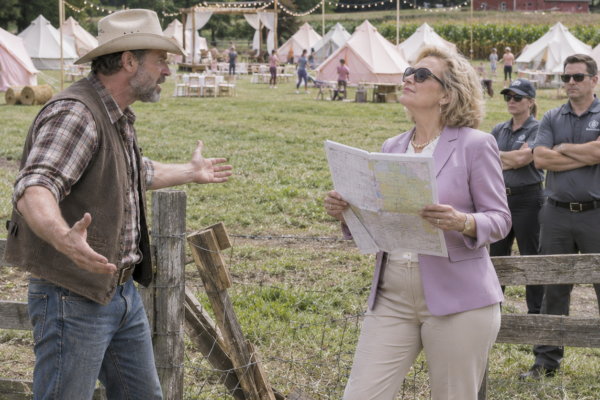
“Tear Down That Fence or We’ll Do It Ourselves,” the HOA President Threatened After His Men Cut the Wire Along My 120-Acre Texas Ranch. He Claimed My Property Ruined His Luxury Subdivision’s View, Even Though His HOA Had No Authority Over My Land. Then His Inspectors Climbed My Fence Again—And This Time, They Discovered What I’d Installed Behind the Cedar Posts..k
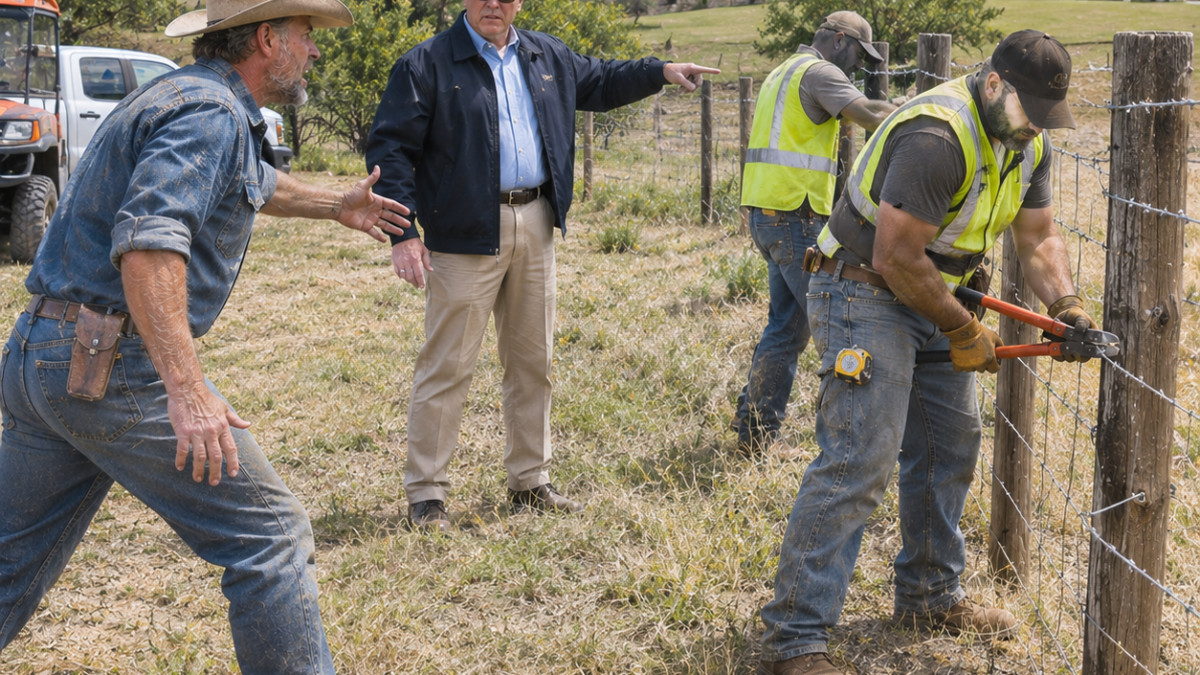
“Tear Down That Fence or We’ll Do It Ourselves,” the HOA President Threatened After His Men Cut the Wire Along My 120-Acre Texas Ranch. He Claimed My Property Ruined His Luxury Subdivision’s View, Even Though His HOA Had No Authority Over My Land. Then His Inspectors Climbed My Fence Again—And This Time, They Discovered What I’d Installed Behind the Cedar Posts.
At 10:17 on a Thursday morning, I heard a grown man scream from the northern fence of my Texas ranch.
I was repairing an irrigation line when the sound carried across the pasture.
“SON OF A—!”
I grabbed my phone and opened the security-camera feed.
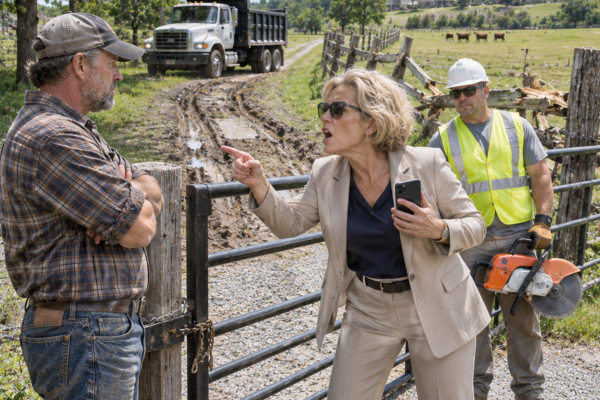
Two men in matching Clear Hill Acres HOA polo shirts stood beside my new livestock fence. One was stumbling backward, clutching his hand. The other was staring at the wire as though it had personally insulted him.
Then the first man looked straight into the camera.
“YOU ELECTRIFIED THIS THING?”
I almost laughed.
Not because somebody getting shocked was funny.
Because the bright yellow warning signs were impossible to miss.
ELECTRIC FENCE — AGRICULTURAL LIVESTOCK CONTAINMENT.
There was one every few fence sections.
The man had climbed across my posted boundary, placed his hand on the energized livestock wire, and discovered that my cattle fence did exactly what it was designed to do.
I saved the footage.
Then my phone rang.
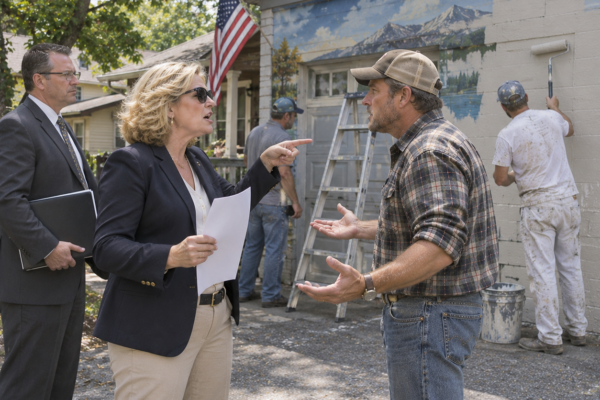
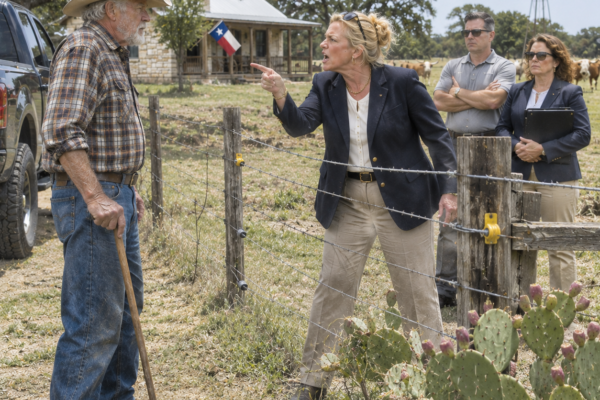
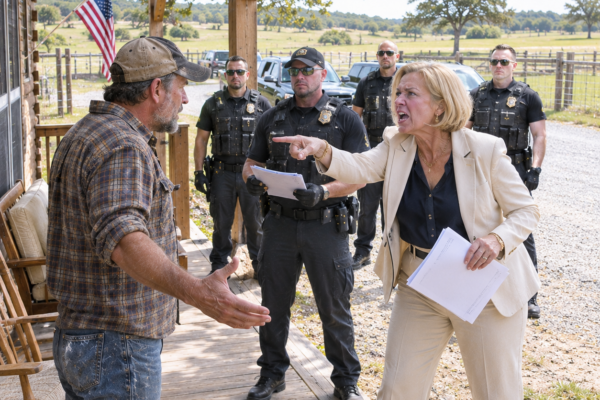
The caller was Bradley Sloan, president of Clear Hill Acres Homeowners Association.
“Clay Banner, you have gone too far!”
“Morning, Bradley.”
“Your dangerous fence just attacked one of our compliance officers!”
I looked at the screen.
His employee was already standing upright and arguing with his partner.
“Did your man cross my property line?”
“That’s irrelevant!”
“It’s the only thing that’s relevant.”
“You installed an electrified barrier beside a residential neighborhood!”
“I installed an approved agricultural fence on my working ranch.”
“You’re going to remove it immediately.”
“No.”
Bradley’s breathing grew louder.
Then he said something that told me the entire dispute was about to get uglier.
“Mr. Banner, if you won’t remove that fence voluntarily, we’ll find a legal way to remove it for you.”
My name is Clay Banner. I’m fifty-nine years old, a third-generation Texas rancher, and the owner of 120 acres my grandfather purchased in 1931.
My family’s land sits west of Fort Worth, where the limestone hills give way to open pasture, mesquite, and cattle country.
We’d worked that ground through droughts, storms, and cattle prices low enough to make a grown man question his judgment.
My grandfather built the first fences.
My father replaced most of them.
And I intended to leave the ranch to my own children someday.
Then developers bought the neighboring property and began building Clear Hill Acres.
The subdivision was expensive.
White limestone entrances, decorative streetlights, perfectly manicured lawns, and homes that cost more than everything my grandfather owned during his lifetime.
I had no objection to people buying nice houses.
But their HOA president apparently objected to seeing a working ranch from his subdivision.
The trouble began when I replaced my aging northern fence.
Five hundred yards of treated cedar posts, reinforced rails, and livestock-rated wire, installed along a boundary verified by a licensed surveyor.
I used sturdy materials because I had cattle to contain, not because I wanted to impress anybody.
Within a week, Bradley sent me a violation notice.
It cited Section 4.2.2 of Clear Hill Acres’ architectural standards.
According to the letter, my fence was an “unacceptable visual barrier” that disrupted the subdivision’s aesthetic harmony.
He gave me thirty days to remove it.
There was one problem.
My ranch wasn’t part of Clear Hill Acres.
Never had been.
The development didn’t even share a property line with my fence. A forty-three-foot strip of separately owned land lay between the subdivision boundary and my ranch.
I sent Bradley my deed, survey, and county parcel records.
He answered with another violation notice.
Then another.
Soon he was accusing me of creating a public nuisance, obstructing neighborhood views, and maintaining a dangerous agricultural structure.
His inspectors began appearing beside the fence.
One climbed over it to photograph my pasture.
Another cut the top wire.
My security cameras recorded both incidents.
I filed reports with the county sheriff’s office.
Deputy Marcus Judson examined the footage, photographed the damage, and confirmed that the reported conduct warranted investigation.
Then I received yet another HOA letter.
This one claimed my fence was electrically hazardous.
At the time, it wasn’t even electrified.
That’s when I realized Bradley wasn’t making a mistake.
He was building a case.
I consulted the appropriate agricultural fencing requirements, had the installation reviewed, and upgraded the fence using a properly rated livestock energizer.
My cattle needed secure containment, especially with a new road and neighborhood traffic nearby.
Everything was installed for ordinary agricultural use, with clear warnings.
Two days later, Bradley’s men crossed the boundary again.
And one of them received a brief shock.
Now Bradley was threatening to sue me.
By Friday, his attorney had delivered a formal demand alleging that my fence posed an imminent danger to the neighboring community.
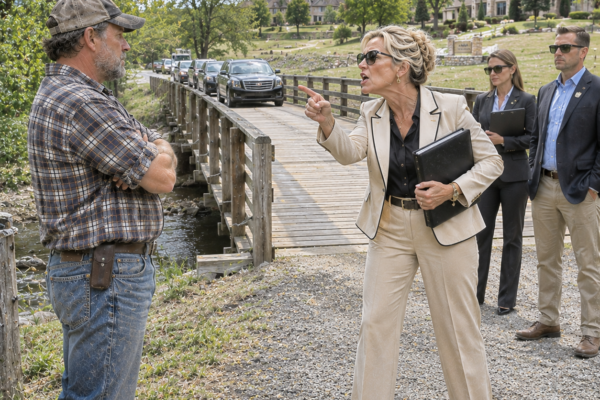
That afternoon, Bradley drove to my ranch in a black SUV.
He stepped out wearing expensive sunglasses and carrying a leather folder.
“Clay,” he said, “this could all go away if you were more reasonable.”
“How reasonable?”
He glanced toward the northern pasture.
“There’s a developer prepared to pay for a portion of your land. We could replace that ugly fence with something attractive. Everybody wins.”
I stared at him.
“So that’s what this is about.”
“What?”
“You don’t want my fence removed. You want the land behind it.”
Bradley’s smile vanished.
“Be careful, Mr. Banner. Your family has a long history of being difficult.”
I felt my stomach tighten.
“My family?”
He adjusted his sunglasses.
“Your grandfather made a similar mistake years ago.”
Then he walked back to his SUV.
I stood beside the gate, watching him leave.
My grandfather had been dead for almost twenty years.
And until Bradley mentioned him, I had no idea the Sloan family had ever tried to get its hands on our ranch before.
Part 2:
At 10:17 on a Thursday morning, I heard a grown man scream from the northern fence of my Texas ranch.
I was repairing an irrigation line when the sound carried across the pasture.
“SON OF A—!”
I grabbed my phone and opened the security-camera feed.
Two men in matching Clear Hill Acres HOA polo shirts stood beside my new livestock fence. One was stumbling backward, clutching his hand. The other was staring at the wire as though it had personally insulted him.
Then the first man looked straight into the camera.
“YOU ELECTRIFIED THIS THING?”
I almost laughed.
Not because somebody getting shocked was funny.
Because the bright yellow warning signs were impossible to miss.
ELECTRIC FENCE — AGRICULTURAL LIVESTOCK CONTAINMENT.
There was one every few fence sections.
The man had climbed across my posted boundary, placed his hand on the energized livestock wire, and discovered that my cattle fence did exactly what it was designed to do.
I saved the footage.
Then my phone rang.
The caller was Bradley Sloan, president of Clear Hill Acres Homeowners Association.
“Clay Banner, you have gone too far!”
“Morning, Bradley.”
“Your dangerous fence just attacked one of our compliance officers!”
I looked at the screen.
His employee was already standing upright and arguing with his partner.
“Did your man cross my property line?”
“That’s irrelevant!”
“It’s the only thing that’s relevant.”
“You installed an electrified barrier beside a residential neighborhood!”
“I installed an approved agricultural fence on my working ranch.”
“You’re going to remove it immediately.”
“No.”
Bradley’s breathing grew louder.
Then he said something that told me the entire dispute was about to get uglier.
“Mr. Banner, if you won’t remove that fence voluntarily, we’ll find a legal way to remove it for you.”
My name is Clay Banner. I’m fifty-nine years old, a third-generation Texas rancher, and the owner of 120 acres my grandfather purchased in 1931.
My family’s land sits west of Fort Worth, where the limestone hills give way to open pasture, mesquite, and cattle country.
We’d worked that ground through droughts, storms, and cattle prices low enough to make a grown man question his judgment.
My grandfather built the first fences.
My father replaced most of them.
And I intended to leave the ranch to my own children someday.
Then developers bought the neighboring property and began building Clear Hill Acres.
The subdivision was expensive.
White limestone entrances, decorative streetlights, perfectly manicured lawns, and homes that cost more than everything my grandfather owned during his lifetime.
I had no objection to people buying nice houses.
But their HOA president apparently objected to seeing a working ranch from his subdivision.
The trouble began when I replaced my aging northern fence.
Five hundred yards of treated cedar posts, reinforced rails, and livestock-rated wire, installed along a boundary verified by a licensed surveyor.
I used sturdy materials because I had cattle to contain, not because I wanted to impress anybody.
Within a week, Bradley sent me a violation notice.
It cited Section 4.2.2 of Clear Hill Acres’ architectural standards.
According to the letter, my fence was an “unacceptable visual barrier” that disrupted the subdivision’s aesthetic harmony.
He gave me thirty days to remove it.
There was one problem.
My ranch wasn’t part of Clear Hill Acres.
Never had been.
The development didn’t even share a property line with my fence. A forty-three-foot strip of separately owned land lay between the subdivision boundary and my ranch.
I sent Bradley my deed, survey, and county parcel records.
He answered with another violation notice.
Then another.
Soon he was accusing me of creating a public nuisance, obstructing neighborhood views, and maintaining a dangerous agricultural structure.
His inspectors began appearing beside the fence.
One climbed over it to photograph my pasture.
Another cut the top wire.
My security cameras recorded both incidents.
I filed reports with the county sheriff’s office.
Deputy Marcus Judson examined the footage, photographed the damage, and confirmed that the reported conduct warranted investigation.
Then I received yet another HOA letter.
This one claimed my fence was electrically hazardous.
At the time, it wasn’t even electrified.
That’s when I realized Bradley wasn’t making a mistake.
He was building a case.
I consulted the appropriate agricultural fencing requirements, had the installation reviewed, and upgraded the fence using a properly rated livestock energizer.
My cattle needed secure containment, especially with a new road and neighborhood traffic nearby.
Everything was installed for ordinary agricultural use, with clear warnings.
Two days later, Bradley’s men crossed the boundary again.
And one of them received a brief shock.
Now Bradley was threatening to sue me.
By Friday, his attorney had delivered a formal demand alleging that my fence posed an imminent danger to the neighboring community.
That afternoon, Bradley drove to my ranch in a black SUV.
He stepped out wearing expensive sunglasses and carrying a leather folder.
“Clay,” he said, “this could all go away if you were more reasonable.”
“How reasonable?”
He glanced toward the northern pasture.
“There’s a developer prepared to pay for a portion of your land. We could replace that ugly fence with something attractive. Everybody wins.”
I stared at him.
“So that’s what this is about.”
“What?”
“You don’t want my fence removed. You want the land behind it.”
Bradley’s smile vanished.
“Be careful, Mr. Banner. Your family has a long history of being difficult.”
I felt my stomach tighten.
“My family?”
He adjusted his sunglasses.
“Your grandfather made a similar mistake years ago.”
Then he walked back to his SUV.
I stood beside the gate, watching him leave.
My grandfather had been dead for almost twenty years.
And until Bradley mentioned him, I had no idea the Sloan family had ever tried to get its hands on our ranch before.
I watched Bradley’s taillights disappear beyond the cattle guard.
Then I walked into the barn and pulled down a wooden box from the shelf above my father’s old workbench.
It was marked BANNER LAND PAPERS in black permanent marker.
I hadn’t opened it in years.
Inside were yellowed tax receipts, photographs, old grazing agreements, and letters my grandfather had kept long after their practical purpose seemed to have passed.
Granddad’s name was Henry Banner.
He bought the first acreage in 1931, when cattle weren’t worth much and land outside Fort Worth could still be bought by somebody willing to work harder than seemed reasonable.
Our property wasn’t particularly beautiful by the standards of a luxury real-estate brochure.
It had rocky rises, a shallow seasonal creek, mesquite thickets, and pasture that needed careful management to support livestock.
But Granddad understood the land.
He repaired the windmill when it failed.
Moved cattle before storms.
And taught my father to read the sky before checking the weather report.
His favorite expression was simple.
“Clay, a fence is a promise. It tells you what’s yours to care for and what’s somebody else’s to respect.”
I’d heard him say it hundreds of times.
When I was fourteen, I thought he was talking about cattle.
Now I wasn’t so sure.
Near the bottom of the box, beneath a folder of old tractor receipts, I found an envelope dated April 1994.
The return address belonged to Sloan Land Development.
I opened it.
Inside was a proposal to purchase a strip along our northern boundary.
The letter described a future residential development, planned road access, and a request to acquire approximately fourteen acres from the Banner property.
It was signed by Richard Sloan.
Bradley’s father.
My grandfather had written his response directly on the back.
Mr. Sloan, the land is not for sale. Please do not send another survey crew through my pasture without asking.
Then, in smaller writing:
They seem more interested in the road than the land.
I sat down on an overturned feed bucket.
The old man had seen it thirty years before I did.
A developer wanting the northern strip.
An unwanted inspection.
A family saying no.
I searched farther into the box and found a county survey from 1994.
The proposed road alignment was marked with a pencil line.
That line crossed the same northern pasture Bradley was now trying to make me surrender.
The development had changed names.
The surrounding property had changed hands.
But the target hadn’t.
It was still our land.
I laid the old survey beside the modern subdivision plat.
Then I saw something that made me stop.
The 1994 road proposal didn’t end at the northern fence.
It curved toward the county highway, passing through a corridor that the present Clear Hill Acres layout had left undeveloped.
I looked at the current map again.
Forty-three feet.
That was the width of the narrow strip separating the HOA’s common property from my ranch.
And according to the tax records attached to the development’s application, that strip was owned by a company called Sloan Family Land Holdings.
Bradley hadn’t been randomly complaining about a fence near his neighborhood.
His family’s company still owned the land between us.
I needed to find out why.
The following Monday, I drove to the county clerk’s office in Weatherford.
Roberta Ellis had worked there for nearly thirty years. She knew my father, remembered my grandfather, and had once told me that half the land disputes in Parker County could be avoided if people read their deeds before getting angry.
When I walked in carrying two survey maps, she raised an eyebrow.
“Clay Banner. Somebody moving your fence again?”
“Trying to.”
She took the maps.
We compared the recorded subdivision plat, my ranch boundary, and the land held by Sloan Family Land Holdings.
Roberta confirmed that the ownership records showed three distinct properties.
Clear Hill Acres’ subdivision land ended at one boundary.
The Sloan family company owned the forty-three-foot strip beyond it.
My ranch began on the far side.
“That’s three different legal descriptions,” she said. “An HOA rule governing one doesn’t automatically apply to the others.”
“I’ve explained that to Bradley.”
“And he hasn’t listened?”
“He’s listened. He just doesn’t like the answer.”
She smiled faintly.
Then I showed her the 1994 letter.
Her expression changed.
“Richard Sloan.”
“You remember him?”
“Everybody who worked here in the nineties remembers Richard Sloan.”
She leaned back.
“He spent years trying to assemble enough land for a development northeast of your grandfather’s property. Most people sold.”
“My grandfather didn’t.”
“No, he certainly didn’t.”
She turned toward her computer.
“Let’s see what the current company filings show.”
The public records identified Bradley as a managing member of Sloan Family Land Holdings.
They also showed recent activity involving an adjoining development proposal.
The plan involved a new residential phase north of Clear Hill Acres.
A proposed internal road crossed the family’s forty-three-foot strip and approached my ranch.
But the proposed expansion couldn’t reach its intended highway access without additional land rights.
My northern pasture lay squarely in the way.
I understood enough to recognize the problem.
Bradley wanted more than a prettier view.
His development needed land.
And I wasn’t selling.
I thanked Roberta and drove home with copies of the records.
That afternoon, I walked the northern fence with my ranch hand, Miguel Ortega.
Miguel had worked for me for eleven years.
He was forty-six, had two daughters in high school, and knew my cattle almost as well as I did.
He stopped at the section that had been cut.
Fresh repairs stood out against the older wire.
“You think they’re coming back?” he asked.
“Bradley doesn’t strike me as someone who takes no for an answer.”
Miguel looked toward the subdivision.
“That’s a problem.”
“Why?”
He pointed to the gate.
“Because every time somebody cuts that fence, your cows are one mistake away from getting out onto that new road.”
He was right.
It wasn’t a theoretical concern.
The northern pasture held thirty-two cow-calf pairs and two replacement heifers. We rotated them through our available grazing and supplemented feed during the dry months.
If somebody damaged the fence at night, we could wake up to animals wandering toward traffic.
A collision could kill cattle.
It could also kill a driver.
That was why the repeated fence cutting frightened me more than Bradley’s insulting letters.
At six the next morning, one of my trail cameras recorded a silver pickup slowing beside the northern boundary.
Two men stepped out.
They wore Clear Hill Acres security jackets.
One unfolded a map.
The other approached the fence carrying a pair of long-handled cutters.
He looked directly at a warning sign.
Then glanced toward his partner.
The second man gestured impatiently.
The man with the cutters reached toward the wire.
Then stopped.
He apparently remembered what had happened to his coworker the previous Thursday.
He backed away.
They stood talking for another minute, climbed back into the pickup, and drove off.
I saved the recording.
Then I called Deputy Judson.
He came out around lunchtime.
I’d known Marcus since he was a teenager. His father had repaired our tractor engines, and Marcus had spent summers helping neighboring ranchers before joining the sheriff’s office.
He examined the video.
“Same company?”
“Same HOA uniforms.”
“Can you identify the men?”
“One appeared on the earlier footage. The other I don’t know.”
Marcus made a note.
Then I showed him the latest repair receipts.
“How much have they cost you?”
“Almost four thousand so far, between replacement materials, contractor checks, and lost work time.”
He shook his head.
“That’s a lot of money for somebody else’s architectural preferences.”
“It’s not about preferences.”
I handed him the development map.
He looked it over.
“What’s this?”
“Bradley Sloan wants part of my northern pasture for an expansion project. His dad tried buying it in 1994.”
Marcus studied the road alignment.
“Have you told your attorney?”
“That’s my next call.”
He handed the map back.
“Clay, I can document what occurred and investigate reported crimes. But I can’t settle a subdivision land dispute from the front seat of a patrol car.”
“I know.”
“Good. And keep checking that fence. I don’t want to answer a call about loose cattle on that road.”
Neither did I.
That evening, I contacted Daniel Torres.
Daniel was a property-rights attorney in Austin and an old friend from the Army.
We’d served in the same communications unit when we were young enough to believe sleeping on rocky ground was an adventure.
He still had the same dry sense of humor.
When I described the first violation notice, he laughed.
When I told him about the cut fence, he stopped.
When I described the development proposal, he asked for every document.
Two days later, he called.
“Clay, these people are building a record against you.”
“I figured.”
“The HOA notices keep escalating. They began with appearance, shifted to alleged hazards, and now they’re threatening civil action. That’s not a coincidence.”
“Can we stop them?”
“We can make them prove their authority. And we can pursue relief for trespass and damage if the evidence supports it.”
He paused.
“But first I want an independent review of the electric fence.”
I frowned.
“It’s livestock equipment.”
“I know. I also know they’ll argue you installed it to injure their employees. I want an expert to verify the equipment, location, signs, and ordinary agricultural purpose.”
I agreed.
A qualified fencing contractor and an independent inspector evaluated the installation.
They documented the energizer’s rating, the safety warnings, the line’s placement inside my boundary, and the livestock-containment purpose.
They confirmed that the system was operating as intended for that installation.
I didn’t need anybody injured to prove my point.
I needed cattle that stayed inside the pasture and trespassers who stayed outside it.
Several days later, a local television reporter arrived at my gate.
Her name was Ashley Reed.
She worked for a Fort Worth-area station and had heard about a bizarre dispute involving an HOA trying to regulate a ranch it didn’t own.
“Mr. Banner,” she asked, “is it true your fence has become the subject of multiple HOA violations?”
“Yes.”
“Are you a member of Clear Hill Acres?”
“No, ma’am.”
“Then why is the association fining you?”
“That’s a good question for its president.”
She smiled.
“Would you be willing to show us the boundary records?”
I invited her to photograph the fence and examine copies of the recorded survey.
She filmed the cattle grazing beyond the cedar posts.
The yellow warning signs.
The new subdivision road.
And the survey markers confirming the property lines.
I explained that the electrified equipment was installed for livestock management, not as a trap for people.
Then she asked whether I thought the fence was dangerous.
“Any working farm has things people shouldn’t handle without permission,” I said. “That’s why they’re marked. The simplest way to avoid trouble here is to stay off somebody else’s property.”
The segment aired that evening.
Its headline read:
RANCH FENCE SPARKS DISPUTE WITH LUXURY HOA.
They showed the posted boundary and discussed the damage reports.
The story didn’t accuse every Clear Hill Acres resident of wrongdoing.
It focused on the HOA’s repeated demands against land outside its recorded boundaries.
I appreciated that.
A few residents contacted me afterward to say they hadn’t known anything about the dispute.
One woman said she’d complained to the board about the new security patrols because the added expense hadn’t been explained.
Another asked whether the HOA could really fine a working ranch.
I answered as simply as I could.
“Not under rules that don’t apply to it.”
For twenty-four hours, Bradley said nothing.
Then a process server drove through my gate.
He handed me a lawsuit.
Clear Hill Acres Homeowners Association v. Clay Banner.
And just like that, the man trying to take my northern pasture had decided to make me defend my own fence in court.
The lawsuit was forty-six pages long.
I read it at my kitchen table while the evening sun dropped behind the western pasture.
Bradley’s attorneys alleged that my fence interfered with neighborhood enjoyment, created an unreasonable hazard near residential property, and threatened Clear Hill Acres’ long-term development interests.
There were aerial photographs, witness statements, engineering language, and a request for an injunction requiring me to deactivate and remove portions of the fence.
One paragraph caught my attention.
It claimed the fence obstructed a “historically contemplated community-access corridor.”
I read that twice.
Then a third time.
The words sounded harmless enough.
But I knew what they meant.
Bradley was trying to turn his father’s failed 1994 purchase proposal into something resembling an established access right.
I called Daniel.
“You seen page nineteen?”
“Yes.”
“He’s claiming an access corridor.”
“He’s claiming one was contemplated. That’s very different from a recorded easement.”
“He doesn’t have an easement.”
“I haven’t found one. And if his lawyers have one, they’ll need to produce it.”
I looked down at the filing.
“He knows that.”
“Maybe. But don’t assume every allegation he makes is supported by evidence. That’s why we have discovery.”
Daniel filed our response within the required period.
We denied the unsupported allegations and asserted claims based on the documented trespass and property damage.
He also sought appropriate declaratory relief establishing that Clear Hill Acres’ governing restrictions did not apply to my ranch.
The court would need to examine the actual instruments and evidence.
It wasn’t enough for either side to simply declare victory.
That part didn’t bother me.
I had the original deed.
The surveys.
The photographs.
And a family history that went back nearly a century.
Bradley had a stack of HOA bylaws written for a subdivision that didn’t exist when my grandfather built his first fence.
Then he began a publicity campaign.
A letter circulated among Clear Hill Acres homeowners warning that an aggressive rancher had installed high-voltage equipment near their children.
It suggested my property might contain additional hazards.
The letter included a photograph of one of my cows standing beside the fence.
But it cropped out the warning signs and the broad strip of land between my property and the subdivision.
One resident forwarded it to me.
I showed Daniel.
“That’s not a complete picture of the boundary,” I said.
“No,” he agreed. “But our response will be the actual documents, not another angry newsletter.”
Bradley’s strategy depended on making me look unreasonable.
I intended to make his evidence look incomplete.
For several weeks, the dispute moved through lawyers’ offices rather than my pasture.
We exchanged records.
Bradley’s attorneys requested information about my fence equipment, ranch operations, and installation history.
Daniel requested the HOA’s claimed authority, its communications about my property, and documents concerning the proposed northern development.
Some requests were disputed.
Others produced useful information.
One afternoon, Daniel called with a question.
“Clay, how much did you say Bradley offered for the northern strip?”
“He never gave me a number. Just said a developer would pay well.”
“And he offered to rename the development for your family?”
“Yes.”
Daniel chuckled.
“That’s generous of him.”
“Apparently the Banner name’s worth more than the land.”
“Maybe. But we’ve received something interesting.”
He sent me a copy of a development consulting agreement.
The document was between Sloan Family Land Holdings and a company working on Clear Hill Acres’ proposed expansion.
It included a payment provision tied to securing access rights along my northern boundary.
If the project obtained the required land rights, Bradley’s family company stood to receive a substantial development fee.
I stared at the numbers.
Now the forty-three-foot strip made sense.
Bradley’s family owned the narrow corridor.
But that corridor wasn’t enough for the project they wanted to build.
They needed access and additional acreage beyond it.
My ranch was the obstacle.
I called Daniel back.
“Is this why he started the fence dispute?”
“We can’t establish his private thoughts from one contract. But it shows a financial interest the court should know about.”
“Did the homeowners approve this?”
“That’s another question we’re asking.”
The next useful records came from the HOA itself.
Clear Hill Acres had collected a special assessment for security and neighborhood beautification.
Some of that money had been used for patrols near my fence.
More had gone toward legal consultation related to what the financial records called northern boundary compliance.
Several invoices referenced my ranch by name.
I felt my jaw tighten.
Homeowners were paying extra assessments so their president could pursue a fight over land they didn’t own.
And according to the board minutes produced in discovery, there was no clear authorization for some of those expenditures.
A resident named Allison Pierce contacted me after the news report.
She lived near the northern entrance and worked as a high school counselor.
“Mr. Banner, I’m sorry to bother you.”
“You’re not bothering me.”
“Can I ask something about the fence?”
“Sure.”
“Bradley says your fence is right against the neighborhood playground.”
I almost laughed.
“Ma’am, there’s no playground on that side.”
She was quiet.
“What?”
“The closest play area is several streets away. The subdivision property ends forty-three feet before you reach my fence.”
“Then why did the newsletter say children were being endangered?”
“That’s a question for Bradley.”
Allison sighed.
“My husband and I moved here last year. We didn’t buy our house so we could fight with a cattle rancher.”
“And I didn’t stay on my family ranch to fight with a subdivision.”
She hesitated.
“Would you mind showing me the actual survey?”
I agreed to meet her and her husband at my front gate the following Saturday.
They arrived with another couple.
I spread the recorded plat across the hood of my pickup.
We traced the lines together.
The HOA common property.
The separately owned Sloan strip.
My ranch.
Allison shook her head.
“He never showed us this.”
Her husband looked toward the pasture.
“So the HOA doesn’t even own the land next to your fence?”
“That’s correct.”
He stared at the map.
“Then what are we paying lawyers to do?”
I didn’t have an answer.
But I suspected that question was about to become a serious problem for Bradley.
The following Tuesday, a storm rolled over the ranch shortly after midnight.
Rain hammered the roof.
Lightning moved across the northern sky.
At 1:36 a.m., my phone sounded a motion alert.
I opened the camera feed.
Two figures stood at the northern gate.
One carried a flashlight.
The other was working at the latch.
I sat upright.
Then I saw the gate swing open.
My stomach dropped.
The north pasture held cattle.
If that gate stayed open, they could wander toward the new development road.
I called Miguel and the sheriff’s office.
Then I pulled on my boots.
I wasn’t going to confront the intruders.
I was going to make certain my animals didn’t end up in traffic.
By the time I reached the barn, Miguel was starting the ranch utility vehicle.
He looked at me.
“Gate?”
“Open.”
He swore.
“Anybody near it?”
“The cameras showed two people. They’re gone now.”
We drove toward the pasture, keeping our lights low enough not to spook the cattle.
The rain had eased.
But the ground was slick, and the herd was moving uneasily near the northern fence.
Three heifers were already approaching the open gate.
Miguel moved along the inside of the pasture to turn them back while I secured the entrance.
My hands shook as I closed the latch.
Then I looked down.
The hardware had been deliberately damaged.
Fresh marks cut across the metal.
Somebody had opened a working cattle gate in the middle of the night.
For a moment, I didn’t think about Bradley or his lawsuit.
I thought about a frightened animal stepping onto a dark road.
About a family driving home late.
About headlights catching a black cow at highway speed.
I photographed the gate after the animals were safely contained.
Then I waited for Deputy Judson.
When Marcus arrived, he examined the damage and watched the video.
The camera had recorded the truck.
Its license plate.
And a clear view of one man’s face when he turned toward the floodlight.
Marcus recognized him from the earlier fence incident.
“Clay,” he said quietly, “this is getting serious.”
I looked toward the northern pasture.
“It was serious the first time they cut the wire.”
He nodded.
“But now we’ve got somebody tampering with a gate holding livestock beside a public road.”
He took the necessary information for the investigation.
Before leaving, he told me something I hadn’t expected.
“One of the men involved in the earlier fence damage has asked to speak with investigators.”
“Why?”
Marcus looked toward the subdivision.
“Apparently he’s starting to worry about who’ll take the blame when all this comes out.”
That was the first real crack in Bradley Sloan’s operation.
And the man who’d climbed my fence was about to explain why he’d been sent there in the first place.
His name was Travis Cole.
He was twenty-eight, had worked for the private security contractor serving Clear Hill Acres for less than a year, and had been one of the men recorded climbing my fence.
His lawyer arranged for him to give a statement to investigators.
I wasn’t present.
Marcus later explained what information could be shared with me, and Daniel obtained relevant testimony and records through the civil proceedings.
Travis admitted he’d been instructed to photograph the fence and document conditions that could support HOA enforcement.
That much wasn’t surprising.
Then he described the instructions that followed.
When ordinary photographs failed to show anything particularly dangerous, he and another employee were told to get closer.
They climbed the fence.
They damaged wire.
They returned at night.
According to Travis, their supervisor had described the work as creating “documented access concerns” that would strengthen the HOA’s claim that the northern boundary needed to be replaced.
I stared at the summary Daniel showed me.
“Documented access concerns?”
“That’s the phrase he used.”
“They cut my fence, then complained that my fence was unsafe.”
“That’s what the testimony suggests.”
There were messages.
Work assignments.
Invoices.
And a payment approved through the HOA’s security account.
One text from Bradley to the contractor’s manager said:
The Banner fence needs to become a board-level safety issue. We cannot advance the northern expansion while that barrier remains.
I read it twice.
Then I looked at Daniel.
“He knew exactly what he was doing.”
“The communications are strong evidence that this was connected to the expansion.”
Daniel turned another page.
“The security contractor has also identified the employees involved in the gate incident. Investigators will decide what charges the evidence supports.”
I looked toward the northern pasture.
I’d spent days repairing damage these men had created.
I’d worried about cattle escaping.
I’d paid for surveys, equipment inspections, and lawyers.
All while Bradley stood in front of television cameras describing himself as a concerned community leader.
My anger was no longer theoretical.
It had a name.
A cost.
And a stack of records.
Daniel continued.
“There’s one more thing.”
He handed me a document from Sloan Family Land Holdings.
It was an investor presentation for the proposed Clear Hill Acres expansion.
A rendering showed luxury houses on a landscaped hillside, a broad private road, and a community recreation center.
The center occupied part of my northern pasture.
The road crossed the family company’s narrow strip and curved through land I owned.
In the lower corner, an annotation read:
Banner acquisition pending — anticipated resolution through boundary compliance negotiations.
I stared at those words.
“Acquisition pending?”
“Yes.”
“I’ve never agreed to sell.”
“I know.”
“He’s telling investors he’s already working out how to get my land.”
Daniel nodded.
“That seems to be the implication.”
The rendering was dated before Bradley sent his first violation notice.
That was the detail that mattered most to me.
He had begun planning the acquisition before inventing the fence dispute.
The fence wasn’t the obstacle that created his interest in my land.
His interest in my land had created the fence dispute.
I thought about my grandfather’s 1994 letter.
The old man had refused Richard Sloan.
Three decades later, Richard’s son was attempting to accomplish the same thing through an HOA.
And now he was using other homeowners’ money to help finance the pressure.
When Daniel presented the documents to the court through the proper procedures, Bradley’s attorneys objected to several interpretations.
They argued that the development plans were preliminary and that the association’s safety concerns were legitimate.
Daniel didn’t ask the court to assume criminal intent based on an ambitious planning document.
He asked the judge to examine the actual property records, the conduct documented on video, the authority claimed by the HOA, and the financial connection between Bradley and the proposed acquisition.
The first major hearing concerned the HOA’s request for an injunction against my electric fence.
Judge Evelyn Hart presided.
She was a practical woman in her early sixties who seemed unimpressed by complicated language when a simpler question would do.
The courtroom was crowded.
A local reporter sat in the back.
Several Clear Hill Acres homeowners attended.
Miguel sat behind me, wearing his best button-down shirt and looking more uncomfortable than he did during a cattle auction.
Bradley arrived in a charcoal suit, carrying a polished leather portfolio.
He didn’t look at me.
His attorney began by describing the electrified boundary as an unreasonable danger to nearby residents.
He referred to the employee who had received a shock.
He cited concerns about visual obstruction, neighborhood safety, and interference with future access improvements.
Judge Hart let him finish.
Then she asked, “Where is the fence located?”
The attorney gestured toward a map.
“Along the northern edge of the Clear Hill Acres development area.”
“On whose property?”
“The defendant’s agricultural parcel.”
“And is that parcel subject to your client’s covenants?”
“We believe the surrounding circumstances create enforceable obligations relating to safety and access.”
She looked down at her notes.
“That isn’t the same as a recorded covenant.”
The attorney began explaining the association’s historic planning expectations.
Judge Hart raised one hand.
“Counsel, I’m asking for the instrument that authorizes this homeowners association to enforce its architectural standards against Mr. Banner’s land.”
He referred to the neighborhood declaration.
She examined it.
“Mr. Banner’s legal description doesn’t appear here.”
“No, Your Honor.”
“Then let’s be careful about distinguishing a legitimate neighboring landowner’s complaint from an HOA claiming authority it may not possess.”
Daniel stood when it was our turn.
He presented the recorded survey.
The parcel records.
The fence inspection.
And the camera footage showing the man entering my property before touching the energized wire.
Judge Hart reviewed the video without comment.
Then she asked about the warnings.
Daniel showed the dated photographs.
Bright signs.
Proper identification.
The actual location relative to the road and subdivision.
The judge turned toward the HOA’s attorney.
“Do you dispute that the individual crossed a posted private boundary?”
The attorney acknowledged what the video showed but argued that the fence created a danger nonetheless.
The judge listened.
Then she said, “The mere fact that someone receives a shock after unlawfully touching a properly installed agricultural fence doesn’t, by itself, establish that the homeowner is maintaining a public nuisance. I need evidence of an actual legal violation.”
The HOA hadn’t supplied that evidence.
She declined to order the fence deactivated on the preliminary record.
Then she scheduled further proceedings concerning the property claims and related relief.
Bradley looked furious.
As we left the courtroom, he stepped into my path.
“This isn’t over, Clay.”
I looked at him.
“You’re right.”
He leaned closer.
“You could have made good money on that land.”
“Then you should’ve asked whether I wanted to sell it.”
He smiled coldly.
“You’re throwing away an opportunity.”
I looked toward Miguel, waiting beside the courthouse doors.
“Bradley, you keep talking about opportunity like it’s something you can force a man to accept.”
He didn’t answer.
I stepped around him.
Outside, Ashley Reed approached with her microphone.
“Mr. Banner, how do you feel about the judge’s decision?”
I thought about it.
Then I said, “I’m glad the court is looking at the actual land records. That’s what this should’ve been about from the start.”
“Do you intend to remove the fence?”
“No, ma’am.”
“Why not?”
I looked toward the courthouse.
“Because my cattle still need a fence tomorrow morning, whether Bradley Sloan likes it or not.”
The interview aired that evening.
This time, several Clear Hill Acres residents contacted Daniel rather than me.
They wanted to know why their association was paying legal fees to pursue land beyond its governing boundaries.
A few wanted to see the development plan.
Others asked whether Bradley had disclosed his family’s financial interest.
The board had some difficult questions ahead.
And Bradley was beginning to run out of people willing to accept his answers.
Three months later, the case returned to Judge Hart’s courtroom for a hearing on the remaining property issues.
By then, the county had completed its investigation into the damaged fence and gate.
The security contractor had dismissed the employees responsible for the unauthorized work. The individuals identified in the criminal investigation faced consequences through the applicable legal proceedings.
The contractor also agreed to cooperate in resolving the civil claims.
Bradley’s position had become increasingly difficult to defend.
The recorded property boundaries were clear.
My ranch wasn’t subject to Clear Hill Acres’ covenants.
The HOA couldn’t impose architectural standards on it.
And the association’s own records showed that its president had pursued enforcement while possessing a personal financial interest in acquiring the land.
Daniel’s presentation was methodical.
First, the 1931 deed and subsequent recorded conveyances.
Then the modern survey.
Then the 1994 purchase proposal from Richard Sloan.
Finally, the current development agreement and communications about the fence.
The chain of events was difficult to ignore.
Bradley’s family had wanted that northern strip for decades.
When the modern project required it, Bradley tried to turn my refusal into a compliance problem.
Judge Hart questioned the association’s attorney.
“Was there ever a recorded agreement granting Clear Hill Acres authority over Mr. Banner’s fence?”
“No, Your Honor.”
“Did the association own the land where its personnel conducted these inspections?”
“No.”
“Was there a court order authorizing the employees to enter the ranch?”
“No.”
She looked down at the documents.
“Then the association’s repeated notices were issued without the authority they claimed.”
Bradley sat rigidly beside his attorney.
The judge continued reviewing the remaining evidence, including the fence damage, the security contractor’s instructions, and the communications concerning the expansion.
When the hearing ended, she ruled that Clear Hill Acres’ architectural restrictions did not apply to my ranch and granted permanent relief preventing the HOA from asserting those restrictions against my property.
The court also recognized that the documented entries and damage supported my claims for civil remedies.
The financial claims required their own resolution.
Neither side could make the expense of months of litigation disappear simply by winning an argument over jurisdiction.
Daniel and the HOA’s new counsel negotiated while the remaining damages issues were prepared for trial.
The association’s insurers reviewed the claims.
The security contractor’s insurer did the same.
Ultimately, the responsible parties reached a settlement totaling $135,000 to address the documented property losses, legal expenses covered by the agreement, disruption, and other asserted damages.
The settlement was formalized through the appropriate court process.
The HOA also agreed to withdraw every notice against my property, stop sending unauthorized inspectors, and publish a written correction acknowledging that my ranch had never been subject to its architectural covenants.
I read the agreement twice before signing.
Then I called Daniel.
“You’re sure this means they’re done sending me fence notices?”
He laughed.
“If they send another one asserting the same nonexistent authority, they’ll have a much bigger problem.”
I looked toward the northern pasture.
“Good.”
“Clay?”
“Yeah?”
“How’s the herd?”
“Better than Bradley Sloan’s legal position.”
Daniel laughed again.
“Then I’d say we’re making progress.”
The public apology appeared in the association’s next community communication.
It wasn’t as dramatic as Bradley’s threatening letters.
There was no embossed seal.
No polished speech about neighborhood standards.
Just a statement acknowledging the boundary, withdrawing the disputed demands, and expressing regret for the unauthorized actions taken against me.
But the residents noticed.
They also noticed the financial reports.
The association had spent a considerable amount of money on a fight that had nothing to do with maintaining its common areas.
When the independent board review was completed, several directors concluded that Bradley had failed to disclose material conflicts of interest and had directed enforcement activity outside the association’s authority.
He lost the presidency.
Then he resigned from the board.
I didn’t attend the meeting where that happened.
Miguel and I were moving cattle into a different pasture.
That seemed a better use of my afternoon.
Allison Pierce called afterward.
“Clay, I thought you’d want to know.”
“Know what?”
“Bradley resigned.”
I leaned against the gate.
“Well, how about that.”
“The board is reviewing the security contracts, too. And we’re requiring a conflict-of-interest disclosure before anyone approves spending related to a director’s outside business.”
“Sounds sensible.”
She hesitated.
“I’m sorry we didn’t ask more questions sooner.”
I looked toward the houses beyond the northern fence.
“Allison, you didn’t cut my wire.”
“No. But our fees helped pay the people who did.”
I couldn’t argue with that.
She continued.
“A few neighbors want to come apologize in person.”
I smiled.
“Tell them I’m not asking anyone to apologize for buying a house next to my cattle.”
She laughed.
“But if they’d like to come by Saturday, Miguel’s making brisket.”
Six families showed up.
They brought potato salad, peach cobbler, baked beans, and enough sweet tea to fill a water trough.
One elderly woman handed me a pecan pie.
“Mr. Banner, I hope you’ll accept this.”
I took it.
“Ma’am, I don’t think I’ve ever turned down pecan pie.”
She smiled.
“My husband grew up on a ranch. He says your fence is the nicest-looking cattle fence he’s seen in years.”
“Tell him I appreciate that.”
Then she looked toward the pasture.
“We moved out here because we wanted to live near the country. I’m sorry somebody tried to make you change it for us.”
That sentence stayed with me.
Because most of the people in Clear Hill Acres hadn’t asked Bradley to harass me.
They hadn’t requested cut wire, fake violations, or a lawsuit.
They’d bought homes beside a working ranch.
And the majority seemed perfectly happy letting me keep working it.
The trouble had come from one man who thought his position gave him the right to decide what happened beyond his property line.
By late summer, the northern fence was fully repaired.
The damaged gate had been replaced.
The cameras remained in their original lawful positions.
The livestock-rated electrical system continued operating as part of our normal ranch management.
And the survey markers were clearly documented so nobody could claim the boundary was uncertain.
I used part of the settlement to build a new equipment barn.
Nothing fancy.
Steel roof.
Sturdy timber supports.
Enough space for feed, tools, and the ranch utility vehicle.
Miguel helped with the construction.
So did Harold Kim, a younger rancher whose family owned property north of us.
Harold had called after seeing the news story.
His family had been receiving pressure from another developer about an access route through their land.
He wanted to know how I’d handled the dispute.
I told him to come by.
We walked the northern fence on a cool Saturday morning.
He looked at the cedar posts and the warning signs.
“So this is the famous fence.”
“Apparently.”
“Did you ever think about taking it down just to make them stop?”
I looked across the pasture.
“Sure. For about half a second.”
He laughed.
Then I grew serious.
“But it wasn’t just about the fence. Bradley wanted part of the ranch. If I’d removed the fence, that wouldn’t have changed what he was trying to accomplish.”
Harold nodded.
“What should I do about the developer pressuring my family?”
“Start with your records. Find out exactly what you own, what easements exist, and what the other party is actually claiming. Get a qualified survey and a good attorney before the problem gets worse.”
He studied the property marker.
“Your grandfather really bought this place in 1931?”
“Every acre.”
“That’s something.”
I nodded.
“It is.”
Over the following months, Harold introduced me to several other landowners who were concerned about development pressure along the county roads.
We started meeting occasionally at the feed store.
Nobody wanted to fight subdivisions for the sake of fighting.
Most of us sold livestock, repaired equipment, raised families, and preferred quiet lives.
But we agreed that knowing our boundaries and keeping accurate records mattered.
Daniel provided general information about landowner rights and explained when people should seek individual legal advice.
Howard, a local surveyor, joined us for one meeting and brought examples of the mistakes that frequently caused boundary disputes.
We talked about recorded easements, property surveys, agricultural operations, and the difference between an actual government requirement and a demand issued by a private organization.
I found the meetings surprisingly satisfying.
I’d spent months defending one piece of land.
Now I was helping people understand how to protect their own without making the same mistakes.
That fall, the county held a public workshop on agricultural land boundaries and subdivision development.
Representatives discussed surveying practices, access disputes, and the importance of checking legal authority before taking enforcement action.
I attended.
I didn’t give a speech.
I sat in the back and listened.
At the end, a young man recognized me.
“You’re the rancher with the electric fence.”
“That’s me.”
He grinned.
“Did it really shock an HOA inspector?”
“Yes.”
“Bet that taught him something.”
I thought about the recorded footage.
Then I shook my head.
“I hope what taught him something was having to explain why he’d climbed a posted fence.”
The young man laughed.
I smiled.
But I meant it.
The electricity wasn’t the lesson.
The property line was.
A fence doesn’t create ownership.
A deed, survey, and the applicable law establish property rights.
The fence simply helps everybody understand where those rights begin and end.
One evening, as winter approached, I found myself standing in the new barn beside Miguel.
He was examining the initials we’d carved into one of the support beams after finishing construction.
C.B.
M.O.
H.K.
Clay Banner.
Miguel Ortega.
Harold Kim.
Three sets of initials belonging to men who’d helped build something useful with their own hands.
Miguel looked at me.
“Your grandfather would’ve liked this barn.”
“I think so.”
“He would’ve liked what happened to Bradley, too.”
I laughed.
“He probably would’ve had some colorful opinions.”
Miguel grinned.
Then he turned serious.
“Clay, you ever wonder what would’ve happened if you hadn’t had those cameras?”
I looked toward the northern fence.
“All the time.”
Without the footage, Bradley could have claimed his employees were simply inspecting the road.
Without the survey, he could have pretended the boundary was unclear.
Without the old development letter, the family connection might have remained hidden.
And without Daniel, I’d have spent even more time trying to answer legal threats I hadn’t earned.
It had taken more than being stubborn.
It had taken documentation.
Patience.
Good people.
And a willingness to let the evidence speak when anger would’ve been easier.
I looked at Miguel.
“That’s why I keep records.”
He nodded.
“Your grandfather taught you that?”
“Some of it.”
“And the rest?”
I smiled.
“Bradley Sloan was a pretty expensive teacher.”
We laughed.
The following spring, nearly a year after the first violation letter, I walked the northern pasture at sunrise.
The grass was still damp from an overnight shower.
A few cattle grazed near the water trough.
Beyond the fence, Clear Hill Acres looked peaceful.
Freshly painted houses.
Neat lawns.
A man walking a golden retriever along the neighborhood sidewalk.
Nobody was climbing the wire.
Nobody was photographing my barn through the fence.
And nobody was threatening to remove five hundred yards of working cattle enclosure because it didn’t match their landscaping theme.
As I approached the northern corner, I noticed a little boy standing beside the road with his father.
The boy pointed toward my property.
“Daddy, is that the electric fence from television?”
His father laughed.
“Yep. That’s the one.”
The boy looked fascinated.
“Can we touch it?”
“No, buddy. We stay on this side.”
I walked over, stopping inside my own fence.
“Morning.”
The father tipped his cap.
“Morning, Mr. Banner.”
I looked at the boy.
“You know why that fence is there?”
“To shock people?”
I shook my head.
“To keep my cattle safe.”
He looked toward the herd.
“Oh.”
“Those animals can get hurt if they wander onto the road. The fence helps make sure they stay where they belong.”
The boy considered that.
Then he asked, “So the people got shocked because they weren’t supposed to be there?”
“That’s about right.”
His father smiled.
“Come on, son. We’ve got to get home.”
They waved and continued walking.
I stayed beside the fence for a moment.
The cedar posts stood straight.
The wire was intact.
The warning signs caught the early sunlight.
Beyond them stretched the land my grandfather had bought when the country was struggling through the Great Depression.
Land my father had worked.
Land I’d spent a lifetime trying to keep productive.
I thought about the first letter Bradley sent me.
Thirty days to remove the fence.
Preserve aesthetic harmony.
Comply with neighborhood standards.
I’d almost thrown it away because it seemed too ridiculous to matter.
Then I remembered the cut wire.
The damaged gate.
The court summons.
The development plans showing a recreation center on pasture I’d never offered to sell.
And Bradley’s confident promise that everything would go away if I simply became reasonable.
What he’d really wanted was for me to surrender something my family had spent generations protecting.
He’d underestimated the value of that history.
He’d also underestimated how much evidence a rancher could gather when someone kept trespassing on his land.
I walked back toward the house.
The sun climbed above the mesquite trees.
My dog, Hank, came trotting down the driveway, tail wagging.
He followed me onto the porch.
I poured another cup of black coffee and sat in my grandfather’s old wooden chair.
From there, I could see the northern fence running across the pasture.
Five hundred yards of cedar, steel, and carefully maintained livestock wire.
Nothing especially remarkable to look at.
Just a working ranch boundary.
But to me, it represented nearly a hundred years of family history.
My grandfather never got rich from this place.
Neither did my father.
I probably wouldn’t, either.
We had other reasons for staying.
There was the smell of rain hitting dry Texas soil.
The sound of calves calling for their mothers.
The satisfaction of fixing something with your own hands.
And the simple peace of knowing the ground beneath your boots belonged to your family because generations before you had worked to keep it.
Bradley Sloan had seen that same ground and imagined a profitable subdivision.
He’d had every right to propose buying it.
He’d had no right to invade it, damage it, or pretend his HOA controlled it.
That difference cost him his presidency, his credibility, and a substantial settlement.
For me, the outcome wasn’t about humiliating him.
It was about being able to look at the next generation of my family and say I hadn’t given away their inheritance because a man with a leather folder told me to.
I took a sip of coffee.
Hank settled at my feet.
The morning breeze moved through the grass.
And beyond the northern pasture, the new subdivision slowly came to life.
People walked their dogs.
Cars pulled from driveways.
Children waited for the school bus.
Everybody stayed on their own side of the boundary.
Which was all I’d ever asked.
I looked toward the fence one last time.
Granddad had been right.
A fence was a promise.
Mine still stood.
And after everything Bradley Sloan had tried, the land behind it was still ours.